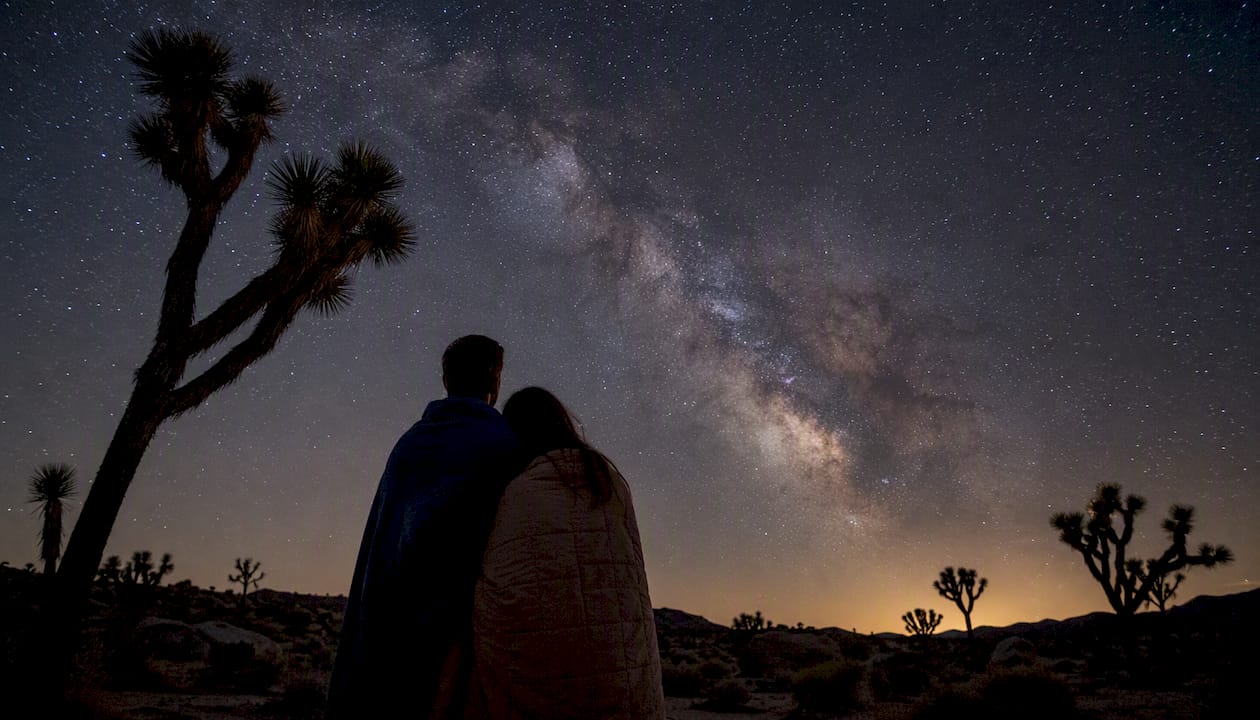
Joshua Tree stargazing is as good as it gets in Southern California. Head to one of the four NPS-designated viewing lots—Quail Springs, Hidden Valley, Cap Rock, or Ryan Mountain—for easy, legal access. For the darkest skies, drive east to Pinto Basin Road or Cottonwood Campground, where the Coachella Valley light dome fades behind the mountains.
Three things to do right now before you go:
- Check moon phase and weather. A new moon night with low wind and no clouds is the gold standard. Even a half-moon washes out the Milky Way.
- Pick your spot. The four designated lots work great for most visitors. If you want deeper darkness, aim for the east side of the park.
- Pack the essentials. Red headlamp, warm layers (desert temps drop fast after sunset), at least two liters of water per person, and a fully charged phone.
Two rules you cannot skip: stay close to your vehicle in designated parking-area stargazing zones, and no overnight camping in parking lots.
Pro Tip: Download an offline star map app like SkySafari or Stellarium before you leave home. Cell service is spotty inside the park, and you will want it the moment you look up.
Key Takeaways
Joshua Tree’s International Dark Sky Park designation, combined with its high-desert elevation and east-side darkness, makes it one of the best stargazing destinations in the American Southwest — plan around a new moon, head east for the darkest skies, and use red light only.
| Point | Details |
|---|---|
| Best dark-sky locations | Pinto Basin Road pullouts and Cottonwood Campground are the darkest spots in the park. |
| NPS vehicle rule | Stay within 20 feet (6 meters) of your vehicle in all four designated stargazing lots. |
| Milky Way season | The core is visible March through September; peak viewing runs April through August. |
| Night-vision protection | Eyes need 20–30 minutes to adapt; one white light resets the clock entirely. |
| Socalsights planning | The Socalsights adventure guide offers curated pullouts, packing lists, and itineraries built around NPS rules. |
Table of Contents
- Why Is Joshua Tree Such a Great Place to Stargaze?
- Where Are the Official NPS Stargazing Spots in Joshua Tree?
- What Are the Darkest Stargazing Spots in Joshua Tree?
- Can You Camp Overnight for Better Stargazing?
- How Do You Protect Your Night Vision (and Everyone Else’s)?
- When Is the Best Time to See the Milky Way at Joshua Tree?
- What Camera Settings Work Best for Astrophotography at Joshua Tree?
- Are There Guided Stargazing Programs at Joshua Tree?
- What Do You Need to Know Before You Go?
- Socalsights Curated Picks: Three Pullouts and Sample Itineraries
- What a Single Night Under Joshua Tree’s Sky Actually Feels Like
- Plan Your Joshua Tree Night Sky Adventure with Socalsights
- Sources
Why Is Joshua Tree Such a Great Place to Stargaze?
Joshua Tree National Park holds an International Dark Sky Park designation, a recognition given by DarkSky International to places that actively protect night-sky quality and limit artificial light. That designation is not just a badge — it signals real darkness, real stars, and a park that enforces lighting standards.
The high-desert setting does a lot of the work. Elevation across the park ranges from roughly 1,000 feet near Cottonwood to over 5,000 feet near the Wonderland of Rocks. Higher elevation means thinner air, lower humidity, and fewer atmospheric particles scattering light. The result is a sky that feels almost three-dimensional on a clear night.
That east-west gradient matters when you are planning. The west entrance near Twentynine Palms and the south entrance near Cottonwood Springs both face different light-pollution sources. NPS notes that growing nearby communities pose an ongoing threat to the park’s dark skies, which is why visitor behavior — keeping lights off, using red filters — directly supports the park’s designation.
Key conditions that make Joshua Tree nights exceptional:
- Low average humidity compared to coastal Southern California
- Wide, flat horizons in the basin areas that let you see the Milky Way arc from edge to edge
- Minimal tree canopy blocking the sky (the Joshua trees themselves are short enough to frame, not block, the view)
Where Are the Official NPS Stargazing Spots in Joshua Tree?
The National Park Service designates four parking areas specifically for stargazing. Each has its own character, and knowing the differences helps you pick the right one for your night.
Quail Springs
Located along Park Boulevard in the western section, Quail Springs is one of the more accessible lots. It sits at a moderate elevation with open sightlines to the south and west. Restrooms are not available directly at this lot, so plan accordingly. The western sky here can show some glow from the Coachella Valley, but the overhead and northern views are excellent.
Hidden Valley
Hidden Valley parking area is one of the most popular spots in the park during the day, which means it can get busy at night too. The surrounding rock formations create a natural amphitheater effect — you feel enclosed by boulders while the sky opens above you. Restrooms are available nearby. This is a solid pick if you want atmosphere along with your stars.
Cap Rock
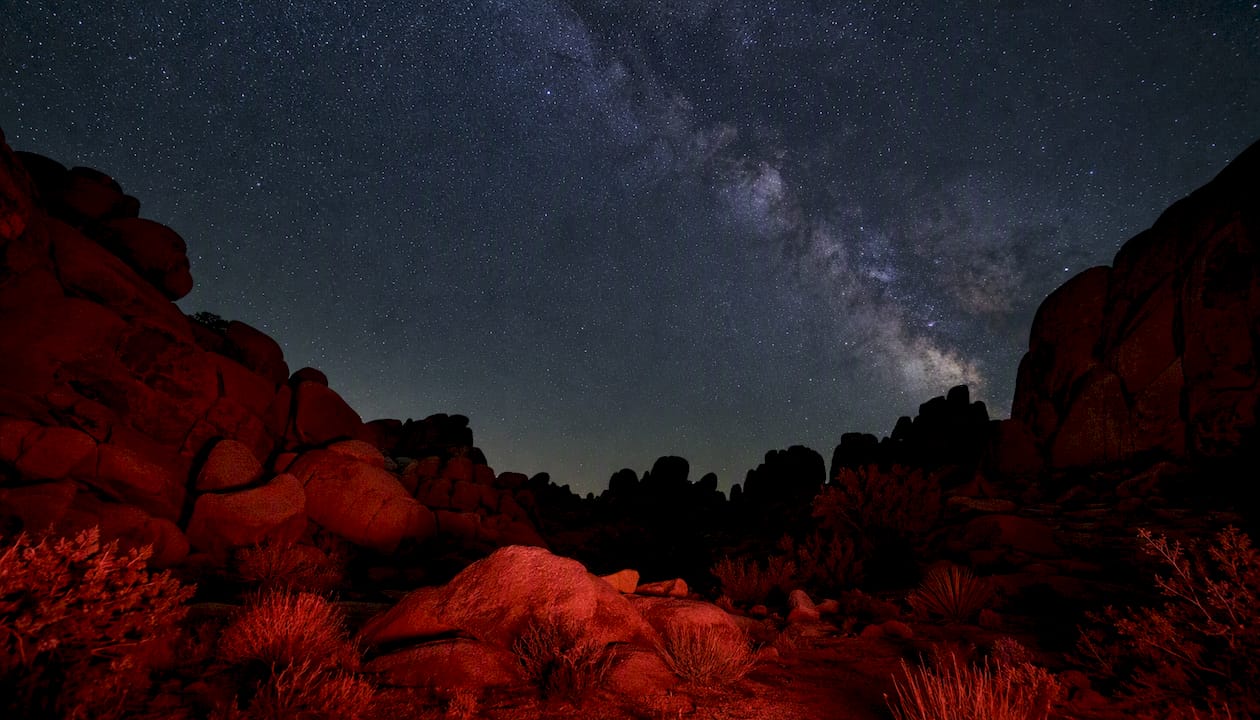
Cap Rock sits near the center of the park and offers a wide, flat parking area with good all-sky views. The iconic balanced rock formation makes for a striking foreground in photos. Restrooms are available here. Accessibility is relatively good, with a paved loop trail nearby that is manageable for most visitors.
Ryan Mountain
The Ryan Mountain parking area gives you access to one of the park’s best elevated viewpoints. The lot itself is a fine stargazing spot, and if you want to hike up Ryan Mountain (about 1.5 miles one way), the summit view at night is remarkable — though hiking in the dark requires a headlamp and careful footing. No restrooms at this lot.
NPS rule for all four lots: stay within 20 feet (6 meters) of your vehicle while stargazing in designated areas. Service animals are permitted; pets must be on a leash no longer than six feet and are restricted to paved areas and parking lots.
| Lot | Restrooms | Accessibility | Best Sky Direction | Notes |
|---|---|---|---|---|
| Quail Springs | No | Moderate | Overhead, north | Some western glow |
| Hidden Valley | Yes (nearby) | Good | Overhead | Rock formations, popular |
| Cap Rock | Yes | Best of four | All-sky | Paved loop nearby |
| Ryan Mountain | No | Moderate | All-sky | Hike option for summit views |
Pro Tip: Arrive at least 30 minutes before full dark to get your bearings while you can still see the ground. Tripping over a curb in the dark is a real way to end a night early.
What Are the Darkest Stargazing Spots in Joshua Tree?
If the designated lots feel too crowded or you want a noticeably darker sky, the east side of the park is where to go. NPS specifically calls out Pinto Basin Road (the stretch between Cholla Cactus Garden and Cottonwood Spring) and Cottonwood Campground as having the least traffic and some of the park’s darkest conditions.
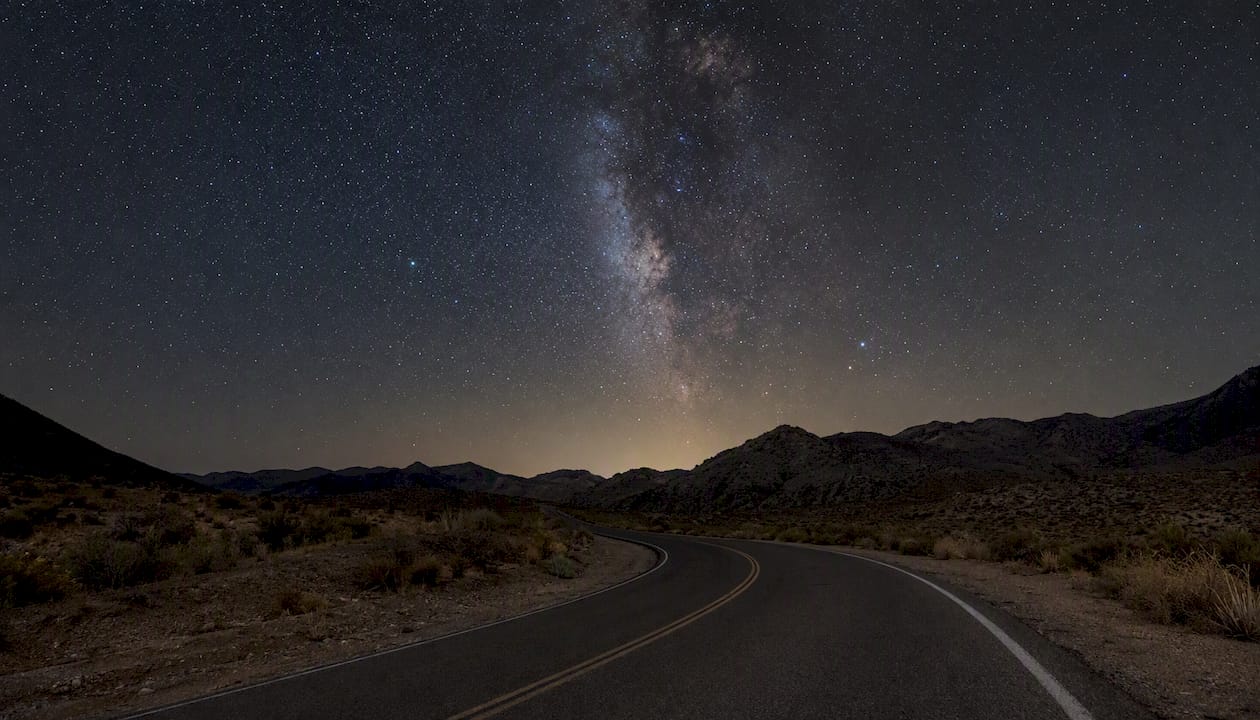
The reason is simple geography. Pinto Basin sits in a low valley surrounded by mountains that block the Coachella Valley glow to the west. Drive the Pinto Basin Road after dark and you will notice the sky getting progressively darker as you head south. Safe pullouts along this road offer wide-open basin views with almost no artificial light on the horizon.
Cottonwood Campground, near the south entrance, is the farthest point from Palm Springs and sits at a lower elevation with a broad southern horizon. Campers here regularly report seeing the Milky Way reflected in the quiet of the basin.
| Location | Darkness Level | Access | Best For |
|---|---|---|---|
| Pinto Basin Road pullouts | Darkest in park | Paved road, pullouts | Milky Way, wide-field views |
| Cottonwood Campground | Very dark | South entrance, paved | Overnight campers |
| Cholla Cactus Garden | Dark | Paved lot | Foreground photography |
A few safety points for roadside pullouts:
- Pull completely off the road and turn off all vehicle lights before your eyes start adjusting.
- No roadside overnight camping is permitted — pullouts are for viewing, not sleeping.
- Watch for other vehicles on Pinto Basin Road; it is a two-lane road with limited lighting.
- Stay aware of your surroundings; the desert floor has loose rock and cactus close to the road edge.
Can You Camp Overnight for Better Stargazing?
Yes, and it is one of the best ways to experience the Joshua Tree night sky. The park has nine campgrounds, and staying overnight means you can watch the sky shift from dusk through the early morning hours when the Milky Way is often at its most dramatic position.
Cottonwood Campground is the top pick for darkness. Its south-entrance location puts it furthest from the major light domes, and the open desert around it gives you unobstructed views in nearly every direction. Reservations are recommended, especially on weekends and during peak season (fall and spring).
Other campgrounds worth considering:
- Jumbo Rocks — large, spread-out sites with great rock formations for framing shots
- White Tank — smaller and quieter, good for a more solitary experience
- Belle Campground — no hookups, first-come first-served, and relatively uncrowded
For the absolute darkest experience, backcountry camping in the park’s wilderness areas is an option. You need to register at a backcountry board before heading out, carry all your own water (there is none in the backcountry), and have solid navigation skills. This is not a casual option — it is for prepared backpackers who want to sleep under a sky with zero nearby light sources.
Entrance fees apply regardless of how you enter. If the fee station is unstaffed when you arrive at night, you can pay online or at a self-pay kiosk. The park never fully closes, but fee collection is always required.
Pro Tip: Book Cottonwood Campground well in advance for new moon weekends in April, May, and August. Those nights fill up fast once the astronomy community notices the calendar.
How Do You Protect Your Night Vision (and Everyone Else’s)?
This is where most first-timers accidentally ruin their own experience. NPS guidance is clear: it takes 20–30 minutes for your eyes to fully adapt to darkness. One flash of white light resets that clock entirely.
The fix is simple. Use a red-mode headlamp or cover your flashlight with red cellophane or tape. If you need to check your phone, drop the brightness to minimum and consider a red-filter app. Keep the phone in your pocket as much as possible.
Other etiquette and safety points:
- Watch your step. Cacti and uneven ground are everywhere, and they are invisible in the dark without a light.
- Wear closed-toe shoes. Sandals are a bad idea in Joshua Tree at any hour, but especially at night.
- If you attend a public star party with telescopes, do not touch the eyepiece or nudge the mount — let the operator handle adjustments to keep alignment for everyone.
- Pets must stay on a leash; emotional-support animals follow the same rules as pets in the park.
Light pollution from growing communities near the park is an ongoing conservation issue. Every visitor who keeps lights off and uses red filters is directly helping protect the park’s dark-sky designation and the nocturnal wildlife that depends on natural darkness.
When Is the Best Time to See the Milky Way at Joshua Tree?
The Milky Way core is visible roughly March through September, with the peak window running April through August. Outside those months, the core sits below the horizon during the hours when the sky is fully dark.
Moon phase matters as much as the calendar month. A new moon night in May will show you far more than a full moon night in July. Plan your trip around the new moon window — typically a five-to-seven-day stretch each month when the moon rises and sets before the sky gets fully dark.
- March and April — The Milky Way core rises in the southeast before midnight. Orion dominates the western sky early in the evening. Temperatures are mild, making these months ideal for long sessions.
- May and June — Core visibility improves dramatically. The Summer Triangle (Vega, Deneb, Altair) climbs higher each week. Nights are warm enough to sit outside comfortably without heavy layers.
- July and August — Peak Milky Way season. The core arcs high overhead around midnight. The Perseid meteor shower peaks in mid-August and is one of the most reliable annual shows — plan for a new moon Perseid night if you can.
- September — The core starts to drop earlier. Still excellent viewing, and crowds thin out after Labor Day.
- December — The Geminid meteor shower peaks mid-month and is actually one of the strongest showers of the year. The Milky Way core is gone, but the Geminids are worth a cold night in the desert.
Other showers to note: the Lyrids in late April and the Quadrantids in early January both produce reliable activity, though neither matches the Perseids or Geminids in peak rate.
What Camera Settings Work Best for Astrophotography at Joshua Tree?
You do not need a professional setup to get a great shot of the Joshua Tree night sky. A camera with manual controls, a wide-angle lens, and a sturdy tripod will get you there.
Start with these settings and adjust from there:
| Setting | Starting Point | Why |
|---|---|---|
| Aperture | widest available aperture | Lets in the most light |
| ISO | 1600–3200 | Brightens the sensor without overexposing |
| Shutter speed | 20–25 seconds | Captures stars before they trail |
| Focus | Manual, set to infinity | Autofocus fails in the dark |
| White balance | 3200–4000K | Keeps sky color natural |
NPS photography guidance recommends a tripod, manual settings, and patience. Those three things cover 90% of what separates a blurry phone snap from a real astrophoto.
Gear checklist:
- Sturdy tripod (lightweight travel tripods wobble in desert wind)
- Remote shutter release or use your camera’s 2-second timer
- Wide-angle lens (24mm or wider is ideal)
- Spare batteries (cold nights drain them faster than you expect)
- Red-filter headlamp so you can adjust settings without ruining your adaptation
Pro Tip: Change only one setting at a time between shots. If you adjust ISO and shutter speed simultaneously, you will not know which change made the difference. Small, single adjustments teach you the camera faster than any tutorial.
For phone photographers, Night Mode on recent iPhone and Pixel models can produce surprisingly good results. Lock the phone to a tripod, use the longest Night Mode exposure available, and avoid touching the screen during the shot.
Are There Guided Stargazing Programs at Joshua Tree?
Yes, and they are worth checking before your visit. The National Park Service runs ranger-led night-sky programs throughout the year, typically scheduled around new moon periods. Check the NPS events calendar or stop by a visitor center when you arrive — programs are posted there and sometimes fill up quickly.
The park also hosts an annual Night Sky Festival, a multi-day event that brings together astronomers, rangers, and the public for telescope viewing, talks, and guided walks, according to various local event listings. Dates vary by year, so check the NPS site for current scheduling.
Sky’s the Limit Observatory, located in Twentynine Palms just outside the park, is the most established local partner for guided observing. They host public star parties and educational programs, and their volunteers are genuinely enthusiastic about sharing the sky with newcomers.
Benefits of joining a guided event:
- Access to large telescopes you would not bring yourself
- Expert identification of planets, nebulae, and star clusters
- A social experience that solo viewing cannot replicate
The trade-off is flexibility. Guided events run on a fixed schedule, and you are sharing the space with a group. If you want to linger at a specific spot or move around the park freely, DIY viewing gives you that freedom. For first-timers, though, a ranger program or Sky’s the Limit session is a genuinely great way to start.
If you want to connect with local astronomy groups before your trip, California astronomy meetups are a good resource for finding organized viewing events and communities near you.
Pro Tip: If you attend a public star party, ask the telescope operator what they are pointing at before you look. Knowing you are about to see Saturn’s rings or the Andromeda Galaxy makes the moment land completely differently.
What Do You Need to Know Before You Go?
A few logistics that catch visitors off guard, especially on night visits.
The park entrance fee is $35 per vehicle (as of 2026), and it covers seven days. If you arrive after the fee station closes, pay at a self-pay kiosk or online through Recreation.gov. The park never fully closes, but the fee is always required.
Cell service is limited to nearly nonexistent in most of the park. Download offline maps (Google Maps offline, Gaia GPS, or AllTrails) before you leave. Tell someone your plan — where you are going, which lot or campground, and when you expect to be back.
Pre-visit checklist:
- At least two liters of water per person (more in summer)
- Food and snacks for the full visit
- Warm layers and a wind layer (desert nights cool fast, even in summer)
- Closed-toe shoes
- Red headlamp and a backup light source
- Fully charged phone and a portable battery pack
- Offline maps and a star chart or app
- Emergency contact plan
Road conditions can change. Pinto Basin Road and the park’s interior roads are generally well-maintained, but check the NPS site for closures before heading out. Some roads require high-clearance vehicles.
Socalsights Curated Picks: Three Pullouts and Sample Itineraries
Here are three safe, legal pullouts that offer excellent dark-sky views without requiring off-road driving or backcountry access.
- Pinto Basin Road, south of Cholla Cactus Garden — Wide pullout with a flat basin view to the south and east. Minimal traffic after 9 PM. Bring a blanket and face south for the Milky Way core.
- Cap Rock parking area — The paved lot and nearby rock formations make this one of the most comfortable spots for a casual night out. Great for groups and families.
- Cottonwood Spring Road pullout (near south entrance) — Darker than most western-side options, with a wide southern horizon. Combine with a Cottonwood Campground stay for a full night.
Single-night itinerary: Arrive at the south entrance by 7 PM. Drive to Cottonwood Campground to set up. Head to a Pinto Basin Road pullout by 8:30 PM. Watch the sky darken fully by 9 PM, then spend two to three hours with the Milky Way. Return to camp by midnight.
Weekend itinerary: Night one at Hidden Valley (arrive Friday afternoon, set up at a nearby campground, stargaze from the lot). Night two at Cottonwood (drive east Saturday afternoon, camp, and use Pinto Basin Road pullouts for the darkest views of the trip).
Community tips: park parallel to the road so your headlights point away from other viewers when you leave. Keep your setup compact and close to your vehicle. Pack out everything you bring in.
Pro Tip: Check local Southern California activity guides for daytime activities to pair with your stargazing night — Joshua Tree has excellent hiking, rock climbing, and roadside art installations worth seeing before the sun goes down.
For more curated SoCal ideas beyond the park, the 100+ SoCal Sights list is a good place to keep exploring.
What a Single Night Under Joshua Tree’s Sky Actually Feels Like
I want to be honest with you about something most guides skip. The rules — the 20-foot limit, the red light, the no-camping-in-lots rule — feel like bureaucratic fine print until you are actually standing in the dark at Cap Rock at 10 PM with the temperature dropping and the Milky Way arcing directly overhead. Then they make complete sense.
The red light rule is not about compliance. It is about the 25 minutes you spent letting your eyes adjust, and not wanting to lose that. The moment someone nearby flicks on a white flashlight, the whole sky seems to dim. You feel it physically.
The temperature drop is real and fast. I have watched visitors in shorts start shivering by 9:30 PM in what felt like a warm evening. Layers are not optional — they are the difference between staying out until midnight and retreating to your car at 9.
The single most important thing to remember: use red light only, give your eyes 20–30 minutes to adapt, and stay close to your vehicle in designated areas. Everything else is details.
Plan Your Joshua Tree Night Sky Adventure with Socalsights
Socalsights takes the guesswork out of planning a Joshua Tree stargazing night by putting curated local knowledge in one place. Instead of piecing together NPS pages, moon calendars, and campground availability separately, you get a focused guide built around real Southern California experience.
What the Socalsights Joshua Tree guide gives you:
- Curated pullout locations with safety notes and darkness rankings
- A quick-check packing list you can screenshot before you leave
- Sample one-night and weekend itineraries built around NPS rules
- Moon-phase planning cues so you pick the right night
All recommendations follow NPS guidelines. Nothing in this guide encourages off-road driving, illegal camping, or any behavior that harms the park or other visitors.
Ready to plan your night? Browse the Socalsights adventure overview and find your next Southern California experience.
Sources
Official and authoritative resources used in this guide:
- Stargazing at Joshua Tree (U.S. National Park Service)
- DarkSky International
- 2026 Guide to the Night Sky (Visit Joshua Tree / local guide)
- When Can I See The Milky Way In Joshua Tree? (Astrorover)