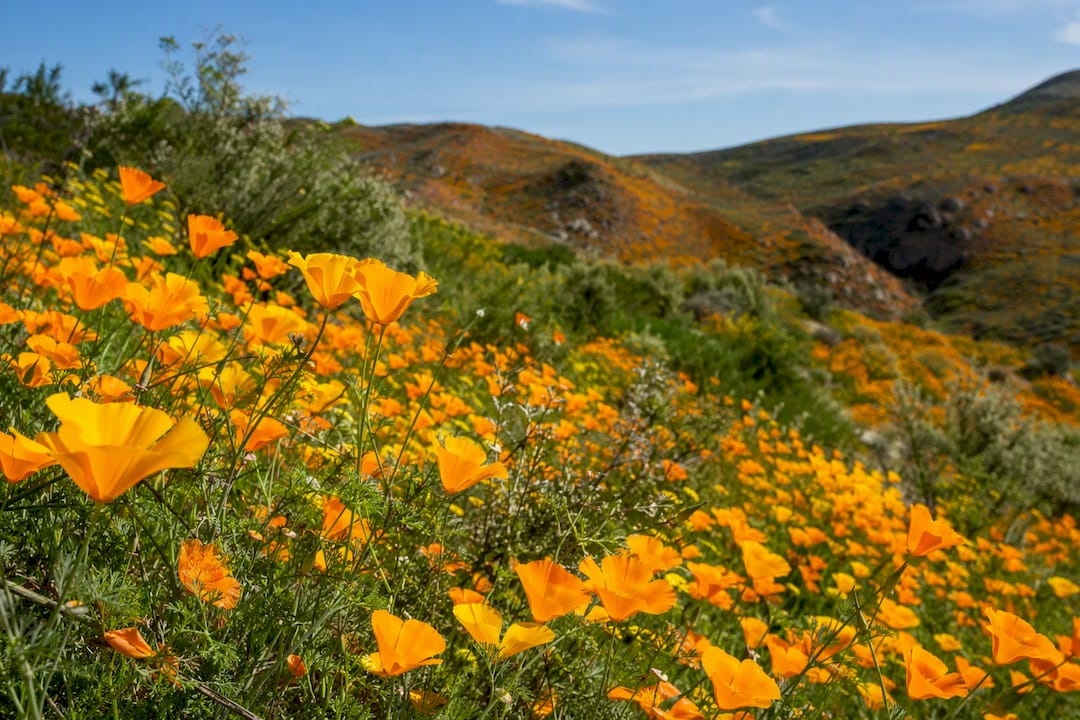
Limited to strong, depending on location. Right now, your best shots at a real display are Carrizo Plain National Monument, Death Valley National Park, Antelope Valley California Poppy Reserve, Anza-Borrego Desert State Park, Walker Canyon near Lake Elsinore, and Point Mugu State Park. Conditions shift week to week, so before you drive out, check the park’s official status page. That one step saves more disappointing trips than anything else on this list.
TL;DR:
- Peak wildflower blooms vary by elevation and location, with desert floors peaking from late February to early April and higher elevations sometimes not peaking until late April or May.
- Rain, particularly multiple storms spaced across fall and winter, is critical for a super bloom, but temperature spikes and strong winds can quickly end the display.
- Visiting early morning on weekdays and staying on designated trails helps prevent damage and secures a better experience for future blooms.
- Conditions can change rapidly, so checking real-time park alerts, satellite imagery, and local social media updates is essential before planning a trip.
- Focus on smaller, less crowded bloom sites and learn key species to enhance your experience while reducing ecological impact.
Table of Contents
- Where To See The Southern California Super Bloom Now
- When Does Each Region Typically Peak?
- What Actually Causes A Super Bloom?
- How To Visit Without Wrecking It For Next Year
- How To Check Real-Time Bloom Status Before You Go
- Small Habits That Protect The Next Bloom
- Flowers You’ll Actually See On The Trail
- SoCal Sights’ Take On Seeing The Bloom Right
- Sources
Where To See The Southern California Super Bloom Now
I’ve chased blooms across this region for years, and the honest truth is that no two spots peak on the same calendar. Here’s the current lay of the land, site by site, so you can pick the one that actually matches your travel dates.
Carrizo Plain National Monument is having a moment. Landsat satellite imagery from NASA captured extensive yellow blooms spreading across the Soda Lake basin and up into the Temblor Range in early March. NASA scientists monitoring the imagery described the display as bigger than they expected. If you go, park at the Goodwin Education Center and walk the Painted Rock or Soda Lake overlook trails rather than pulling off along Soda Lake Road, where shoulder parking has damaged fragile crust in past seasons.
Death Valley National Park rewards patience because its bloom moves with elevation. The National Park Service notes that lower-elevation flowers typically show from mid-February through mid-April, while higher basins like those near Dante’s View bloom weeks later. Badwater Basin and the areas around Furnace Creek are worth checking first this season. Expect gold desert dandelion and purple sand verbena rather than the poppy-heavy palette you’ll find further west.
Antelope Valley California Poppy Reserve remains the classic postcard shot, rolling orange hillsides against the Tehachapi foothills. It’s also the most crowded site on this list on weekends, so if you can only go once, aim for a weekday morning.
Anza-Borrego Desert State Park covers enough ground that something is usually blooming somewhere inside it, from Henderson Canyon Road’s poppy fields to the ocotillo stands near Blair Valley. Check individual trail conditions before heading out, since some backcountry roads wash out after the same rains that trigger the bloom.
Walker Canyon (Lake Elsinore) has a complicated history. It produced one of the most photographed poppy hillsides in the state a few years back, and it also produced some of the worst crowd damage anywhere in Southern California, which led the city to close the trailhead entirely during peak years. If it reopens this season, expect strict shuttle-only access and zero tolerance for off-trail photos.
Point Mugu State Park gives you the rare combination of coastal bluffs and wildflowers in the same frame. Look for lupine and California poppy along the La Jolla Valley Loop, with sweeping views toward the Pacific that the inland desert sites simply can’t match.
A few things hold true across every site:
- Bloom status can change within a week if a heat spike or Santa Ana wind event moves through.
- The most photogenic hillsides are almost always the most fragile ones, so binoculars beat trampling for a closer look.
- California State Parks reports a moderate to strong bloom across desert parks this season but directs visitors to check each park’s individual page, since conditions vary dramatically even within the same county.
When Does Each Region Typically Peak?
Elevation drives everything about wildflower timing in Southern California, and understanding that pattern helps you avoid arriving two weeks too early or a month too late.
- Low desert floors (under 3,000 feet): Death Valley, Anza-Borrego’s lower valleys, and Carrizo Plain typically peak from late February into early April. These spots warm up fastest and burn out fastest, sometimes within a two-week window.
- Coastal and foothill zones (Antelope Valley, Walker Canyon, Point Mugu): These sites usually run a few weeks behind the low desert, often peaking in March into early April, though coastal fog at Point Mugu can push things slightly later than inland foothill sites.
- Mid-to-high elevation basins (Death Valley’s upper zones, mountain foothills above 4,000 feet): These areas lag well behind, sometimes not peaking until late April or into May, since cooler soil temperatures delay germination.
Aspect matters almost as much as elevation. A south-facing slope soaks up more direct sun and often blooms a week or two ahead of a north-facing slope just across the same canyon. Microclimates explain why one side of Anza-Borrego can be finished blooming while another section twenty minutes away is just getting started.
If you’re planning around a specific date, work backward from elevation. Booking a trip for early March? Stick to the low desert. Traveling in late April or May? Look toward the higher foothill and mountain-adjacent sites instead, where the show is often just getting going while the desert floor has already faded to brown.
What Actually Causes A Super Bloom?
“Super bloom” isn’t a formal scientific term. Britannica describes it as a descriptive label for the rare, large-scale wildflower events that happen when several environmental factors line up at once, rather than a category botanists use in research.
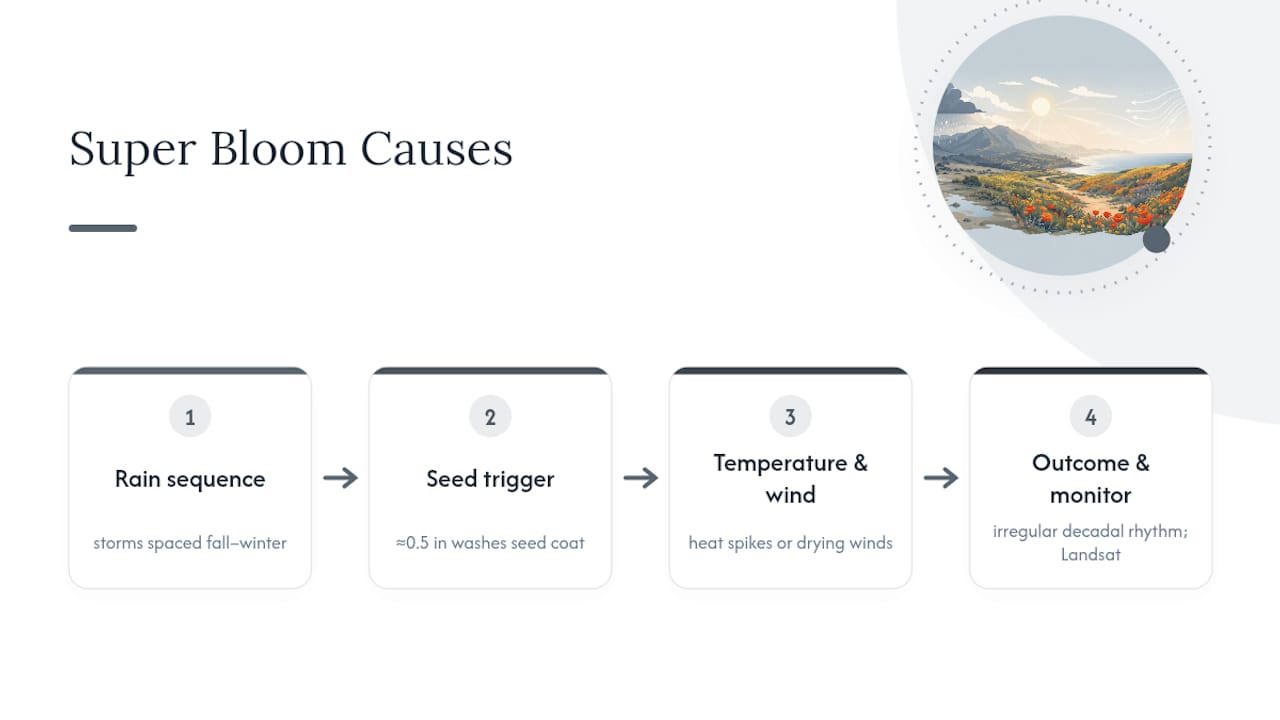
The recipe starts with rain, but it’s not just about total rainfall. It’s about spacing. Desert seeds need a sequence of storms spread across fall and winter, not one big deluge and then nothing. Death Valley’s own park data notes that a half-inch storm can be the critical trigger that washes the hard seed coat off dormant seeds and kicks off germination, but that single storm only matters if more rain follows in the following weeks.
Temperature and wind can undo all of it. A Salk Institute researcher explained to NBC San Diego that even with enough rainfall banked, an early heat spike or a run of strong drying Santa Ana winds can cut a bloom short before it ever peaks. That’s the piece most first-time visitors miss: rain gets a bloom started, but heat and wind decide whether it finishes.
Notable bloom years tend to arrive on an irregular, roughly decadal rhythm rather than a predictable schedule, which is part of why satellite monitoring through programs like Landsat has become such a useful confirmation tool for scientists trying to track bloom extent in near real time.
How To Visit Without Wrecking It For Next Year
Every trampled hillside you’ve seen in a viral photo started with one person stepping off the trail for a better shot. UC Riverside plant ecologist Loralee Larios put it plainly when describing this year’s early bloom: staying on trails and leaving flowers unpicked is what allows those same plants to drop seed and bloom again next season.
Here’s what that looks like in practice:
- Stay on marked trails, even when the flowers just off the path look better.
- Never pick flowers or dig up seeds. What looks like a few blossoms to you is next year’s seed bank for everyone.
- Skip off-roading entirely, and check individual park rules before flying a drone.
- Bring more water than you think you need. Desert sites offer little shade, and heat risk climbs fast even in cooler months.
- Arrive early or go on a weekday to dodge both crowds and the worst midday heat.
Crowding has real consequences. Trampling from heavy visitation has forced trail closures and shuttle-only access at sites like Diamond Valley Lake and Walker Canyon in past bloom years, and once a hillside gets stripped of topsoil by thousands of boots, it can take multiple seasons to recover its bloom density.
If you want to support wildflower conservation beyond just visiting responsibly, look into volunteer restoration days through your local park district, or buy native seed from a reputable native plant nursery like Theodore Payne Foundation or California Botanic Garden instead of collecting anything from the field.
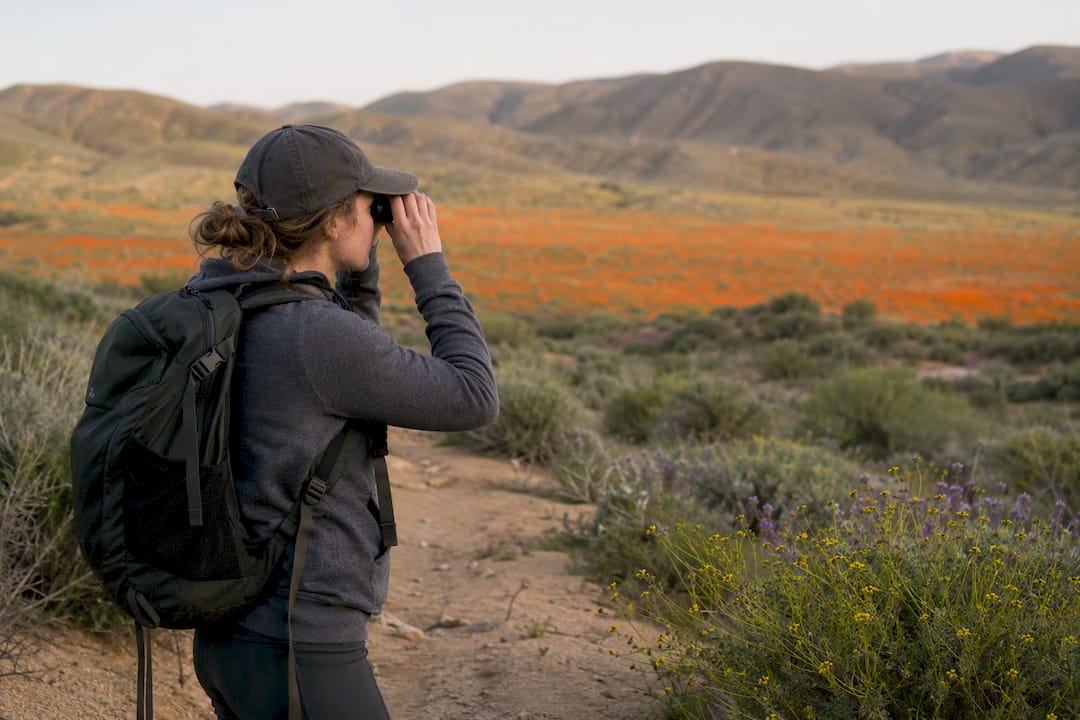
Pro Tip: Pack a pair of compact binoculars. You get a closer look at delicate blooms without ever leaving the trail, and it beats the “just one step off the path” temptation every time.
How To Check Real-Time Bloom Status Before You Go
Bloom conditions change fast enough that a blog post from three weeks ago can already be wrong. Check these sources the week of your trip, not the month before.
- NPS park pages, including Death Valley’s official alerts, post road closures and current bloom notes.
- California State Parks’ wildflower bloom page tracks conditions across desert state parks and links out to individual park pages.
- BLM district pages and local park district social media accounts often post the fastest on-the-ground updates, especially for sites like Carrizo Plain.
- NASA’s satellite reporting through programs monitoring Landsat imagery offers a useful secondary confirmation of how widespread a bloom actually is, beyond what a single trail report can tell you.
Before heading out, run through a short checklist: confirm parking availability, check for shuttle requirements at high-traffic sites, look up sunrise time for early light, and pack layers, since desert mornings run cold even when afternoons spike hot.
Small Habits That Protect The Next Bloom
Responsible viewing isn’t complicated, but it does take a little intention. Park in designated lots instead of pulling onto shoulders, since compacted roadside soil struggles to support seed germination the following year. Pack out everything you bring in, including fruit peels and tissue, since even biodegradable trash disrupts the desert’s delicate nutrient balance.
Photograph from established viewpoints rather than walking into a field for the “editorial” shot. Drone rules vary by park and monument, so check before you fly, since disturbed wildlife and startled visitors are common complaints at popular bloom sites. If you’re traveling with a group, agree ahead of time to stick together on marked paths, since one wanderer often triggers a chain reaction of others following the same shortcut.
Consider visiting less-publicized bloom pockets instead of the same handful of Instagram-famous hillsides. Spreading foot traffic across more sites reduces the concentrated damage that hits places like Walker Canyon during peak years. Smaller, quieter blooms often deliver just as much color with a fraction of the ecological cost, and you’ll likely enjoy the visit more without fighting for a parking spot or a clear sightline.
Flowers You’ll Actually See On The Trail
Knowing a few species by sight turns a walk through color into something more memorable. California poppy is the icon, bright orange with a silky, almost papery petal that closes up on cloudy days and reopens in full sun. Desert sand verbena shows up as low mats of pink to magenta blooms, often the first color you’ll spot on a Death Valley hillside. Desert dandelion brings pale yellow, daisy-like flowers in dense carpets across low desert floors.
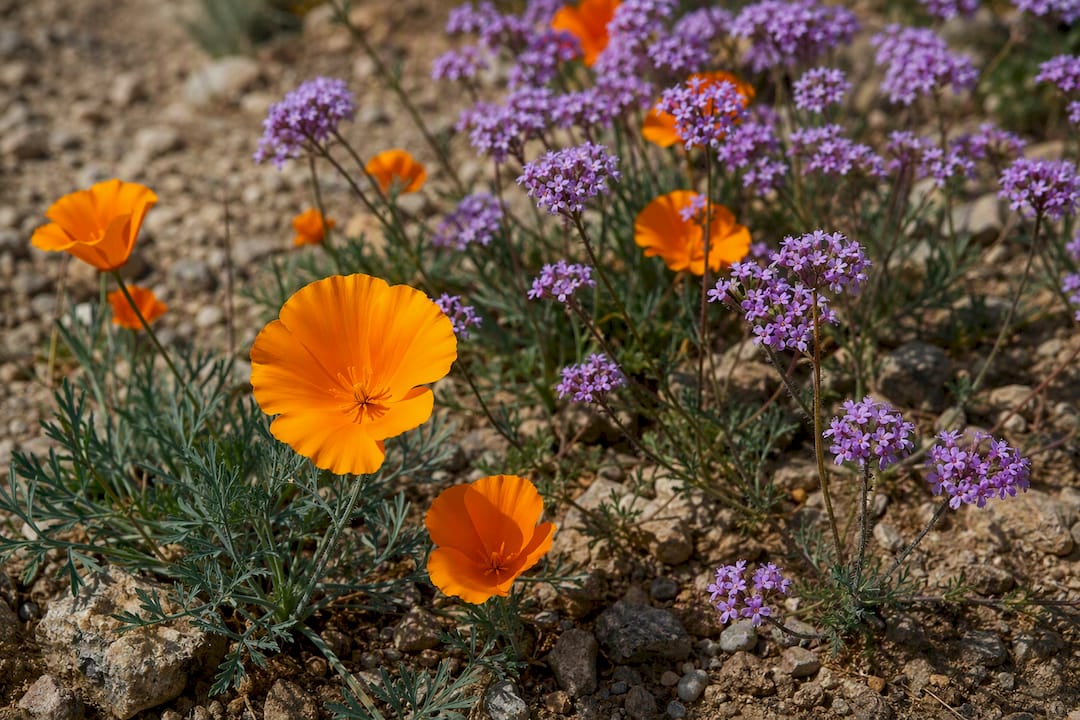
At Carrizo Plain, look for hillside daisy contributing much of that vivid yellow NASA’s satellite imagery picked up from orbit, often mixed with patches of purple phacelia. Coastal sites like Point Mugu add lupine, recognizable by its tall purple-blue spikes, alongside poppies along the same bluffs. In rockier desert terrain, keep an eye out for ocotillo, whose bright red tubular flowers top spindly, cactus-like stalks rather than growing low to the ground.
Learning even five or six of these names changes how you experience a bloom. Instead of one undifferentiated wash of color, you start noticing the layered mix of species that makes each site distinct, and it makes for a far better story when you’re describing the trip later.
SoCal Sights’ Take On Seeing The Bloom Right
The single best trick for beating both crowds and heat is arriving before sunrise. I know that sounds brutal for a wildflower trip, but the light is softer, the parking lots are empty, and you get the hillside mostly to yourself before the tour buses show up around 10 a.m.
Weekday mornings beat weekends every time, and choosing a secondary trailhead over the main one at a popular site often gets you the same view with a fraction of the foot traffic. Some of the best patches we’ve heard about from our community aren’t the famous hillsides at all. They’re smaller roadside pockets that never make it into a listicle, which honestly makes them better for conservation since fewer feet means less damage. If you want a curated list of these kinds of finds beyond wildflower season, our SoCal Sights collection is built around exactly that kind of local discovery, and our membership program gets you deeper access to community-sourced spots as they get shared.
— Joshua
Sources
- Britannica — Super-bloom
- NPS — Death Valley wildflowers
- NASA Earth Observatory — A fault line in full bloom
- UCR News — Superbloom ahead of schedule
- California State Parks — Wildflower bloom