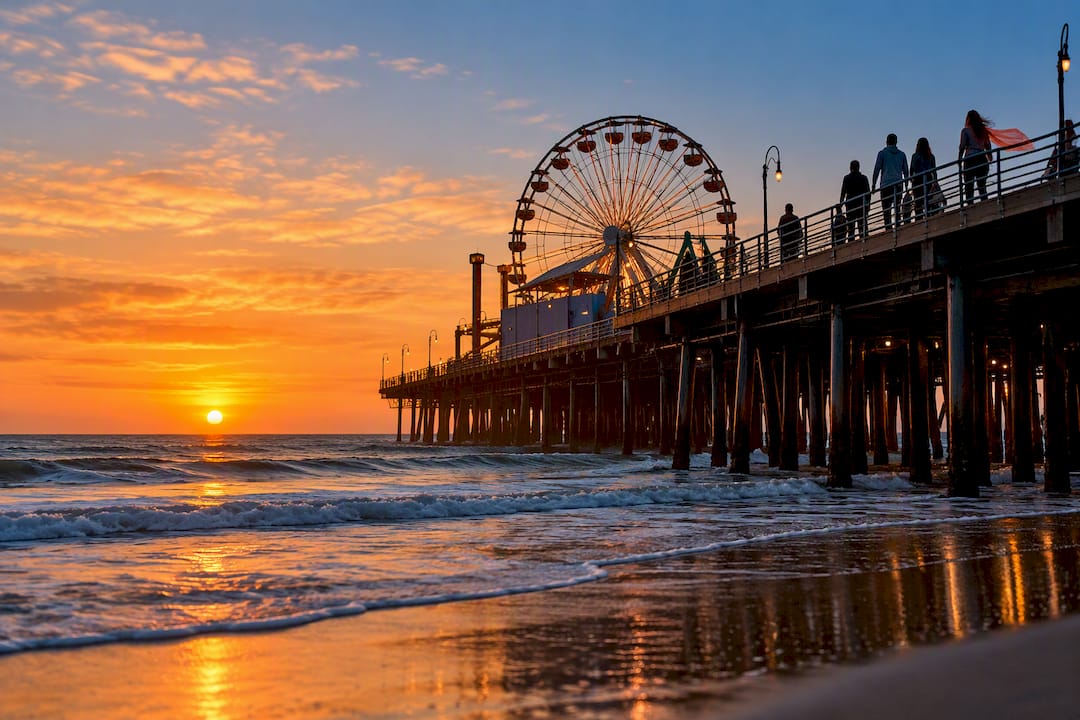
For a classic ocean horizon, head to Santa Monica Pier or Palisades Park. For the best skyline view, go to Griffith Observatory. If you want cliff-top drama and don’t mind a short walk, pick Point Dume or Baldwin Hills Scenic Overlook. Whichever you choose, get there 30 to 45 minutes before sunset. Sundown in LA is a fast show, and the best colors show up after the sun disappears.
TL;DR:
- Santa Monica Pier and Palisades Park offer easy access to classic ocean sunsets, with nearby public transit and minimal planning required.
- Griffith Observatory provides iconic city skyline views and Hollywood Sign scenery, but parking fills early and crowds are high.
- Hillside spots like Baldwin Hills Overlook and Mulholland Drive turn sunsets into panoramic shows with fewer visitors, though some locations involve uneven terrain or limited amenities.
- Sunset hikes at Baldwin Hills, Point Dume, or Runyon Canyon deliver better angles and solitude, but require arriving early and bringing proper gear.
- Coastal fog and seasonal differences impact colors, with winter sunsets appearing more dramatic, and summer evenings often softer and longer.
Table of Contents
- Best Sunset Spots in Los Angeles Near the Ocean
- Best Sunset Views in LA From the Hills and Skyline
- Sunset Hikes in Los Angeles Worth the Climb
- The Best Sunset Spot for Tonight, by What You Want
- Timing, Gear, and Safety for a Los Angeles Sunset
- Photography Tips for Shooting an LA Sunset
- How Weather and Season Change the Colors
- Sunset Spots That Work for Families and Group Hangouts
- Accessible Sunset Viewing Options in Los Angeles
- Food, Restrooms, and Other Amenities Near Sunset Spots
- A Local’s Honest Pick for an Underrated LA Sunset
- Want a Ready-Made Sunset Itinerary?
- Sources
- FAQ
Best Sunset Spots in Los Angeles Near the Ocean
If you want that classic California postcard shot, the coast is where you go. Los Angeles gives you two very different flavors of ocean sunset: the busy, festive pier scene and the quiet, cliff top hush. Both are worth your evening, just for different reasons.
Santa Monica Pier and Palisades Park sit right next to each other, which makes this the easiest coastal sunset to pull off with zero planning. The Pacific Wheel Ferris wheel at Pacific Park lights up right as the sky turns orange, and its silhouette against the water is one of the most photographed shots in the city. You can catch the Expo Line light rail straight to Downtown Santa Monica Station and walk five minutes to the bluffs, which beats fighting for a parking spot. If you’d rather drive, the pier’s public parking structures fill up fast on weekends, so budget extra time or park a few blocks inland and walk. Palisades Park, just above the pier along Ocean Avenue, gives you a grassy, palm-lined perch with zero admission and benches for settling in.
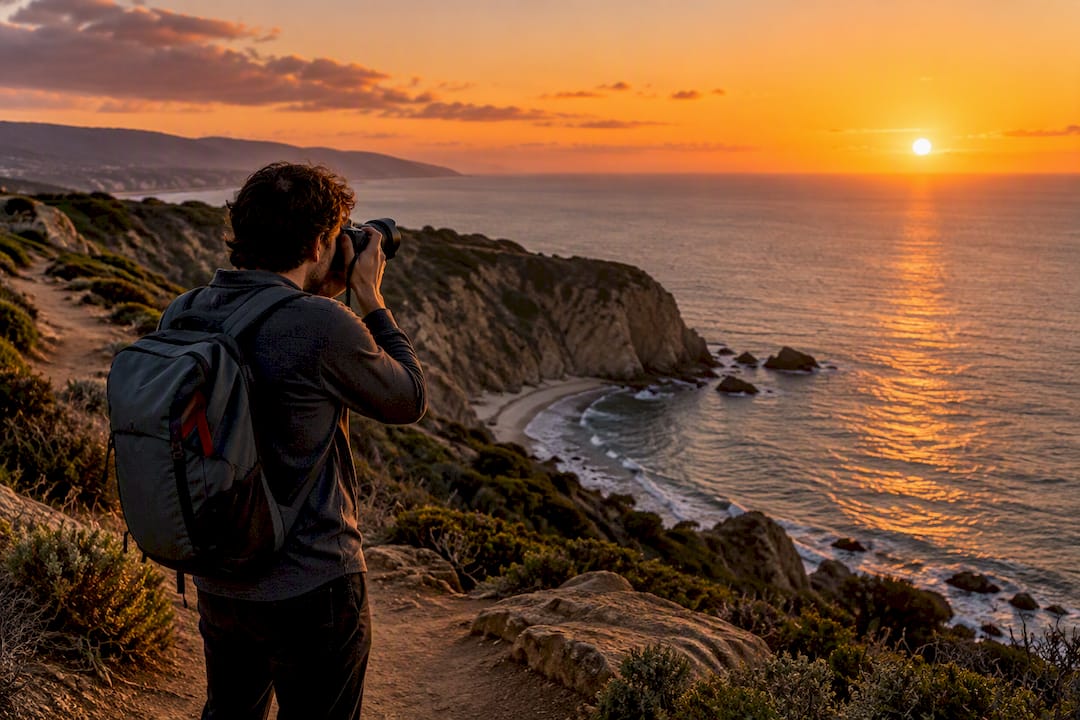
Point Dume in Malibu is the spot for readers who want drama over convenience. This bluff sits high above the Pacific, and the moderate walk out to the point rewards you with 180 degree views that make the whole ocean look like it’s on fire at dusk. It’s quieter than the pier scene, which makes it a favorite for couples and serious photographers who don’t want strangers wandering into their frame. Parking at Westward Beach fills early on summer evenings, so arrive with daylight to spare.
Manhattan Beach Pier delivers a softer, more residential version of the pier experience. Pastel skies, a laid back South Bay crowd, and a walkable downtown right behind you make this a natural pick for families who want dinner and a sunset in the same trip.
El Matador State Beach is the one to save for a special evening. Getting down requires a set of wooden stairs, and the payoff is a beach scattered with sea stacks and rock arches that frame the sun perfectly. The narrow lot fills quickly, and there’s no lifeguard on duty, so keep an eye on the tide line as you shoot.
A few quick notes before you go:
- Santa Monica and Manhattan Beach piers get crowded on weekends, arrive 45 minutes early for a good rail spot.
- Point Dume and El Matador both involve uneven terrain, wear shoes you can actually walk in.
- Check tide charts before visiting El Matador since high tide shrinks the usable sand.
- Metered parking near the Santa Monica Pier runs through the evening, so keep coins or a payment app handy.
Best Sunset Views in LA From the Hills and Skyline
Ocean sunsets get all the postcards, but Los Angeles has an entirely different sunset experience built into its hills: watching the sky turn pink while a carpet of city lights flickers on below you. This is the version locals tend to prefer once they’ve done the beach thing a few times.
Griffith Observatory is the reliable heavyweight here. Its west facing terraces line up perfectly with the setting sun, and once it’s down, you get the Hollywood Sign, the Downtown skyline, and the whole basin lighting up in front of you. The observatory’s official site is worth checking before you go, since the parking lot regularly fills an hour or more before sunset on clear evenings. If the lot is full, the shuttle from the Greek Theatre lot is your backup, and it runs frequently enough that the wait rarely eats into golden hour.
Baldwin Hills Scenic Overlook offers something different: a 360 degree view that takes in both the ocean haze to the west and the skyline to the east. You can drive straight to the top lot for a small fee, or earn the view on foot.
A few more hilltop options worth knowing:
- Mulholland Drive has several unmarked turnouts above the Valley and above Hollywood that stay nearly empty even on weekends.
- Barnsdall Art Park, perched above Hollywood Boulevard, gives you a free, low-key overlook with picnic tables and almost no tourists.
- Runyon Canyon’s East Ridge trail adds a short climb but rewards you with a wide, unobstructed skyline view without the Griffith crowds.
Crowd level runs highest at Griffith Observatory, moderate at Baldwin Hills, and lowest at the Mulholland turnouts and Barnsdall. None of these require more than a short walk from parking, except the East Ridge route at Runyon, which we cover next.
Sunset Hikes in Los Angeles Worth the Climb
Some of the best sunset views in LA come with a small physical toll, and that’s part of the appeal. A short climb thins out the crowd and usually buys you a better angle than anyone parked at the bottom.
- Baldwin Hills Scenic Overlook staircase. The climb runs about a mile up 282 steps to the summit, which is steep enough to feel like a real workout but short enough to finish before the light fades. If stairs aren’t your thing, the drive-up lot at the top of Hetzler Road costs $2 per hour or $6 for the full day, and the park stays open daily from 8:00 AM until sunset.
- Point Dume Cove Trail. This loop covers roughly 1.1 miles with a modest elevation gain, starting from the Westward Beach parking lot. The trail climbs to the bluff top before dropping back toward the cove, giving you both the cliff view and beach access in one outing.
- Temescal Canyon Overlook. A moderate out and back trail in Pacific Palisades that trades ocean proximity for elevation, putting you above the coastline haze on clearer evenings.
- Runyon Canyon East Ridge. A steady, exposed climb with little shade, best started with plenty of daylight left since the trail has no lighting.
Every one of these trails gets genuinely dark fast once the sun drops, and LA’s canyon trails don’t have streetlights waiting for you. A headlamp is the single most useful item you can bring on any sunset hike, since phone flashlights drain batteries and leave one hand full. If you want more trail options before committing to an evening hike, check our guide to the best hikes in Los Angeles sorted by difficulty.
Pro Tip: Start your climb 45 to 60 minutes before sunset, not 30. The extra buffer means you’re not racing the light on the way up, and you’ll have time to scout your framing before the sky starts changing.
The Best Sunset Spot for Tonight, by What You Want
Not every evening allows for a scouting trip. If you’ve only got one shot at a Los Angeles sunset this visit, match your pick to what you actually want out of it.
- Want the iconic, unmistakably LA shot? Griffith Observatory. Skyline, Hollywood Sign, and a sunset all in one frame.
- Want the classic beach sunset without a car? Santa Monica Pier and Palisades Park, both reachable by rail.
- Want a romantic, quieter coastal view and don’t mind driving? Point Dume or El Matador State Beach.
- Want solitude over convenience? Skip the pier and observatory crowds for a Mulholland Drive turnout or Barnsdall Art Park.
The tradeoff is consistent across the city: the easiest spots to reach are also the most crowded, and the quietest spots ask a little more of you, whether that’s a drive, a climb, or both.
Timing, Gear, and Safety for a Los Angeles Sunset
Arrive 30 to 45 minutes before official sunset time and plan to stay another 10 to 20 minutes after the sun disappears. The afterglow, that stretch where the sky deepens into pink and purple after the sun itself is gone, is often the best part of the whole show, and it’s the part most visitors miss because they leave too early.
Winter sunsets tend to run crisper and more dramatic, while summer evenings usually bring softer, longer fades. Coastal fog and marine layer can mute a sunset entirely on some summer evenings, so if you’re coastal-bound in June or July, check a local forecast first.
What to bring:
- A headlamp if you’re doing any hike, since canyon trails go dark within minutes of sunset.
- A light layer, even in summer. Ocean breezes drop the temperature fast once the sun is down.
- Water, especially for the Baldwin Hills staircase or Runyon’s East Ridge.
- A small blanket or sitting pad if you’re claiming a spot on grass or bluffs early.
If you’re headed to Baldwin Hills, remember the park closes at sunset and top-lot parking runs $2 per hour or $6 for the day. Check hours ahead of time for any spot on a schedule, since closures shift seasonally.
Photography Tips for Shooting an LA Sunset
You don’t need a professional camera to get a strong sunset shot in Los Angeles. You need good timing and a couple of habits.
Golden hour, the 20 to 30 minutes before sunset, gives you warm, soft light that’s forgiving on phones and cameras alike. The real color payoff often comes in the 10 minutes after the sun is gone, when the sky shifts through pink, orange, and purple.
On your phone:
- Tap the horizon to set exposure, then drag down slightly to keep the sky from blowing out.
- Turn HDR on for scenes with both bright sky and dark foreground, like a silhouette shot.
- Use a person, pier railing, or tree branch as a foreground silhouette to add depth.
With a camera:
- Bring a tripod for anything shot after the sun sets, since shutter speeds slow down fast in low light.
- Bracket your exposures if your camera supports it, then blend for a full dynamic range shot.
- At cliff-top spots like Point Dume or El Matador, keep gear strapped down. Ocean gusts have taken more than a few tripods over the edge.
Ocean scenes reward wide shots that include reflections on wet sand. City scenes, like the view from Griffith Observatory, do better with a slightly longer lens that compresses the skyline against the sky. For more location ideas built specifically around photography, see our guide to LA’s best photo spots.
Pro Tip: If you’re shooting El Matador or Point Dume, get your silhouette shots first while the sun is still visible, then switch to wide landscape shots for the afterglow. Trying to do both at once means you’ll miss one or the other.
How Weather and Season Change the Colors
Los Angeles sunsets change noticeably with the calendar. Winter air tends to be drier and cleaner, which produces sharper, more saturated colors and crisper cloud edges. Summer sunsets often stretch out longer with softer, more pastel fades, partly because of the coastal marine layer that rolls in during the warmer months.
Clouds are your friend here, within reason. A sky with scattered or broken cloud cover, rather than a totally clear one, tends to produce the most vivid color because the clouds catch and scatter the light. If you check a forecast and see “partly cloudy” for sunset, that’s often a better sign than “clear.” Give it 10 to 20 minutes after the sun actually drops below the horizon. That’s frequently when the sky puts on its best display, well after most casual visitors have already packed up and left.
Sunset Spots That Work for Families and Group Hangouts
Some of these locations handle a crowd of kids, coolers, and folding chairs a lot better than others. Palisades Park is the easiest pick for a family group. It’s flat, grassy, and has plenty of bench seating, plus the Santa Monica Pier’s arcade and rides are a two minute walk away if the kids get restless before the sky finishes changing.
Manhattan Beach Pier works well for the same reason. Wide sidewalks, a walkable downtown, and enough space on the sand for a group blanket setup make it forgiving for families juggling strollers or beach gear.
Baldwin Hills Scenic Overlook is a strong option for a group that wants a shared activity built into the evening. The staircase climb turns the outing into a mini group challenge, and the summit has enough open space for several families to spread out without feeling cramped. If some of your group would rather skip the stairs, the drive-up lot means nobody gets left out.
Griffith Observatory can work for larger groups too, but go in expecting company. Weekend crowds mean you’ll want to stake out your spot on the terraces early and keep younger kids close, since the railings and drop-offs demand attention.
Skip El Matador and Point Dume for big groups. The narrow stairs, limited parking, and uneven cliff terrain make both spots better suited to smaller parties of two or three.
Accessible Sunset Viewing Options in Los Angeles
Not every great sunset spot in LA requires stairs or a hike, and that matters if you’re visiting with a wheelchair, a stroller, or a mobility limitation of any kind.
Santa Monica Pier and Palisades Park are your most accessible options. Both sit at street level with paved paths, ramps, and accessible parking near the pier entrance, and you can get an unobstructed ocean view without walking more than a few hundred feet from a drop-off point.
Griffith Observatory’s main terraces are also reachable without stairs from the primary parking areas, though the lot itself can require a longer walk when it’s full and you’re parked along the access road. Calling ahead or checking the observatory’s official visitor information before you go is worth it if mobility is a concern, since shuttle drop-off points can change.
Baldwin Hills Scenic Overlook has a real advantage here that a lot of visitors miss: the drive-up lot at the top of Hetzler Road gets you the same 360 degree view as the staircase climbers, without a single step. That $2 per hour or $6 daily parking fee buys you full access to the summit view.
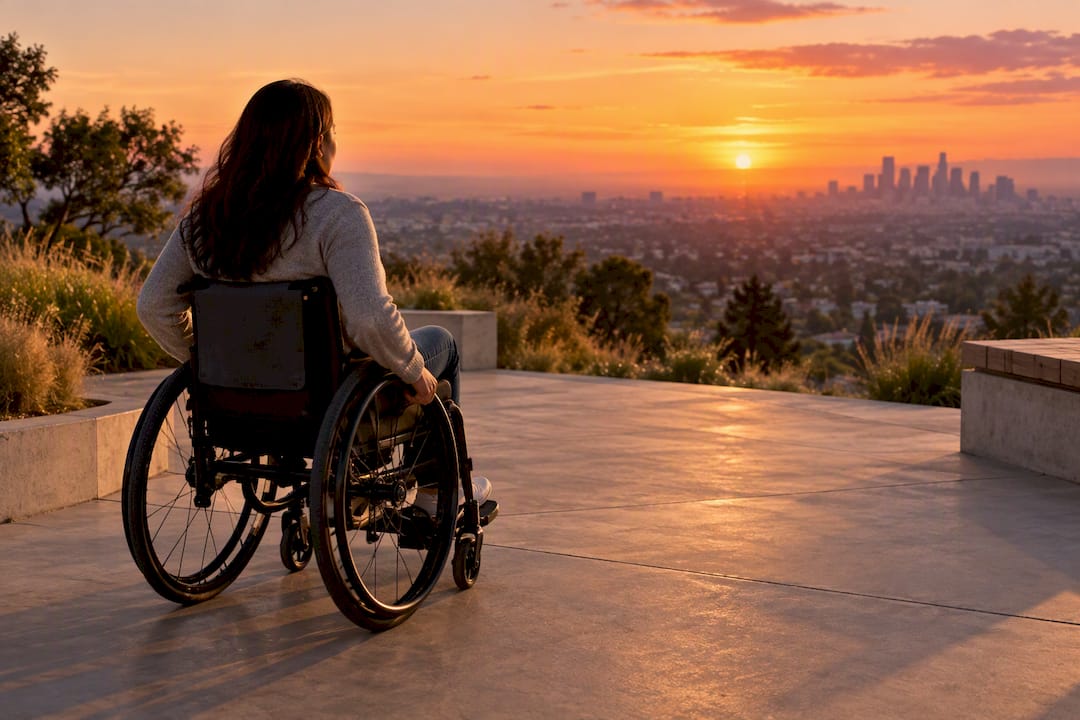
Point Dume, El Matador, and the Runyon Canyon East Ridge all involve uneven terrain, stairs, or steep grades that make them difficult or unsafe for visitors with mobility limitations. If dramatic coastal cliffs are the goal but stairs aren’t an option, Palisades Park’s bluff-top views offer a comparable, flat-access alternative.
Food, Restrooms, and Other Amenities Near Sunset Spots
Santa Monica Pier wins on amenities by a wide margin. You’ve got restrooms, dozens of food options from casual to sit-down, and enough coffee shops along the Third Street Promenade to fuel an entire evening before or after your sunset.
Manhattan Beach Pier’s downtown strip offers a similar setup on a smaller scale: casual restaurants, a few coffee shops, and public restrooms right near the pier entrance.
Griffith Observatory has restrooms and a small café inside the building itself, which is a nice option if you want a snack before heading to the terraces. Just know that the café tends to close before the observatory grounds do, so plan food before sunset rather than after.
Baldwin Hills Scenic Overlook is more bare-bones. There are restrooms near the main lot, but don’t expect food vendors, so bring water and snacks if you’re settling in for a while.
Point Dume and El Matador have the least infrastructure of the bunch. Both are limited to portable restrooms or none at all, and the nearest real food options mean a drive back into Malibu proper. Plan accordingly if you’re bringing kids or staying past dark.
A Local’s Honest Pick for an Underrated LA Sunset
My personal favorite isn’t on most lists: the quiet turnouts along Mulholland Drive above the Cahuenga Pass, where you get the Valley haze turning gold on one side and Hollywood lighting up on the other, with maybe two other cars around. It’s not dramatic in the way El Matador is, but it feels like the city showing itself off just for you.
Wherever you go, pack out what you bring in, keep noise down near residential overlooks like Mulholland, and give other visitors room to enjoy their own view. For more spots like this one, our guide to offbeat things to do in LA has a few more that rarely make the standard lists.
— Joshua
Want a Ready-Made Sunset Itinerary?
Scouting parking, hike difficulty, and timing for every spot on this list takes real legwork, and that’s exactly the kind of local detail Socalsights was built to hand you already sorted. A Socalsights membership gets you curated routes, printable maps, and insider timing notes for sunset spots and dozens of other Southern California outings, so you’re not cross-referencing five browser tabs the night before your trip.
If you’re building out a longer visit around your sunset plans, our guide to unique things to do in Los Angeles pairs well with an evening at any of these spots. Check the membership page to see what’s included and start planning your next Los Angeles evening with a route already mapped out for you.
Sources
Conditions change, especially at state parks and public overlooks, so confirm details before you head out:
- Baldwin Hills Scenic Overlook | California State Parks
- Griffith Observatory official site
- Santa Monica Pier | Pacific Park
- Best places in LA to watch the sunset | CBS Los Angeles
FAQ
Where does the sun set in Los Angeles?
The sun sets over the Pacific Ocean for coastal spots like Santa Monica, Malibu, and Point Dume, and behind the western hills and skyline for inland spots like Griffith Observatory and Baldwin Hills. Your exact view depends on whether you’re facing open ocean or the city basin.
Where are the prettiest sunsets in the US?
Los Angeles is regularly named among the country’s best sunset cities, and local guides consistently point to Griffith Observatory, Point Dume, Palisades Park, and Baldwin Hills as standout spots. The mix of ocean horizon and hillside skyline views gives LA more variety than most single-coast or single-skyline cities.
Why are sunsets in LA so beautiful?
Los Angeles benefits from a coastal marine layer, hillside elevation changes, and air particulates that scatter light into deeper oranges and pinks. Winter sunsets tend to look crisper and more dramatic, while summer evenings often bring longer, softer color fades.
What is the golden hour in Los Angeles?
Golden hour is the 20 to 30 minute window before sunset when light turns warm and soft, ideal for both phone and camera photography. It’s followed by the afterglow, the 10 to 20 minutes after sunset when the sky often deepens into its most vivid pinks and purples.
Does Socalsights have sunset spot itineraries?
Yes, Socalsights members get curated routes and timing notes for sunset spots along with other Southern California outings through the Socalsights membership. For current pricing and plan details, please refer to the membership page on the appropriate website.