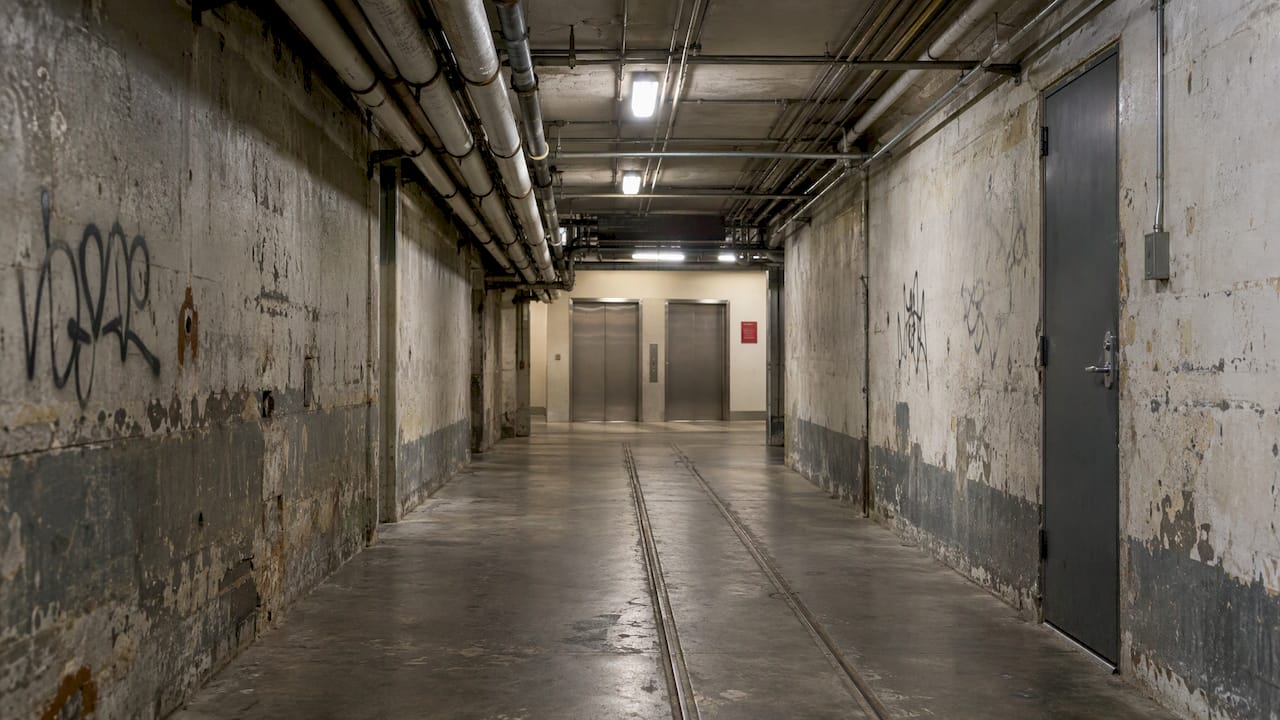
Los Angeles does have tunnels under downtown, and a few of them are real, documented and even walkable. The big “secret network” stories are mostly legend. At SoCal Sights we like the hidden side of this city, so here is what is actually down there, what you can see with your own eyes, and what is sealed, closed or just a good campfire tale.
TL;DR
- The Civic Center pedestrian tunnels near the Hall of Records are the main underground passages in LA you can walk through, and they come with posted rules and hours.
- The 1925 Pacific Electric subway is real, but its western portal is permanently sealed and you can’t go in.
- Two historic vehicular tunnels, on 2nd Street and 3rd Street, still carry traffic downtown and are easy to see from the street.
- The Prohibition-era mega network and the “Lizard People” tunnels have no maps or evidence behind them, according to the LA Public Library.
- Stay out of anything closed or unmarked: unauthorized entry is trespassing.
Table of Contents
- The tunnels that are actually documented
- The Civic Center tunnels: the one you can actually walk
- The Pacific Electric subway: real, huge and closed
- Streets that go through hills: the 2nd and 3rd Street tunnels
- The pedestrian tunnels all over LA
- Myth check: Prohibition tunnels and Lizard People
- Is it safe? Rules for visiting
- A half-day underground-and-above plan
- Promo: put your business in front of curious explorers
- Perspective
- FAQ
- Sources
The tunnels that are actually documented
Let me sort this out first, because the internet mixes it all together. Downtown LA has four kinds of underground space that show up in real records:
- The Civic Center pedestrian tunnels, which connect county government buildings.
- The old Pacific Electric subway, a trolley tunnel from 1925.
- Vehicular tunnels from the early 1900s, a couple of which still carry cars.
- Pedestrian underpasses all over the city, built mostly so people (often kids) could cross busy streets.
There are also leftovers like a Bunker Hill people-mover stub along 3rd Street, left over from a transit project that was killed in 1981, according to LAmag’s history of downtown’s deserted tunnels. That one is a curiosity more than a destination.
A city engineer put it well in a 1986 LA Times piece: LA’s tunnels aren’t there to shield you from bad weather the way they are back East. They’re mostly underground arteries for moving things and people. That one idea explains most of what you’ll find.
The Civic Center tunnels: the one you can actually walk
If you only do one underground thing in LA, make it this one. The surviving Civic Center tunnels stretch several blocks, from around Spring and Temple streets over to 1st Street and Grand Avenue. They run beneath the Hall of Justice, the Clara Shortridge Foltz Criminal Justice Center, the Kenneth Hahn Hall of Administration, the Hall of Records and the Stanley Mosk Courthouse, per the LA Times.
How to find the entrance
Public access runs through a standalone elevator behind the Hall of Records, around 222 N. Hill St. and 320 W. Temple St. The Metro Civic Center/Grand Park station is close by, so this pairs easily with a car-free day (more on that below). Rules and hours are posted on red signs at the elevator, so read them before you go down. Hours for government spaces can change, so check at the entrance instead of trusting any blog, including this one.
What you’ll see
Don’t expect a glowing neon city. Think a wide, plain, utilitarian passage, roughly 12 feet across, with pipes, old tracks and some graffiti, linking county buildings. It’s more about the feel of the place and the history than about sights. It rewards people who like industrial, behind-the-scenes spots.
The stories that make it worth the trip
These tunnels have been used for some wild things, all documented by the LA Times:
- Mickey Cohen, 1951. The mobster was moved through a tunnel under Spring Street from his Hall of Justice jail cell to the federal courthouse for his tax-evasion trial. That tunnel was closed in 1994 when the Hall of Justice shut after Northridge earthquake damage.
- “Operation Midnight,” 1960. Between midnight and 7:30 a.m. on October 2, $1 billion in cash and negotiable securities was pushed through the Civic Center tunnels on carts, from the old Hall of Records to the new Hall of Administration. Officers with submachine guns, shotguns and gas grenades guarded 16 underground checkpoints, following a 42-page procedural manual.
The same system still serves the courts. LAmag notes that one of these passageways is used to move defendants between court and jail, which is a good reminder that this is a working part of the county, not an attraction. Be quiet, be polite and stay on the public route.
The Pacific Electric subway: real, huge and closed
This is the one people mean when they say “abandoned LA subway.” The city’s first subway opened at Fourth and Hill streets in 1925. According to LAmag, the tunnel was 4,325 feet long, opened December 1, 1925, and cost more than $4 million. Several hundred trolley cars used it daily for three decades. The last trolley rolled out of the western portal on June 19, 1955, with a banner reading “To Oblivion.”
The LA Times says it ran about a mile and sat roughly 65 feet beneath Bunker and Crown hills (LA Times, 2004).
What happened to it
In 1967, as part of the Bunker Hill urban renewal project, workers filled in the section between Figueroa and Flower streets. The western portal is permanently sealed, and LAmag reports there are no plans to reopen the one-block stub between Olive Street and Grand Avenue. A developer has talked about renovating the old terminal lobby and platforms beneath an apartment building, but with no date set.
So what can you do? Walk the area above it. The old Subway Terminal Building is still a landmark, and the buried history makes a great stop on a downtown walk. Just don’t go hunting for a way in. It’s closed, and it isn’t safe.
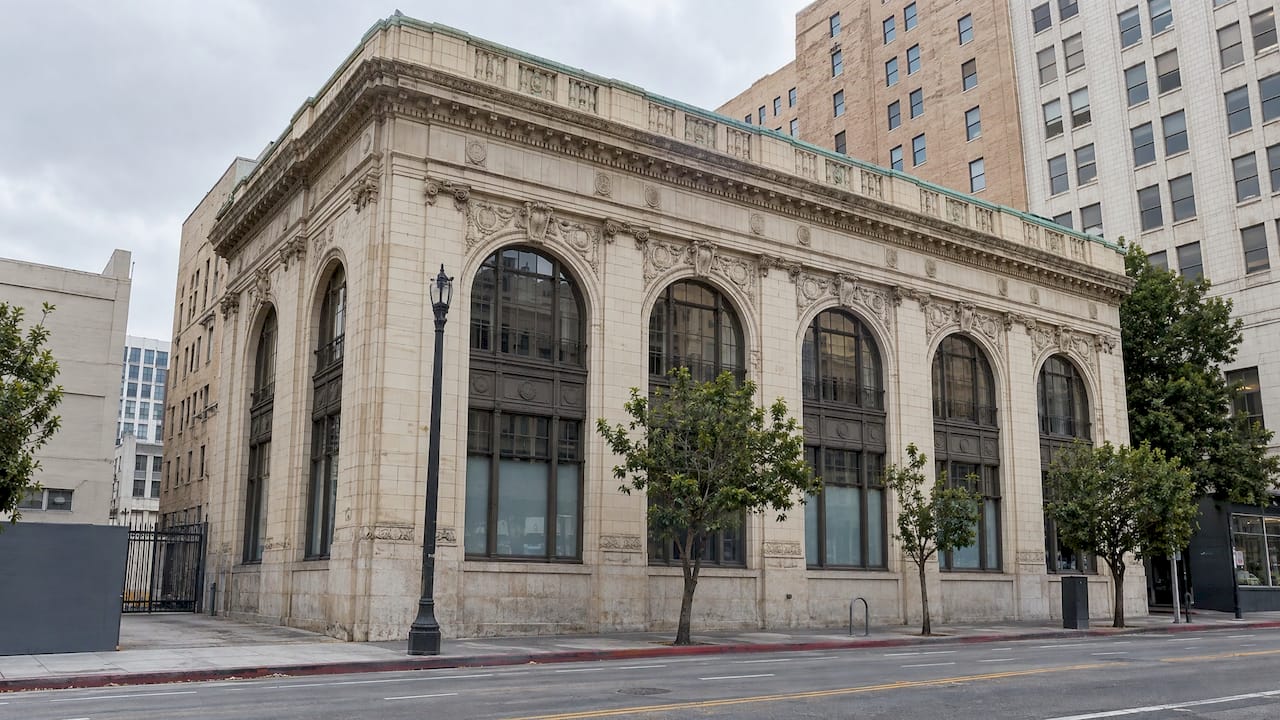
Streets that go through hills: the 2nd and 3rd Street tunnels
Not every LA tunnel is a mystery. Two old vehicular tunnels downtown still do their original job. The Broadway and Third Street tunnels both opened in 1901, and the Hill Street tunnels followed in 1909, per PBS SoCal’s Lost LA.
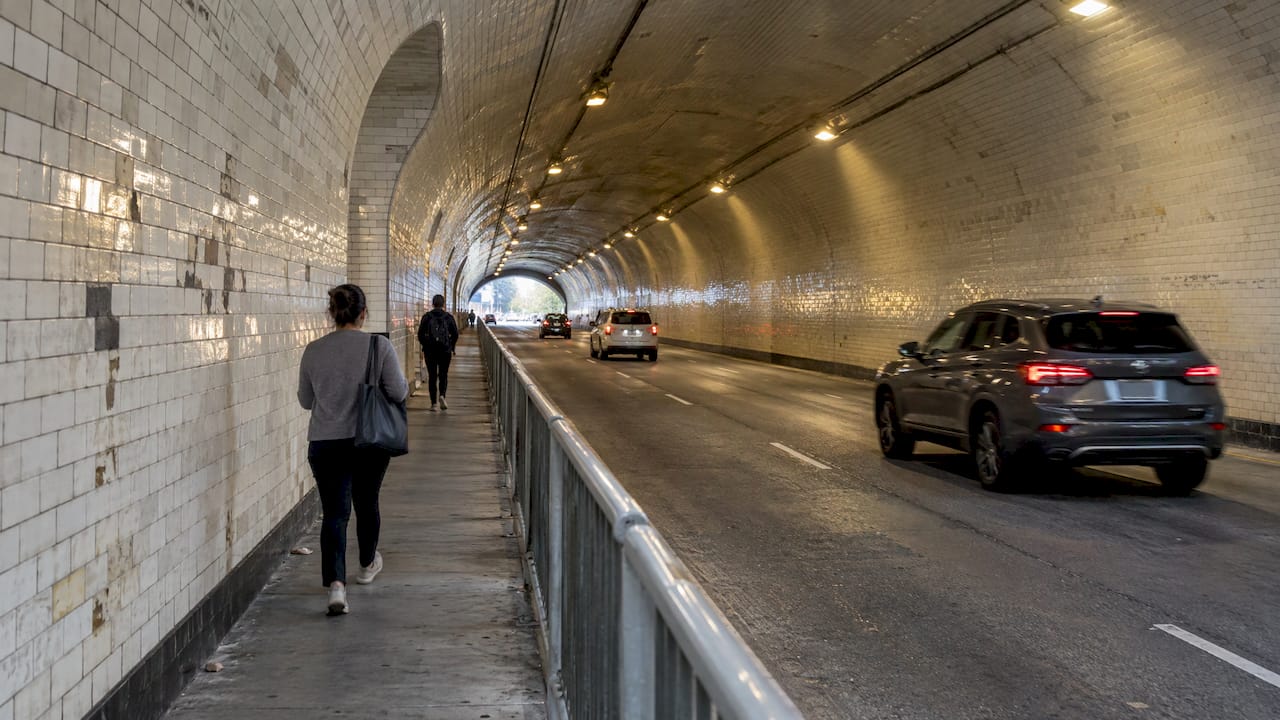
The Broadway tunnel ran nearly 800 feet under Fort Moore Hill and cut 15 minutes off a horse-and-carriage trip. The 2nd Street tunnel, lined with glazed tile, opened in 1924 and is still in use, according to the LA Times. When the 101 freeway went in around 1949, Fort Moore Hill was reduced to a stump, and part of the Broadway tunnel became a freeway overpass.
If you want a cheap, quick tunnel moment, the 2nd Street tunnel is it. Its tile walls are a favorite with photographers, and you’ll recognize it from movies. Walk the sidewalk if you can, and never stop a car inside it.
The pedestrian tunnels all over LA
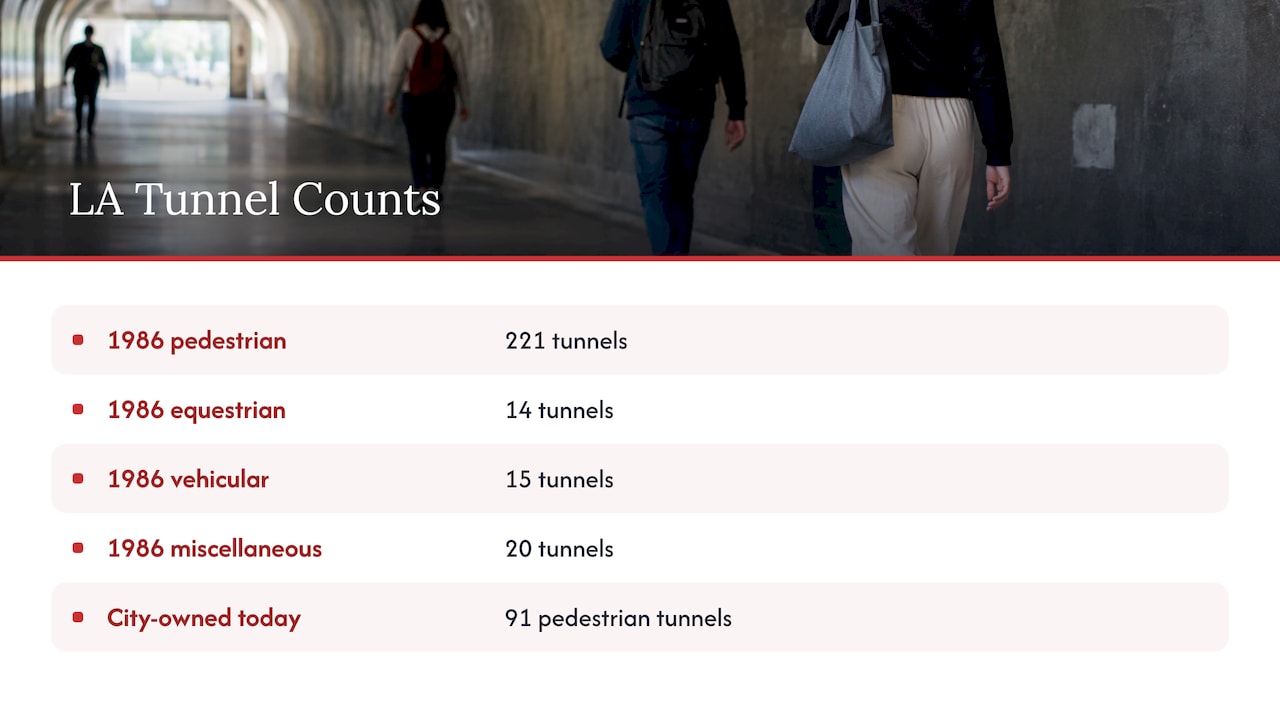
Here’s a fun fact I like: LA has a lot of little tunnels that you probably walked past without knowing it. The city owns and maintains 91 pedestrian tunnels, most dating from the early 1950s through the late 1970s, with a few from the 1920s, according to LAist. Back in 1986, Public Works had 270 tunnels on file, including 221 pedestrian tunnels, 14 equestrian, 15 vehicular and 20 miscellaneous (LA Times).
The first one built specifically so kids could avoid car traffic was an experimental tunnel under Sunset Boulevard in 1924, built for students at Micheltorena Street Elementary at the request of local parents and school officials.
Many of the city’s tunnels have since been closed. Some were filled with sand or cement slurry and capped at both ends for safety. The Bureau of Engineering also points to dirty, dangerous conditions in some of them. This is exactly why I’d treat these as “look from the sidewalk” spots, not exploring spots.
Myth check: Prohibition tunnels and Lizard People
You’ll see claims all over the web about a huge Prohibition-era tunnel maze under downtown. Here’s what holds up. LAmag does cite historian Richard Schave on Prohibition-era speakeasies under the King Edward Hotel and a Rosslyn Hotel annex. Those are specific basement-level spaces. A citywide network is something else.
On that, the LA Public Library is blunt in an episode transcript: a vast network is pretty unlikely, since if such tunnels existed, no maps were made, and if maps were made, they weren’t delivered to the library.
The Lizard People legend
The famous “Lizard People” tunnel story goes back to the 1930s and a man named Shufelt. He claimed dowsing showed gold under Fort Moore Hill and an ancient race that dug shafts shaped like a lizard from where Dodger Stadium is now to the Central Library. The library keeps a vertical file of clippings on it. But Peter Hauge of the library says there are very few stories of him actually finding anything.
It’s a great tale to tell on a downtown walk. Just tell it as a tale. If what you really want is a genuine underground adventure and you’re traveling beyond LA, Denmark’s Mønsted limestone mines are a real place with a real underground route to walk.
Is it safe? Rules for visiting
A few simple guidelines keep this fun:
- Use the public entrance only. The Hall of Records elevator is the sanctioned way into the Civic Center tunnels. Follow the posted hours and rules.
- Don’t enter closed tunnels. Unauthorized entry is trespassing. In the 1986 LA Times piece, a UCLA police sergeant said students caught in tunnels were subject to trespassing charges.
- Skip sealed or capped tunnels. The city has filled many with sand or cement for safety reasons.
- Dress for conditions if you’re ever on an official tour. Abandoned underground spaces can mean water, mud and humidity, and LAmag advises waterproof boots and a reliable flashlight for the old subway.
- Earthquakes. A city structural engineer told the LA Times that LA’s tunnels are among the safest places to be in a quake, because the ground around an underground structure moves along with it.
A half-day underground-and-above plan
Here’s how I’d put it together if you’ve got a free morning downtown:
- Start at the Hall of Records. Take the public elevator down, follow the posted rules, and walk the Civic Center tunnel route.
- Walk to Bunker Hill. Look at the Subway Terminal Building and think about the trolleys that once ran underneath.
- Stroll the 2nd Street tunnel. Check out the glazed tile.
- Finish above ground. Murals and street art are all over downtown, and our mural routes guide covers five of them.
You don’t need a car for any of it. Our guide to getting around LA without a car shows how to link the Metro stops. If you want more offbeat ideas after, try our offbeat things to do in Los Angeles or the LA secret stairs and walk loops.
Promo: put your business in front of curious explorers
People who search for underground LA are exactly the kind of visitors who love local, offbeat spots. If you run a downtown business, tour, restaurant or event, you can reach them through SoCal Sights with advertising, featured placements or a membership.

See the details on our Advertise With SoCal Sights page.
Perspective
Here’s how we see it at SoCal Sights. The best hidden-gem stories are the ones you can check. A tunnel with a documented history, like the Civic Center passages with their Mickey Cohen and Operation Midnight stories, beats a rumor every time, because you can stand there and know it’s true.
That’s why we focus on curated, local picks and let locals share their own favorite spots. Information overload is the real problem for visitors: a thousand pages repeat the same tunnel myths. We’d rather give you the real places, the real logistics and the stories worth telling, and we want the local businesses around them to be easy to find too.
Go see downtown from underneath, then come back up and eat something good.
Joshua
FAQ
Can you visit the underground tunnels in Los Angeles?
Partly. The Civic Center pedestrian tunnels are open to the public through a standalone elevator behind the Hall of Records, with rules and hours posted at the entrance. The abandoned 1925 subway is closed, and its western portal is permanently sealed.
Are there secret tunnels under downtown LA?
There are real, documented ones: the Civic Center passages, the old Pacific Electric subway, and some Prohibition-era basement spaces under historic hotels. A giant secret network is not supported by evidence, according to the LA Public Library.
What are the LA tunnels from the Lizard People story?
They’re a 1930s legend based on a man’s dowsing claims about shafts under Fort Moore Hill. The library holds a file of clippings, but very few stories describe him finding anything.
Is it legal to explore abandoned tunnels in LA?
No, not without authorization. Entering closed tunnels can mean trespassing charges, and many of the city’s tunnels have been capped with sand or cement. Stick to the public Civic Center route and look at the others from the street.
Sources
- Footpaths beneath L.A. echo history, Los Angeles Times (2008)
- Infiltrating the Underground: L.A.’s Tunnels, Los Angeles Times (1986)
- Hills Yielded Early to Make Way for the City’s Traffic, Los Angeles Times (2004)
- Inside L.A.’s Dark Network of Deserted Underground Tunnels, LAmag (2015)
- Unearthing LA’s Pedestrian Tunnels, LAist (2022)
- Lost Tunnels of Downtown L.A., PBS SoCal
- Haunted Central transcript, Los Angeles Public Library
- Mønsted limestone mines