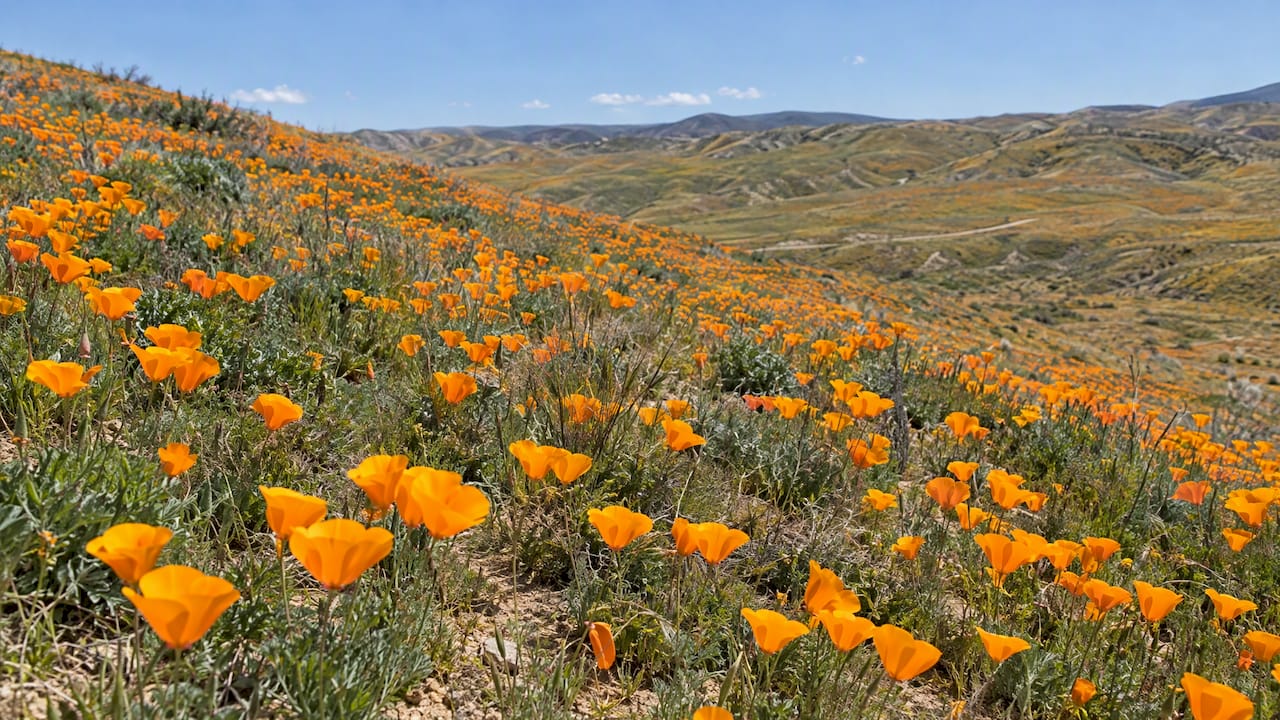
The best window to catch Antelope Valley poppies in full bloom typically falls between late March and mid-April, though flowers can appear anywhere from mid-February through May depending on rainfall. Before you drive out, check the official reserve page or call the Wildflower Hotline, because bloom timing shifts every year and we’d hate to see you make the trip for nothing. Go early on a weekday for the best light and the smallest crowds.
TL;DR:
- Check the reserve page or PoppyCam before leaving, because rainfall and overnight weather can quickly change bloom conditions at the reserve.
- Poppies open most fully from 10 AM to 3 PM on sunny, calm days, while cold, wind, and cloud cover can keep petals closed.
- Bring $10 per vehicle for parking and allow time for roughly 8 miles of trails; the visitor center area includes a paved accessible route.
- Choose a weekday and arrive before 10 AM, since peak bloom weekends fill quickly and overflow parking may add a long walk or wait.
- Stay on marked trails and leave flowers untouched, because foot traffic compacts the loose soil poppies need to germinate in future seasons.
Table of Contents
- Quick Facts: Location, Hours, Fees, and Trails
- When Poppies Peak and How Weather Shapes Each Day
- How to Get There, Park, and Pack for the Day
- What the Trails Feel Like and What Else You’ll See
- Getting the Shot Without Hurting the Habitat
- Desert Safety and Why the Rules Matter
- Local Tips for a Better, Quieter Visit
- A Few Honest Thoughts on the Poppy Fields
- Plan Your Full Southern California Trip With Us
- FAQ
- Sources
Quick Facts: Location, Hours, Fees, and Trails
The Antelope Valley California Poppy Reserve sits in the western Antelope Valley, roughly 15 miles west of Lancaster and about 90 minutes from downtown Los Angeles depending on traffic. It’s a straightforward drive up the Antelope Valley Freeway, and most visitors treat it as a half-day trip rather than an overnight stay.
Here’s what you need to know before you go:
- Hours: Open sunrise to sunset, year-round, according to California State Parks.
- Parking fee: $10 per vehicle, per day, collected at the entrance kiosk.
- Trail mileage: About 8 miles of trails total, including a paved, wheelchair-accessible section near the visitor center.
- Visitor center: The Jane S. Pinheiro Interpretive Center opens seasonally during peak bloom, usually spring.
- Live updates: The reserve maintains a PoppyCam and a Wildflower Hotline for real-time bloom status.
The reserve offers 8 miles of trails, a figure that surprises a lot of first-time visitors who picture a quick loop around a flower field. It’s a genuine hiking destination, not just a roadside pullout, so budget more time than you’d expect for a short wildflower stop.
When Poppies Peak and How Weather Shapes Each Day
California’s state flower doesn’t follow a fixed calendar. The wildflower season at the reserve generally runs from mid-February through May, with peak viewing most often landing in late March to mid-April. Some years run early, some run late, and the only way to know for sure is to check conditions close to your visit.
Superblooms, the rare years when poppies carpet entire hillsides in orange, happen when winter rainfall lines up with mild spring temperatures. Recent superbloom years included 2017, 2019, and 2023, though the reserve staff are quick to point out they do nothing to water or encourage the flowers. The bloom lives or dies entirely on natural rainfall, which is part of what makes a good year feel special.
Poppies are phototropic, meaning the petals open with warmth and sunlight and close up tight when it’s cold, windy, or overcast. That’s why the same hillside can look completely different at 8 AM versus noon.
| Time of day | Typical poppy behavior |
|---|---|
| Early morning | Petals often still closed or curled |
| Midday (10 AM to 3 PM) | Petals fully open on sunny, calm days |
| Late afternoon | Petals may begin closing as temperatures drop |
| Overcast or windy days | Petals stay closed regardless of time |
Pro Tip: Call the Wildflower Hotline the morning of your visit, since conditions can change overnight after a cold front moves through.
How to Get There, Park, and Pack for the Day
Getting to the reserve is easy, but timing your arrival matters more than the drive itself. Here’s a simple sequence to follow:
- Check conditions first. Call the Wildflower Hotline at 661-724-1180 or check the PoppyCam before leaving home.
- Plan your route. From Los Angeles, take the Antelope Valley Freeway (CA-14) north, then follow signs west on Lancaster Road, which becomes Avenue I, toward the reserve.
- Arrive early. Lots fill fast on weekends during peak bloom, and overflow parking can mean a long walk or a long wait.
- Pay at the kiosk. The $10 per vehicle fee is collected on-site, cash or card depending on staffing.
- Start on the main trail. The paved ADA section near the visitor center gives everyone an easy first look before branching onto dirt trails.
Weekdays are noticeably calmer than Saturdays and Sundays during a strong bloom year, and arriving before 10 AM usually means an easier parking experience and softer morning light for photos.
Pack smart, because the Antelope Valley sun doesn’t mess around:
- Water, more than you think you’ll need, since there’s little shade on the trails.
- Sun protection: hat, sunscreen, and sunglasses.
- Sturdy walking shoes, since trails are dirt and can get uneven.
- Binoculars if you want a closer look at distant hillsides.
- Snacks, since food options inside the reserve are limited.
There’s no camping at the reserve, and shade is scarce once you’re out on the trail system. Restrooms and picnic areas are available near the visitor center, and the paved accessible trail makes a solid option for visitors who want the poppy experience without tackling the hillier dirt paths.
What the Trails Feel Like and What Else You’ll See
The Antelope Loop is the reserve’s signature trail, a gentle rolling path through hillsides that turn orange during a good bloom. Benches are scattered along the route, which makes it easy to slow down and actually take the scene in instead of rushing through.
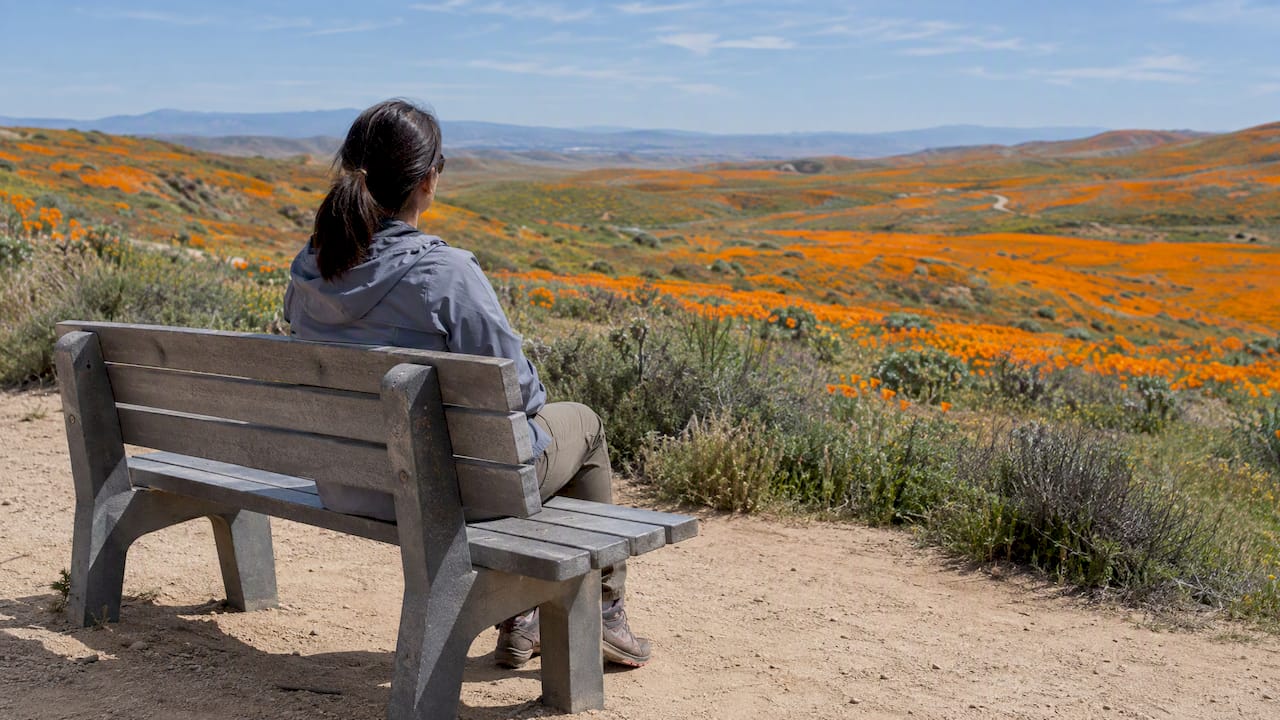
Poppies rarely bloom alone out here. Depending on timing and rainfall, you might also spot owl’s clover, lupine, goldfields, cream cups, and coreopsis mixed in among the orange, creating patches of purple, yellow, and white that make the hills look almost painted.
Wildlife sightings are common too, including:
- Red-tailed hawks circling overhead, hunting the open grassland.
- Jackrabbits darting between shrubs near the trail edges.
- Western fence lizards sunning themselves on rocks.
- Occasional coyote sightings at dawn or dusk, best observed from a distance.
Reserve rules exist for good reason, and they’re simple to follow: stay on marked trails, never pick the flowers, no drones, and no pets except service animals. These aren’t bureaucratic hurdles. They’re what keeps the hillsides looking the way you came to see them.
Getting the Shot Without Hurting the Habitat
The best photos come from the same window that gives you the best viewing: late morning to early afternoon on a sunny, calm day, when every petal is wide open. Harsh midday light can wash out the orange, so angling your shots slightly off-direct-sun often gives richer color.
A few techniques make a real difference:
- Use a telephoto lens to get close-up detail instead of stepping off the trail into the flowers.
- Shoot low and wide to include the scale of a hillside, not just a single bloom.
- Look for foreground interest, like a cluster of poppies against a distant mountain backdrop.
- Shoot during the golden hour near sunset for warmer tones, keeping in mind petals may already be closing.
Pro Tip: A zoom lens gets you the tight, detailed poppy shot everyone wants, without trampling a single stem.
If you’re planning anything beyond casual phone photos, like an organized group shoot or commercial work, the reserve requires a permit. And no matter how tempting that viral “lying in the poppy field” shot looks on social media, drones are prohibited and off-trail walking damages the very thing you’re trying to photograph.
Desert Safety and Why the Rules Matter
Antelope Valley sits in high desert, and spring days can swing from chilly mornings to genuinely hot afternoons fast. Bring more water than feels necessary, watch for early signs of heat illness like dizziness or headache, and take breaks in whatever shade you can find near the visitor center.
The “stay on the trail” rule isn’t arbitrary. Soil compaction from foot traffic reduces the loose, aerated ground poppies need to germinate, according to botanical research on the species, which means a shortcut through the flowers today can mean fewer blooms for years afterward.
A few guidelines worth repeating:
- No picking flowers, which is enforced with fines.
- No pets, except service animals.
- Stay on marked trails at all times, even for photos.
- Consider supporting the Poppy Reserve Mojave Desert Interpretive Association, the local group that helps sustain the reserve through volunteer work and donations.
Local Tips for a Better, Quieter Visit
We’ve found that timing and small detours make a bigger difference here than most visitors expect. Weekday mornings, especially Tuesday through Thursday, tend to run far lighter than weekend crowds even during a strong bloom year. If the main trail feels packed, side paths branching off the Antelope Loop often give you the same hillside views with far fewer people in your shot.
A few ways to round out the day:
- Pack a picnic for the designated areas near the visitor center before or after your hike.
- Pair your poppy visit with a broader day trip, since the surrounding area has plenty to explore if you build in extra time.
- Check our guide to other Southern California super bloom spots if you want to compare nearby wildflower destinations in the same season.
- If poppies aren’t blooming yet, Anza Borrego’s wildflower season sometimes overlaps and offers a backup plan.
A Few Honest Thoughts on the Poppy Fields
There’s something genuinely humbling about standing on a hillside that’s turned entirely orange by a flower that didn’t need a single drop of help from us. No irrigation, no planting, just rainfall and timing lining up the way they’re supposed to.
That’s exactly why the rules around staying on trails and leaving flowers alone matter so much to us. Every bloom year depends on the seedbed surviving the one before it. We focus on finding the places that make Southern California feel worth exploring, and few spots capture that better than a hillside of wild poppies that nobody planted.
— Joshua
Plan Your Full Southern California Trip With Us
A poppy hillside is a great start to a day, but the Antelope Valley sits close to a lot of ground worth covering, and we built our membership around helping local spots and trip ideas reach people exactly like you. Through Advertise With SoCal Sights, local businesses and event organizers get featured placement on our site, which means the recommendations you see come from real local spots trying to connect with visitors, not generic filler.

If you want to stretch your poppy day into a full weekend, a few of our guides pair nicely:
- Our Southern California road trip guide for stringing together multiple stops.
- Our weekend getaway picks from Los Angeles if you want to turn this into an overnight trip.
Check out our membership page to see how we help local spots get discovered, or browse our guides for your next outing.
FAQ
Is a poppy considered a wildflower?
Yes, the California poppy is classified as a wildflower, meaning it grows and reproduces naturally without cultivation. At the Antelope Valley reserve, poppies grow alongside other wildflowers like lupine and goldfields, all part of the same native plant community.
Can you just scatter California poppy seeds?
California poppy seeds generally need loose, well-drained soil and full sun to germinate well, so simply tossing them on compacted or shaded ground often leads to poor results. Timing matters too, since fall sowing in most of California tends to produce stronger spring growth than a random scatter at the wrong time of year.
Is California poppy hallucinogenic?
No, the California poppy is not hallucinogenic, despite its botanical relation to opium poppies. Its pollen also isn’t a wind-borne allergen, and while it has a history in indigenous herbalism, there’s no clinical evidence supporting psychiatric treatment claims.
What is the rarest poppy color?
California poppies most commonly bloom in shades of orange, yellow, and red, though pink and white variations do occur. There isn’t one single color that botanical sources universally designate as the rarest, since rarity depends heavily on the specific population and region.
Sources
- Antelope Valley California Poppy Reserve State Natural Reserve
- California poppy (Eschscholzia californica) — Wikipedia