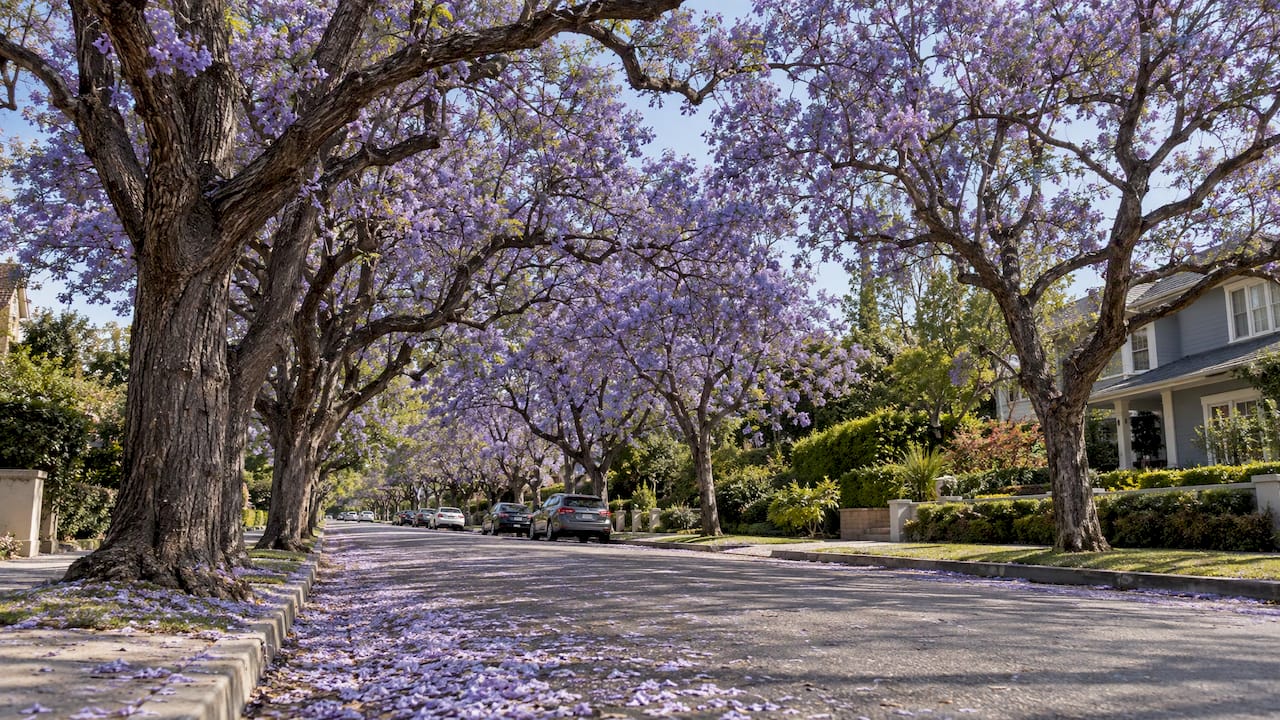
Los Angeles jacarandas usually flower from late April to mid-June, and June is the month most people think of as peak purple. The exact week moves from year to year with the weather. So the smart plan is to aim for the late May to mid-June sweet spot, check a bloom map the week you go, and pick a street or two where the trees are packed together. Below I’ll walk you through the timing, why it shifts, the best places to go, and how to turn it into a full day out.
TL;DR
- Typical window: late April to mid-June, according to LAist’s April 2026 reporting. Late May through June is the safest bet for full color.
- Timing shifts: heat is a major flowering cue, so a warm spring pulls the show earlier and a cool one pushes it later.
- Bloom length: expect roughly two months of color across the region, though any single street looks its best for a shorter stretch.
- Where to go: Pasadena, San Marino, Westwood, Beverly Hills, West Hollywood and the L.A. County Arboretum are the classics.
- Heads up: fallen blossoms carpet the ground and can be slippery or messy, so wear shoes you don’t mind getting purple.
Table of Contents
- When is jacaranda season in Los Angeles?
- Why the bloom date moves every year
- How long does the bloom last?
- Where to see jacarandas around Los Angeles
- Tips for a better jacaranda outing
- Make it a full SoCal day
- The jacaranda basics: climate, flowering age and invasiveness
- Planning a jacaranda day: a simple routine
- Own a local business near the blooms?
- Our take on jacaranda season
- FAQ
- Sources
When is jacaranda season in Los Angeles?
The short answer is spring into early summer. LAist reported in April 2026 that Los Angeles jacarandas typically flower from late April to mid-June. The Los Angeles Times said something similar in 2019: blooms can start as early as March, but they’re usually dependable from April through June.
If you want one month to circle on the calendar, make it June. LAist described June as the city’s signature purple-bloom period and noted that the flowers typically last about two months. That’s why you’ll see people posting purple-lined streets from May all the way into the start of summer.
One thing I always tell friends: “jacaranda season” isn’t one single moment. Different neighborhoods, different street exposures and even different trees on the same block wake up at different times. You might catch a half-bloomed street in early May and a full tunnel of purple two miles away.
A quick month-by-month feel
| Month | What you can usually expect |
|---|---|
| March to early April | Early surprises in warm years, but not something to plan a trip around |
| Late April to mid-May | Blooms building, with some streets already showing strong color |
| Late May to mid-June | The sweet spot for most visitors |
| Late June into July | Fading in many places, with scattered late bloomers in some years |
This table is a rule of thumb built from the reported ranges above. Treat it as a starting point, then check current conditions before you go.
Why the bloom date moves every year
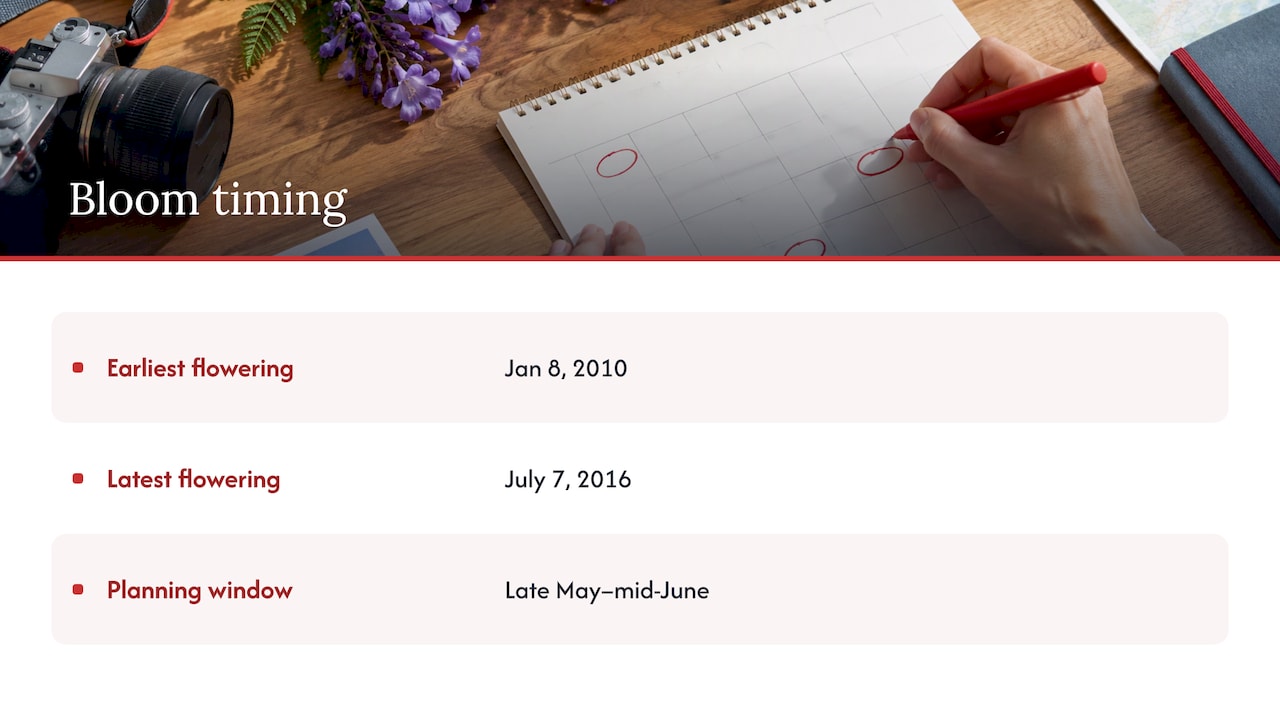
Jacarandas aren’t tightly calendared, and Los Angeles proves it. The Los Angeles Times reported in 2023 that Huntington records showed flowering as early as January 8 in 2010 and as late as July 7 in 2016. That’s a wild range for one tree species in one region.
Here are the main reasons it shifts.
Heat is a big trigger. In that same 2023 piece, Occidental College biologist Gretchen North explained that heat triggers the flowering signals in these trees. A warm stretch in spring can tell the trees it’s time.
A March heat wave can start things early. LAist reported in 2026 that a March heat wave came before early flowering, and TreePeople’s Loral Hall said temperatures above 90°F gave the trees a signal to flower. So if you hear about a hot March or April, start watching for purple sooner than usual.
Light and local conditions matter too. The Los Angeles Times reported in 2024 that jacarandas respond to heat and light, and that conditions in Los Angeles differ from those in their native regions, which contributes to irregular flowering dates.
Years really do differ. That 2024 report said flowering arrived about three weeks earlier than it had in 2023. Same trees, same city, a three-week swing.
What does this mean for you? Don’t lock in a single date months ahead if you can avoid it. Pick a flexible two-week window in late May to mid-June, and make the final call based on the latest bloom reports and photos.
How long does the bloom last?
LAist reported in May 2025 that jacarandas across greater Los Angeles would keep blooming for about the next two months. An older Forbes guide from 2013 described the show as lasting about six weeks. Those numbers don’t quite match, and that’s fine: it depends on how you count and what kind of year it is.
My practical take: the region has color for six to eight weeks, but a specific street is at its absolute best for a shorter window. Flowers drop, the ground turns purple, and then the canopy thins. If you’re chasing the full “purple tunnel” look, go when the trees are heavy with blossoms and the street below is just starting to carpet.
Where to see jacarandas around Los Angeles
The Los Angeles Times named several reliable viewing spots in a 2024 roundup of where to see jacarandas in Los Angeles and Orange County. Here’s how I’d group them.
Pasadena and San Marino
The San Gabriel Valley side is a favorite for a reason. Reported spots include East Del Mar Boulevard, Del Monte Street and Paloma Street in Pasadena. In San Marino, the Times pointed to Monterey Road, from Garfield Road to Old Mill Road, as a jacaranda-lined route.
These are residential streets, so park legally, keep your voice down and don’t block driveways. If you’re making a day of it, our Pasadena hidden gems guide has community-picked spots for lunch, coffee and wandering.
Westside: Westwood, Beverly Hills and West Hollywood
Whittier Drive near Holmby Park in Westwood made the list, along with streets in Beverly Hills and West Hollywood. This side of town works well if you’re staying near the coast or the Hollywood area and want a quick purple fix without a long drive.
L.A. County Arboretum
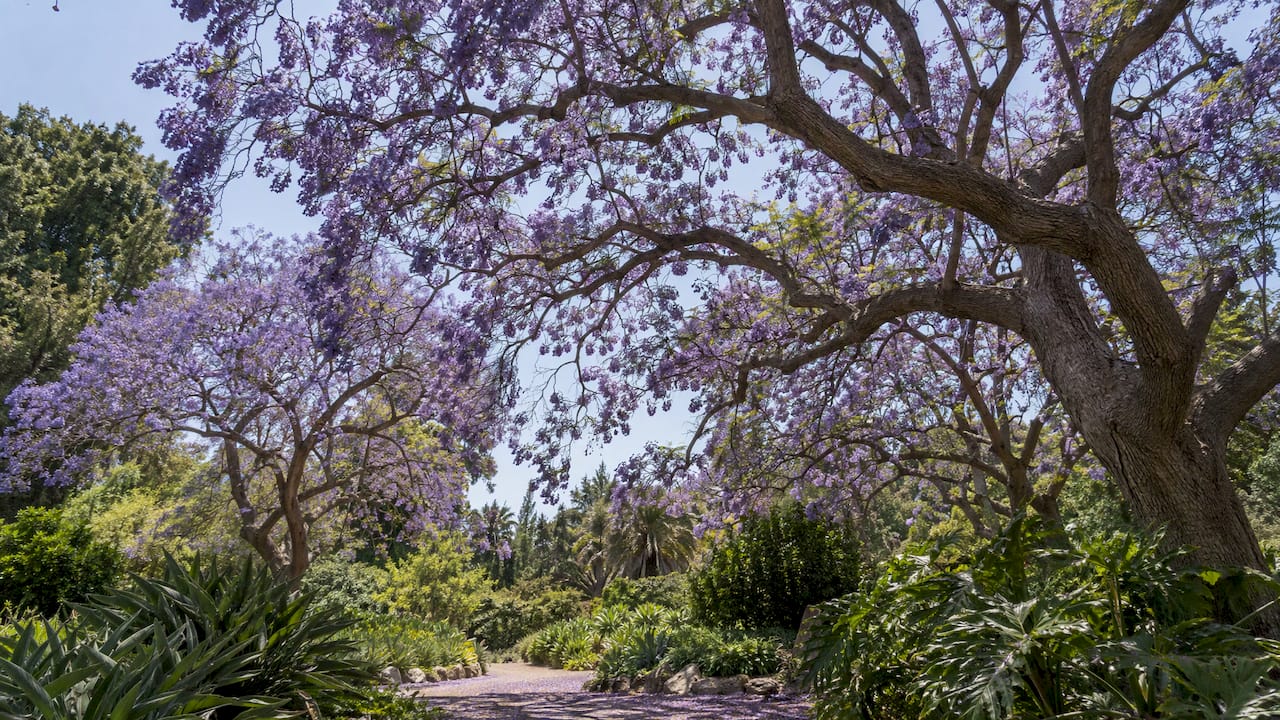
The L.A. County Arboretum in Arcadia is another stop LAist named, and it quoted the Arboretum’s longtime botanist Frank McDonough on photographing the blooms. It’s a good choice if you’d rather stroll through a garden than hunt for street parking. Check the Arboretum’s official page for current hours and admission before you head out.
Use a map to find clusters near you
If you’re not sure where the trees are near your own neighborhood, LAist published an interactive map in 2024. You can search an address or zoom into a neighborhood to find jacaranda locations across Los Angeles County. CNN data and graphics editor Matt Stiles told LAist the map was built from collected municipal tree-inventory data, which is why it can show clusters so well.
One caution: blooms vary street by street. A map shows you where trees are planted, not whether they’re flowering this week. Pair it with recent photos or news before you drive.
Tips for a better jacaranda outing
Go early or on a weekday. Popular streets get crowded in peak weeks, and residential blocks get tense when too many cars show up at once. Morning light is softer for photos, too.
Expect a purple mess underfoot. Jacarandas drop lots of flowers and leaves. The University of Florida’s horticulture profile notes substantial leaf and flower drop and even advises against planting them near pools because of the litter. That’s a gardener’s concern, but for visitors it just means the ground gets covered. Wear flat shoes with grip, since crushed blossoms on pavement can be slick.
Be a good neighbor. Most of the best streets are lined with people’s homes. Stay on public sidewalks, keep off lawns, and don’t pick flowers or shake branches.
Keep a flexible plan. Because timing swings so much, have a backup. If your first street isn’t blooming yet, there may be a warmer neighborhood nearby that is.
Look around while you’re out. Spring is a good time for wildlife-watching in the region too. If you like birds, this piece on where the parrots go in spring is a fun read for the same season.
Make it a full SoCal day
Jacaranda streets are quick stops, usually an hour or so. Here’s how I’d round out the rest of the day.
- Add a garden. Our guide to Japanese gardens in Los Angeles covers hours, entry costs and festival timing if you want more green and calm.
- Grab coffee. Our neighborhood guide to the best coffee in Los Angeles helps you find a good cup near wherever you end up.
- Keep the art going. If you’re in the mood to wander, art walks in Los Angeles pair nicely with an afternoon of street-hopping.
- Chase more blooms. Jacarandas come after the wildflowers. If you’re planning a whole spring of flowers, see our Southern California super bloom spots, the Carlsbad Flower Fields and Antelope Valley poppies.
- Want something off the usual path? Try our unique things to do in Los Angeles for offbeat picks that fill out a day.
The jacaranda basics: climate, flowering age and invasiveness
A few questions come up every year, so here are quick answers.
What climate do jacarandas like?
University of Florida horticulture guidance describes jacaranda as suited to USDA zones 9B to 11, preferring full sun and well-drained soil. The USDA zone is a map of average winter lows, and Southern California’s mild winters fit well. That’s part of why the trees do so well around Los Angeles.
How long does a jacaranda take to flower?
Seedlings take a number of years to flower, and the guidance doesn’t give an exact figure. Grafted trees or rooted cuttings can flower sooner. If you’re thinking about planting one, you’ll likely wait a while for those first purple blooms. A seasonal reference like this planting calendar can help you plan other garden work around the year.
Is jacaranda invasive in California?
Jacaranda isn’t identified as invasive in the California Invasive Plant Council’s inventory. That inventory is an expert-reviewed assessment of plants that threaten California’s natural areas, and plants not listed may have an insignificant impact or insufficient risk to qualify for its Watch status. So for visitors, there’s no invasive-plant reason to skip the show.
Planning a jacaranda day: a simple routine
Here’s the routine I use every year.
- Start watching in mid-April. Warm weather pulls the bloom earlier. If you hear about a heat wave, keep an eye out.
- Look at recent photos the week you go. Local news and community posts are your best signals for what’s blooming right now.
- Pick two areas, not one. If one neighborhood is just budding, you’ve got a backup.
- Open the map for nearby clusters. Use the interactive map to find tree-lined streets close to where you are.
- Go early. Fewer cars, softer light, and better parking.
- Build in a stop. A coffee, a garden or a lunch spot turns a quick look into a proper outing.
If you’re based in another part of the region, jacaranda streets exist beyond the places above. Our guides to Long Beach hidden gems and San Pedro hidden gems are good starting points for exploring those areas while you keep an eye out for purple.
Own a local business near the blooms?
Every spring, thousands of people head out for jacarandas and look for a place to eat, sip or browse nearby. SoCal Sights offers local businesses and event organizers a way to reach visitors and residents exploring Southern California, through advertising, featured placements and membership. You can see the options on our Advertise With SoCal Sights page.

If you run a café, shop or event near a jacaranda-lined street, that’s the page to start with.
Our take on jacaranda season
I’ve watched people plan trips around a single date and end up standing under bare branches. Jacaranda season doesn’t work like a festival with a printed schedule. It works like the weather.
That’s exactly why local knowledge matters. A map tells you where trees are. A neighbor tells you that the block by the park popped last weekend, or that the hilly street is still a week behind. We built SoCal Sights around that kind of tip: hidden gems and local favorites that mainstream guides miss, shared by people who live here.
So here’s our advice. Aim for late May to mid-June, stay flexible, and pair the purple with something local you’d never find on a standard list: a small café, a quiet garden, a neighborhood you haven’t explored. If you’ve got a favorite jacaranda street, share it with us. The best spots usually come from locals.
Joshua
FAQ
When is jacaranda season in Los Angeles?
Blooms typically run from late April to mid-June, with June often the peak. The timing shifts with the weather, and in some years flowers show up as early as March. Check recent photos and local reports the week you plan to go.
How long do the blooms last in LA?
Across greater Los Angeles, the color tends to last roughly two months, though one older guide described about six weeks. Any single street looks its best for a shorter stretch, so don’t wait too long once you see it blooming.
Where is the best place to see jacarandas in Los Angeles?
Reported favorites include East Del Mar Boulevard, Del Monte Street and Paloma Street in Pasadena, Monterey Road in San Marino, Whittier Drive by Holmby Park, streets in Beverly Hills and West Hollywood, and the L.A. County Arboretum. An interactive county map can show you clusters near your address.
Why do jacarandas bloom early some years?
Heat is a major trigger. A hot spell in March or April can signal the trees to flower sooner, which is why one year’s bloom can arrive weeks ahead of another’s.
Is jacaranda invasive in California?
It isn’t identified as invasive in the California Invasive Plant Council’s inventory, which assesses plants that threaten natural areas. The main thing visitors notice is the heavy drop of blossoms and leaves.
Sources
- Why LA is being treated to early jacaranda blooms | LAist
- It’s jacaranda season: When purple reigns | Los Angeles Times, 2019
- LA Jacaranda Map | LAist
- When do jacarandas bloom in Los Angeles? | Los Angeles Times, 2023
- Jacarandas are now in bloom in Los Angeles | Los Angeles Times, 2024
- It’s that time of the year, when LA glows in purple | LAist
- Best Places To See Jacarandas In Bloom In Los Angeles | Forbes, 2013
- Where can you see jacaranda trees in Los Angeles and Orange County | Los Angeles Times, 2024
- Jacaranda mimosifolia: Jacaranda | University of Florida IFAS
- Jacaranda | UF/IFAS Gardening Solutions
- The Cal-IPC Inventory | California Invasive Plant Council