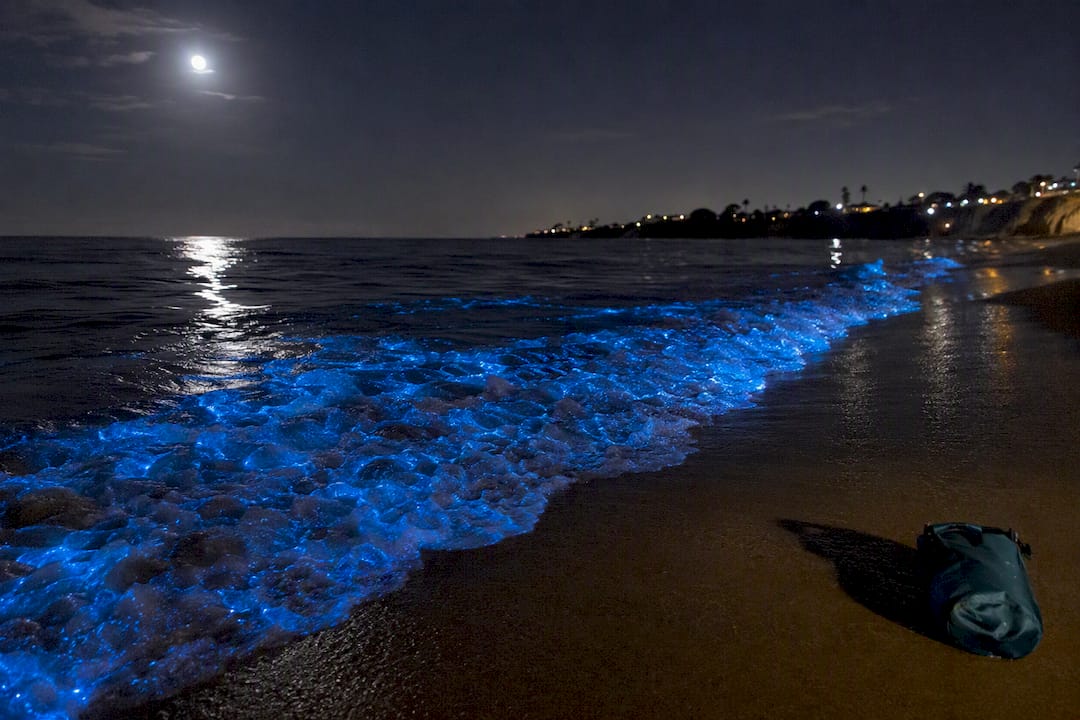
Yes, San Diego does light up. Scripps Pier and La Jolla Shores are the most reliable bets, with Torrey Pines State Beach close behind for anyone who wants darker sand and fewer crowds. Nobody can promise a glow on any given night, so your best move is spotting a reddish-brown “red tide” during the day, then heading back after dark, away from streetlights, to see if it turns electric blue.
TL;DR:
- Bioluminescence in San Diego is caused by Lingulodinium polyedra, and its visibility depends on water disturbance, temperature, and plankton concentration.
- Scripps Pier and La Jolla Shores offer the most reliable glow, with less ambient light increasing the chances of seeing flashes.
- Optimal viewing occurs two hours after sunset during new moon phases, with daytime red tide signs being a strong indicator for that night’s glow.
- Active blooms can coincide with low dissolved oxygen, and water safety advisories suggest avoiding swimming if toxins are suspected.
- Shore-based viewing remains the safest and most accessible method, with guides warning against night kayaking or swimming due to environmental and safety risks.
Table of Contents
- What Causes Bioluminescence San Diego Beaches Are Known For
- Best San Diego Beaches for Bioluminescent Waves
- When Is the Best Time to See Bioluminescent Bay Effects in San Diego?
- Is It Safe to See Bioluminescent Waves in San Diego?
- How to Photograph and Experience the Glow
- Why Bioluminescence Matters to San Diego’s Marine Ecosystem
- A Brief History of Glowing Waters Along the San Diego Coast
- How Human Activity Shapes Local Bioluminescent Events
- Guided Tours and Community Bioluminescence Events
- A Local’s Take on Chasing the Glow
- Plan Your San Diego Bioluminescence Night With Socalsights
- Where to Verify Bioluminescence Conditions Before You Go
- Sources
What Causes Bioluminescence San Diego Beaches Are Known For
The blue flashes you see in the surf come from a microscopic organism called a dinoflagellate, and in San Diego, the culprit is almost always Lingulodinium polyedra. These single-celled plankton drift by the billions during a bloom, and they light up when something physically jostles them. A wave breaking, a dolphin cutting through the water, a paddleboard slicing past. It’s a defense mechanism. Scripps researchers describe the flash as a startle response meant to spook predators, which explains why calm water often stays dark while a crashing wave erupts in neon blue.
Here’s the part that trips people up: the reddish brown color you might see during the day and the blue glow you see at night come from the same organism, but one does not guarantee the other. A red tide just means the water is dense with these plankton. Whether they glow depends on concentration, water temperature, and how disturbed the water gets after sunset.
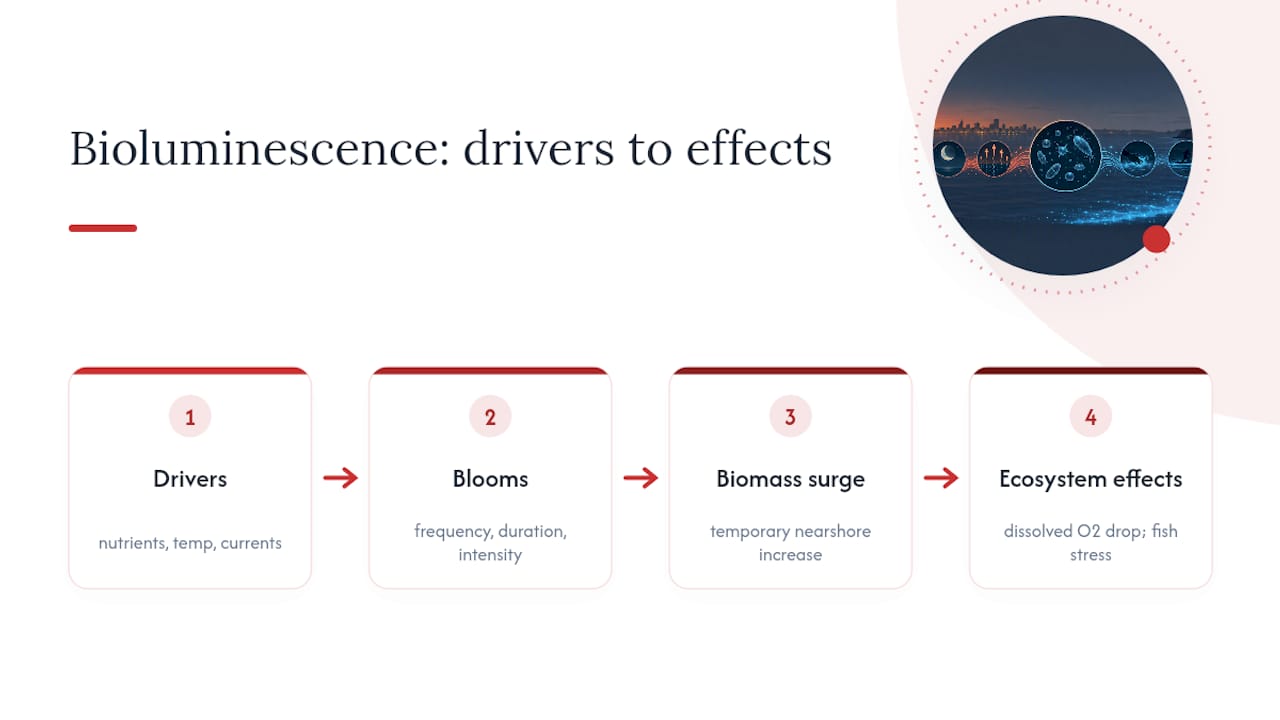
One thing worth remembering: NOAA’s NCCOS program has funded research into these blooms because they sometimes coincide with low dissolved oxygen in the water, which matters for the ecosystem well beyond the light show tourists come for. Events can stretch from a few days to several weeks, and intensity varies wildly from one stretch of coast to the next, sometimes within the same night.
Best San Diego Beaches for Bioluminescent Waves
Not every beach along the coast lights up the same way, and where you stand matters almost as much as when you show up. Here’s how the go-to spots stack up against each other.
- Scripps Pier and La Jolla Shores. This is the classic pick, and for good reason. The pier’s pilings physically agitate the water as waves pass through them, which amplifies the visible flash. It’s also close to the research community that studies these blooms, so it tends to get reported early when something is happening.
- Torrey Pines State Beach. The northern stretches here stay noticeably darker than beaches closer to downtown, which gives your eyes a real advantage. Less ambient light means more contrast, and more contrast means you’ll catch flashes you’d otherwise miss.
- Sunset Cliffs and Point Loma. The rocky surf breaking against the cliffs here can produce a genuinely dramatic glow, since rough terrain disturbs the water more than a flat sandy bottom does. Just watch your footing. These cliffs are unstable in places, and wandering around in the dark near a drop-off is not worth a better photo.
- Del Mar, Solana Beach, and Encinitas. Local reporting has repeatedly placed sightings along this corridor during larger events, and NBC 7 San Diego has documented displays stretching from La Jolla up through Encinitas in the same week. If one beach is quiet, drive a few miles up the coast before giving up.
- Ocean Beach Pier and Mission Beach. These are the easiest spots to reach if you’re staying centrally or don’t have a car, but they also carry more light pollution from nearby boardwalks and parking lots. Worth a look if convenience matters more than a perfect dark-sky view.
Structure plays a bigger role here than most people expect. Internal waves moving toward shore can create stripes of concentrated plankton running parallel to the coast, which is why one beach might glow brilliantly while the one next door looks like plain dark water. If your first stop is a bust, don’t assume the whole coastline is dead. Move on.
When Is the Best Time to See Bioluminescent Bay Effects in San Diego?
Timing makes or breaks a bioluminescence trip more than location does. A handful of rules will put the odds in your favor.
- Aim for spring through early fall. Blooms happen most often in this window, though Scripps has documented events outside it, so don’t rule out a winter trip if you spot a red tide.
- Wait at least two hours after sunset. Your eyes need time to adjust, and residual daylight washes out the faint blue flashes even when the bloom is active.
- Pick a night close to the new moon. A bright moon overhead does to bioluminescence what a streetlight does. It drowns it out. The darker the sky, the more contrast you get.
- Check the tide and current direction. Whether the glow shows up in the breaking waves or drifts offshore depends on how the bloom is moving that day, which is part of why the same beach can look completely different two nights in a row.
- Scout during daylight first. A reddish-brown tint to the water is the single best free predictor you have. If you see that color in the afternoon, come back that same night.
There’s no official text alert or hotline for this. Scripps and SCCOOS run sampling programs, but they don’t push real-time notifications to beachgoers. Your fastest signal is usually a daytime drive along the coast plus a scroll through local social media for recent sightings.
Is It Safe to See Bioluminescent Waves in San Diego?
The glow is beautiful, but the same bloom that produces it can sometimes cross into harmful algal bloom (HAB) territory, and that’s not a detail to skip past.
- View from the shore first. You don’t need to touch the water to see the flashes in breaking waves, and shore viewing removes almost all the risk.
- Avoid swimming during an active red tide unless local health guidance has specifically cleared the water. Some blooms produce toxins that irritate the respiratory system, and SCCOOS maintains current advisories worth a quick check before you go.
- Follow lifeguard postings at the beach. They’re often the fastest local source of information about water conditions that night.
- Bring a red-filter flashlight, not a white one. White light ruins your night vision and washes out the glow for everyone around you.
- Go with at least one other person, especially if you’re heading toward cliffs, pilings, or rocky areas after dark.
- Leave the wildlife alone. Dolphins and seabirds are sometimes what’s triggering the flashes you’re watching. Keep your distance and don’t chase them for a better view.
Pro Tip: If you’re unsure whether a bloom is active, scoop a small jar of discolored water during the day, chill it briefly to cut down background light, then gently swirl it in a dark room that night. If it’s genuinely bioluminescent, you’ll see faint blue sparks when you shake it. This is a low-risk way to confirm activity without stepping into the ocean.
How to Photograph and Experience the Glow
Shore viewing is the realistic default for almost everyone, but a few other options exist if you’re set up for them.
- Camera settings matter more than gear quality. A long exposure of several seconds, a tripod or a rock to hold the camera steady, and a bumped-up ISO will capture flashes your eyes barely register. Most phone cameras struggle here unless you’re running a manual app that lets you control shutter speed directly.
- Night kayaking or surfing is only for experienced people. There’s no organized night tour operation for bioluminescence around San Diego, and local guides are clear that heading into dark water on your own carries real risk. If you go, a life jacket and a same-day HAB check are non-negotiable.
- Boat viewing happens occasionally when blooms sit offshore, and local news outlets tend to report these sightings after the fact rather than in advance.
- Skip touching or scooping live water for a closer look. It disturbs the very organisms you came to see, and repeated agitation from curious hands adds up across a busy night at a popular beach.
Why Bioluminescence Matters to San Diego’s Marine Ecosystem
The light show is the part everyone photographs, but the biology underneath it is doing real ecological work. Lingulodinium polyedra and similar dinoflagellates sit near the base of the coastal food web, and a bloom of this size represents a massive, if temporary, surge of biomass moving through the nearshore water column.
That surge doesn’t come without tradeoffs. NCCOS-funded research has looked specifically at how these blooms sometimes coincide with drops in dissolved oxygen along the Southern California coast, a condition that can stress fish and other marine life even as the bloom itself puts on a dazzling nighttime display. The same organism that delights beachgoers can, at high enough density, strain the very water it’s floating in.
Researchers also treat bioluminescent events as a kind of natural gauge for coastal water conditions. Bloom frequency, duration, and intensity shift with nutrient levels, water temperature, and current patterns, which makes San Diego’s recurring displays a long-running dataset on how the local ocean is changing year over year. Scripps has been tracking these patterns for decades, and that continuity is part of why San Diego shows up so often in bioluminescence research despite being just one stretch of California coastline among many.
A Brief History of Glowing Waters Along the San Diego Coast
Glowing surf isn’t a recent discovery here. Coastal communities and sailors noticed luminous wakes and breaking waves along the Southern California coast long before anyone understood the biology behind it, and the phenomenon has shown up in local lore for generations as something between a curiosity and a minor spectacle.
What’s changed is how San Diego residents track and share it. A widespread 2020 event turned bioluminescence into a genuinely regional story, with crowds gathering at beaches from La Jolla down through Ocean Beach and social media turning individual sightings into real-time community reports almost overnight. That event, more than any single research paper, is probably what put “bioluminescence San Diego” into the local vocabulary the way it exists today.
Scripps Institution of Oceanography, based right in La Jolla, has quietly shaped that history from the science side for decades. Its proximity to some of the best viewing spots in the city means the researchers studying these blooms are often working within walking distance of the beaches where people are watching them glow, which is a fairly rare overlap of research access and public spectacle.
How Human Activity Shapes Local Bioluminescent Events
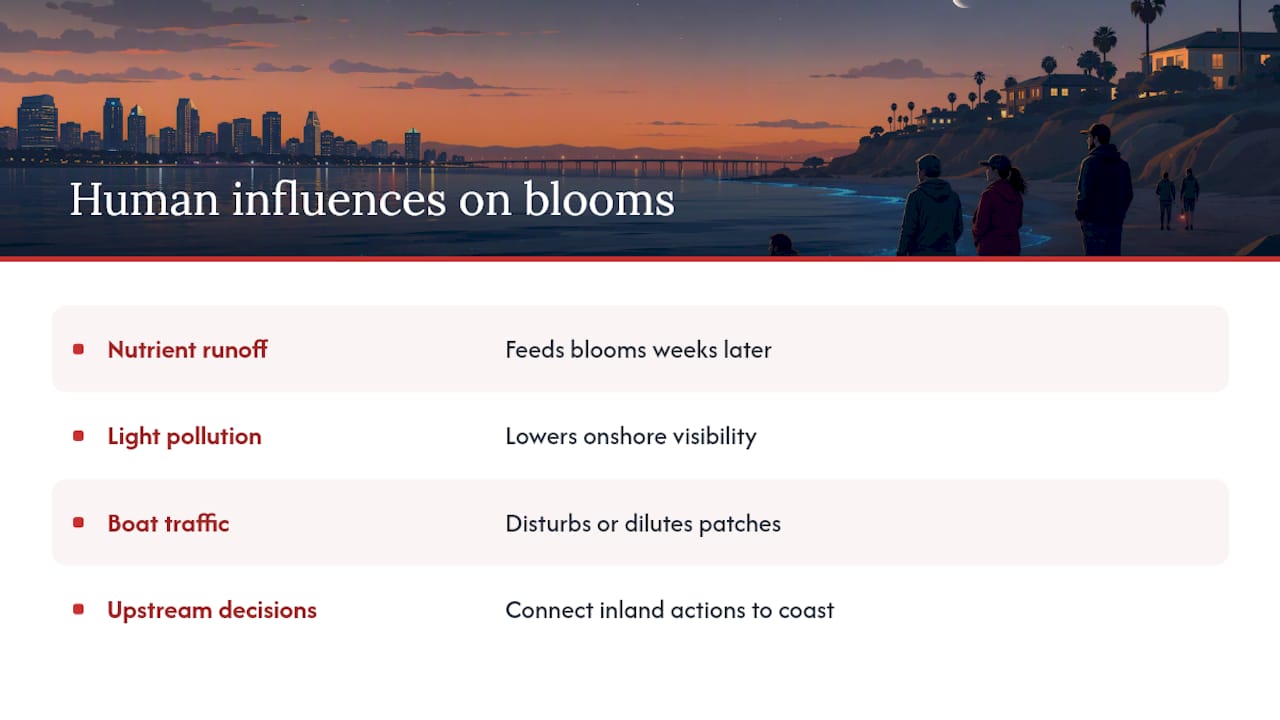
Coastal water quality plays a direct role in how often and how intensely these blooms occur, and human activity is tangled up in that picture more than most beachgoers realize. Nutrient runoff from urban storm drains, agricultural areas, and wastewater can feed the very plankton blooms that produce the glow, meaning a bad rain season inland can echo in brighter (or more frequent) displays along the coast weeks later.
Light pollution works against the show rather than feeding it. Beaches near dense development, boardwalks, and parking lot lighting make it genuinely harder to see a flash that a darker beach a few miles up the coast would show clearly. That’s part of why Torrey Pines and the quieter stretches around Sunset Cliffs tend to outperform Mission Beach on a comparable night, even when the bloom itself is spread fairly evenly along the coastline.
Boat traffic and heavy nearshore activity can also disturb blooms in ways that scatter or dilute a concentrated patch of plankton before it drifts to shore. It’s not a dramatic effect on any single night, but repeated disturbance across a bloom’s multi-week lifespan can shift where and when the glow shows up.
None of this means a trip to the beach is doing measurable harm on its own. It does mean the conditions that produce a great bioluminescence night in San Diego are connected to decisions made well inland, long before anyone shows up with a flashlight.
Guided Tours and Community Bioluminescence Events
Don’t expect a dedicated night tour industry built around bioluminescence here. Local guides are consistent on this point: there’s no centralized boat or kayak operation running regular bioluminescence trips around San Diego the way you might find in other coastal regions. Most viewing is shore-based, informal, and driven by word of mouth once a bloom gets confirmed.
That said, community response tends to organize itself once word spreads. During major events, like the widespread 2020 bloom, beaches saw informal gatherings form almost spontaneously, with groups showing up after seeing local news coverage or social media posts from earlier that same night. Local news outlets, particularly NBC San Diego, have become one of the more reliable ways residents learn a bloom is active in real time, often reporting from the beach itself as sightings roll in.
If you’re hoping for something more structured, your best bet is pairing a bioluminescence check with an existing daytime coastal activity, like a whale-watching trip out of San Diego, and simply planning your evening around the same stretch of coast. Some local outfitters that run evening kayak trips will mention bioluminescence as a possible bonus during active bloom season, but treat that as a maybe, not a guarantee, and always confirm HAB safety status before anyone paddles out after dark.
A Local’s Take on Chasing the Glow
The best night I’ve had chasing this wasn’t at a famous spot. It was a quiet stretch near Torrey Pines after I’d noticed rust colored water there that afternoon. No moon, no streetlights, just waves breaking and lighting up blue every time they hit the sand. That daytime check made all the difference.
Before you go: look for red tide in daylight, wait until at least two hours after sunset, park legally, bring a friend, and skip the white flashlight. Respect any posted health advisories. Socalsights hears from local readers who’ve had similarly hit-or-miss nights, which is exactly why checking conditions first matters more than picking the “best” beach on a list.
— Joshua
Plan Your San Diego Bioluminescence Night With Socalsights
Chasing a glow that might or might not show up is a lot easier when you’re not also scrambling to figure out where to park, eat, or crash for the night. Socalsights builds curated San Diego itineraries that pair a bioluminescence stop with the practical stuff nobody wants to research at 9 PM. Nearby parking, a decent late dinner, and a place to stay if you’re not driving home after dark.

If Torrey Pines or Sunset Cliffs are on your shortlist, our guide to San Diego’s secret beaches covers quieter stretches of coast that pair well with a night viewing trip, and our weekend coastal itinerary helps you build out the rest of the day around it. For a full look at what Socalsights covers across the region, browse the types of SoCal Sights we curate, then start piecing together your own coastal night out.
Where to Verify Bioluminescence Conditions Before You Go
A few sources are worth a quick check before you drive out.
- Scripps Institution of Oceanography publishes ongoing research and FAQ updates on local red tides and blooms.
- SCCOOS tracks harmful algal bloom advisories and weekly toxin sampling along the coast.
- NOAA NCCOS covers the broader research funding and ecological findings behind these blooms.
- NBC 7 San Diego reports on active events as they’re happening, often with the most current sighting locations.
Sources
- FAQ: Red Tides and Bioluminescence off California | Scripps Institution of Oceanography
- Red Tide Brings Bioluminescence to San Diego Beaches | Scripps Institution of Oceanography
- Harmful algal bloom resources | SCCOOS
- Bioluminescent algae is illuminating San Diego coastal waters once again! | NOAA NCCOS
- Bioluminescent waves are still glowing in San Diego | NBC 7 San Diego