Month: September 2026

  • 10 Los Angeles Waterfall Hikes for Families, Swimmers, and Quiet Views

    10 Los Angeles Waterfall Hikes for Families, Swimmers, and Quiet Views

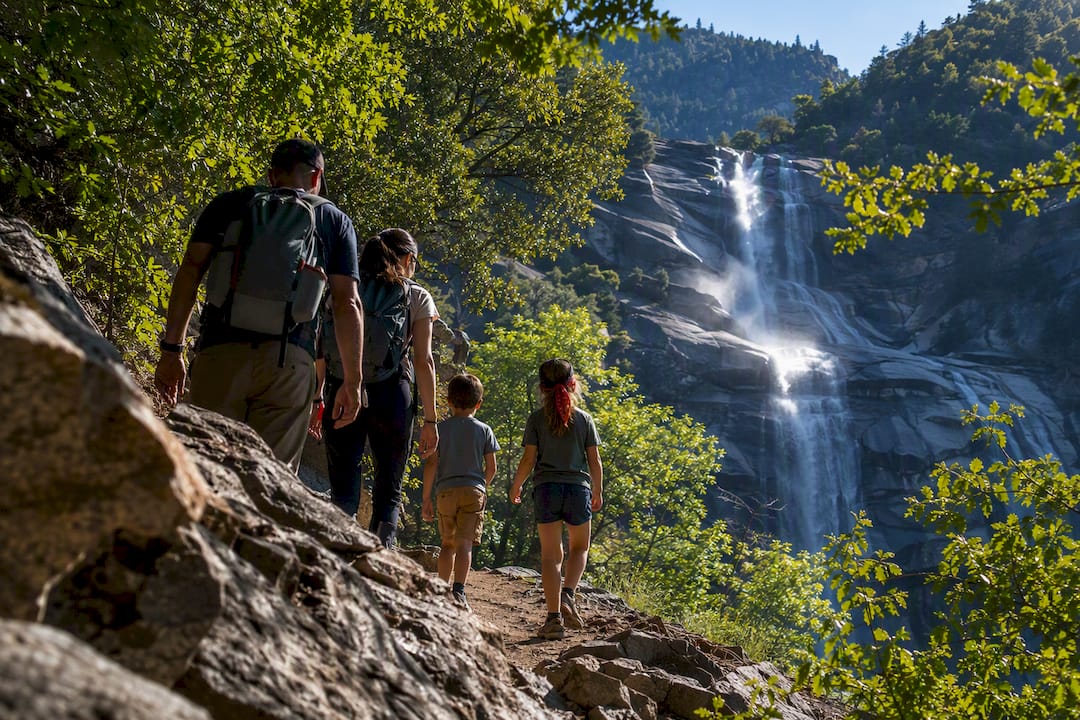
    The best waterfall hikes near Los Angeles right now are Eaton Canyon Falls for easy access, Switzer Falls and Sturtevant Falls for shaded scenery, Millard Canyon Falls and Hermit Falls for swimming, and Escondido Falls for a coastal detour off the 101. Go between December and May, when winter rain actually gives these creeks something to work with. Skip August and you’ll thank yourself later.


    TL;DR:

    • Waterfalls typically flow best from December through May, depending on winter rainfall, with some streams becoming safety hazards after storms.
    • Hermit Falls and Millard Canyon Falls offer the most reliable swim-friendly pools, but all water-related dangers include cold temperatures and slick rocks.
    • Parking at popular trailheads like Chantry Flat and Switzer Picnic Area requires an Adventure Pass, and lots fill early on weekends, so advance planning is essential.
    • Shorter hikes like San Antonio Falls and Stoddard Falls are ideal for families or mobility concerns, but most routes demand careful trail and weather condition checks.
    • Visiting early in the day, avoiding storm aftermath, and following safety guidelines can significantly reduce risks on these waterfalls.

    Table of Contents

    Waterfall Hiking Los Angeles: The Trails That Deliver

    Los Angeles isn’t exactly known for waterfalls, and that reputation isn’t entirely fair. The San Gabriel Mountains and the Santa Monica range both hide genuine falls, some tucked a mile from a Metro line, others buried deep enough in the Angeles National Forest that you’ll forget you’re 40 minutes from Pasadena traffic. What separates a good waterfall hike from a wasted Saturday morning is timing and picking the right trail for your crew. Here’s the rundown on the ten that consistently earn a spot on any serious list of waterfalls near LA.

    Eaton Canyon Falls

    This is the trail Los Angeles sends first-timers to, and for good reason. It’s about 3.5 miles round trip with mild elevation gain, rated easy, and it dumps you at a 40-foot falls with a shallow pool at the base.

    • Distance: ~3.5 miles round trip
    • Difficulty: Easy
    • Swim-friendly: Yes, shallow wading pool, not deep enough for real swimming
    • Parking: Free lot at the Eaton Canyon Nature Center, no Adventure Pass needed
    • Best months: from December through spring

    Escondido Falls

    Malibu’s answer to the canyon hike, and one of the few on this list with ocean air in the mix. The lower falls sit about 3.7 miles round trip from the trailhead and are the version you’re actually allowed to visit.

    • Distance: ~3.7 miles round trip
    • Difficulty: Moderate
    • Swim-friendly: Wading only at the lower pool
    • Parking: Limited roadside parking on Winding Way; arrive before 9 a.m. on weekends
    • Best months: December through spring, when the lower falls typically run

    The upper falls look tempting in photos, but they’re closed and sit on private property, a restriction born from repeated rescue calls, not overcaution. Trespassing up there risks a fine and, worse, a helicopter bill.

    Switzer Falls

    A shaded, creek-crossing hike that feels more Sierra foothills than Los Angeles County. The full route to the falls runs about 4 to 4.5 miles round trip, threading past the ruins of an old 1920s trail resort, chapel foundation included.

    • Distance: ~4 to 4.5 miles round trip
    • Difficulty: Moderate
    • Swim-friendly: A small lower pool works for wading in spring
    • Parking: Adventure Pass required at the Switzer Picnic Area lot
    • Best months: from December through spring

    Sturtevant Falls

    Part of the Big Santa Anita Canyon system, this one runs through a historic resort area that used to host actual mule-pack trips into the mountains. Figure roughly 3.5 miles round trip on a gently graded trail that crosses the creek several times.

    • Distance: ~3.5 miles round trip
    • Difficulty: Easy to moderate
    • Swim-friendly: Small pool at the base, cold but doable in late spring
    • Parking: Adventure Pass required at Chantry Flat, and the access road is narrow and fills fast on weekends
    • Best months: from December through spring

    Millard Canyon Falls

    Short, shaded, and one of the easiest legitimate waterfalls in the range. The round trip clocks in at just 2.8 miles, with several stream crossings that get your boots wet even in a dry year.

    • Distance: ~2.8 miles round trip
    • Difficulty: Easy
    • Swim-friendly: Yes, a decent-sized pool for wading and shallow swimming
    • Parking: Small lot near Millard Campground, fills by mid-morning on weekends
    • Best months: from December through spring

    Hermit Falls

    The unofficial swimming hole of the San Gabriels, reached via the same Chantry Flat trailhead as Sturtevant but branching off toward a deeper series of pools. Expect close to 3 miles round trip with some scrambling near the end.

    • Distance: ~3 miles round trip
    • Difficulty: Moderate, with rocky footing near the falls
    • Swim-friendly: Yes, the best true swimming spot on this list
    • Parking: Adventure Pass required at Chantry Flat
    • Best months: late spring to early summer, after peak runoff but before pools dry out

    Trail Canyon Falls

    A quieter pick above the Big Tujunga Canyon, popular with locals who’ve grown tired of Switzer’s crowds. The hike runs about 4.5 miles round trip past an old cabin ruin before reaching a 30-foot falls.

    • Distance: ~4.5 miles round trip
    • Difficulty: Moderate
    • Swim-friendly: No, current is too narrow for a real pool
    • Parking: Adventure Pass required, roadside lot near the trailhead
    • Best months: from January through spring

    San Antonio Falls

    Sitting at the base of Mt. Baldy, this is less a hike and more a stroll, and one of the few on this list that welcomes kids without much complaint. Round trip is under a mile and a half on a wide fire road.

    • Distance: about one and a half miles round trip
    • Difficulty: Easy
    • Swim-friendly: No, the pool is shallow and the water is glacially cold
    • Parking: Free lot near Manker Flats, no pass required at this specific trailhead
    • Best months: early spring, when snowmelt feeds the falls

    Stoddard Falls

    A short detour off the Angeles Crest Highway corridor, often paired with a stop at nearby Buckhorn Campground. It’s roughly a mile round trip, making it one of the shortest true waterfall hikes near Los Angeles.

    • Distance: about one mile round trip
    • Difficulty: Easy
    • Swim-friendly: Limited, more of a trickle in dry years
    • Parking: Adventure Pass required
    • Best months: early spring

    Paradise Falls

    Out in Thousand Oaks, technically Ventura County but close enough that Angelenos treat it as their own. The loop through Wildwood Regional Park runs about 3.5 miles and passes a small cave along the way.

    • Distance: ~3.5 miles round trip
    • Difficulty: Easy to moderate
    • Swim-friendly: No, the pool is more decorative than swimmable
    • Parking: Free lot at the Wildwood Park trailhead, no Adventure Pass needed
    • Best months: from December through spring

    Which LA Waterfalls Are Actually Swim-Friendly?

    Not every waterfall on this list is worth packing a swimsuit for, and a few that look inviting online are quietly dangerous once you’re standing in front of them.

    1. Hermit Falls has the deepest, most reliable pool of the bunch, popular enough on summer weekends that you’ll be sharing it with a crowd.
    2. Millard Canyon Falls offers a smaller but genuinely swimmable pool, best in late spring before the flow thins out.
    3. Eaton Canyon Falls is wading depth only. Fine for cooling off, not for actual laps.
    4. Escondido Falls gives you a shallow lower pool. The deeper upper pools are off-limits, closed and on private land.
    5. Switzer Falls has a modest lower pool that works in wetter years but can shrink to almost nothing by July.

    Water temperature in all five stays cold well into June, runoff from snowpack higher up the range. The real hazard isn’t the cold, though. It’s what happens after a storm: currents pick up fast, rocks around the pools turn slick, and every one of these spots sees search-and-rescue calls tied to people climbing where they shouldn’t. Climbing the fall face itself is one of the most common causes of injury on these trails, not the swimming.

    Pro Tip: Check rainfall totals from the past 48 hours before you go. A dry trailhead can still sit above a swollen creek if it rained hard up canyon the night before.

    When Do LA’s Waterfalls Actually Flow?

    Best months for waterfall hiking in Los Angeles run December through April or May, tracking directly with the region’s rainy season. Flow depends entirely on how wet the preceding winter was, which means a strong El Niño winter can keep falls running into June, while a drought year might leave some barely trickling by March.

    Storms complicate the picture. A big rain event swells the falls almost overnight, but it also raises flash flood risk and can trigger temporary trail closures on routes with multiple creek crossings, Switzer and Sturtevant especially. Before you commit to a drive, check the local weather forecast for rain in the past week, scan USFS alerts for the Angeles National Forest, and glance at recent trip reports from hikers who were just there. Conditions shift fast enough that a report from two weeks ago isn’t always trustworthy.
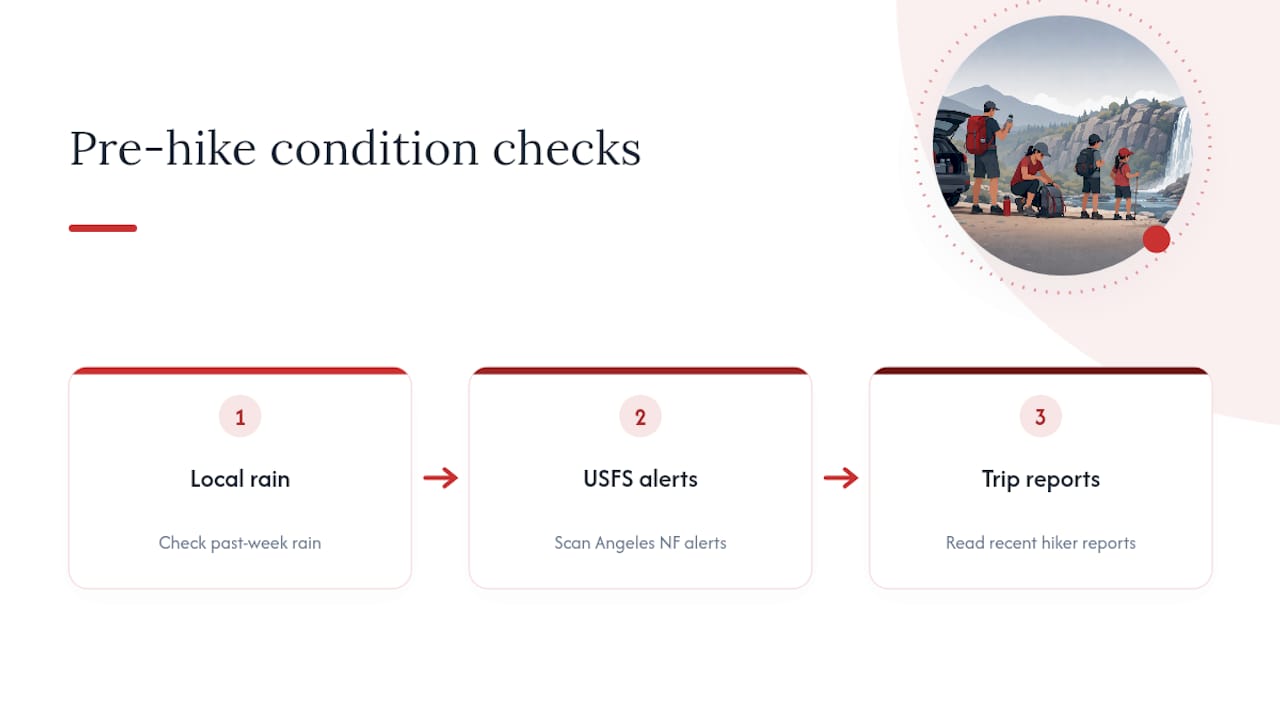
    Three checks for waterfall trail conditions

    Parking and Adventure Pass Rules You Need to Know

    Most Angeles National Forest trailheads, Switzer, Sturtevant, Hermit, Trail Canyon, and Stoddard among them, require a displayed Adventure Pass to park legally. Buy one at local outdoor retailers or a USFS office before you drive up; rangers do ticket unmarked vehicles.

    • Arrive before 8 a.m. on weekends. Lots at Chantry Flat and Switzer Picnic Area fill fast, and the access roads leading up are narrow with limited turnaround space.
    • Bring exact change or a card for pass machines. Not every trailhead kiosk works reliably.
    • If a lot is full, don’t improvise a spot on the shoulder near a gate. Check for a secondary trailhead nearby instead.
    • Some canyon roads get gated after dark or during fire restrictions, so confirm hours before you plan an evening hike.

    Safety, Crowds, and What to Bring

    Pack light but don’t skip the basics: 1 to 2 liters of water per person, sun protection even on shaded trails, sturdy footwear for wet rock, a small first-aid kit, and a dry bag if you’re bringing a phone near any pool.

    • Never climb the face of a waterfall. It’s the leading cause of injury and rescue calls on these trails.
    • Entering closed sections, like Escondido’s upper falls, risks both a fine and a rescue bill if things go wrong.
    • Cold water and slick granite are a bad combination even for strong swimmers.
    • To dodge crowds, hit popular trails like Sturtevant or Switzer on a weekday morning, or try a less-trafficked hike instead.

    Pro Tip: Even a one-mile hike like San Antonio Falls has long stretches with zero shade, so treat it with the same sun caution you’d give a longer trail.

    Picking the Right Waterfall Hike for Your Group

    Match the trail to what your group actually wants, not what looks best on Instagram.

    • Short on time or hiking with young kids? San Antonio Falls or Stoddard Falls, both under 1.5 miles.
    • Want to swim, not just look? Hermit Falls or Millard Canyon Falls.
    • Chasing the best photos? Switzer Falls, thanks to the shaded canyon and old ruins along the way.
    • Craving solitude over convenience? Trail Canyon Falls sees a fraction of Switzer’s foot traffic.
    • Traveling with anyone who has mobility concerns? Stick to Eaton Canyon or San Antonio Falls. Both have gentler grades and fewer creek crossings.

    Steep approaches and stream crossings rule out several of these for strollers or wheelchairs, so check trail notes before committing.

    Local Tips SoCal Sights Readers Keep Sharing

    A few things we’ve picked up from the SoCal Sights community that don’t show up in most trail guides: the best photo light at Eaton Canyon hits mid-morning, not midday, when the canyon walls cut the glare. Switzer’s old chapel ruins make a good rest stop about a third of the way in, easy to miss if you’re moving fast. And Millard Canyon’s upper pool, past the main falls, stays noticeably quieter than the lower one most weekends.
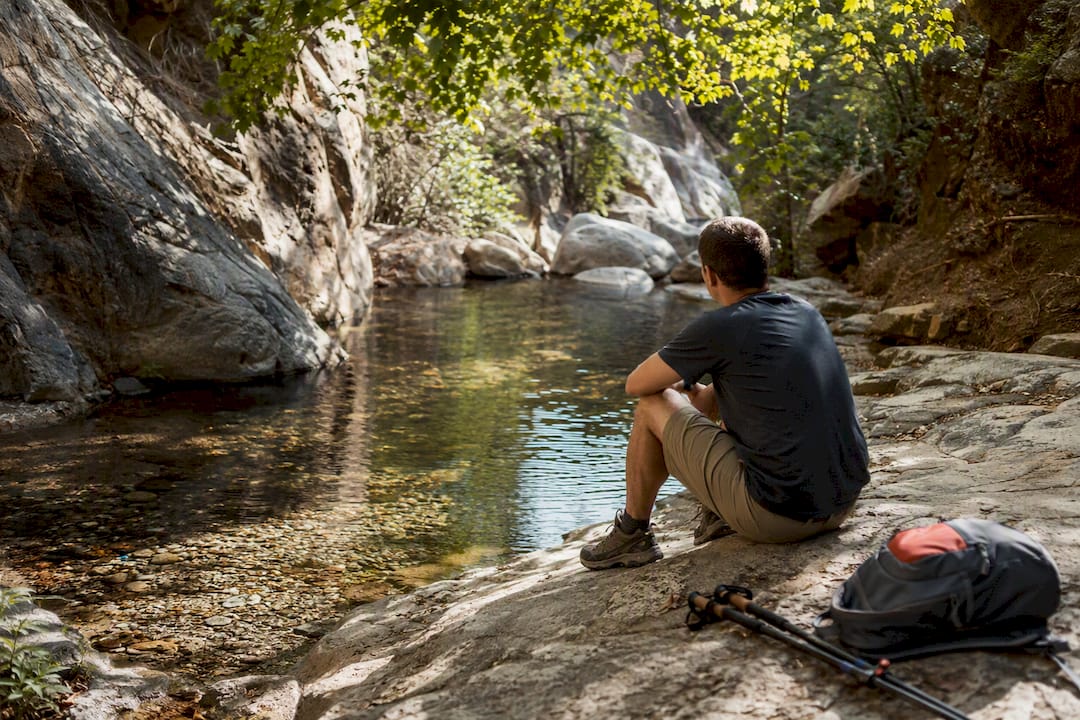
    Quiet upper pool in Millard Canyon

    Pair a morning at Millard Canyon or Eaton Canyon with lunch in Altadena or a swing through Los Angeles’s other standout trails for a full day out. If you’re extending the trip further, our weekend getaway picks cover a few good overnight options within reach of the San Gabriels.

    How This List Came Together

    I picked these ten trails based on flow reliability, ease of access, and how much variety they offer between families, swimmers, and photographers. Los Angeles waterfall hiking rewards patience with timing more than raw ambition, and that’s shaped every recommendation here. If you’ve found a quieter approach to one of these trails, or a seasonal quirk I missed, send it our way. This list gets better with local input.

    — Joshua

    Want More Local Picks Beyond the Trailhead?

    This platform offers a curated alternative to browsing multiple hiking forums for weekend planning. Instead of guessing which trailhead has parking or which nearby town is worth a stop after your hike, you get one curated source built specifically around Southern California’s lesser-known spots.

    Socalsights

    Beyond waterfall hikes, Socalsights covers everything from offbeat things to do in Los Angeles to nearby day-trip ideas that pair well with a morning at the falls. If Millard Canyon or Switzer leaves you wanting more, browse the full guide to unique LA activities and start planning your next stop before you’re even back in the car.

    Where to Check Before You Head Out

    Sources

  • From 133 Steps to 500+: LA’s Secret Stairs and Easy Walk Loops

    From 133 Steps to 500+: LA’s Secret Stairs and Easy Walk Loops

    Los Angeles has dozens of publicly accessible historic staircases tucked into its hillside neighborhoods, and the best starting points are the Music Box Steps, Micheltorena Stairs, Bunker Hill Steps, and Murphy’s Ranch. Some are gated or partly closed, so check access before you go. Below you’ll find a curated list, three walk loops, and the maps you need to plan your own outing.


    TL;DR:

    • Many of LA’s historic staircases date to the 1920s and were originally built to connect hillside homes to trolley lines, now mostly abandoned or overgrown.
    • The best starting points include the Music Box Steps, Micheltorena Stairs, Bunker Hill Steps, and Murphy’s Ranch, but access can vary with gates or closures.
    • Walk loops typically range from 1.5 to 3.5 miles, with routes suitable for quick outings or more strenuous half-day adventures; check current statuses before heading to Murphy’s Ranch.
    • Proper footwear, water, and neighborhood etiquette are essential, especially since these stairs run through residential areas with limited lighting and uneven surfaces.
    • Trustworthy guides and downloadable maps from Charles Fleming’s Secret Stairs and local resources help plan safe, enjoyable explorations of these hidden city landmarks.

    Table of Contents

    What are LA’s secret stairs, exactly?

    The phrase “secret stairs” comes largely from journalist Charles Fleming, whose guidebook mapped out the city’s forgotten public staircases neighborhood by neighborhood. These aren’t secret in the sense of being hidden or off limits. They’re public rights of way, built into the hills nearly a century ago, that most Angelenos drive right past without noticing. Fleming has cataloged roughly half of the stairs he identified as still accessible today, with plenty of others gated, overgrown, or swallowed by private landscaping. That’s the tension that makes this hobby interesting: you’re chasing a piece of civic history that the city itself has half forgotten.

    Top secret stairs to visit in LA

    Some of these you can knock out in fifteen minutes. Others will leave your legs shaking. Here’s where to start.

    1. Music Box Steps (Silver Lake). These 133 steps earned their fame from Laurel and Hardy’s Oscar-winning short film The Music Box, and a plaque near the top commemorates the connection. It’s steep but short, and the surrounding streets are lined with 1920s bungalows worth a slow look.
    2. Micheltorena Stairs (Silver Lake). A colorful, mosaic-tiled staircase that neighbors maintain themselves, painted in bright rainbow patterns. It’s one of the most photographed stairs in the city and an easy add-on to a Music Box walk.
    3. Bunker Hill Steps (Downtown LA). Modeled loosely on the Spanish Steps in Rome, this modern staircase cuts through the financial district with a waterfall feature running down the center. Fully public, well-lit, and stroller-friendly if you take the adjacent escalator.
    4. Murphy’s Ranch (Pacific Palisades). This is the outlier on the list: a former Nazi sympathizer compound turned graffiti-covered ruin inside Rustic Canyon, reachable by a stairway that Fleming cites as the longest referenced in his research, with over five hundred steps. Expect a steep dirt approach trail before you even reach the stairs, and know that fire damage has periodically closed sections of the park.
    5. Castellammare Stairs (Pacific Palisades). A quieter coastal staircase with sweeping Pacific views, tucked between beach homes above the Pacific Coast Highway. Fewer crowds than the Silver Lake stairs, and a good sunset spot.
    6. Eldred Street Stairs (Mount Washington). Widely cited as one of the steepest public streets in the country, with a staircase running alongside it that locals use as an informal fitness circuit.
    7. Prospect Stairs (Silver Lake). A short, unassuming connector stair that locals use daily and tourists rarely find, good for rounding out a neighborhood loop.
    8. Baxter Street Stairs (Echo Park). Tucked beside one of the steepest paved streets in LA, this staircase rewards the climb with a clear view toward Downtown.

    Suggested walks and loops that string stairs together

    You don’t need a whole day to feel like you’ve explored somewhere new. Most stair routes run 1.5 to 3.5 miles, which puts them squarely in microadventure territory rather than full hike commitment.

    • Easy loop (about 1.5 miles, 45 minutes): Start at Bunker Hill Steps downtown, wander through the Grand Park area, and loop back. Metro’s Red Line drops you within a block, so parking isn’t an issue.
    • Moderate Silver Lake loop (about 2.5 miles, 90 minutes): Combine the Music Box Steps with the Micheltorena Stairs, connecting through quiet residential blocks. Park near Sunset Boulevard and budget time for photos.
    • Strenuous Palisades loop (about 3.5 miles, 2 to 2.5 hours): Tackle Murphy’s Ranch from the Rustic Canyon trailhead, then detour toward Castellammare if you have energy left. Bring more water than you think you need. Sections near Murphy’s Ranch have seen closures, so check current status before committing.

    Google Maps handles walking directions fine for the easier loops, but for Murphy’s Ranch and Eldred Street, a dedicated hiking app or downloaded offline map avoids wrong turns on unmarked hillside paths.

    How the secret stairs happened: a quick history

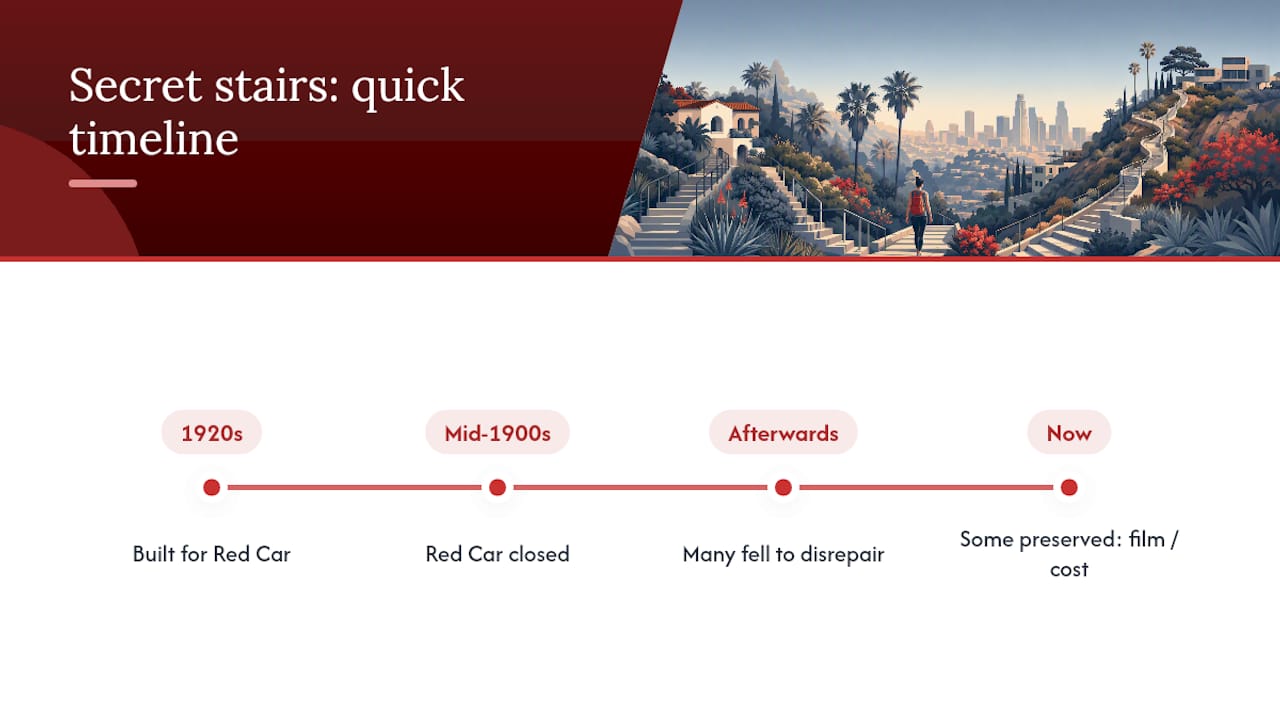
    Most of these staircases date to the 1920s, when Los Angeles built them to connect hillside homes to the Pacific Electric Railway’s Red Car trolley lines. Cars weren’t yet the default, and steep terrain meant stairs were often faster than switchback roads. When the Red Car system shut down in the mid-20th century, many staircases lost their purpose and fell into disrepair, some for decades. The Music Box Steps survived partly because of their film pedigree. Others survived simply because tearing them out cost more than leaving them alone, which is how LA ended up with a scattered network of pre-automobile infrastructure hiding in plain sight.

    How the secret stairs happened: a quick history — overview diagram

    Access, safety, and neighborhood etiquette

    These stairs run through people’s actual neighborhoods, so how you show up matters.

    • Check for gates or posted closures before you drive out, especially at Murphy’s Ranch, since sections open and close depending on fire risk and cleanup status.
    • Wear real shoes, not sandals. Uneven, mossy, or cracked steps are common even on the well-maintained routes.
    • Bring water, particularly for the Palisades and Mount Washington routes, where shade is scarce.
    • Skip solo visits after dark. Many of these stairs sit on quiet residential streets with limited lighting.
    • Keep your voice down, don’t block driveways or gates while taking photos, and pack out anything you bring in.

    Pro Tip: If you’re photographing the Music Box Steps, look for the small plaque near the top marking the film connection. It’s easy to miss if you’re focused on catching your breath.

    Planning your stair walk: maps, transit, and what to bring

    A little prep turns a confusing detour into a smooth afternoon.

    1. Download a free route PDF from Secret Stairs, which maps most of the routes covered here with turn-by-turn detail.
    2. Check parking rules before you go. Silver Lake and Echo Park have permit zones on many residential blocks; Downtown routes near Bunker Hill are easiest by Metro.
    3. Pack water, sunscreen, a phone with charge, and shoes with real tread.
    4. Aim for early morning or late afternoon. Midday sun on exposed stairs like Eldred Street gets brutal fast, and the light for photos is better anyway.

    Where to find trustworthy guides and maps

    You don’t have to piece this together from scratch.

    • Charles Fleming’s Secret Stairs guidebook and the companion Secret Stairs site remain the most complete mapped resource, with downloadable route PDFs.
    • NBC Los Angeles has covered guided walking tours built around these same routes.
    • National Park Service pages, like the one for Bayside Trail at Cabrillo National Monument, are worth studying as a model for how to lay out distance, elevation, and hazard details before any coastal-adjacent stair walk.
    • Socalsights keeps its own walk-ready itineraries if you want a route already built around your fitness level.

    Why these staircases are worth the climb

    Secret stairs are the rare LA outing that costs nothing, takes under two hours, and still teaches you something about the city. What strikes me most is how these routes reward attention rather than mileage. You’ll notice architecture, murals, and plaques you’d never catch from a car. My favorite short loop pairs the Music Box Steps with a stop at a nearby Silver Lake coffee spot afterward. It’s low effort, high payoff, and it’s the kind of walk you can talk a skeptical friend into. If you’ve found a staircase not listed here, or you’ve got a good photo from one, Socalsights always wants to hear about it.

    — Joshua

    Get a ready-made stair walk from Socalsights

    Socalsights is the shortcut for readers who’d rather walk than research. Instead of stitching together PDFs, transit schedules, and neighborhood parking rules on your own, our local guides hand you a route that’s already been mapped, timed, and checked for closures.

    Socalsights

    Each guide pairs the walk itself with practical extras: where to grab coffee near the route, which stretches are stroller-friendly, and what to skip if you’re short on time. If Silver Lake and the Palisades have you hooked, our Los Angeles hiking guide covers longer options for when you want to push past the stairs into full trail territory. Pull up the itinerary landing page, pick a neighborhood, and head out this weekend with a plan already in hand.

    Sources

  • Wait Two Hours After Sunset to See Bioluminescence in San Diego Safely

    Wait Two Hours After Sunset to See Bioluminescence in San Diego Safely

    Yes, San Diego does light up. Scripps Pier and La Jolla Shores are the most reliable bets, with Torrey Pines State Beach close behind for anyone who wants darker sand and fewer crowds. Nobody can promise a glow on any given night, so your best move is spotting a reddish-brown “red tide” during the day, then heading back after dark, away from streetlights, to see if it turns electric blue.


    TL;DR:

    • Bioluminescence in San Diego is caused by Lingulodinium polyedra, and its visibility depends on water disturbance, temperature, and plankton concentration.
    • Scripps Pier and La Jolla Shores offer the most reliable glow, with less ambient light increasing the chances of seeing flashes.
    • Optimal viewing occurs two hours after sunset during new moon phases, with daytime red tide signs being a strong indicator for that night’s glow.
    • Active blooms can coincide with low dissolved oxygen, and water safety advisories suggest avoiding swimming if toxins are suspected.
    • Shore-based viewing remains the safest and most accessible method, with guides warning against night kayaking or swimming due to environmental and safety risks.

    Table of Contents

    What Causes Bioluminescence San Diego Beaches Are Known For

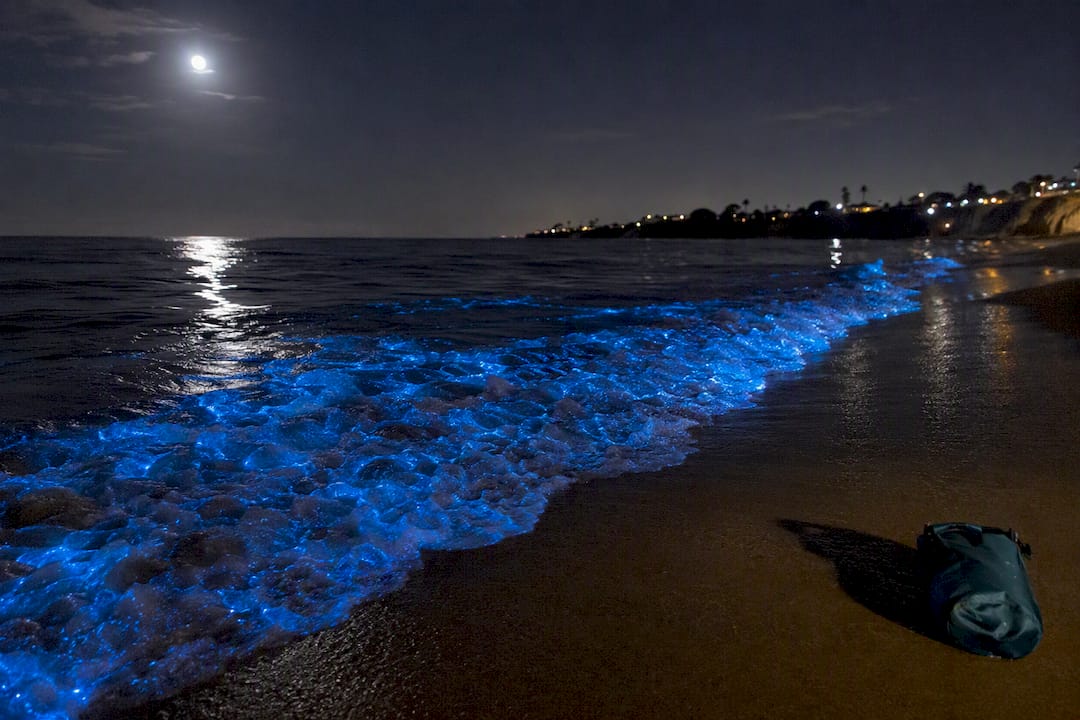
    The blue flashes you see in the surf come from a microscopic organism called a dinoflagellate, and in San Diego, the culprit is almost always Lingulodinium polyedra. These single-celled plankton drift by the billions during a bloom, and they light up when something physically jostles them. A wave breaking, a dolphin cutting through the water, a paddleboard slicing past. It’s a defense mechanism. Scripps researchers describe the flash as a startle response meant to spook predators, which explains why calm water often stays dark while a crashing wave erupts in neon blue.

    Here’s the part that trips people up: the reddish brown color you might see during the day and the blue glow you see at night come from the same organism, but one does not guarantee the other. A red tide just means the water is dense with these plankton. Whether they glow depends on concentration, water temperature, and how disturbed the water gets after sunset.

    One thing worth remembering: NOAA’s NCCOS program has funded research into these blooms because they sometimes coincide with low dissolved oxygen in the water, which matters for the ecosystem well beyond the light show tourists come for. Events can stretch from a few days to several weeks, and intensity varies wildly from one stretch of coast to the next, sometimes within the same night.

    Best San Diego Beaches for Bioluminescent Waves

    Not every beach along the coast lights up the same way, and where you stand matters almost as much as when you show up. Here’s how the go-to spots stack up against each other.

    • Scripps Pier and La Jolla Shores. This is the classic pick, and for good reason. The pier’s pilings physically agitate the water as waves pass through them, which amplifies the visible flash. It’s also close to the research community that studies these blooms, so it tends to get reported early when something is happening.
    • Torrey Pines State Beach. The northern stretches here stay noticeably darker than beaches closer to downtown, which gives your eyes a real advantage. Less ambient light means more contrast, and more contrast means you’ll catch flashes you’d otherwise miss.
    • Sunset Cliffs and Point Loma. The rocky surf breaking against the cliffs here can produce a genuinely dramatic glow, since rough terrain disturbs the water more than a flat sandy bottom does. Just watch your footing. These cliffs are unstable in places, and wandering around in the dark near a drop-off is not worth a better photo.
    • Del Mar, Solana Beach, and Encinitas. Local reporting has repeatedly placed sightings along this corridor during larger events, and NBC 7 San Diego has documented displays stretching from La Jolla up through Encinitas in the same week. If one beach is quiet, drive a few miles up the coast before giving up.
    • Ocean Beach Pier and Mission Beach. These are the easiest spots to reach if you’re staying centrally or don’t have a car, but they also carry more light pollution from nearby boardwalks and parking lots. Worth a look if convenience matters more than a perfect dark-sky view.

    Structure plays a bigger role here than most people expect. Internal waves moving toward shore can create stripes of concentrated plankton running parallel to the coast, which is why one beach might glow brilliantly while the one next door looks like plain dark water. If your first stop is a bust, don’t assume the whole coastline is dead. Move on.

    When Is the Best Time to See Bioluminescent Bay Effects in San Diego?

    Timing makes or breaks a bioluminescence trip more than location does. A handful of rules will put the odds in your favor.

    1. Aim for spring through early fall. Blooms happen most often in this window, though Scripps has documented events outside it, so don’t rule out a winter trip if you spot a red tide.
    2. Wait at least two hours after sunset. Your eyes need time to adjust, and residual daylight washes out the faint blue flashes even when the bloom is active.
    3. Pick a night close to the new moon. A bright moon overhead does to bioluminescence what a streetlight does. It drowns it out. The darker the sky, the more contrast you get.
    4. Check the tide and current direction. Whether the glow shows up in the breaking waves or drifts offshore depends on how the bloom is moving that day, which is part of why the same beach can look completely different two nights in a row.
    5. Scout during daylight first. A reddish-brown tint to the water is the single best free predictor you have. If you see that color in the afternoon, come back that same night.

    There’s no official text alert or hotline for this. Scripps and SCCOOS run sampling programs, but they don’t push real-time notifications to beachgoers. Your fastest signal is usually a daytime drive along the coast plus a scroll through local social media for recent sightings.

    Is It Safe to See Bioluminescent Waves in San Diego?

    The glow is beautiful, but the same bloom that produces it can sometimes cross into harmful algal bloom (HAB) territory, and that’s not a detail to skip past.

    • View from the shore first. You don’t need to touch the water to see the flashes in breaking waves, and shore viewing removes almost all the risk.
    • Avoid swimming during an active red tide unless local health guidance has specifically cleared the water. Some blooms produce toxins that irritate the respiratory system, and SCCOOS maintains current advisories worth a quick check before you go.
    • Follow lifeguard postings at the beach. They’re often the fastest local source of information about water conditions that night.
    • Bring a red-filter flashlight, not a white one. White light ruins your night vision and washes out the glow for everyone around you.
    • Go with at least one other person, especially if you’re heading toward cliffs, pilings, or rocky areas after dark.
    • Leave the wildlife alone. Dolphins and seabirds are sometimes what’s triggering the flashes you’re watching. Keep your distance and don’t chase them for a better view.

    Pro Tip: If you’re unsure whether a bloom is active, scoop a small jar of discolored water during the day, chill it briefly to cut down background light, then gently swirl it in a dark room that night. If it’s genuinely bioluminescent, you’ll see faint blue sparks when you shake it. This is a low-risk way to confirm activity without stepping into the ocean.

    How to Photograph and Experience the Glow

    Shore viewing is the realistic default for almost everyone, but a few other options exist if you’re set up for them.

    • Camera settings matter more than gear quality. A long exposure of several seconds, a tripod or a rock to hold the camera steady, and a bumped-up ISO will capture flashes your eyes barely register. Most phone cameras struggle here unless you’re running a manual app that lets you control shutter speed directly.
    • Night kayaking or surfing is only for experienced people. There’s no organized night tour operation for bioluminescence around San Diego, and local guides are clear that heading into dark water on your own carries real risk. If you go, a life jacket and a same-day HAB check are non-negotiable.
    • Boat viewing happens occasionally when blooms sit offshore, and local news outlets tend to report these sightings after the fact rather than in advance.
    • Skip touching or scooping live water for a closer look. It disturbs the very organisms you came to see, and repeated agitation from curious hands adds up across a busy night at a popular beach.

    Why Bioluminescence Matters to San Diego’s Marine Ecosystem

    The light show is the part everyone photographs, but the biology underneath it is doing real ecological work. Lingulodinium polyedra and similar dinoflagellates sit near the base of the coastal food web, and a bloom of this size represents a massive, if temporary, surge of biomass moving through the nearshore water column.

    That surge doesn’t come without tradeoffs. NCCOS-funded research has looked specifically at how these blooms sometimes coincide with drops in dissolved oxygen along the Southern California coast, a condition that can stress fish and other marine life even as the bloom itself puts on a dazzling nighttime display. The same organism that delights beachgoers can, at high enough density, strain the very water it’s floating in.

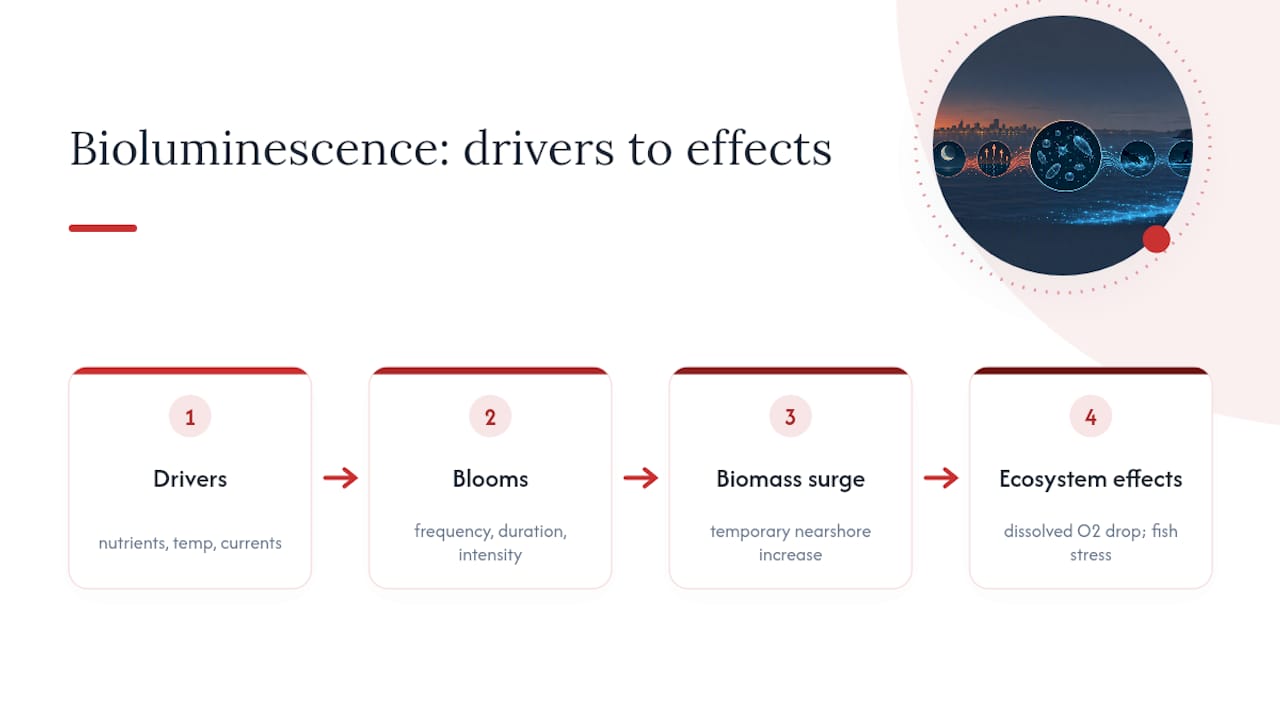
    Researchers also treat bioluminescent events as a kind of natural gauge for coastal water conditions. Bloom frequency, duration, and intensity shift with nutrient levels, water temperature, and current patterns, which makes San Diego’s recurring displays a long-running dataset on how the local ocean is changing year over year. Scripps has been tracking these patterns for decades, and that continuity is part of why San Diego shows up so often in bioluminescence research despite being just one stretch of California coastline among many.

    Factors influencing San Diego bioluminescence blooms

    A Brief History of Glowing Waters Along the San Diego Coast

    Glowing surf isn’t a recent discovery here. Coastal communities and sailors noticed luminous wakes and breaking waves along the Southern California coast long before anyone understood the biology behind it, and the phenomenon has shown up in local lore for generations as something between a curiosity and a minor spectacle.

    What’s changed is how San Diego residents track and share it. A widespread 2020 event turned bioluminescence into a genuinely regional story, with crowds gathering at beaches from La Jolla down through Ocean Beach and social media turning individual sightings into real-time community reports almost overnight. That event, more than any single research paper, is probably what put “bioluminescence San Diego” into the local vocabulary the way it exists today.

    Scripps Institution of Oceanography, based right in La Jolla, has quietly shaped that history from the science side for decades. Its proximity to some of the best viewing spots in the city means the researchers studying these blooms are often working within walking distance of the beaches where people are watching them glow, which is a fairly rare overlap of research access and public spectacle.

    How Human Activity Shapes Local Bioluminescent Events

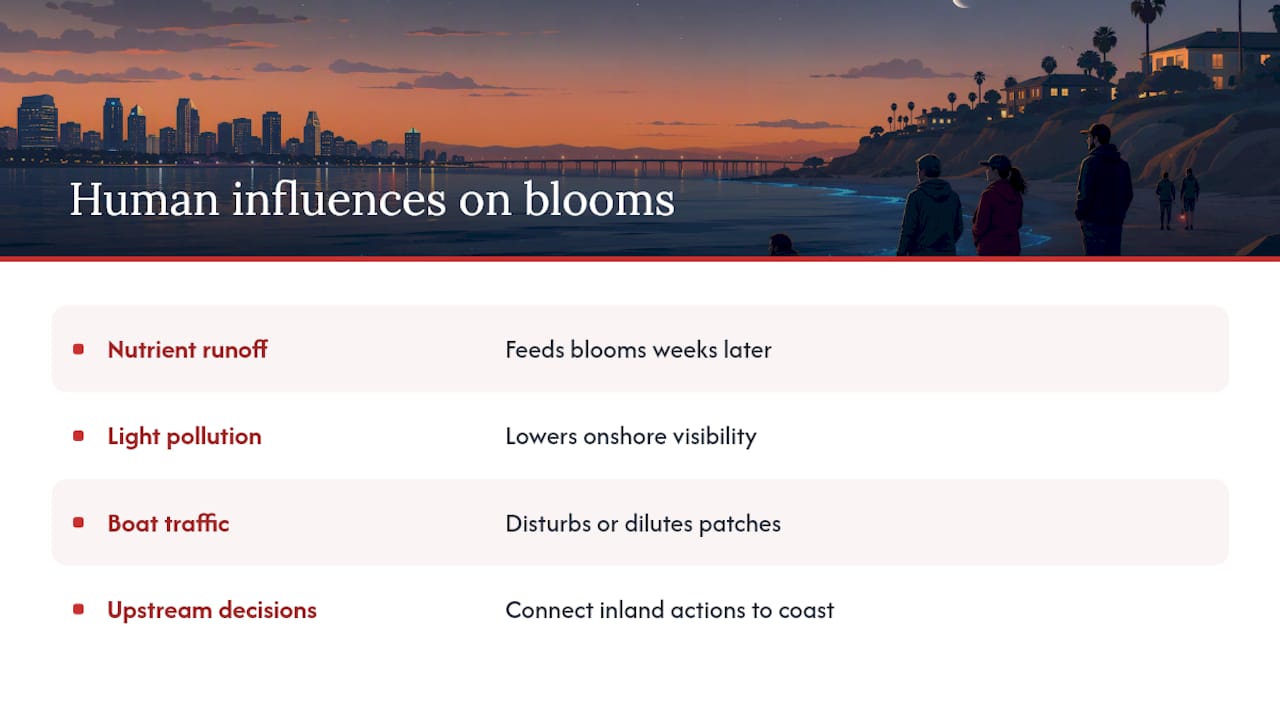
    Coastal water quality plays a direct role in how often and how intensely these blooms occur, and human activity is tangled up in that picture more than most beachgoers realize. Nutrient runoff from urban storm drains, agricultural areas, and wastewater can feed the very plankton blooms that produce the glow, meaning a bad rain season inland can echo in brighter (or more frequent) displays along the coast weeks later.

    Light pollution works against the show rather than feeding it. Beaches near dense development, boardwalks, and parking lot lighting make it genuinely harder to see a flash that a darker beach a few miles up the coast would show clearly. That’s part of why Torrey Pines and the quieter stretches around Sunset Cliffs tend to outperform Mission Beach on a comparable night, even when the bloom itself is spread fairly evenly along the coastline.

    Boat traffic and heavy nearshore activity can also disturb blooms in ways that scatter or dilute a concentrated patch of plankton before it drifts to shore. It’s not a dramatic effect on any single night, but repeated disturbance across a bloom’s multi-week lifespan can shift where and when the glow shows up.

    None of this means a trip to the beach is doing measurable harm on its own. It does mean the conditions that produce a great bioluminescence night in San Diego are connected to decisions made well inland, long before anyone shows up with a flashlight.

    How Human Activity Shapes Local Bioluminescent Events — overview diagram

    Guided Tours and Community Bioluminescence Events

    Don’t expect a dedicated night tour industry built around bioluminescence here. Local guides are consistent on this point: there’s no centralized boat or kayak operation running regular bioluminescence trips around San Diego the way you might find in other coastal regions. Most viewing is shore-based, informal, and driven by word of mouth once a bloom gets confirmed.

    That said, community response tends to organize itself once word spreads. During major events, like the widespread 2020 bloom, beaches saw informal gatherings form almost spontaneously, with groups showing up after seeing local news coverage or social media posts from earlier that same night. Local news outlets, particularly NBC San Diego, have become one of the more reliable ways residents learn a bloom is active in real time, often reporting from the beach itself as sightings roll in.

    If you’re hoping for something more structured, your best bet is pairing a bioluminescence check with an existing daytime coastal activity, like a whale-watching trip out of San Diego, and simply planning your evening around the same stretch of coast. Some local outfitters that run evening kayak trips will mention bioluminescence as a possible bonus during active bloom season, but treat that as a maybe, not a guarantee, and always confirm HAB safety status before anyone paddles out after dark.

    A Local’s Take on Chasing the Glow

    The best night I’ve had chasing this wasn’t at a famous spot. It was a quiet stretch near Torrey Pines after I’d noticed rust colored water there that afternoon. No moon, no streetlights, just waves breaking and lighting up blue every time they hit the sand. That daytime check made all the difference.

    Before you go: look for red tide in daylight, wait until at least two hours after sunset, park legally, bring a friend, and skip the white flashlight. Respect any posted health advisories. Socalsights hears from local readers who’ve had similarly hit-or-miss nights, which is exactly why checking conditions first matters more than picking the “best” beach on a list.

    — Joshua

    Plan Your San Diego Bioluminescence Night With Socalsights

    Chasing a glow that might or might not show up is a lot easier when you’re not also scrambling to figure out where to park, eat, or crash for the night. Socalsights builds curated San Diego itineraries that pair a bioluminescence stop with the practical stuff nobody wants to research at 9 PM. Nearby parking, a decent late dinner, and a place to stay if you’re not driving home after dark.

    Socalsights

    If Torrey Pines or Sunset Cliffs are on your shortlist, our guide to San Diego’s secret beaches covers quieter stretches of coast that pair well with a night viewing trip, and our weekend coastal itinerary helps you build out the rest of the day around it. For a full look at what Socalsights covers across the region, browse the types of SoCal Sights we curate, then start piecing together your own coastal night out.

    Where to Verify Bioluminescence Conditions Before You Go

    A few sources are worth a quick check before you drive out.

    • Scripps Institution of Oceanography publishes ongoing research and FAQ updates on local red tides and blooms.
    • SCCOOS tracks harmful algal bloom advisories and weekly toxin sampling along the coast.
    • NOAA NCCOS covers the broader research funding and ecological findings behind these blooms.
    • NBC 7 San Diego reports on active events as they’re happening, often with the most current sighting locations.

    Sources

  • 12 LA Dessert Spots and Exactly What to Order

    12 LA Dessert Spots and Exactly What to Order

    If you only trust one list of dessert spots Los Angeles has to offer, make it this one: the hakka mochi at Joy on York, the apple pie skillet at Jones Hollywood, and the PJ Sundae at Pasjoli are the three orders that come up again and again in every serious LA dessert conversation. Add Magpies Softserve for chef-driven soft serve and Diddy Riese for a cheap, iconic ice cream cookie sandwich, and you’ve got a starting five that spans the city. Twelve more picks, organized by neighborhood, dessert type, and hours, follow below.


    TL;DR:

    • Joy on York’s hakka mochi is chewy, not overly sweet, and best enjoyed on weekdays to avoid long lines.
    • Pasjoli’s PJ Sundae and burnt Basque cheesecake require reservations and are best for a full sit-down dining experience.
    • Diddy Riese cookie sandwiches, often the most affordable option, typically have lines after 9 p.m., especially during weekends.
    • Salt & Straw offers limited-season flavors, with long weekend lines, making weekday visits more reliable.
    • Late-night dessert options include Jones Hollywood for the skillet apple pie and Diddy Riese for cookie sandwiches, but some spots close earlier.

    Table of Contents

    The Best Dessert Spots in Los Angeles, Item by Item

    This is the actual bucket list. Each entry names the exact thing to order, not just the shop, because in a city this stacked with sweets, ordering the wrong item is the real risk.

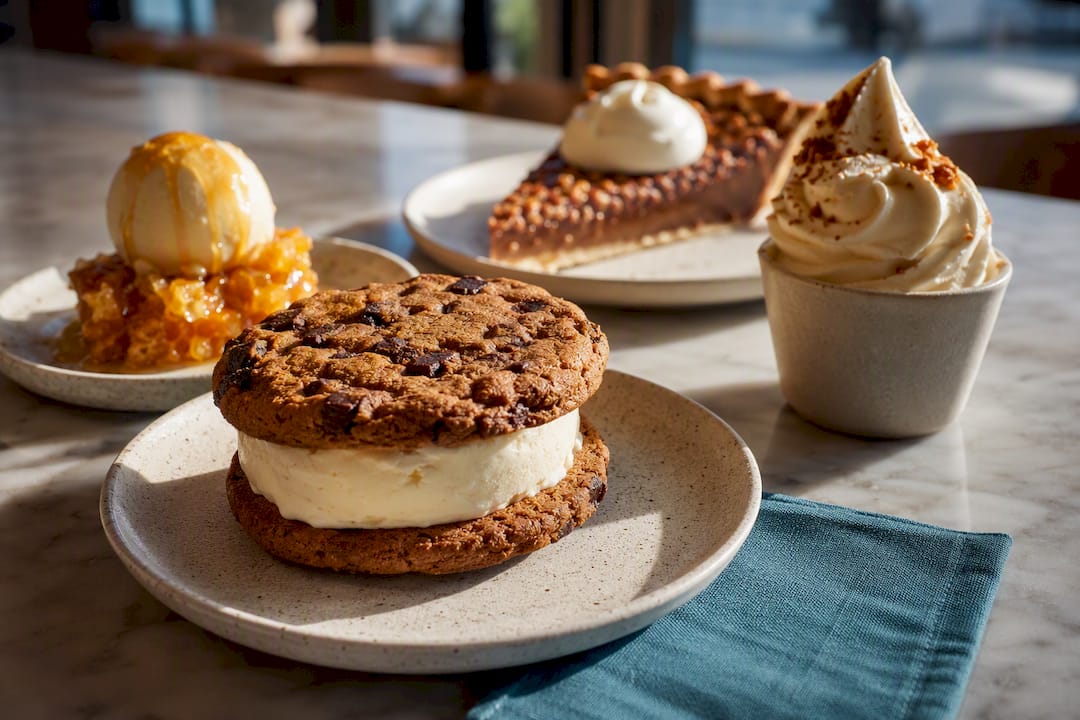
    1. Joy on York (Highland Park) — hakka mochi. This is the dessert LA food writers can’t stop mentioning, and for good reason. The hakka mochi at Joy on York is chewy, not overly sweet, and unlike anything else on this list, which is exactly why it belongs here first. Go on a weekday afternoon if you want to skip a line.

    2. Pasjoli (Santa Monica) — PJ Sundae or burnt Basque cheesecake. Pasjoli treats dessert like a main event, not an afterthought, and its PJ Sundae and burnt Basque cheesecake prove it. Reservations are smart here since it’s a full sit-down restaurant, not a walk-up counter, so plan the dessert around a dinner booking rather than a standalone stop.

    3. Jones Hollywood (Hollywood) — apple pie on a cast iron skillet. Warm, shareable, and served bubbling in its own skillet, Jones’ apple pie is the kind of dessert built for splitting across a table of four. It’s also one of the few genuinely dependable options after 11 p.m., which earns it a second mention later in this guide.

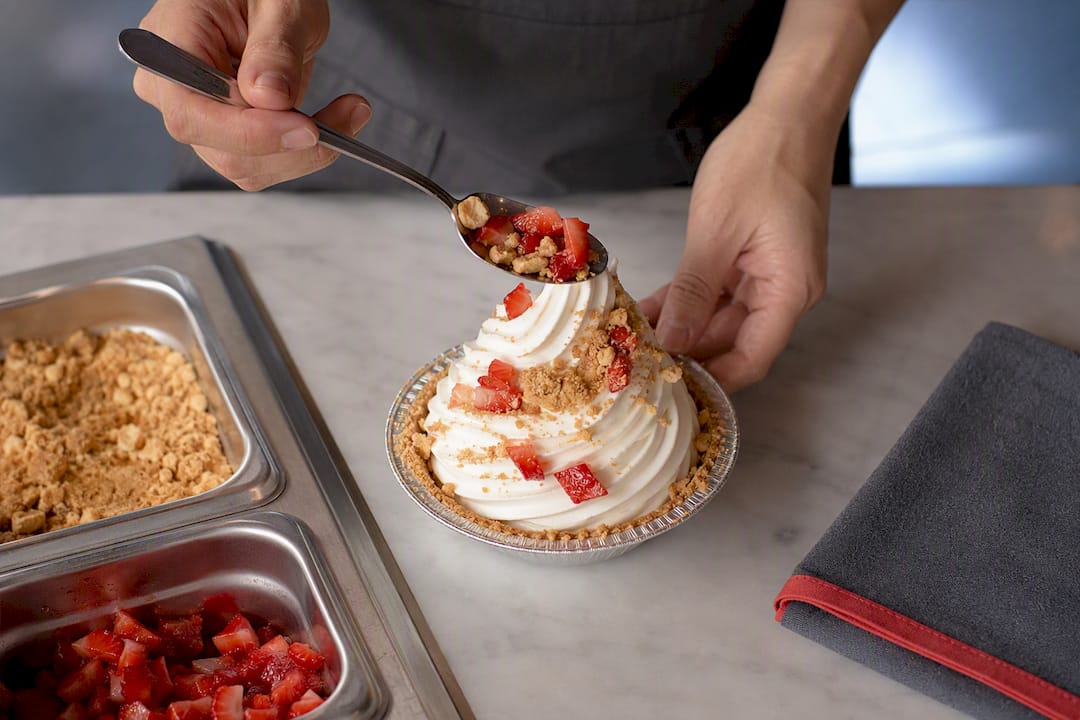
    4. Magpies Softserve (multiple locations) — soft-serve pie. Chef-owned and scratch-made, Magpies turns soft serve into something closer to pastry, layering it into actual pie form with rotating seasonal flavors. Check the flavor board before you order since the lineup changes often.

    5. Diddy Riese (Westwood) — ice cream cookie sandwich. A UCLA institution that’s stayed cheap and consistent for decades, Diddy Riese lets you pick two cookies and a scoop for a price that still feels like a steal. Expect a line most evenings, especially after 9 p.m. when the campus crowd rolls in.

    6. Salt & Straw (multiple locations) — seasonal small-batch scoop. Known citywide for inventive, ingredient-driven flavors that rotate by season, Salt & Straw rewards asking staff for a taste before committing. Weekend afternoons bring long lines, so weekday visits are the move.

    7. Sweet Angeles (Beverly Hills) — Dubai chocolate bar. This bakery built its reputation on the Dubai chocolate bar, a pistachio-and-chocolate bar that’s become one of the more talked-about bakery items in the city. Custom cakes are also a specialty if you’re planning ahead for a celebration.

    8. The Apple Pan (West LA) — banana cream pie. A no-frills counter that’s been serving the same classic pies for generations, The Apple Pan’s banana cream pie is the kind of old-school dessert that doesn’t need a trend cycle to stay relevant. Cash and counter seating only, so come with patience and small bills.

    9. La Casita Mexicana (Bell) — flan or tres leches. For a genuinely traditional take on Mexican dessert, La Casita Mexicana’s flan and tres leches are dense, rich, and worth the drive south of downtown. Pair either with coffee if you’re staying for a full meal.

    10. Antico Nuovo (Downtown/Arts District) — honeycomb ice cream. Restaurant desserts don’t always get top billing, but Antico Nuovo’s honeycomb ice cream is proof that a chef-driven kitchen can make a simple scoop feel like a signature dish. Order it after a pasta course, not instead of one.

    11. Badash Bakes — matcha cinnamon roll. A newer name that’s earned its spot on serious dessert maps for a matcha cinnamon roll that balances bitterness and sweetness better than most bakery riffs on the trend.

    12. Cento Raw Bar — mosaic ube cheesecake. An unexpected pairing spot since it’s known for raw seafood, Cento’s mosaic ube cheesecake shows up on chef-driven dessert lists for its color and texture as much as its flavor, a good reminder that some of the best desserts in the city are hiding in restaurants that aren’t dessert shops at all.

    Best Dessert Spots by Type

    Sometimes you know exactly what you’re craving before you know where to go. Here’s how the city breaks down by category.

    • Ice cream and soft serve: Salt & Straw for rotating small-batch flavors, Magpies Softserve for scratch-made soft-serve pies, and Antico Nuovo for a chef’s take on a simple honeycomb scoop.
    • Pastries and bakery items: Sweet Angeles in Beverly Hills for the Dubai chocolate bar and custom cakes, Badash Bakes for the matcha cinnamon roll.
    • Specialty ethnic desserts: Joy on York in Highland Park for hakka mochi, La Casita Mexicana in Bell for flan and tres leches.
    • Shareable restaurant desserts: Pasjoli in Santa Monica for the PJ Sundae and burnt Basque cheesecake, Cento Raw Bar for the mosaic ube cheesecake.
    • Classic Westside institutions: The Apple Pan for banana cream pie, Diddy Riese near UCLA for cookie sandwiches.

    That spread covers the Westside, Central LA, the East side, Koreatown-adjacent neighborhoods, and points south, so wherever you’re starting from, something worthwhile is within a reasonable drive.

    Where to Find Late-Night Dessert in LA

    Cravings don’t respect closing times, and neither should your dessert plans. Here’s what to hit after 11 p.m.:

    1. Jones Hollywood stays reliable late into the night for that skillet apple pie, and it functions as a full restaurant, so you can order a real dinner alongside it.
    2. Diddy Riese in Westwood often runs late thanks to the college crowd, making it a solid stop if you’re already out near campus.
    3. Salt & Straw locations vary by hour, so check the specific shop before heading over.
    4. Magpies Softserve counters keep evening hours that work well after a movie or a late dinner nearby.
    5. The Apple Pan closes earlier than the others, so treat it as an early-evening stop rather than a true late-night one.
    6. La Casita Mexicana pairs well with a late dinner if flan is the goal rather than a standalone dessert run.

    Late-night dessert guides consistently point to Jones and a handful of similar spots as the dependable after-hours options in a city where most bakeries close by 8 or 9 p.m.

    Pro Tip: Street parking near Hollywood and Westwood gets tight after 9 p.m. on weekends, so budget an extra ten minutes to circle the block or use a paid lot rather than counting on curb space right outside.

    How to Pick the Right Spot for the Occasion

    Match the visit to three things: dessert type, service model, and setting. A date night calls for a sit-down spot like Pasjoli where the dessert caps a full meal. A quick solo craving is better served by a counter shop like Diddy Riese or Magpies, where you’re in and out in ten minutes. Kids do best somewhere casual and fast, not somewhere with a wait list.

    Watch for two red flags before you drive across town:

    • No visible line management or ordering system at a popular spot usually means a longer wait than posted hours suggest.
    • Seasonal or limited-run items (a specific soft-serve pie flavor, a holiday cake) may not be available when you show up, so it’s worth a quick call or social media check first.

    Two questions solve most of this in advance: does the spot take reservations, and is the item you want a seasonal one-off or a permanent menu fixture?

    Why This Guide Holds Up

    Socalsights builds these lists the way a local would text a friend: specific items, specific neighborhoods, no filler. Every spot here gets checked against what actual LA food coverage and shop menus say, not just what’s trending that week, and entries get revisited as menus and hours shift. Community tips from locals factor in too, since the person who drove to La Casita Mexicana last month knows more about current wait times than any old review does. Expect this list to get refreshed as seasonal items rotate and new spots earn their place.

    Getting There: Parking, Transit, and Access Notes

    Most of these spots sit in car-dependent parts of LA, so plan parking before you plan the order. Westwood spots like Diddy Riese sit inside UCLA’s orbit, where metered street parking is common but competitive during the school year. Highland Park, home to Joy on York, has more forgiving street parking but narrower sidewalks, worth knowing if you’re navigating with a stroller or wheelchair.

    Santa Monica’s Pasjoli and Beverly Hills’ Sweet Angeles both sit in areas with paid lots and structures nearby, which tend to be more reliable than street parking during dinner rush. Downtown’s Antico Nuovo benefits from the Arts District’s mix of street parking and nearby lots, though weekend evenings get tight.

    Public transit covers some of this ground: Metro’s Expo Line reaches Downtown and parts of the Westside, and Metro Rapid buses run through Hollywood and Westwood corridors. Still, LA’s dessert map rewards a car far more than it rewards transit, particularly if you’re stringing together more than one stop in an evening.

    Wheelchair access varies by shop rather than by neighborhood. Counter-service spots like Magpies and Diddy Riese tend to have street-level entry and minimal seating obstacles. Sit-down restaurants like Pasjoli and Antico Nuovo, being full-service establishments, generally meet standard accessibility expectations for seating and restrooms, but calling ahead for specific needs is always the safer move.

    What Each Dessert Spot Actually Costs

    Dessert in LA spans a wide range, and knowing the rough price bracket before you go helps you plan a crawl without surprises. Counter-service spots keep things affordable: Diddy Riese’s cookie sandwiches and Magpies’ soft-serve cups typically run in the affordable, under ten dollar range per person, making them easy to stack into a multi-stop outing without blowing a budget.

    Bakery items land in the middle. Sweet Angeles’ Dubai chocolate bar and similar specialty items tend to cost more than a basic cookie but less than a restaurant dessert course, reflecting the ingredients and craft involved. Joy on York’s hakka mochi falls into this same moderate bracket, priced like a specialty bakery treat rather than a quick snack.

    Restaurant desserts carry the highest price tags on this list, which makes sense given they’re built into full dining experiences. Pasjoli’s PJ Sundae and Antico Nuovo’s honeycomb ice cream are priced the way a proper restaurant dessert course should be, often ten to fifteen dollars or more, since you’re paying for plating and technique alongside the ingredients. The Apple Pan sits closer to the affordable end despite being a sit-down counter, keeping its classic pies accessible.

    Comparison of Los Angeles dessert price tiers

    Budgeting a dessert crawl around one restaurant stop and two or three counter stops keeps the overall cost reasonable while still covering a range of styles.

    Vegan and Gluten-Free Options Across the List

    Dietary restrictions don’t have to sideline a dessert outing in LA, though the options are unevenly spread across this list. Salt & Straw has built a reputation for rotating dairy-free and vegan scoop options alongside its standard menu, making it one of the more dependable stops for anyone avoiding dairy. Magpies Softserve also tends to offer plant-based swaps at select locations, though flavor availability shifts by shop, so a quick call ahead saves a wasted trip.

    Gluten-free eaters have fewer guaranteed options among the core bucket-list items. Ice cream and soft serve are naturally easier to adapt than baked goods, so Salt & Straw and Magpies remain safer bets than pastry-heavy stops like Sweet Angeles or Badash Bakes, where gluten is baked into the core product.

    Restaurant desserts often have more flexibility than counter shops simply because a kitchen can accommodate a substitution on request. Pasjoli and Antico Nuovo, as full-service restaurants, are generally better positioned to handle a dietary note passed along at the time of reservation than a walk-up bakery counter would be. If a specific allergy is non-negotiable, calling ahead beats guessing at the counter every time.

    The Feel of Each Spot: Casual, Trendy, or Family-Friendly

    The vibe shifts as much as the menu does across this list, and matching the setting to your plans matters as much as matching the dessert. Diddy Riese and The Apple Pan lean thoroughly casual and unpretentious, the kind of counter spots where a family with kids or a group of tired students blends right in without a second glance.

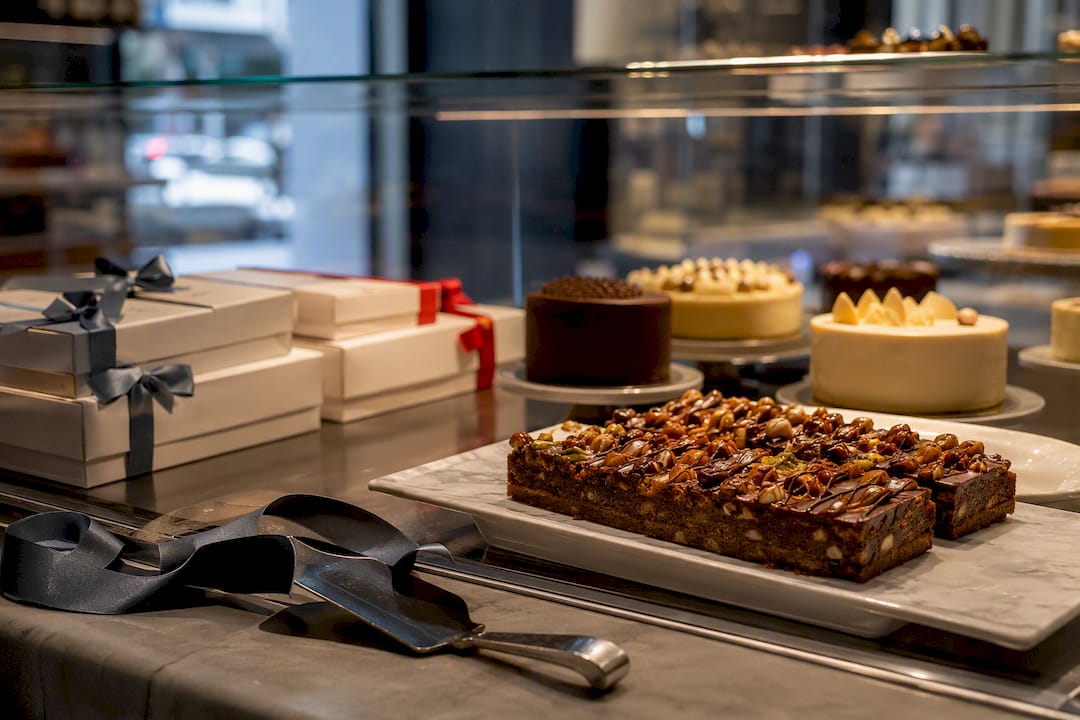
    Joy on York and Badash Bakes sit closer to trendy without tipping into stuffy, the sort of places where a photo of your order feels natural rather than forced. Sweet Angeles in Beverly Hills leans polished, with a bakery display case built for browsing and gifting, which makes it a stronger fit for a special errand than a quick solo stop.

    Specialty desserts arranged in bakery display case

    Pasjoli and Antico Nuovo are full restaurants first, dessert spots second, meaning the ambiance is dinner-appropriate: dim lighting, table service, a slower pace suited to couples or small groups rather than a fast in-and-out visit. La Casita Mexicana carries a warm, family-run feel that suits a multi-generational meal rather than a quick stop between errands. Knowing which category you’re walking into saves the awkwardness of showing up in flip-flops to a white-tablecloth restaurant, or overdressing for a paper-cup soft-serve counter.

    Seasonal Drops Worth Watching For

    Some of the best items on this list aren’t permanent menu fixtures, which is exactly why checking ahead matters before a special trip. Magpies Softserve rotates its soft-serve pie flavors seasonally, meaning the exact combination that made headlines in the summer may be gone by fall, replaced by something built around whatever fruit or flavor profile is peaking that month.

    Seasonal soft serve pie with fresh toppings

    Salt & Straw built its entire brand identity around limited-run, season-specific flavors, often tied to local ingredients or collaborations that only last a few weeks at a time. That unpredictability is part of the appeal, but it means a flavor a friend raved about last month might not be on the board when you show up.

    Bakery items follow a similar pattern around holidays. Sweet Angeles tends to introduce cake and gift-box options tied to major holidays, and specialty bars like the Dubai chocolate bar have surged in availability as demand has grown, meaning stock can run out faster than expected during peak interest windows. When a specific seasonal item is the entire reason for a trip, a quick call or social media check beats a wasted drive.

    My Own LA Dessert Crawl

    Treat dessert as the main event for one afternoon and you’ll understand more about LA’s food culture than a dozen regular dinners could teach you. Here’s the crawl I’d actually run: start at Diddy Riese near UCLA around 2 p.m. for a cheap cookie sandwich and easy parking before the evening rush. Drive to Magpies Softserve for a soft-serve pie around 4 p.m., timed before dinner crowds build. End at Pasjoli in Santa Monica for a proper dinner and the PJ Sundae, booked ahead since it’s the one stop that needs a reservation. Three stops, one afternoon, and a real cross-section of what makes this city’s dessert scene worth taking seriously.

    — Joshua

    Plan Your Dessert Outing With Socalsights

    Socalsights is the shortcut for turning a list like this into an actual afternoon, without the hours of cross-referencing hours, menus, and neighborhoods yourself. Where a generic search leaves you guessing which spots are still open or worth the drive, Socalsights builds curated, neighborhood-based guides that pair naturally with a dessert crawl, like our guide to the best coffee in LA for pairing a morning cup with an afternoon treat, or unique things to do in Los Angeles for building out a fuller day around your dessert stops.

    Socalsights

    If you want a mapped, ready-to-follow itinerary instead of piecing one together from scratch, start with Fun Activities Near Me for local picks organized by neighborhood, and build your next outing around whichever dessert spot from this list is closest to home.

    Sources