Month: November 2026

  • Swimming Holes in Los Angeles: Where to Cool Off and Stay Safe

    Swimming Holes in Los Angeles: Where to Cool Off and Stay Safe

    Los Angeles has real freshwater swimming spots, but they’re mostly creek pools in the mountains and canyons around the city, not a tidy list of lakes with lifeguards. The best-known ones are Malibu Creek’s Rock Pool, Switzer Falls in the San Gabriel Mountains, and, a longer drive south, Cedar Creek Falls near San Diego. I’ve pulled together what each one is like, what it costs to park, and the closures and water-quality notes that change how you plan your day.

    Socalsights
    Find More Southern California Gems
    Explore local recommendations for memorable activities and food spots across Southern California, including places beyond the usual travel guides.

    Explore SoCal Sights

    TL;DR

    • Malibu Creek State Park’s Rock Pool is the closest classic swimming hole to LA, with all-day parking at $12 per car. Swimming comes with water-quality cautions, and diving is against state law.
    • Switzer Falls (Angeles National Forest) needs an Adventure Pass or America the Beautiful Pass, and you can reach Arroyo Seco Creek from the picnic area.
    • Eaton Canyon’s waterfall trails remain closed until December 31, 2027 after the Eaton Fire, so skip it for now.
    • Cedar Creek Falls requires a permit and is best in fall, winter and spring, not summer.
    • For a lifeguarded swim, LA County runs three designated freshwater swim beaches, normally open Memorial Day to Labor Day.

    Table of Contents

    What a “swimming hole” means around LA

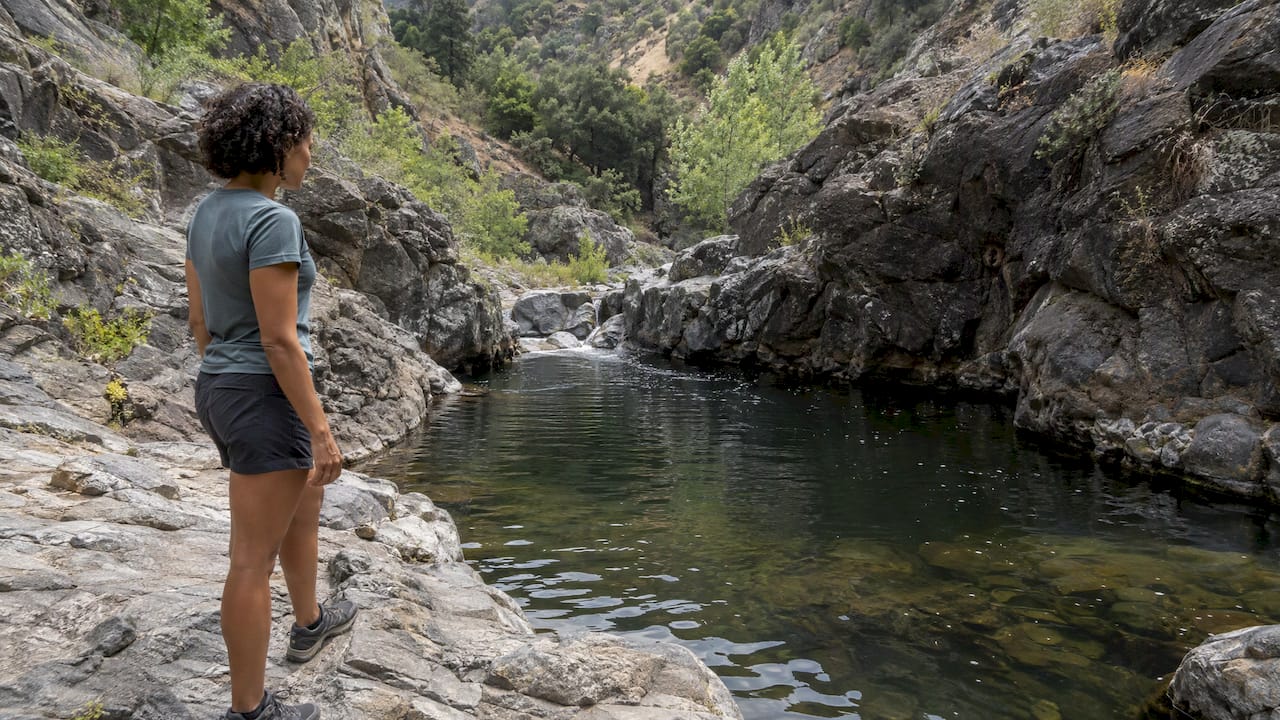
    If you’re picturing a deep, clear pool with a rope swing, adjust your expectations a little. Around Los Angeles, swimming holes are usually wide spots in a creek, often at the bottom of a hike, and what you get depends on the season and the last rainstorm. In a dry summer some are shallow and warm. After winter storms they can be cold and fast.

    There’s also a safety reality. The LA County Department of Public Health says that many places where people get in the water, including swimming holes, creeks, ponds and rivers, aren’t designated swim areas. They usually have no restrooms or lifeguards, and runoff can carry high bacteria counts from animal and human sources. That doesn’t mean you can’t have a great day. It means you pick your spot, check conditions and go in with your eyes open.

    Malibu Creek Rock Pool

    This is the one most people mean when they say swimming hole in LA. The Rock Pool sits inside a volcanic rock canyon in Malibu Creek State Park, about an hour from much of the city depending on traffic, and it’s popular with hikers and climbers. The park is at 1925 Las Virgenes Rd, Calabasas, CA 91302, and the gates open 8am to 10pm.

    Parking and fees

    State Parks lists parking per car at $12 all day, $9 for 3 hours, $6 for 2 hours and $3 for 1 hour. Bring a plan for how long you’ll stay, because the hike in and the time at the pool add up faster than you expect.
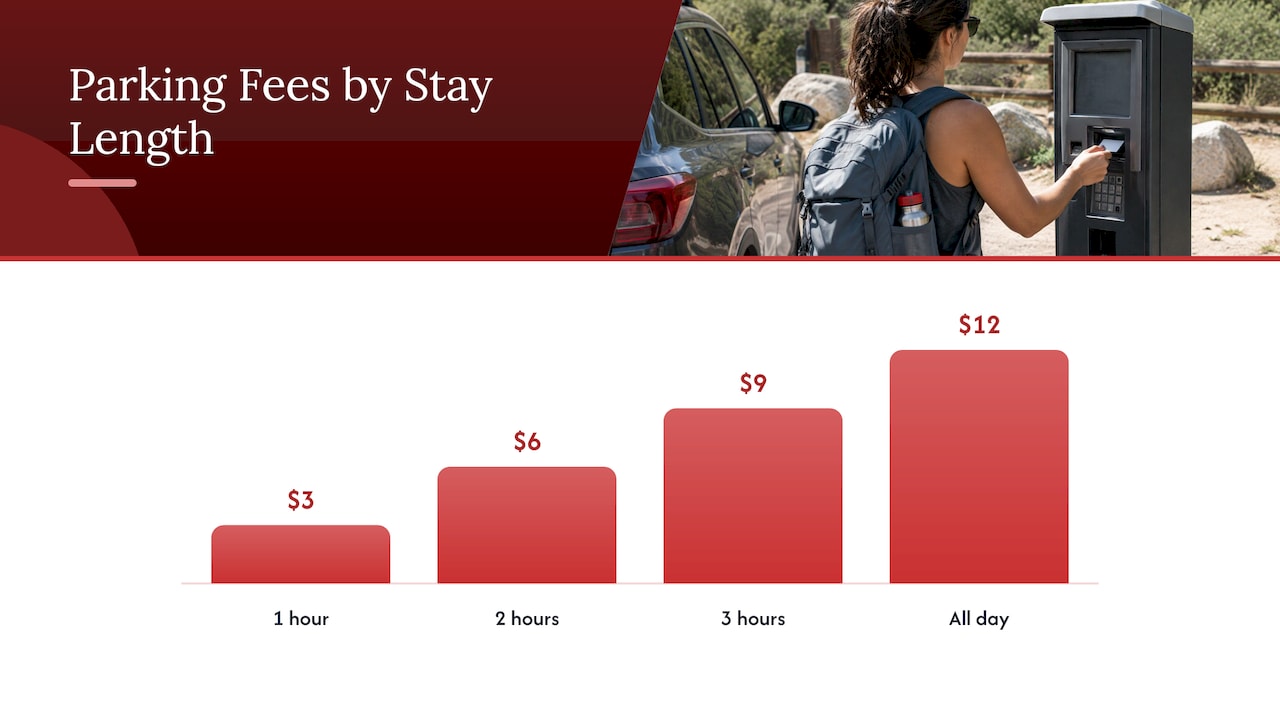
    Malibu Creek parking fees by stay length

    Rules and water quality

    Here’s what I’d want you to know before you pack the car:

    • Dogs are not allowed on the hiking trails or at the Rock Pool, per the park’s visitor page. Leave them home.
    • Diving at the Rock Pool is against state law because of shallow water and submerged rocks. Same page, same message: no jumping or diving.
    • California State Parks’ 2018 brochure notes poor water quality from urban runoff in Century Lake and the Rock Pool and describes swimming there as unhealthy because of bacteria levels.
    • On the other side, Heal the Bay’s 2025 River Report Card gave Malibu Creek at Rock Pool an A+, with a median E. coli concentration of 41 MPN/100mL, below the state health standard.

    Those findings come from different years and different testing, so the practical move is to check the latest numbers on the day. More on that below.

    Why it’s worth the trip anyway

    The canyon scenery is the draw. There are climbs from 5.8 to 5.10c around the pool, including Planet of the Apes Wall, plus some fun bouldering, according to the park’s visit guide. Even if you only wade in to your knees, it’s a gorgeous place to spend a few hours. If you’re making a whole day of it, the park also has a 62-site main campground with flush toilets and heated showers.

    Switzer Falls, Angeles National Forest

    Switzer Falls is a classic San Gabriel Mountains outing above La Cañada Flintridge. The Forest Service manages the Switzer Picnic Site, which has 26 picnic sites with tables and BBQ pedestal grills and access to Arroyo Seco Creek for swimming.

    What you need to know

    • Day use runs 6 a.m. to 10 p.m.
    • The cost is $5 per vehicle per day or $30 annually.
    • You need an Adventure Pass or America the Beautiful Pass displayed in your vehicle.
    • The site connects to the Gabrielino National Recreation Trail and has a view of Switzer’s Falls.

    All of that comes from the official Forest Service page. For questions, the Los Angeles Gateway District office is at 12371 N. Little Tujunga Canyon Road, San Fernando, CA 91342, and you can call 818-899-1900.

    This is a creek you’ll enjoy in spring after rain, when it’s flowing and lively. In late summer, expect less water. If you like waterfall hikes in general, our guide to Los Angeles waterfall hikes sorts them by who they suit best, from families to swimmers.

    Eaton Canyon: still closed

    Eaton Canyon was a go-to waterfall for decades. The January 2025 Eaton Fire changed that. According to the LA County Department of Parks and Recreation, Eaton Canyon and surrounding trails remain closed until December 31, 2027, including the Eaton Canyon Waterfall, Altadena Crest Trail, Chaney Trail and Hasting Debris Basin Trail.

    If a blog or map app still points you there, trust the county. Go to Malibu Creek or Switzer Falls instead, and check the county page before any trip in that area.

    Cedar Creek Falls: the day-trip worth planning

    Cedar Creek Falls in Cleveland National Forest is a bit of a drive from LA, so I’d treat it as an overnight or a big day. It features an 80-foot waterfall dropping into a large swimming hole, and the hike is 5 to 6 miles round trip, with trail access in Julian and Ramona.
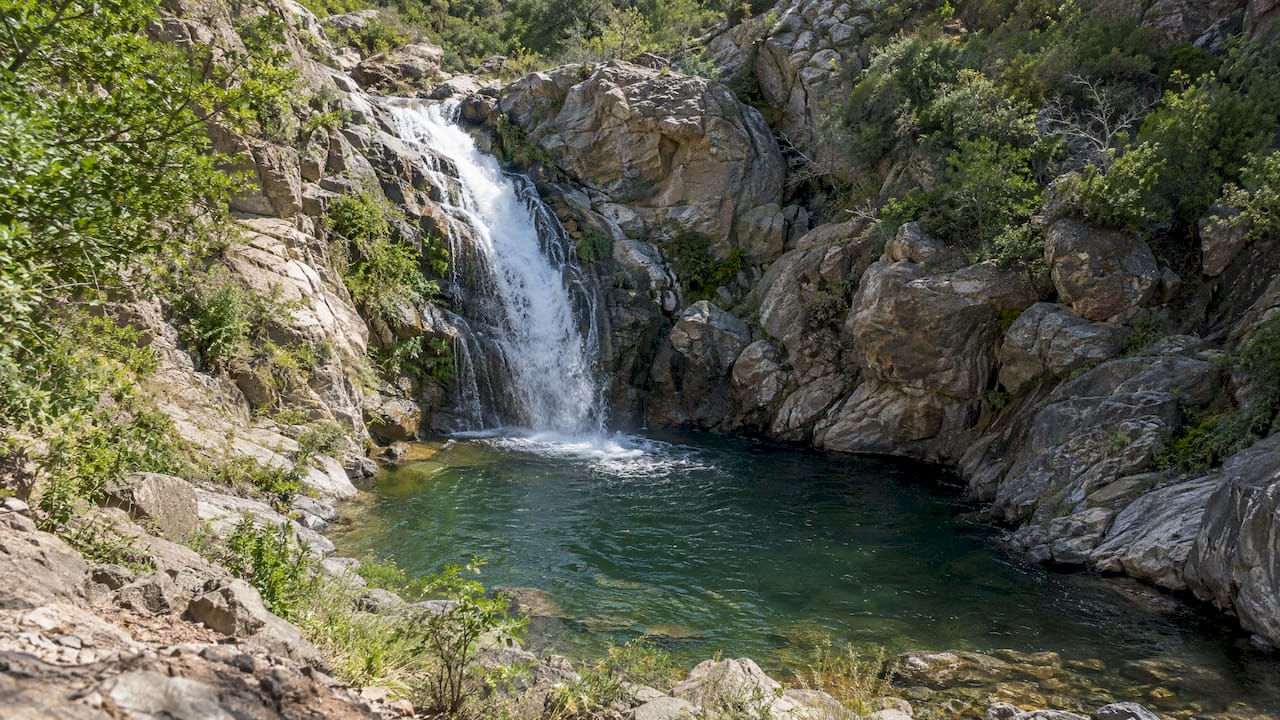
    Cedar Creek Falls above its swimming hole

    Permit and timing

    This one doesn’t let you wing it. Recreation.gov lists a $6 non-refundable reservation fee per permit, which covers the permit holder and up to four additional group members. Permits for the next calendar year are released December 1 of the previous year. The cliffs above and around the falls are closed to climbing, jumping and diving.

    Season matters too. The same page says the falls typically don’t flow in the summer, and the pool at the base becomes stagnant and filled with algae. Fall, winter and spring are the better seasons. It also strongly recommends at least one gallon (four liters) of water per person. Plan a cooler-weather visit and book your permit early.

    Lifeguarded options when you want an easy swim

    Sometimes you just want to swim without wondering about bacteria or rocks. LA County maintains three designated freshwater swim beaches, at Puddingstone Lake, Santa Fe Dam and Castaic Lake. They have restrooms, lifeguards and chlorinators, and they’re normally open for swim season from Memorial Day to Labor Day.
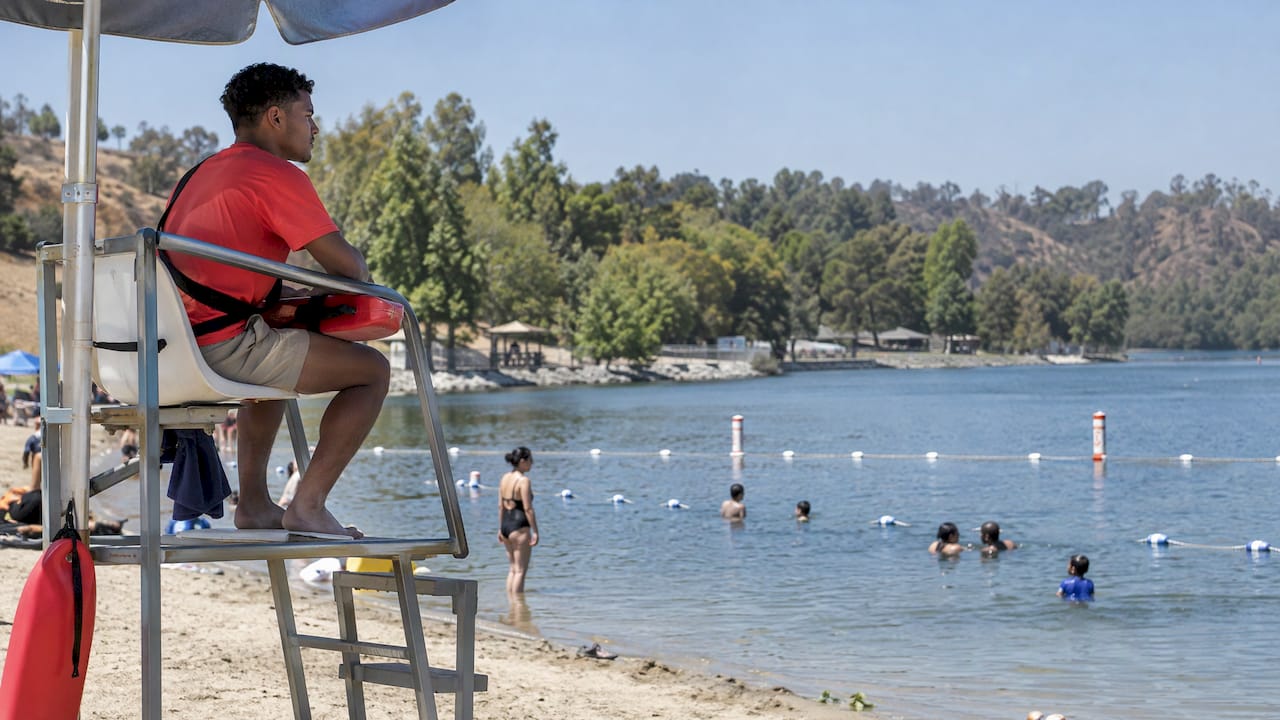
    Lifeguard watching Puddingstone Lake swim area

    They’re not wild and hidden, but they’re a solid pick for kids, big groups or anyone who wants a relaxed afternoon. Check the county page for current hours and conditions before you go.

    Deep Creek and Aztec Falls

    Aztec Falls near Lake Arrowhead shows up in plenty of lists. Before you make plans, know that the Forest Service has listed an active Deep Creek Area Closure (Aztec Falls) alert. Check the San Bernardino National Forest page for the current status. If hot water sounds good instead, our roundup of Southern California hot springs covers soaking spots.

    Quick comparison

    Spot Best for Cost or permit Heads up
    Malibu Creek Rock Pool Scenery, climbing, a short outing from LA $12 all day per car No dogs at the pool, no diving
    Switzer Falls Creek wading, picnics, hiking $5 per vehicle per day, or $30 annually; Adventure Pass or America the Beautiful Pass required Less water in dry months
    Cedar Creek Falls A big waterfall and deep pool $6 permit fee covering up to five people Needs a permit, best outside summer
    LA County swim beaches Easy, lifeguarded swims Check county page Normally open Memorial Day to Labor Day
    Eaton Canyon Not available None Closed until December 31, 2027

    Before you get in the water

    This is the checklist I run through every time.

    1. Look up the water quality. The LA County Department of Public Health says high bacteria counts can happen at any time and risk increases for 72 hours after significant rainfall. It recommends checking a site’s water quality history at Heal the Bay or the LA County Public Works Watershed page before you go.
    2. Stay out of the water after rain. If it rained in the last three days, wade or hike instead.
    3. Wading beats dunking. The same county guidance notes that swimming and getting your head in the water is riskier than wading.
    4. Skip the jumps. Diving and jumping are off the table at Malibu Creek’s Rock Pool and at Cedar Creek Falls, and shallow water can hide rocks anywhere.
    5. Carry water. Take a gallon per person if you’re hiking in. Cedar Creek’s permit page makes the same call.
    6. Pack your pass. If you’re heading into a national forest, keep your Adventure Pass or America the Beautiful Pass on the dash.
    7. Have a backup. If a spot is crowded or the water looks murky, a shaded trail is a fine plan B. Our best hikes in Los Angeles guide has options for every mood.

    If you’re bringing little ones

    Creek pools and kids can be a great combination with the right setup. A swim aid is only one part of it, and it helps to know common mistakes with swim aids so that you pick and fit them well. Keep little ones within arm’s reach and stick to the shallow edge, especially at spots with no lifeguard.

    Our take on finding the good stuff

    We started SoCal Sights because there’s too much information out there and not enough of it comes from people who actually go. Swimming holes are a perfect example. One blog says a spot is a paradise, another says it’s closed, and the map app has no idea.

    Our approach is to lean on local knowledge and the agencies that manage the land. That’s why we keep pointing you to the official page, the county alert or the park’s own visit guide, then add the stuff only locals tell you: which spot to try on a mild weekday, which to save for after the rain, which to skip this year.

    We also love hearing from you. If you’ve found a creek, pool or quiet corner that works, send it our way. The best tips we publish tend to come from the community, and they’re the ones that never make the mainstream lists.

    Joshua

    Get your business in front of SoCal explorers

    Run a campground, outfitter, café or tour company near the trails? Readers use SoCal Sights to plan outdoor days, and local businesses and event organizers can reach them through memberships, featured placements and advertising. Learn more on our advertise with SoCal Sights page.

    Socalsights

    Pricing isn’t published on the page, so reach out through the site to ask what fits your business.

    Make it a whole weekend

    Once you’ve picked your swim spot, build a trip around it. Our weekend getaways from Los Angeles list is useful if you’re heading toward Cedar Creek’s side of the region. If you’d rather get salt water instead, try Malibu’s legally accessible hidden beaches for a tide-aware alternative.

    FAQ

    Can you swim at the Malibu Creek Rock Pool?

    People do, but the guidance is mixed. California State Parks’ 2018 brochure calls the water unhealthy for swimming because of high bacteria levels, while Heal the Bay’s 2025 report card gave the creek at Rock Pool an A+. Diving is against state law, and dogs aren’t allowed at the pool. Check the latest water-quality data before you go and avoid the water for 72 hours after rain.

    Are there swimming holes near Los Angeles open in summer?

    Switzer Falls and Malibu Creek are accessible in summer, though water levels vary. Cedar Creek Falls typically doesn’t flow in summer and its pool can become stagnant, so save it for cooler months. For a guaranteed swim, LA County’s three designated swim beaches are normally open from Memorial Day to Labor Day.

    Do I need a permit or pass for LA swimming holes?

    It depends on the spot. Switzer Picnic Site requires an Adventure Pass or America the Beautiful Pass, and costs $5 per vehicle per day or $30 annually. Malibu Creek charges for parking, at $12 all day per car. Cedar Creek Falls needs a $6 permit that covers you and up to four others.

    Is Eaton Canyon Falls open?

    No. Eaton Canyon and the surrounding trails damaged by the January 2025 Eaton Fire remain closed until December 31, 2027, according to the LA County Department of Parks and Recreation. Check the county trail alert page for updates.

    Sources

  • Beginner Surf Spots in San Diego: Where to Learn

    Beginner Surf Spots in San Diego: Where to Learn

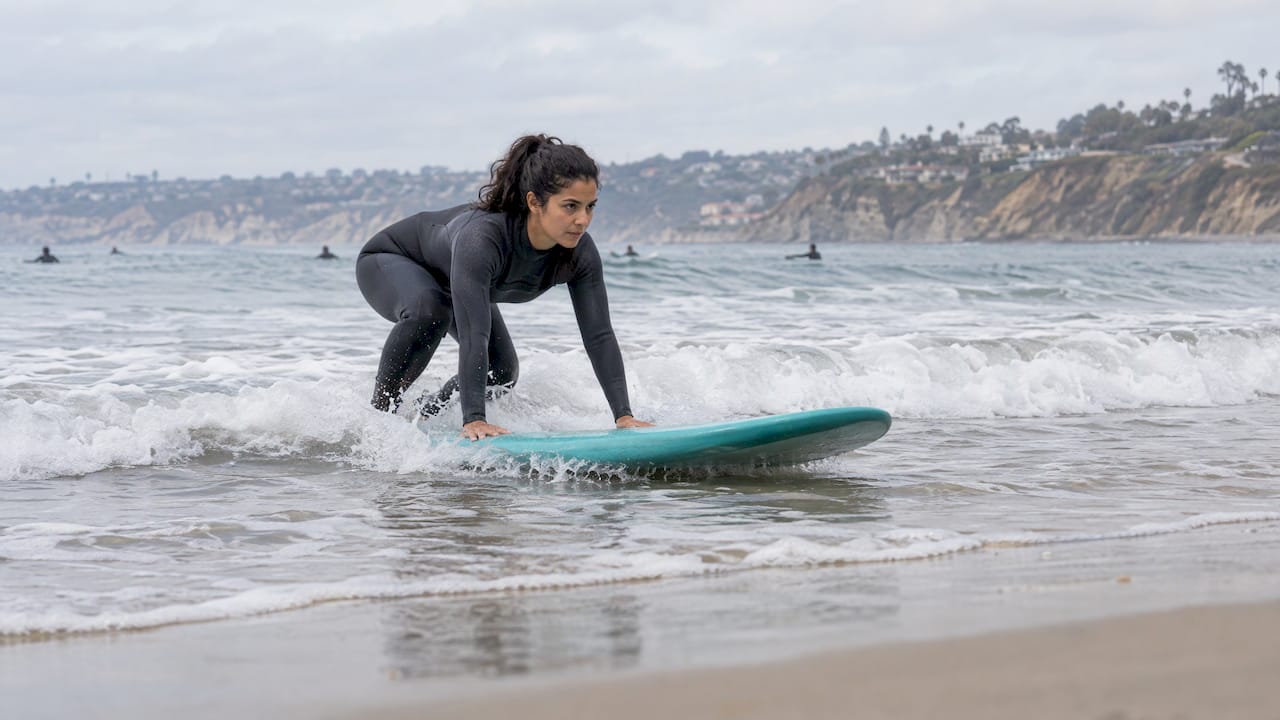
    If you’re learning to surf in San Diego, start at La Jolla Shores, then move to Tourmaline Surfing Park in Pacific Beach once you’re catching whitewater and want your first green waves. San Elijo in North County is a good next step when you’re ready for a reef break. I’ll walk you through what makes each spot friendly, when to go, and the safety basics I’d want a friend to know before paddling out.

    Socalsights
    Find More Ways to Explore San Diego
    Explore Southern California recommendations and local insights to complement your surf outing with authentic places and activities.

    Explore local recommendations

    TL;DR

    • La Jolla Shores is the classic day-one beach: a sandy bottom, a long stretch of beach and permanent lifeguard stations.
    • Tourmaline Surfing Park is the place for your first unbroken waves, especially in the quieter stretch near Law Street.
    • San Elijo’s Tippers is the mellow end of a reef break in Encinitas, good once you have some sand-bottom time.
    • Check swell, wind and tide before you go, and always paddle out near a lifeguard tower.
    • Know what a rip current looks like, and know the rule: swim parallel to shore, not against it.

    Table of Contents

    What makes a beach good for learning to surf

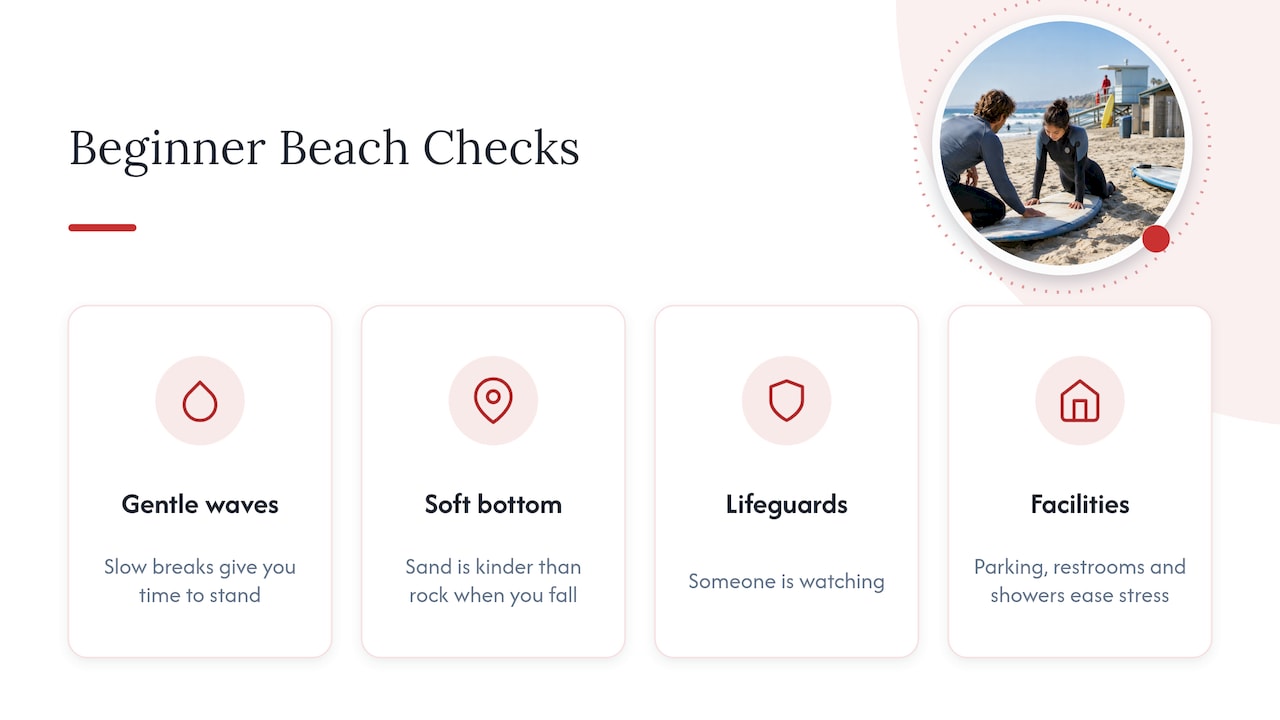
    I look for four things when I send someone out for their first session: gentle waves, a soft bottom, lifeguards and easy logistics. Waves that break slowly give you time to stand up. Sand is a lot kinder than rock when you fall, and you will fall. Lifeguards mean someone is watching. And parking, restrooms and showers mean you’re not stressed before you even get in the water.

    Four checks for choosing a beginner surf beach

    San Diego has plenty of beaches, but only a handful tick all of these boxes. Here are the ones I’d actually point you to.

    La Jolla Shores: the best first day

    If you only remember one name from this guide, make it La Jolla Shores. The City of San Diego describes it as a roughly one-mile sandy beach where summer waves are usually the gentlest of any San Diego beach, with permanent lifeguard stations, parking, restrooms and showers. That combination is hard to beat when you’re carrying a board and a bag and have no idea where anything is.

    Surfline rates La Jolla Shores beginner-to-intermediate, with a sandy bottom. Its guide lists a west or west-northwest swell, east, southeast or south wind, and a medium tide as the best setup. It also notes the spot is less tide-sensitive than Mission Beach or Pacific Beach, which is a nice bonus when you can’t pick your schedule.

    What to look for at the Shores

    • Small, soft waves. Waist-high is plenty for a first session. Overhead days exist here too, and those are not for you yet.
    • Light wind from the land. Offshore or light winds keep the surface cleaner and the waves easier to read.
    • Medium tide. It’s the sweet spot Surfline lists for this beach.
    • Water quality after rain. Surfline says it’s typically okay but can get dicey after rain. If it just poured, I’d wait a bit.

    The Shores is also a busy place. Snorkelers, kayakers and swimmers share the water, so pay attention to which zone is for surfing (more on that below). If you’re curious about the other side of this beach, I wrote up local rules for La Jolla snorkeling and a guide to La Jolla’s seven sea caves, which makes a great post-surf adventure.

    Tourmaline Surfing Park: your first green waves

    Tourmaline, up in Pacific Beach, is where a lot of San Diego surfers cut their teeth. San Diego Magazine calls it a consistent beach break that suits beginners and longboarders, and it points beginners toward the less-crowded sections around Law Street down to the pier.

    That’s good advice. The main peak at Tourmaline can be a crowd of experienced longboarders who know exactly where to sit. As a beginner, you’ll have a better time on the quieter stretch, where you can work on paddling, timing and standing up without feeling like you’re in anyone’s way.

    A few things I’d do here:

    1. Arrive early so you aren’t circling for a spot with a board under your arm.
    2. Watch the lineup for ten minutes before you paddle out. Notice where people sit and where the waves break.
    3. Stay away from the busiest peak, and give anyone already riding a wave plenty of room.

    One local-style tip on tide: a surf rental company’s spot guide suggests medium-high or high tide is best at Tourmaline, while medium tide suits La Jolla Shores. So if you’re doing both, plan the Shores for a different part of the day than Tourmaline.

    San Elijo and Tippers: a step up into North County

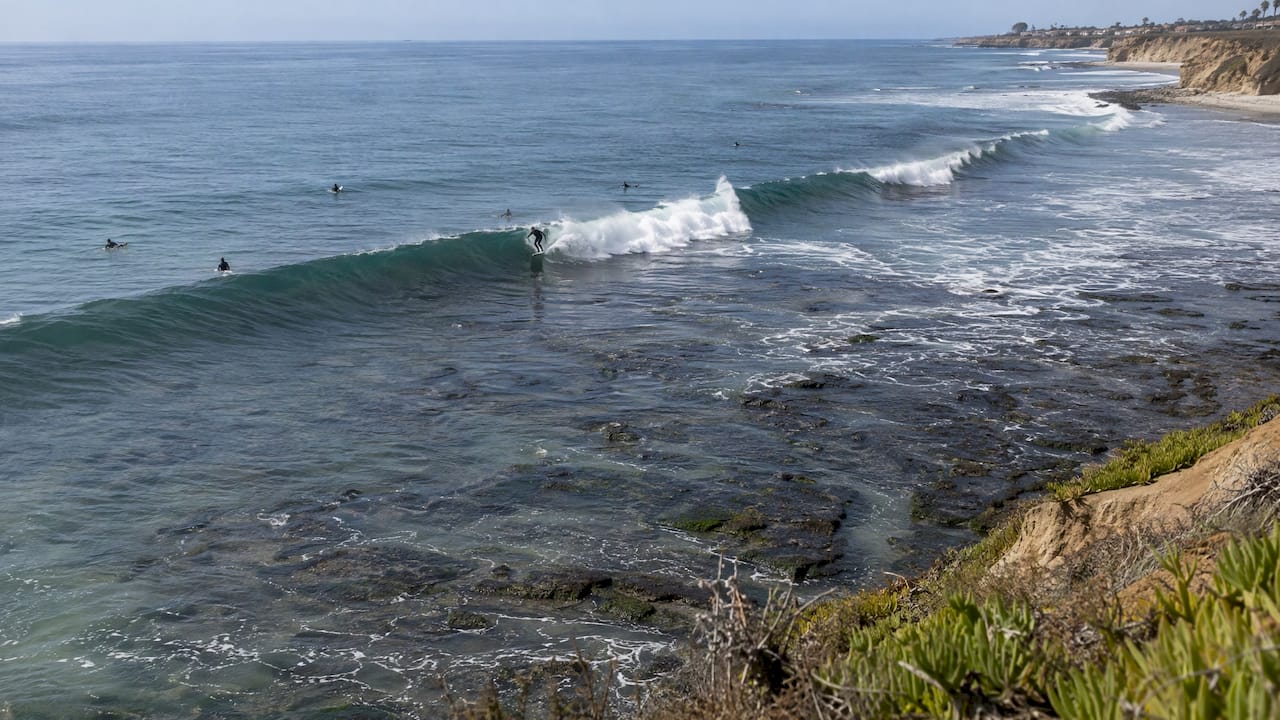
    Once you’re comfortable standing up and turning, North County has some fun options. San Diego Magazine describes San Elijo as a consistent rocky reef break with peeling lefts and rights for surfers of all levels. Tippers is the mellow southernmost peak, and Pipes is the more advanced part of the break.

    I’d call this a second-stage spot. A reef is different from a sandy beach: the bottom is harder and the waves break in more predictable places, which is great for learning to read a wave, but falls are less forgiving. Go with a friend who knows the break, or after a few lessons, and stick to Tippers.

    Peeling wave over the rocky reef at San Elijo

    If you’d rather spend a day exploring the coast around here than chasing waves, our San Diego weekend itinerary pairs nicely with a morning session.

    Other beaches people mention

    You’ll hear a few other names in surf shops and online forums: Mission Beach, Ocean Beach and the Oceanside Harbor area, for example. They can all work on the right day, and the city’s beaches have public parking lots at Mission Bay, Mission Beach, Ocean Beach, Pacific Beach and South Mission Beach, according to the City of San Diego’s beach regulations page. But I’d start at the Shores or Tourmaline, because they’re where beginners and their gear fit in most easily. Some of these other beaches also draw bigger crowds, which means a crowded lineup and less room to fall.

    Quick comparison

    Spot Bottom Best for What to know
    La Jolla Shores Sand Day one, first lessons Lifeguards, restrooms, showers; medium tide is best
    Tourmaline Surfing Park Sand (beach break) First unbroken waves Stay near Law Street toward the pier; busy main peak
    San Elijo (Tippers) Rocky reef Progressing beginners Mellow southern peak; Pipes is more advanced

    How to pick a session

    Choosing the right day matters more than choosing the perfect beach. Here’s how I’d think about it.

    Waves

    Small and slow is the goal. If the surf looks like a wall of water to you, it is probably too big. Surfline lists waist-high to overhead at La Jolla Shores, and the lower end of that range is what you want.

    Wind

    Surfline lists east, southeast or south wind for La Jolla Shores. In general, light wind from the land keeps things tidy. Strong onshore wind chops everything up and makes paddling tiring.

    Tide

    Tide changes how and where waves break. At the Shores, medium tide is the pick. At Tourmaline, the higher end is better. If you only remember one rule, plan around the tide for the beach you chose, not the other way around.

    Your experience level

    Be honest about it. If you can’t yet paddle onto a wave and pop up on whitewater, you’re not ready for a reef break or a crowded peak. Spending a few sessions at the Shores is the fastest way to get there.

    Check before you drive

    Before I leave the house, I look at the forecast and then at a camera. You can compare what you see on live surf webcams with the forecast, which helps you spot whether the surf is smaller or messier than predicted. It’s an easy way to avoid a wasted trip.

    Where to learn: lessons and what a first one looks like

    There are a few ways to learn in San Diego: group lessons run by local surf schools, private instruction, or going out with a friend who surfs. For your first day, I’d go with an instructor. They’ll choose a beginner-friendly spot for the conditions, size a board for you and keep an eye on you in the water.

    A typical first lesson includes a few basics:

    • A beach briefing. You learn how to carry the board, how to lie on it and how to read the waves.
    • Pop-up practice on sand. You rehearse going from lying to standing before you ever get wet.
    • Whitewater time. You practice on waves that have already broken, which are slower and more forgiving.
    • Water safety. Rips, lineup etiquette and how to fall safely.

    Looking for gear? Beginners usually start on a soft, wide foam board and a wetsuit for comfort. A rental from a local shop is a fine way to start, and you can buy later once you know what you like. Since I’m not going to rank businesses here, ask the staff at a shop near your chosen beach what they recommend for the day’s conditions.

    Safety basics before you paddle out

    San Diego is a friendly place to learn, but the ocean is still the ocean. These are the things I would tell my own family.

    Stay near lifeguards

    The City of San Diego says to swim near lifeguards and use signs or ask which zone is for surfing. A checkered flag normally divides zones: one side is for surfboards, the other for swimmers. At permanent lifeguard stations, lifeguards are generally on duty from 9 a.m. to dusk. That’s one more reason to pick the Shores or a beach with a staffed tower. The same city page says the chance of drowning at a lifeguard-protected beach is much lower, at an estimated 1 in 18 million at USLA-affiliated locations.

    Know rip currents

    According to the City of San Diego, rip currents account for about 80% of lifeguard rescues at ocean beaches. If one catches you:

    1. Stay calm.
    2. Swim parallel to the shore until you’re out of the current.
    3. Wave to a lifeguard for help.

    The city also points out that “rip tides” and “undertows” are misnomers: rip currents move seaward and don’t pull people under. That’s a useful thing to know, because it means you don’t have to fight it or panic.

    Don’t dive in headfirst

    In unknown water, check depth and look for obstructions, and enter feet first. The city’s summer safety page warns that diving in headfirst can cause serious injury. Even if you’re excited, wade in.

    Etiquette in the lineup

    Surf etiquette sounds fussy, but it’s mostly common sense:

    • Don’t paddle in front of someone already riding a wave.
    • Keep hold of your board. A loose board is a hazard to people around you.
    • Sit on the shoulder of the crowd, not in the middle of it, while you’re learning.
    • Say sorry when you mess up. Everyone’s been there.

    Parking, timing and making a day of it

    The best beginner beaches are popular, so a bit of planning goes a long way. Public parking lots are available at La Jolla Shores, Mission Bay, Mission Beach, Ocean Beach, Pacific Beach and South Mission Beach, per the city’s beach regulations. I’d still arrive early on weekends and summer days, when lots fill up. Early morning also tends to be calmer than afternoon, though always check the day’s wind and tide.

    After you’re done, there are plenty of ways to round out the day without spending much. Our list of free things to do in San Diego is a good place to start. If the tide is low, tide pools in San Diego are a fun way to spend the rest of the morning. And if you’re a sunrise person, one of our best sunrise spots can make the early alarm worthwhile. For something off the main path, our guide to San Diego’s secret beaches is worth a look once you’ve got your sea legs.

    Staying for the night? We also put together tips on beach camping in San Diego, including tide and fire rules.

    A simple plan for your first month

    Here’s how I’d build skills without rushing.

    1. Session one: Take a lesson at La Jolla Shores. Focus on paddling and popping up in whitewater.
    2. Sessions two to four: Return to the Shores on small days, medium tide. Practice turning your board toward the beach and catching waves earlier.
    3. Sessions five and beyond: Try the quieter stretch near Law Street at Tourmaline and aim for your first unbroken wave.
    4. Later: If you’re feeling steady, visit Tippers at San Elijo with someone who knows the break.

    There’s no hurry. Surfing rewards time in the water more than anything else.

    Perspective: why we send beginners to the Shores first

    We built SoCal Sights around a simple idea: visitors and locals shouldn’t have to dig through endless lists to find the places that feel right. For learning to surf, that means pointing you to the beach where the odds are on your side, and then showing you what else is nearby once the session is done.

    Our community-driven approach is the reason we like this topic. Locals know which stretch of Tourmaline is quiet on a Tuesday, and which corner of the Shores gets crowded with snorkelers. We want those details to reach you, rather than only the headline spots every mainstream guide repeats.

    So our advice is simple: start where there are lifeguards, sand and room to fall, check the conditions, and treat each session as practice. Then explore. San Diego’s coast has far more to offer than waves.

    Joshua

    Want your business in front of San Diego visitors?

    If you run a local business or organize events in Southern California, SoCal Sights is built to put you in front of people who are actively looking for things to do. We offer advertising, featured placements and memberships for local businesses and event organizers. You can read about it on our advertising page.

    Socalsights

    If you’d like to keep exploring first, our Southern California hidden gems guide is a good place to start.

    FAQ

    Is La Jolla Shores beginner surf friendly?

    Yes. Surfline rates it beginner-to-intermediate, and it has a sandy bottom. The City of San Diego says its summer waves are usually the gentlest of any San Diego beach, and it has permanent lifeguard stations. Check conditions first, since water quality can get dicey after rain.

    Where can I learn to surf in San Diego?

    La Jolla Shores is the easiest place to start, followed by the quieter stretch of Tourmaline Surfing Park near Law Street. Many people book a lesson with a local surf school for their first session, so an instructor can pick the spot and board for the day.

    What is the best tide for beginners?

    It depends on the beach. Surfline lists medium tide as best at La Jolla Shores, and a local surf spot guide suggests medium-high or high tide at Tourmaline. Check the forecast for your chosen beach before heading out.

    Is it safe to surf at a beach without a lifeguard?

    I’d stick to beaches with a staffed lifeguard tower while you’re learning. San Diego lifeguards are generally on duty from 9 a.m. to dusk at permanent stations, and the city advises swimming near them and asking which zone is for surfing.

    What should I do if I get caught in a rip current?

    Stay calm, swim parallel to the shore, and wave to a lifeguard for help. The City of San Diego says rip currents move seaward and don’t pull people under, so there’s no need to fight them.

    Sources

  • Apple Picking in Oak Glen: Season, Orchards and Tips

    Apple Picking in Oak Glen: Season, Orchards and Tips

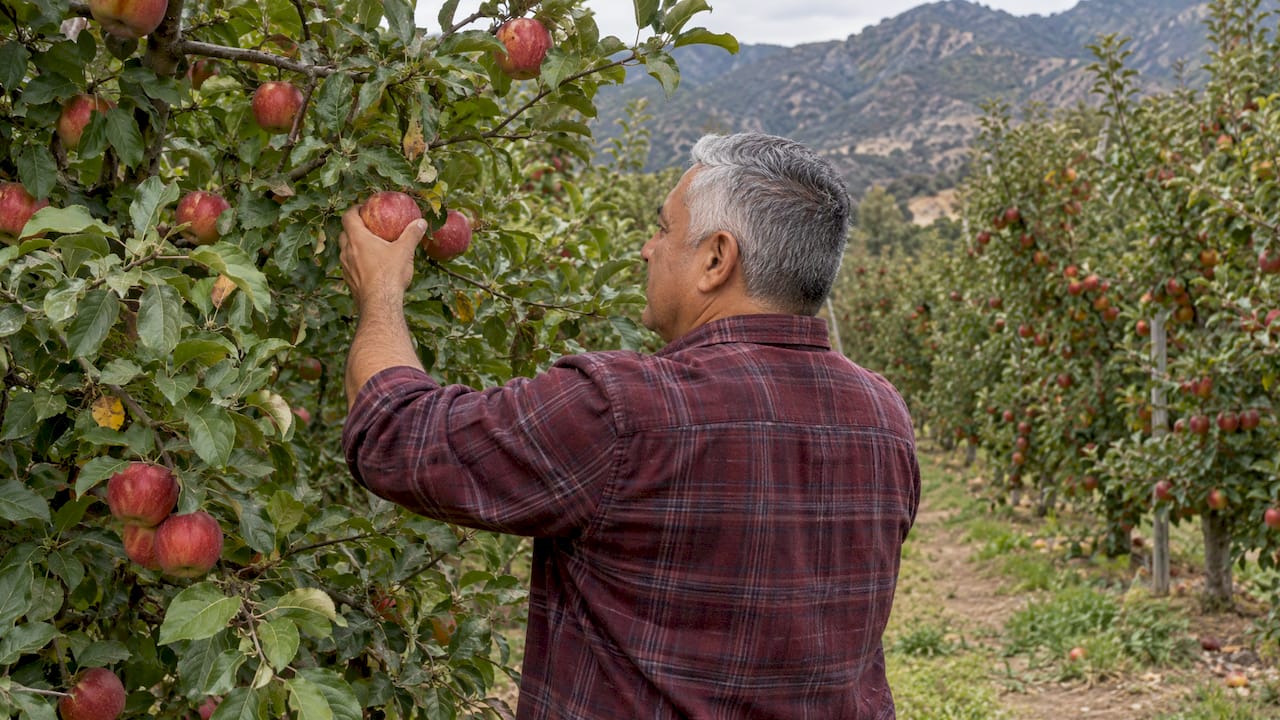
    Yes, you can pick your own apples in Oak Glen, and it’s one of my favorite fall days in Southern California. The season runs roughly from late summer into late November, with the busiest weeks in September and October. Orchards here sell u-pick fruit by the pound, so you fill a bag, weigh it and pay for what you picked. Below you’ll find when to go, what to pick, what to expect at the gate and how to turn a quick orchard stop into a whole day.

    Socalsights
    Find More Southern California Gems
    Planning an Oak Glen apple-picking day? SoCal Sights shares local insights into activities, food spots and unique itineraries across Southern California.

    Explore local recommendations

    TL;DR

    Table of Contents

    When Is Apple Season in Oak Glen?

    Short answer: late summer through November, with the sweet spot from mid-September to late October.

    The farms don’t all say it the same way, which is normal for a crop that depends on weather. Los Rios Rancho lists Oak Glen apple season as August through November. Parrish Pioneer Ranch says its season peaks from September 1 through the end of November, and notes that apples and cider are usually available until January or February. The Los Angeles Times described the traditional season as running from Labor Day to late November.

    Put those together and you get a simple plan:

    • Late August to early September: early varieties start showing up. Fewer crowds, but fewer choices.
    • Mid-September through October: the classic Oak Glen experience. More varieties, more activities, more people.
    • November: the tail end. U-pick can wrap up, and farms may shift toward cider, baked goods and holiday stuff.

    I’m writing this in early November, and that’s a good reminder of how it goes. Los Rios Rancho’s season page says its 2026 apple picking has concluded. If you’re reading this in the off-season, save it for next year and aim for September or October.

    For context, apples nationwide are generally available from late July through early November, according to Food Network. Oak Glen’s season runs a little later than that, which is part of why it feels like such a good fall tradition.

    Where to Pick Your Own Apples

    Oak Glen is a small mountain community above Yucaipa in San Bernardino County, and the orchards are spread along the main road. You’ll see signs for several farms. Two have clear, current information online, so I’ll start there.

    Riley’s Farm

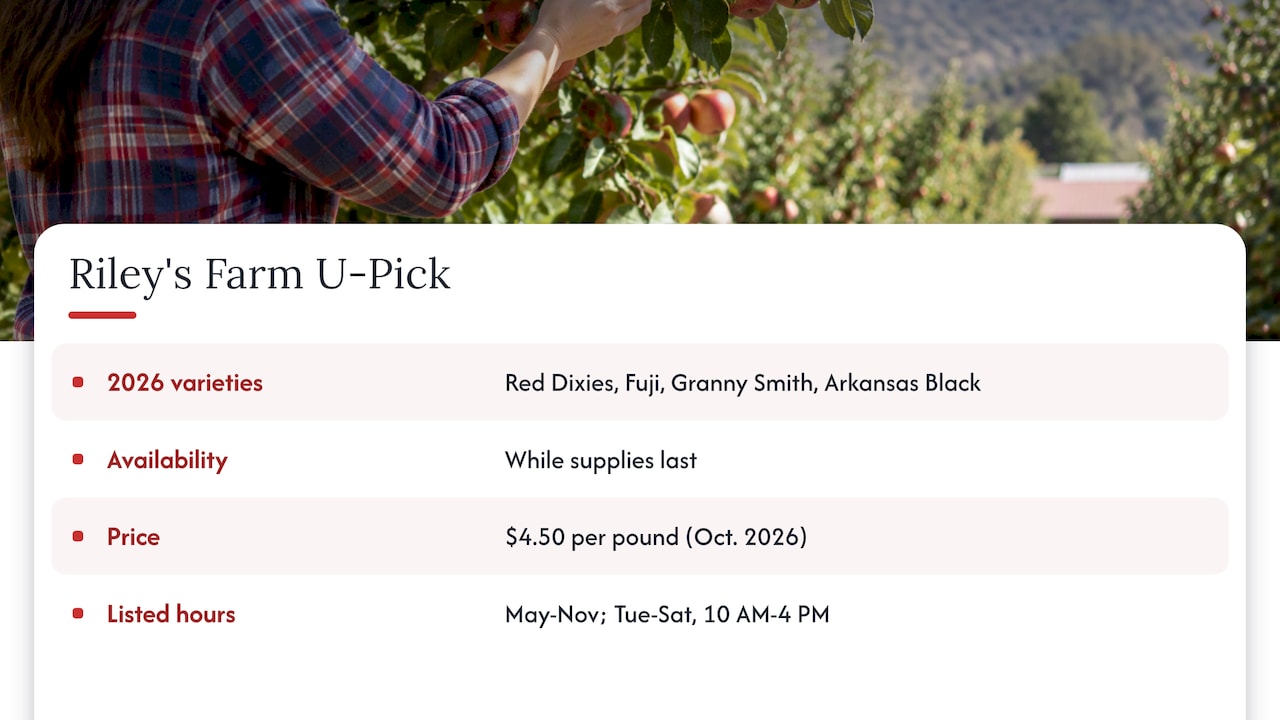
    Riley’s Farm’s official U-pick page posts a 2026 schedule for several apple varieties, including Red Dixies, Fuji, Granny Smith and Arkansas Black. It also says u-pick fruit is available while supplies last, which is the key phrase for the whole area. When a variety is done, it’s done.

    What I like about Riley’s is the focus on flavor. The farm specializes in heirloom apples and, according to its own page, favors varieties for their taste and uses over pretty apples that sit on shelves for months. If you’ve only ever bought apples at the grocery store, an heirloom you pick yourself can taste like a different fruit.

    On price, the same page lists u-pick apples at $4.50 per pound as of October 2026. Prices can change from year to year, so treat that as a guide and check before you go.

    For hours, Riley’s hours and FAQ page has listed u-pick from May to November, Tuesday through Saturday, 10:00 AM to 4:00 PM, and closed on Sundays. That page is older than the u-pick page, so confirm the current days before you plan around a Sunday.

    Riley’s is also known for living-history education and dinner theater, so if you want more than apples, there’s a lot to explore.

    Riley's Farm

    Los Rios Rancho

    Los Rios Rancho is at 39611 Oak Glen Road, Yucaipa, and the farm describes itself as operating year-round. Here’s what its official visitor info says:

    • No reservations required.
    • No admission or parking fees.
    • U-pick apples are sold by the pound.
    • Hours are generally daily from 10:00 AM to 5:00 PM, though u-pick depends on crop availability and seasonal changes.

    That makes it an easy, low-pressure choice when you decide to go on a whim. There’s also a farm kitchen, and the farm lists items like tri-tip sandwiches, BBQ and fresh baked goods. Honestly, that’s a solid lunch plan right there.

    The farm also says that u-pick works as an educational tool, giving families a way to connect with the process that grows their food. If you’re bringing kids, that’s the best part. They get to see where an apple actually comes from.

    Parrish Pioneer Ranch and the others

    Parrish Pioneer Ranch is another Oak Glen stop with its own apple season page, and it’s worth a look if you’re building a day around cider and the late season. You’ll pass other orchards, apple sheds and shops too. Each one has its own rules for u-pick, so ask at the entrance what’s ripe that day.

    What Apples Can You Pick?

    It depends on the week. Each variety has its own ripening window, so a farm might have Granny Smith one weekend and Fuji the next. A few things I tell friends:

    • Check the variety schedule first. Riley’s posts one on its U-pick page. If you want a specific apple, plan around it.
    • Pick for how you’ll use them. Tart apples like Granny Smith are great in pie. Sweeter ones like Fuji are better for snacking.
    • Don’t skip the lesser-known varieties. An apple like Arkansas Black is the kind of thing you won’t often find at a chain grocery store.
    • Pick a little less than you think. At about $4.50 a pound, a big bag adds up, and apples are heavier than they look.

    Here’s a quick cheat sheet for matching an apple to what you want to make.

    What you’re making What to look for Varieties from the posted schedule
    Pie or baking Firm, tart apples Granny Smith
    Snacking Sweet and crisp Fuji
    Something different Heirloom flavor Arkansas Black, Red Dixie

    If you’re not sure, ask the staff. They pick these trees all season and will point you to what’s best that day.

    What to Expect When You Go

    Bring the right stuff

    • A sturdy tote or reusable bag, in case the orchard’s bags run out or you want to carry more.
    • Comfortable closed-toe shoes. Orchard ground can be uneven, and in the fall it can be dusty or damp.
    • Layers. Oak Glen sits up in the mountains, so mornings can feel cooler than the valley below.
    • A card and a little cash, since small stands and shops can differ in what they take.
    • A cooler bag if you plan to pick, then keep exploring for hours.

    Timing your visit

    Weekday mornings are the calmest. Weekends in October are the busiest of the year, so give yourself extra time for parking, lines and a slower pace on the road. If you only have a Saturday, arrive near opening and plan to eat lunch a bit early.

    Keep in mind that Riley’s u-pick days are listed as Tuesday through Saturday, and it’s closed Sundays. Los Rios lists daily hours, so a Sunday trip points you there. Either way, hours can change, so look at the orchard’s page the morning you go.

    Picking etiquette that keeps everyone happy

    • Twist and lift the apple gently instead of pulling hard. It keeps the branch healthy for the next picker.
    • Pick from the trees you’re pointed to, and leave the fallen fruit unless staff say it’s okay to take it.
    • Keep little kids close. Orchards have ladders, tractors and uneven ground.
    • Wash your apples at home before you eat them.

    If the picking is over

    It happens. You get there in November and the trees are bare. Don’t turn around. Parrish says apples and cider are usually available into January or February, and farm kitchens and bakeries keep going after the trees are picked. A warm slice of pie or a cup of cider is still a very good reason to drive up.

    Apple pie and cider at a farm bakery

    Make It a Full Day in Oak Glen

    Apple picking takes an hour or two. The rest of the day is up to you, and Oak Glen is good at filling it.

    1. Start with the u-pick. Go early, fill your bag, and put it in the car or a cooler.
    2. Eat at the farm. Los Rios’s kitchen has tri-tip sandwiches and BBQ, and the baked goods are a perfect dessert.
    3. Do something besides apples. Walk the main road, browse the shops and stands, and stop at whatever catches your eye. If you want history, Riley’s does living-history programs.
    4. Finish with cider. Grab a jug on your way out.
    5. Bake something when you get home. Apples you picked that morning make a very different pie.

    If you’re feeling pie-minded, our guide to Julian pie shops for San Diego day trips is a great next trip for the same craving. Traveling with kids? Our family activities roundup has more ideas for keeping them busy the rest of the weekend.

    Turn It Into a Fall Getaway

    Oak Glen works as a day trip from much of Southern California, but it also pairs well with a longer fall weekend. If you want to build one, our list of weekend getaways from Los Angeles is a good place to start. If you’re the type to stretch a fall trip across state lines, Oak Creek Canyon trip ideas in northern Arizona show how a canyon-and-red-rock weekend can follow an orchard day. And if you’d like more off-the-beaten-path stops closer to home, check out our Southern California hidden gems.

    Want something seasonal and a bit different? Our Oktoberfest in Orange County guide pairs nicely with an October apple weekend.

    Our Take on Oak Glen

    We built SoCal Sights around a simple idea: the best days out in Southern California are usually the ones you don’t see on every top-ten list. Oak Glen is a good example. Yes, plenty of people know about it, but the real fun is in the details: which orchard has the variety you want, where to grab lunch, and which weekday morning is the quiet one.

    That’s why we lean on locals. Our community-driven approach means people who live here share the spots they actually love, and we pass those tips along in plain language so you don’t have to wade through information overload.

    For apple picking, our advice is to pick one orchard as your anchor, check its own page for the current season, then build a day around it. Add a good meal, a slow walk and a stop for cider. That’s an authentic Southern California fall day, and it doesn’t take much planning.

    Joshua

    Get Your Business in Front of Fall Visitors

    If you run a business or organize events in Southern California, the readers who search for things like this are exactly who you want to reach. They’re planning days out, and they’re looking for places to eat, shop and explore.

    SoCal Sights offers advertising, featured placements and memberships for local businesses and event organizers. Pricing isn’t published, so use the page to see how it works and get in touch.

    Socalsights

    If you’d like to see more of what we cover first, browse our local businesses page to see the kinds of places we feature.

    Frequently Asked Questions

    Is there apple picking in Oak Glen?

    Yes. Riley’s Farm lists u-pick apples on its official page, available while supplies last, and Los Rios Rancho sells u-pick apples by the pound during the season. Availability depends on the crop and the week, so check the orchard’s page before you go.

    How much does u-pick cost in Oak Glen?

    Both Riley’s Farm and Los Rios Rancho sell u-pick apples by weight. Riley’s listed $4.50 per pound as of October 2026. Los Rios says it charges no admission or parking fee, though prices can change from year to year.

    Do I need a reservation to pick apples?

    At Los Rios Rancho, no. Its visitor page says reservations aren’t required. Other orchards set their own rules, so check each farm’s page. If a farm lists specific u-pick days, as Riley’s does, plan around those.

    What’s the best month for apple picking in Oak Glen?

    September and October are the peak, with the most varieties and the most activity. Late August can work for early apples, and November is the tail end, when some u-pick wraps up. If you want a calmer visit, go on a weekday morning.

    Can I still get apples if u-pick is finished?

    Often, yes. Parrish Pioneer Ranch says apples and cider are usually available until January or February. Farm shops and kitchens also sell baked goods, so it’s still worth a trip.

    Sources

  • Christmas Markets in Los Angeles: Where to Go in 2026

    Christmas Markets in Los Angeles: Where to Go in 2026

    Los Angeles doesn’t have one big, old-world Christmas market with a clock tower and a chestnut cart. What it has is better suited to the city: a patchwork of craft fairs, artist mercados, light festivals and neighborhood pop-ups spread from Santa Monica to Arcadia to Santa Clarita. For 2026, the big names to know are Enchant Los Angeles at Santa Anita Park, the Renegade Craft Fair in Santa Monica, Jingle Fest in Santa Clarita and the Dreamers Markets pop-ups. I’ll walk you through each, plus a few year-round markets that feel extra cozy in December.

    Socalsights
    Find More SoCal Experiences
    Explore curated insights into Southern California’s activities, food spots, and unique itineraries, including hidden gems shared by locals.

    TL;DR

    • Biggest holiday experience: Enchant Los Angeles at Santa Anita Park in Arcadia, November 20 through December 27, 2026, with a light maze, ice skating and a shopping village.
    • Best for handmade gifts: the Renegade Craft Fair (November 7-8, 2026, Santa Monica) and Jingle Fest in Santa Clarita (November 14, 2026).
    • Most European feel: Think of a pop-up village format, not a permanent market. Pop-up series like Dreamers Markets run across LA, Orange County and San Diego in November and December.
    • Dates shift every year: always confirm on the organizer’s page before you drive. Most of these markets are one- or two-day events.

    Table of Contents

    What a Christmas market means in LA

    If you grew up picturing Nuremberg or Vienna, adjust your expectations before you go. LA’s holiday markets are mostly curated pop-ups: a parking lot, a park or an airport field fills with makers’ booths, food trucks and a DJ or a live band. You get 60-degree sunshine instead of snow, and honestly I love it. You can browse in a T-shirt, grab a warm drink and still feel the season.

    Three flavors show up again and again:

    1. Craft fairs with hundreds of independent artists (think ceramics, prints, candles, jewelry).
    2. Light-and-lights destinations with a shopping village attached, where the market is part of a bigger night out.
    3. Community mercados and neighborhood markets that run on a holiday theme, often free and very local.

    Reddit threads on this topic ask the same thing every year: is there a European-style market near LA? People usually end up pointing to farm-based events outside the city, so it helps to know the pop-up calendar and plan around it.

    The 2026 markets worth planning around

    Here is the quick rundown of what the organizers say for this season. Dates were published for 2026, but small events change hours and locations, so check the linked page the week you go.

    Market Where 2026 dates Best for
    Renegade Craft Fair Santa Monica Airport Interim Open Space November 7-8 Indie makers, free onsite parking
    Jingle Fest Central Park, Santa Clarita November 14, 10 a.m. to 5 p.m. Families, food trucks, big maker crowd
    Enchant Los Angeles Santa Anita Park, Arcadia November 20 to December 27 Lights, skating, shopping village
    Dreamers Markets holiday pop-ups LA, Orange County, San Diego November and December Handmade gifts, packaged treats
    Little Tokyo Farmers’ Market Isamu Noguchi Plaza, Little Tokyo Saturdays through December 26 Produce, culture, a weekly stroll

    Renegade Craft Fair, Santa Monica

    If you want a big dose of independent makers in one afternoon, the Renegade Craft Fair is the one. It lands at the Santa Monica Airport Interim Open Space on November 7-8, 2026, with 275+ curated artists. Parking onsite is free, and the organizers also encourage carpooling, ride services, biking or public transit, which is smart advice on a busy weekend near the Westside.

    This is an early-November event, so it’s perfect for people who like to finish their gift list before December gets chaotic. Bring a tote bag and cash for small booths, just in case.

    Jingle Fest, Santa Clarita

    A little drive north, Jingle Fest ’26 takes over Central Park in Santa Clarita on Saturday, November 14, from 10 a.m. to 5 p.m. The listing mentions 275 artisans and crafters, holiday décor, wood items, custom gifts, food trucks, cocktails, wine and craft beer. Add live entertainment, dancing, Santa, permanent jewelry, face painting, caricatures, magic, juggling, balloon twisting and even snow, and you’ve got an easy family day.

    It’s the closest thing to a festival-style Christmas market on this list, and a good pick if you want kids and adults both entertained.

    Enchant Los Angeles, Arcadia

    Enchant Los Angeles returns to Santa Anita Park from November 20 through December 27, 2026. It’s built around what the organizers call the world’s largest Christmas light maze, plus ice skating, a shopping village and seasonal food and drinks. It’s less a market and more a full evening out, so I’d treat the shopping village as a bonus stop rather than the main event.

    Skater gliding across the Santa Anita rink

    Public ticket sales opened September 8 at 10 a.m. local time, with a choice between General Admission and Premier Passes plus add-on experiences. Popular nights tend to sell out, so book before you commit to a weekend.

    Dreamers Markets pop-ups across SoCal

    If you want a market near where you live, Dreamers Markets runs curated holiday pop-ups across Orange County, Los Angeles and San Diego in November and December. Expect handmade jewelry, ceramics, candles, leather goods, art prints, toys, apparel, packaged chocolate and baked goods, sauces, coffee, tea, beauty products, ornaments and décor. There are usually food trucks, warm drinks, seasonal menus and live music too.

    The organizer says to check its events calendar for the current lineup, and I’d do exactly that, since locations rotate between weekends.

    Markets that feel festive all season

    Some of my favorite December outings aren’t “Christmas markets” at all. They’re regular LA markets that add a little holiday energy.

    LA Plaza de Cultura y Artes: Holiday Artist Mercado

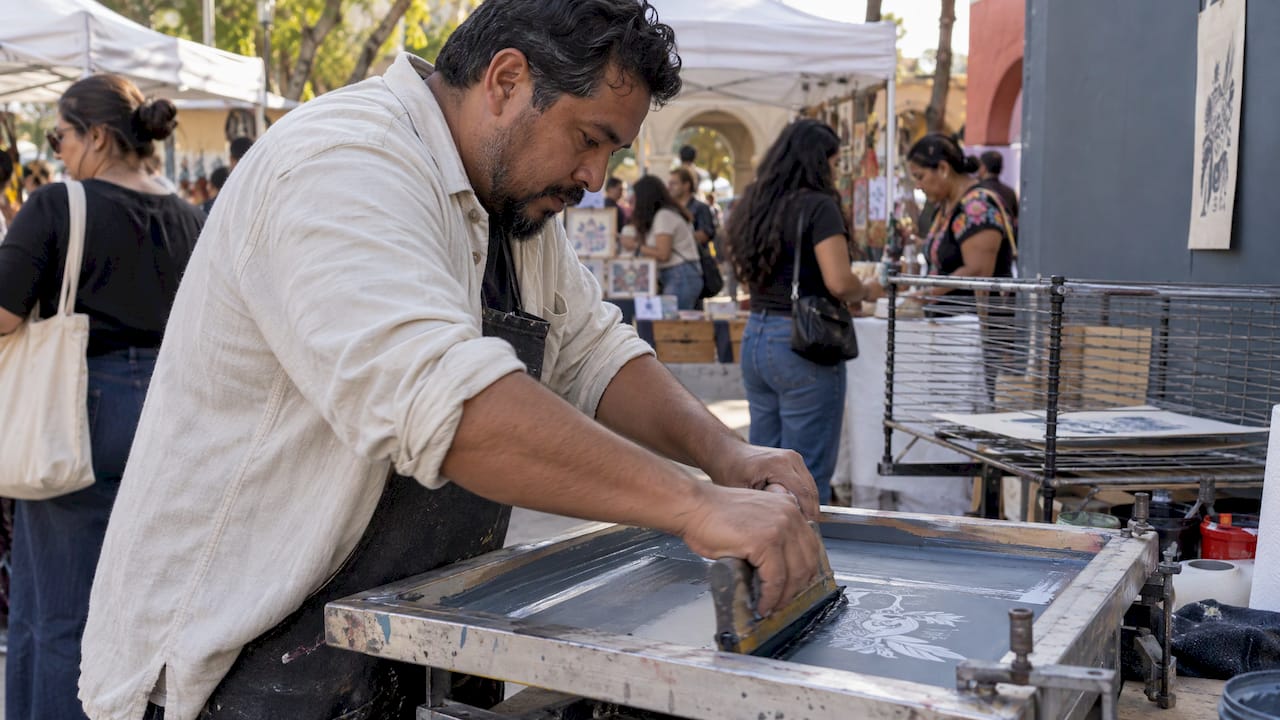
    Downtown, LA Plaza has hosted a free Holiday Artist Mercado with handmade local goods: jewelry, clothing, candles, home décor, prints, ceramics, plants and small-batch treats. The 2025 listing also mentioned DJs, live screen-printing, warm drinks, community booths and a free creative gift-wrapping workshop. Since that’s the most recent listing I could verify, treat it as a pattern to watch for and confirm the 2026 date on the venue’s page.

    Printmaker making a screen print at LA Plaza

    Melrose Trading Post

    On Sundays, Melrose Trading Post brings around 260 local makers, live music, handcrafted goods, vintage fashion, antique furniture and original art. The vendor mix and music change weekly, which is exactly why it’s fun to return. Every ticket supports free arts education for Fairfax High students, so your gift shopping does a little extra good.

    Mercado La Paloma

    In South LA, Mercado La Paloma is a marketplace of family-run stalls serving Ethiopian, Oaxacan, Thai and Yucatán food, alongside vendors selling jewelry, pottery, clothing and folk art from Mexico, Central and South America. It also hosts workshops, dance classes, live music and yoga. Grab lunch, find a handmade gift and call it a day.

    Little Tokyo Farmers’ Market

    Every Saturday through December 26, 2026, the Little Tokyo Farmers’ Market sets up at Isamu Noguchi Plaza with fresh produce, cultural experiences and a real neighborhood feel. Pair it with a walk around the district for a low-key holiday morning.

    Hollywood Farmers’ Market

    The Hollywood Farmers’ Market is an open-air market with seasonal California produce, honey, jams, cheeses, handmade soaps, jewelry, knitted goods, vegan food and gourmet tamales. It also has chef talks, cooking demos, book signings, crafts and tastings. It’s a great place to build a holiday brunch spread or pick up edible gifts.

    How to plan a market day

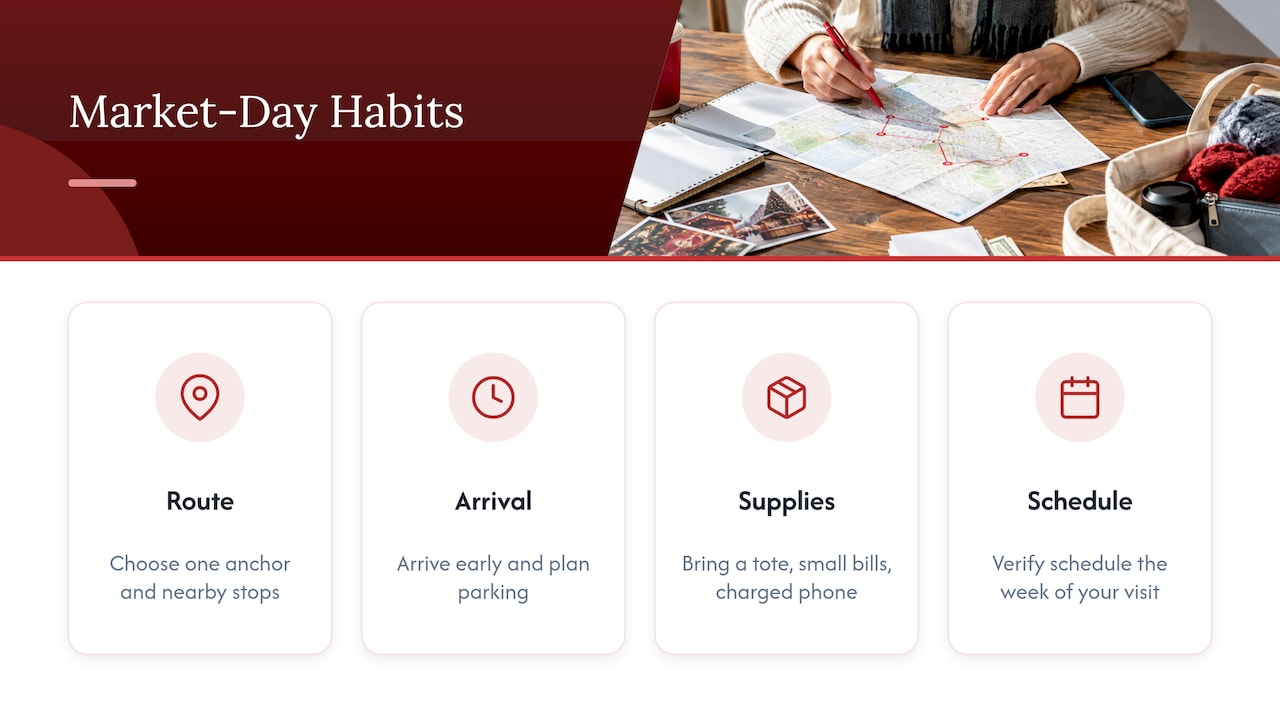
    A good market day in LA is mostly about logistics. A few habits make a big difference.

    Four practical steps for planning a market day

    Pick one anchor and build around it

    Traffic is the real boss in Southern California. Choose one anchor market, then add one or two nearby stops. A Santa Monica craft fair pairs well with a coastal walk, and a Little Tokyo morning pairs well with lunch downtown. For more ideas on where to eat while you’re out, try our guide to Los Angeles food halls.

    Arrive early, park smart

    Big fairs fill up by midday. The Renegade organizers offer free parking in the main lot and additional lots, but they still recommend rideshare, biking or transit. For smaller neighborhood events, assume street parking is tight and give yourself 20 extra minutes.

    Bring a plan for your haul

    Carry a sturdy tote, small bills and a charged phone. Many makers take cards, but connections at outdoor events can be shaky.

    Check the schedule the week you go

    Most of these events are annual or recurring, but exact dates and hours move. Use the organizer pages linked above, not a social media repost from last year.

    Other things to do near the markets

    A market is a good excuse to see the rest of LA in holiday mode. Local travel guides commonly point visitors to The Grove, Rodeo Drive and Beverly Hills lights, Grand Central Market holiday eats, Griffith Observatory and Universal Studios Hollywood as seasonal outings. The Grove’s big tree and festive décor also came up repeatedly when Angelenos shared their favorite photo spots.

    If you’d like something less obvious, a few of our own guides can help:

    Visiting from out of town? Our weekend getaways from Los Angeles can help you stretch the trip.

    Our perspective

    When people ask me for a Christmas market in LA, I understand the picture in their head: mulled wine, wooden stalls, a big tree. I’d gently suggest a different picture. Southern California’s version is made of makers, neighborhoods and sunshine.

    That’s why we built SoCal Sights around local knowledge and community tips rather than a single top-ten list. The best holiday day I’ve had here wasn’t at the biggest event. It was a small mercado where I met a ceramicist, ate something I couldn’t pronounce and left with a gift no mall could match.

    Our approach is to point you toward the markets with real character, explain the practical bits like parking and timing, and leave room for the surprises locals love to share. If you know a pop-up that deserves a spot on this page, we want to hear about it.

    Joshua

    Running a holiday market or local shop?

    If you organize a holiday market, run a shop with seasonal products or host an event for Southern California visitors, you can reach the readers who use guides like this one. We offer advertising, featured placements and memberships for local businesses. See the details on our advertise with SoCal Sights page.

    Socalsights

    We don’t publish a price for this, so reach out through that page to learn what fits your event.

    FAQ

    Is there a European-style Christmas market in Los Angeles?

    LA doesn’t have one permanent, traditional European market. The closest experiences are seasonal pop-ups, such as curated holiday markets and festival-style craft events, plus big light-and-shopping destinations like Enchant at Santa Anita Park. Watch organizer calendars each fall, since village-style markets tend to be one-day events.

    When do Christmas markets in Los Angeles start?

    The 2026 season starts early. The Renegade Craft Fair runs November 7-8, Jingle Fest in Santa Clarita is November 14, and Enchant opens November 20 and runs through December 27. Many pop-up markets cluster in late November and December, so check each organizer’s page for the current schedule.

    Are LA holiday markets free?

    It depends on the event. Community mercados and some pop-ups are free to enter, while light festivals like Enchant use ticketing with General Admission and Premier options. The Little Tokyo Farmers’ Market is a weekly outdoor market, and Renegade offers free onsite parking. Always check the organizer’s page for entry details.

    What can I buy at a holiday market in LA?

    Mostly handmade and small-batch goods: jewelry, ceramics, candles, art prints, apparel, ornaments, leather goods, toys, packaged chocolate and baked goods, coffee and tea. Many markets add food trucks, warm drinks and live music, so you can eat and shop in the same trip.

    Are there holiday markets outside central Los Angeles?

    Yes. Jingle Fest is in Santa Clarita, Enchant is in Arcadia, and Dreamers Markets hosts holiday pop-ups across Orange County, Los Angeles and San Diego. If you’re heading south, our Orange County food halls guide is handy for a lunch stop.

    Sources

  • San Pedro Hidden Gems: 15 Local Spots Worth Finding

    San Pedro Hidden Gems: 15 Local Spots Worth Finding

    San Pedro is the part of Los Angeles where the cliffs, the working port and a tight-knit arts scene all share a few square miles. The best way to see it is to look past the big waterfront names: wander the downtown galleries, find the old neighborhood café, and catch the sunset from a clifftop park most visitors drive right past. Here are the spots I’d send a friend to, with the hours, costs and little tips that make a visit easier.

    Socalsights
    Find More Southern California Hidden Gems
    Explore curated local recommendations for activities, food spots, and unique itineraries across Southern California.

    TL;DR

    • Downtown San Pedro’s First Thursday art walk, House 1002 and the Corner Store are the easiest way to feel the neighborhood’s character.
    • Point Fermin Park, Angels Gate Park and White Point give you ocean views without the crowds of the bigger beaches.
    • Cabrillo Marine Aquarium is free to enter, with a suggested donation, and nighttime grunion viewing at Cabrillo Beach is a local favorite.
    • West Harbor is the new waterfront hangout, with a promenade, rentals and the relocated fish market.
    • Always check hours before you go: park lots, construction and events change.

    Table of Contents

    Start Downtown: Art, Records and Vintage Finds

    Downtown San Pedro is where I’d begin, because it’s walkable and full of places that don’t look like much from the street. Park once, then wander.

    First Thursday ArtWalk

    The First Thursday ArtWalk has been bringing people to the historic core of downtown for nearly 25 years, with more than 30 galleries and studios taking part. As the name says, it happens on the first Thursday of the month. Galleries stay open into the evening, shops put out their best stuff, and the sidewalks fill up with neighbors. Go hungry and plan to wander without a schedule. For the current month’s lineup, check the event’s official page before you head over.

    House 1002

    House 1002 is a home emporium at 1002 S. Pacific Ave., set in a 1920s building that used to be a supermarket. Its 6,000-square-foot showroom is stocked with vintage items, artisanal jewelry, architectural salvage, collectibles, garden accessories and fine art. It’s open Wednesday through Sunday, around noon to 5ish, and closed Monday and Tuesday, so don’t plan it for early in the week. Even if you leave empty-handed, it’s a fun way to spend an hour.

    Warner Grand Theatre

    The historic Warner Grand Theatre is one of downtown’s landmarks. Even a walk past the building tells you this part of town has some history behind it. Check what’s on the calendar if you’d like to see the inside.

    Record shops, guitars and other small stops

    Local roundups of downtown often mention spots like the Arcade Building, a guitar shop and a record store tucked along the same few blocks. I’d treat these as bonus stops between galleries: they come and go, and hours vary, so a quick look at each shop’s own page or social feed before you go saves a wasted trip.

    Neighborhood Food Spots With Real History

    San Pedro’s food scene is a mix of old-school and new. A few places stand out for feeling like they belong to the neighborhood.

    The Corner Store

    The Corner Store is a neighborhood café at 1118 W. 37th St. San Pedro Today reported in November 2023 that it had been open since 1947 and, under new ownership, was offering bottled sodas, candy, gifts, pastries and coffee to go. It’s the kind of stop where you grab a pastry and a soda and feel like a local for ten minutes.

    The Norwegian Church coffee and waffle stop

    Here’s one most visitors don’t know about. San Pedro Today’s local roundup of hidden treasures includes the Norwegian Church’s coffee-and-waffle stop alongside a few other favorites. That list is from 2019, so confirm the current schedule with the church before you make a special trip.

    Green Girl Farms

    The same roundup also points to Green Girl Farms as a local favorite. If you like seeing where your produce comes from, add it to your list, and check its current hours first.

    West Harbor and the fish market

    West Harbor is the newest waterfront destination. It has a walkable promenade, a food collective, and the San Pedro Fish Market in a new 1,500-seat waterfront location while permanent facilities are finalized. You can also rent Surrey bikes and kayaks along the promenade. It’s busier than the other spots on this list, so I’d go on a weekday if you can. Bring a jacket, because the harbor breeze picks up at dusk.

    Parks and Overlooks Without the Crowds

    This is where San Pedro really shines. The cliffs along Paseo Del Mar give you big Pacific views, and most visitors don’t stay long.

    Point Fermin Park

    Point Fermin Park sits at 807 Paseo Del Mar and is run by the City of Los Angeles Department of Recreation and Parks. According to the city, it has hiking trails, ocean views, walking paths, picnic tables and open and shaded space. The park is open 6:30 a.m. to 10:00 p.m., and the parking lot is open seasonally from sunrise to sunset. That last detail trips people up: if you stay for sunset, you may need to park on the street or arrive earlier. Picnic and ceremony permits go through the contact info on the park’s page.

    The historic lighthouse is right there, so it’s an easy pairing. If you like spooky old places, here’s a guide to visiting haunted places in Los Angeles the respectful way, without trespassing.

    Angels Gate Park

    Angels Gate Park is open from 6:30 a.m. to 10:00 p.m., and its parking lot is open from sunrise to sunset. Same tip as above: if you’re planning a late visit, don’t count on the lot.

    White Point and Royal Palms Beach

    White Point/Royal Palms Beach remains open to the public during infrastructure improvements through 2027, though parking is limited because of construction. Go early, expect a short walk, and check the county page for current conditions.

    Peck Park Canyon

    Peck Park Canyon’s Ray Patricio Trails made the San Pedro Today hidden treasures list. It’s a good pick if you want a quieter walk that feels a world away from the harbor.

    Averill Park

    Averill Park comes up again and again when locals share their picks for visitors, including in a Reddit thread of recommendations. It’s a laid-back neighborhood park, perfect for a break between bigger stops.

    Beach, Tide and Wildlife Stops

    Cabrillo Marine Aquarium

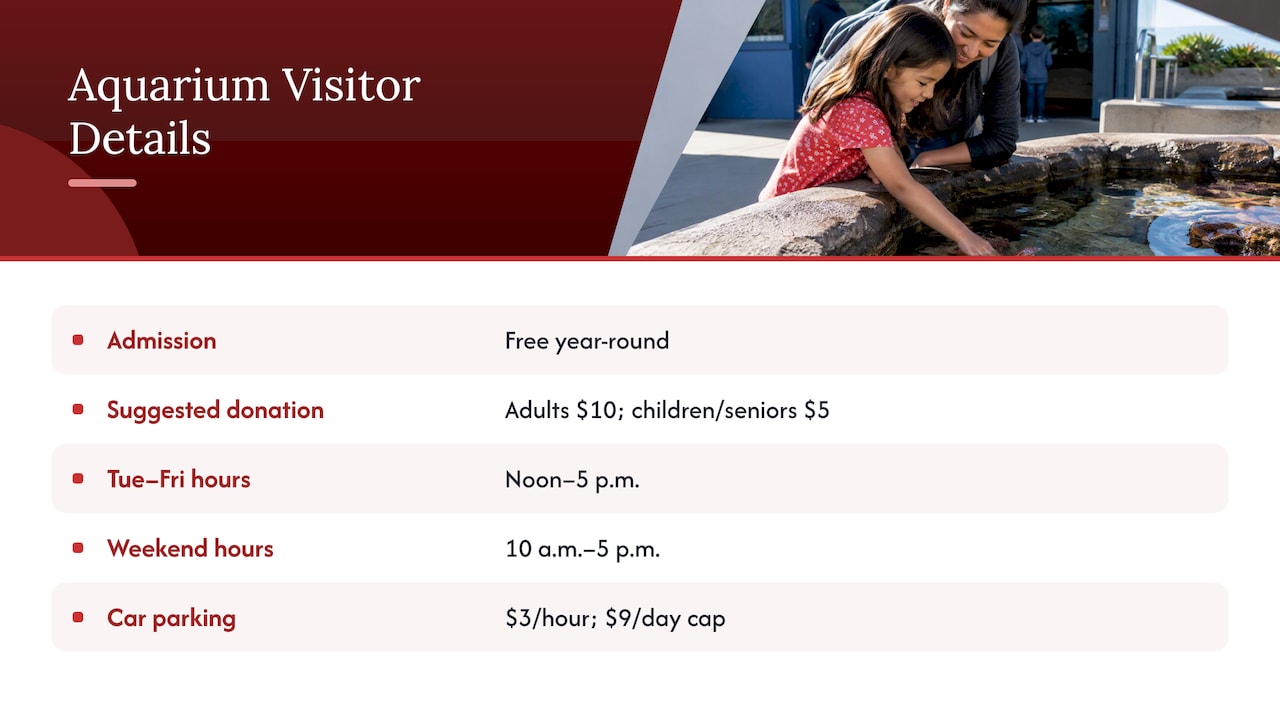
    This one’s a favorite of mine because it costs so little. Cabrillo Marine Aquarium, at 3720 Stephen M. White Drive, is free year-round, with a suggested donation of $10 for adults and $5 for children and seniors. Hours are Tuesday to Friday noon to 5 p.m. and Saturday and Sunday 10 a.m. to 5 p.m. Groups of more than 15 need a reservation. Cabrillo Beach parking is $3 per hour, capped at $9 a day for cars, and it’s card payment only.

    If tide pools are your thing, our guide to Palos Verdes tide pools covers best times and family safety, and it’s just up the coast.

    Cabrillo Marine Aquarium

    Grunion viewing at Cabrillo Beach

    Nighttime grunion viewing at Cabrillo Beach shows up on San Pedro Today’s list of lesser-known things to do. Grunion runs happen on specific nights, so check the official grunion run schedule from the state before you plan an evening around it, and dress warmly.

    Salinas de San Pedro Salt Marsh

    The same list recommends birdwatching at the Salinas de San Pedro Salt Marsh. Bring binoculars and go in the morning, when it’s quiet.

    Waterbird foraging in the Salinas de San Pedro Salt Marsh

    Murals, Classes and Offbeat Experiences

    If you like your travel a little off the map, a few other ideas from San Pedro Today’s activity roundup:

    • Julie Bender 25th Street Mosaic Mural: a colorful public art piece you can enjoy for free.
    • Blue Water Clay: ceramics classes if you’d rather make something than just look.
    • Local events: the Mary Star Fiesta Ferris wheel and the annual Polar Bear swim are fun to watch, or join if you’re brave.

    Another worthwhile local tradition is San Pedro’s Day of the Dead celebration, which lists music, art, food, altars, a Catrina contest, kids’ activities and free trolley rides. It’s held in late October, but dates shift, so use the official site for the current year.

    Two more places from the hidden treasures list are worth knowing: the San Pedro World War II Memorial at Green Hills Memorial Park and the Los Angeles Maritime Museum’s commercial-fishing exhibit. Both tell the story of a town built around the water and the work done on it.

    A Simple Way to Plan Your Day

    Here’s a relaxed route that mixes a bit of everything:

    1. Morning: Coffee and a pastry at the Corner Store, then a walk at Point Fermin Park.
    2. Midday: Cabrillo Marine Aquarium, then a stroll on the beach.
    3. Afternoon: Browse House 1002 and the downtown galleries (Wednesday through Sunday).
    4. Evening: Dinner at West Harbor, then a walk along the promenade. On the first Thursday of the month, swap dinner for the ArtWalk.

    A few practical notes:

    • Parking lots at several parks close at sunset, so build your timeline around that.
    • The aquarium is closed Mondays, so avoid that day for the Cabrillo stops.
    • Bring layers. The coast is often cooler than inland LA.

    Our Perspective

    San Pedro is one of those places that rewards curiosity. The big attractions get plenty of attention, but the stuff I love most is small: a café that has been around for decades, a gallery you stumble into, a park with no line at the gate.

    That’s why we built SoCal Sights around local knowledge. We want to cut through the information overload and point you to places that feel real, and we want locals to chime in with their own favorites. If you know a corner of San Pedro that deserves a mention, that’s exactly the kind of tip our community is for.

    If you like this style of guide, our pieces on unique things to do in Los Angeles and hidden Southern California beaches work the same way.

    Joshua

    Run a Local Business or Event in San Pedro?

    If you own a shop, café, gallery or event in San Pedro, our readers are exactly the people looking for places like yours. We offer advertising, featured placements and memberships for local businesses and event organizers who want to reach visitors and residents across Southern California. You can see the options on our advertise with SoCal Sights page.

    Socalsights

    To go further, try our Long Beach hidden gems guide, which is a short drive east, or our Southern California hidden gems roundup.

    FAQ

    What is San Pedro best known for?

    San Pedro is known for its working port, cliffside parks, the Point Fermin area and a strong arts community downtown. Most visitors come for the waterfront, but the neighborhood’s galleries and old-school cafés are what make it special.

    Are there free things to do in San Pedro?

    Yes. Cabrillo Marine Aquarium is free year-round, with a suggested donation, and parks like Point Fermin and Angels Gate are free to enter. Murals and the downtown art walk cost nothing either, though beach parking at Cabrillo has a fee.

    When is the best time to visit San Pedro’s parks?

    Mornings are usually quietest. Both Point Fermin and Angels Gate are open 6:30 a.m. to 10:00 p.m., but their parking lots only run from sunrise to sunset, so plan around that.

    Is White Point open?

    White Point/Royal Palms Beach is open to the public during improvements through 2027, but parking is limited due to construction. Check the county’s page before you go.

    What should I do on a first visit?

    Pair a clifftop park with the aquarium, then spend the afternoon downtown. If it’s the first Thursday of the month, stay for the ArtWalk.

    Sources

  • Catalina Camping Guide: Campgrounds, Booking and Packing

    Catalina Camping Guide: Campgrounds, Booking and Packing

    Camping on Catalina Island means picking one of five designated campgrounds, booking it ahead, and getting yourself and your gear there by ferry and on foot. Three are run by the Catalina Island Conservancy (Black Jack, Little Harbor and Parsons Landing), and two sit close to the island’s two towns (Hermit Gulch above Avalon and the campground at Two Harbors). I love this trip because you get a Southern California island at night, after the day-trippers have gone home. Here is how to choose a campground, book it, and show up ready.

    Socalsights
    Find More Southern California Gems
    Explore local recommendations for memorable activities, food spots, and lesser-known places across Southern California.

    Explore local recommendations

    TL;DR

    • Catalina has five campgrounds. Hermit Gulch and Two Harbors are the easiest. Black Jack, Little Harbor and Parsons Landing are the hike-in, more remote options.
    • Book early. The Conservancy says to reserve as early as you can, ideally in January, because sites fill fast.
    • Fees are charged per person, per night. A free hiking permit from the Conservancy is required for hikers.
    • Fires are allowed at Little Harbor, Two Harbors and Parsons Landing, but not at Black Jack. Water and firewood are ordered with your reservation.
    • Pack for hills, wind and no shortcuts: you carry in what you need, and you carry out your trash.

    Table of Contents

    The five Catalina campgrounds at a glance

    Most of Catalina is protected wilderness, so camping happens at a short list of designated sites. The Conservancy manages three of them along the Trans-Catalina Trail: Black Jack, Little Harbor and Parsons Landing. The other two are Hermit Gulch and Two Harbors. Here is how I would sort them.

    Campground Setting How you get there Best for
    Hermit Gulch Canyon just above Avalon Walk uphill from town First-timers, families, an easy base for Avalon
    Two Harbors Village at the island’s narrow isthmus Ferry to Two Harbors, then a short walk Beginners who want a store, beaches and water sports nearby
    Black Jack Pines and eucalyptus, inland and high Hike-in (or reach by trail) Quiet nights, big views, trail hikers
    Little Harbor Sandy beachfront on the west side Hike-in Beach camping with room to roam
    Parsons Landing Secluded beach, primitive sites Hike or kayak Solitude and sunsets

    None of these is a drive-up campground. Even the easy ones involve a ferry and a walk, which is a big part of the charm.

    Hermit Gulch: the in-town option

    If you want camping without giving up Avalon’s restaurants, Hermit Gulch is the one. It is the only campground near the main town, and it makes a good first Catalina trip because you can wander down for dinner and be back in your tent by dark.

    The Conservancy notes that for midweek stays at Hermit Gulch from November through March, you book by phone with the Catalina Island Company booking office at 310-510-4205. Outside that window, reserve online. Check the Catalina Island Company’s official page for the current fees and rental gear, since those change.

    If Avalon is your focus, our Avalon-focused Catalina day trip and the Friday to Sunday Avalon weekend itinerary pair nicely with a night or two at Hermit Gulch.

    Two Harbors: the easy “real island” camp

    Two Harbors is the island’s small, laid-back village on the isthmus. It is my pick for people who want the quiet side of Catalina without a long backpack. You get a camp within walking range of a small village, beaches, and snorkeling and kayaking nearby. The Conservancy’s own trail guide treats Two Harbors as a key stop on the Trans-Catalina Trail, with Little Harbor sitting 5 miles away and Parsons Landing 6.5 miles in the other direction.

    It is also the natural base if you want to try just one hike-in night. Sleep at Two Harbors, hike to a more remote beach for a night, and come back.

    Black Jack: pines, ridgeline and no campfires

    Black Jack sits among pine and eucalyptus trees near Mt. Orizaba, the island’s highest peak, at about 1,600 feet above sea level with eleven campsites. It feels completely different from the coast: cooler, quieter, and a long way from either town.

    One rule to plan around: no fires are allowed at Black Jack, while they are allowed at Little Harbor, Two Harbors and Parsons Landing. Bring a stove and warm layers, because evenings up high can feel colder than you expect from a Southern California beach trip.

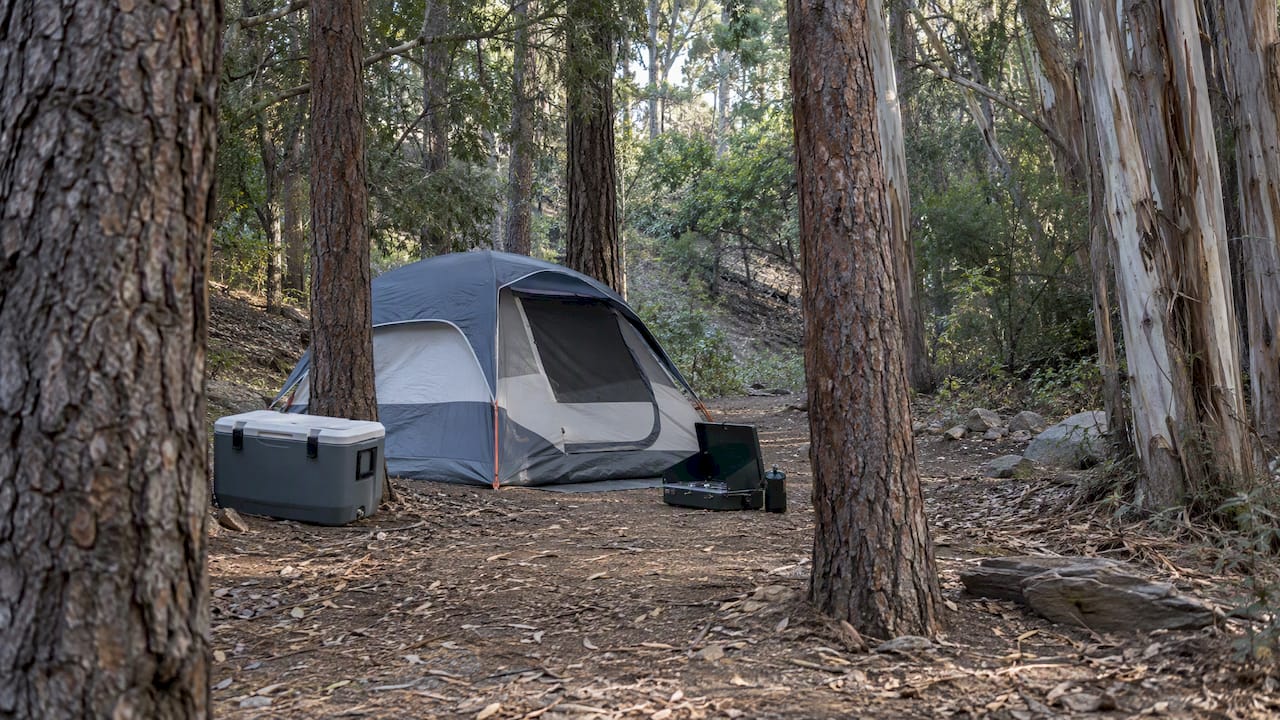
    Tent and stove among Black Jack trees

    Little Harbor: beachfront and easy to love

    Little Harbor is the one the Conservancy calls out as a blend of camping and beach fun, and it has a reputation to match. It sits about seven miles east of Two Harbors and 16 miles from Avalon, with a sandy beachfront and plenty of recreation. On the Trans-Catalina Trail, the stretch from Black Jack to Little Harbor is 8 miles, which gives you a sense of how much walking is involved from the interior.

    What I like: you can drop your pack, then spend hours swimming, beachcombing, and watching the sunset from sand rather than a parking lot. Fires are allowed here, so campfire dinners are on the table (see the rules below).

    Parsons Landing: the remote beach

    Parsons Landing is the most secluded of the group. It is a beach camp about seven miles west of Two Harbors, and its eight primitive campsites each accommodate up to eight people. You get there by a moderately difficult hike or by kayak.

    Be ready for primitive. There is no running water and only a pit toilet, so water comes from the lockers you order with your reservation. In return, you get a quiet beach and one of the best sunsets I know of in Southern California.

    How to book a Catalina campsite

    The booking rhythm matters more than anything else on this trip, so here is the order I would follow.

    1. Pick your nights and your campground. Decide whether you want the easy route (Hermit Gulch or Two Harbors) or a hike-in night.
    2. Book campsites first, then the ferry. The Conservancy advises planning and booking as early as possible, with January the best time to book because sites fill quickly. If you are stringing campgrounds together on consecutive nights, that is where it gets tricky. If your dates are taken, the Conservancy suggests trying the route in reverse.
    3. Order water and firewood with your reservation. On the trail, each locker has 2 gallons of water and one bundle of firewood when you book water.
    4. Get your free hiking permit. A mandatory, free hiking permit is required for all hikers on the island, provided by the Conservancy.
    5. Adjust numbers if plans change. Fees are per person, per night, and you can change the number of occupants after booking by calling or emailing the Conservancy’s office.

    No spontaneous “find a spot and pitch a tent” camping here. Everything is reserved, and the permit is part of how rangers keep hikers safe: permits let rangers contact hikers in danger, for example during wildfires, damaging winds or heavy rain.

    What camping on Catalina costs

    Fees at every campground are charged per person, per night, not per site. Exact amounts change with the season and with the operator, so confirm them on the booking page when you reserve. Here is what I can tell you without guessing:

    As a rule of thumb, budget for campsite fees for every person every night, plus ferry fares, plus food that costs island prices. The cheapest trips are the ones where you bring most of your food from the mainland.

    Getting to the campgrounds

    Catalina is an island, so every trip starts with a boat. Most campers ferry from the mainland to Avalon or Two Harbors, then travel from there.

    To Hermit Gulch: ferry to Avalon and walk uphill from town. If your gear is heavy, ask about a luggage service at the landing, since a hilly walk with a full bag is no fun.

    To Two Harbors: ferry directly to the village and walk to the campground. You still go up and down hills, so a small foldable wagon can help, though some sites are a bit of a haul.

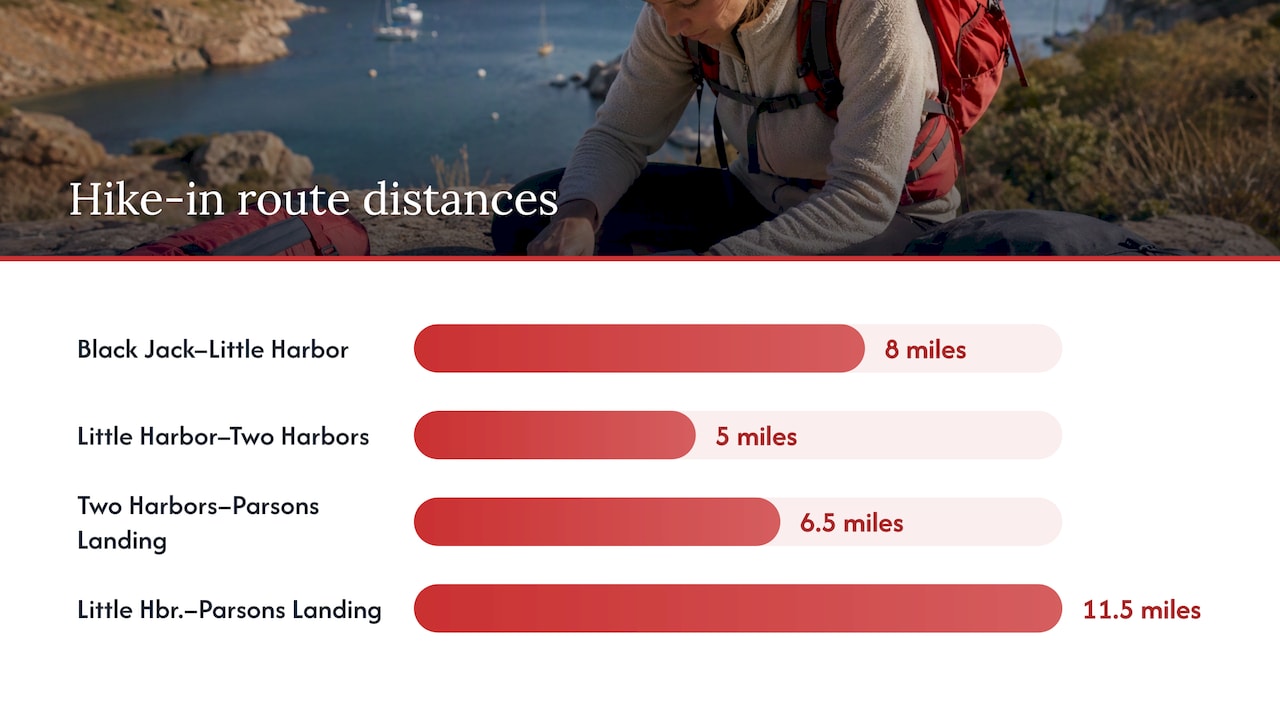
    To the hike-in sites: you walk. A few distances from the Conservancy’s route breakdown are useful for planning a day’s effort:

    • Black Jack to Little Harbor: 8 miles
    • Little Harbor to Two Harbors: 5 miles
    • Two Harbors to Parsons Landing: 6.5 miles
    • Little Harbor to Parsons Landing: 11.5 miles

    Those are real miles with real elevation, in sun. Start early and carry more water than feels sensible. If you would rather skip the trail, Parsons Landing can also be reached by kayak.

    If you are comparing island camping trips, our guide to staging for Channel Islands camping walks through how to plan around boat schedules and cancellations, and much of that thinking applies here too.

    Getting to the campgrounds

    Rules that keep Catalina wild

    Catalina’s interior belongs to the Conservancy, and the rules are simple and worth following. Visitors to Conservancy lands must obey posted signs and instructions from rangers, and may not feed, approach or harass wildlife. The bison and foxes are wild, however relaxed they look.

    If you bring a dog, the Conservancy requires that pets stay on a leash, that you collect all waste, and that vaccinations are current (rabies, distemper combo and Bordetella). Check the permits page before you go, since requirements are updated.

    A few habits I follow on every trip:

    • Store food in the provided lockers or your sealed bags, never in your tent.
    • Pack out all trash.
    • Keep fires small and only where allowed, in the provided rings.
    • Stay on trails and give animals space.

    What to pack for Catalina camping

    This trip is easier if you pack for wind, sun and steep trail, and then trim. Here is my list.

    Shelter and sleep

    • A tent that handles wind, with good stakes
    • Sleeping bag rated for cool nights, especially at Black Jack
    • Sleeping pad and a small pillow

    Food and water

    • A compact stove and fuel (essential at Black Jack, where there are no fires)
    • Pre-ordered water for sites without running water, plus a refillable bottle
    • Simple meals you can cook in one pot

    No matter where you camp, water is the thing that sneaks up on you. This packing list for remote campsites is a good reminder of how much to plan for each day when taps are far away.

    Trail and safety

    • Sturdy shoes and a hat
    • A headlamp with spare batteries
    • Sunscreen and a first-aid kit
    • A printed or offline map
    • Your confirmed permit and reservation details

    Comfort extras

    • A foldable wagon for the walk-up sites
    • A warm layer, even in summer
    • A small trash bag to pack out your trash

    If you do not own camping gear, ask the campground operator what it rents. Some Avalon and Two Harbors options offer gear, which is a good way to try Catalina camping without a big purchase.

    What to do once you are camped

    The campground is the base, and the island is the activity.

    • Hike a piece of the Trans-Catalina Trail. You don’t need to do all of it. A day hike from camp covers some of the best views.
    • Swim and snorkel. Little Harbor and Two Harbors both put you right near the water.
    • Kayak. Parsons Landing is reachable by kayak, and Two Harbors is a natural launch point.
    • Watch the sunset from the sand. Beach camps make this the daily event.
    • Stargaze. With no city glare, Black Jack and Parsons Landing get dark in a way coastal Southern California rarely does.
    • Add a town day. Spend a day in Avalon for food and shops; our Catalina weekend itinerary shows one way to do it.

    If you love getting away from the crowds, see our list of hidden Southern California beaches locals use for more quiet shoreline ideas back on the mainland.

    Our take on camping Catalina

    We built SoCal Sights because most travel guides send everyone to the same handful of places, and the best parts of Southern California tend to be the ones people mention to a friend. Catalina camping is one of those.

    Our advice is to pick your campground for the kind of night you want, not the kind of trip you think you should take. A first-timer who sleeps at Hermit Gulch and wanders Avalon at dinner has a better trip than someone who overreaches on a long hike-in and spends the weekend exhausted.

    We also think local knowledge beats information overload. That is why we focus on curated, community-driven picks, with logistics you can actually use: book early, order your water, and bring a stove. If you have a favorite Catalina site or a tip that worked for you, that is exactly the kind of thing we want to share.

    Joshua

    Reach Southern California travelers with SoCal Sights

    If you run a local business, tour, rental shop or event that serves Southern California visitors and residents, SoCal Sights is built to put you in front of people looking for authentic things to do. Featured placements, advertising and memberships are available through our advertising and membership page.

    Socalsights

    We do not publish a price for it, so reach out through the page to learn what fits your business.

    FAQ

    Can you camp anywhere on Catalina Island?

    No. Camping happens at designated campgrounds, and every site needs a reservation. Hikers also need the Conservancy’s free hiking permit. Plan your campground and dates before you board the ferry.

    Which Catalina campground is best for beginners?

    Hermit Gulch and Two Harbors are the easiest because they are the two that are not remote hike-in camps. Hermit Gulch keeps you close to Avalon, and Two Harbors gives you a quieter village feel with beaches nearby.

    Are campfires allowed on Catalina?

    Sometimes. Fires are allowed at Little Harbor, Two Harbors and Parsons Landing, but not at Black Jack. Order firewood with your reservation, since a bundle costs $14, and always follow posted signs and ranger instructions.

    When should I book a Catalina campsite?

    As early as you can. The Conservancy recommends booking in January because the campsites fill quickly, especially if you want consecutive nights along the trail. If your dates are taken, try the route in reverse.

    Can I bring my dog camping on Catalina?

    On Conservancy lands, dogs must be leashed, owners must collect all waste, and vaccinations must be current for rabies, distemper combo and Bordetella. Check the Conservancy permits page for the latest rules before you go.

    Sources