Month: August 2026

  • 5 Local Rules for La Jolla Snorkeling: Entry Points and Real Time Checks

    5 Local Rules for La Jolla Snorkeling: Entry Points and Real Time Checks

    Yes, La Jolla is one of the best shore-access snorkeling spots in Southern California. Pick La Jolla Cove if you’re a confident swimmer chasing reef life and sea lions up close, or head to La Jolla Shores if you want a gentle sand-bottom entry and a good shot at spotting leopard sharks. Either way, check conditions with a lifeguard first, and if you’re new to snorkeling, a guided tour takes the guesswork out of your first outing.


    TL;DR:

    • Snorkelers with more water confidence should prioritize La Jolla Cove for reef exploration and sea lion sightings, while beginners and families are better suited for Shores’ sandy, sheltered entry.
    • Conditions are best before 10 a.m. when the wind is calm, with late summer to early fall offering the warmest and clearest waters, though year-round snorkeling is possible with a wetsuit.
    • Checking real-time surf and wind conditions with lifeguards is essential before entering, as changing weather can quickly turn ideal conditions into unsafe or murky water.
    • Protecting the marine environment requires avoiding touching or removing marine life, sticking to reef-safe sunscreen, and respecting no-collection rules within the reserve.
    • Experienced snorkelers should plan their visit early in the morning, especially if they want to explore the Cove’s caves, while beginners should focus on Shores’ calmer waters and easier access.

    Table of Contents

    Where to Snorkel in La Jolla: Cove vs. Shores

    Ask any local where to go snorkeling in La Jolla and you’ll get one of two answers, and the right one depends entirely on your comfort in open water.

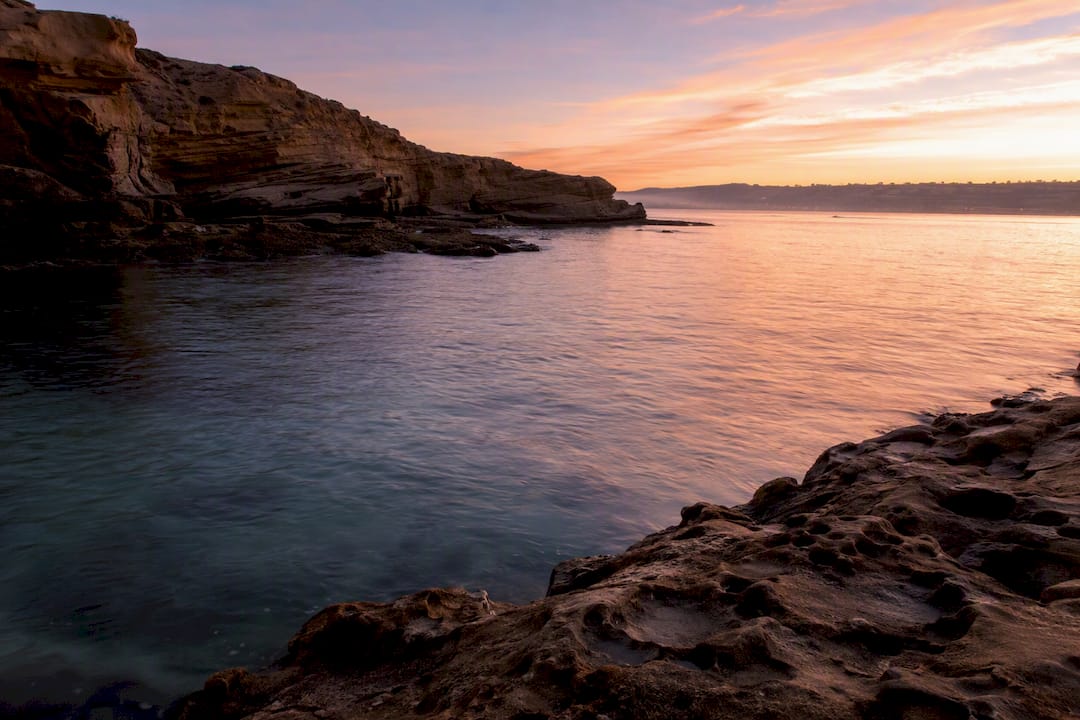
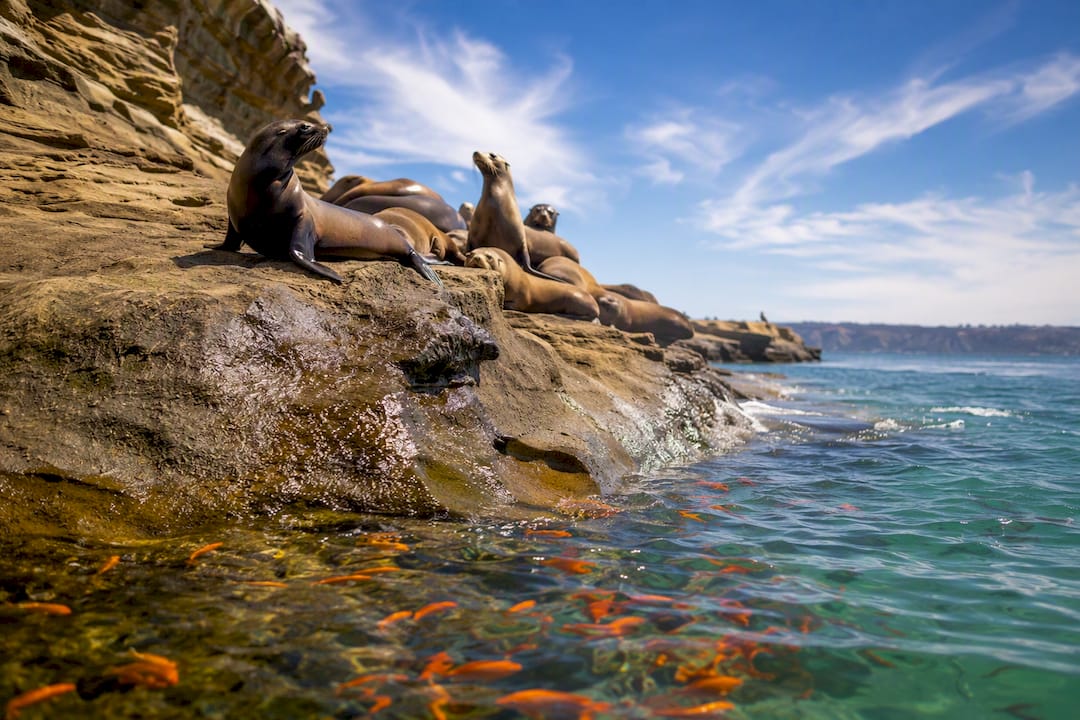
    La Jolla Cove is the small, sheltered cove tucked below Scripps Park, and it’s the spot most people picture when they think of snorkeling here. You climb down a short set of stairs from the park, wade past a narrow strip of sand, and you’re immediately swimming over a rocky reef. There’s no long swim required to find something interesting. Sea lions haul out on the rocks just north of the Cove and often cruise right past snorkelers, and the kelp beds close to shore hold garibaldi, calico bass, and the occasional ray. It’s compact, it’s scenic, and it rewards people who are steady in the water.

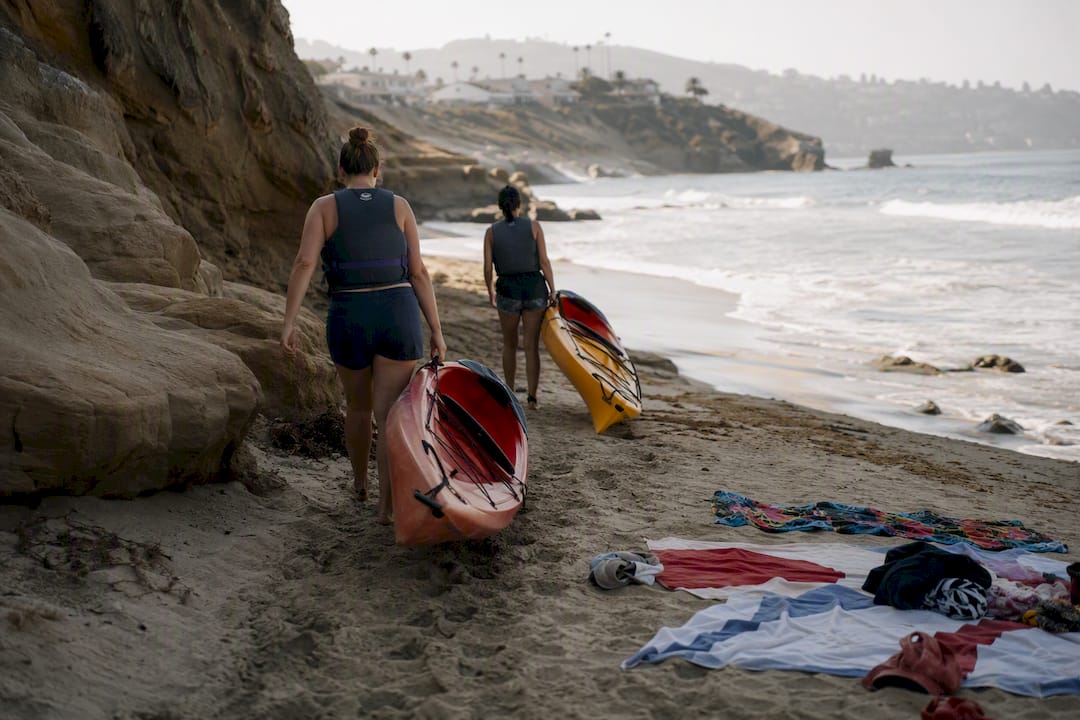
    La Jolla Shores is a different animal entirely. It’s a long, flat sandy beach with a gradual entry, which makes it far more forgiving for beginners and families. The stretch near the Marine Room restaurant is the classic entry point, and the sand flats just offshore are where leopard sharks gather, especially in warmer months. Shores is also the launch point most guided kayak-and-snorkel trips use, since the calmer water makes it easier to paddle out before dropping into the water.

    A quick way to decide between them:

    • Choose the Cove if you’re comfortable treading water over rocks, want reef structure, and are hoping to see sea lions.
    • Choose Shores if you’re a beginner, snorkeling with kids, or specifically want a calmer, sandy-bottom experience.
    • Bring a flotation vest to either spot if you tire easily. Just know the Cove’s protected zone restricts inflatable devices in certain areas, so check current rules before you strap one on.
    • Go with a group at the Cove, since the reef access points can get crowded and current can shift quickly near the rocks.

    Both beaches sit inside the San Diego-La Jolla Underwater Park, a protected reserve that’s the actual reason the water here holds so much life compared to open, unprotected coastline nearby.

    How Do You Know if Conditions Are Good for Snorkeling?

    Morning is almost always your best window. Wind tends to stay calm before 10 a.m., which keeps the surface glassy and visibility clear. Once the afternoon sea breeze kicks in, chop stirs up sand and cuts visibility fast, sometimes down to just a few feet.
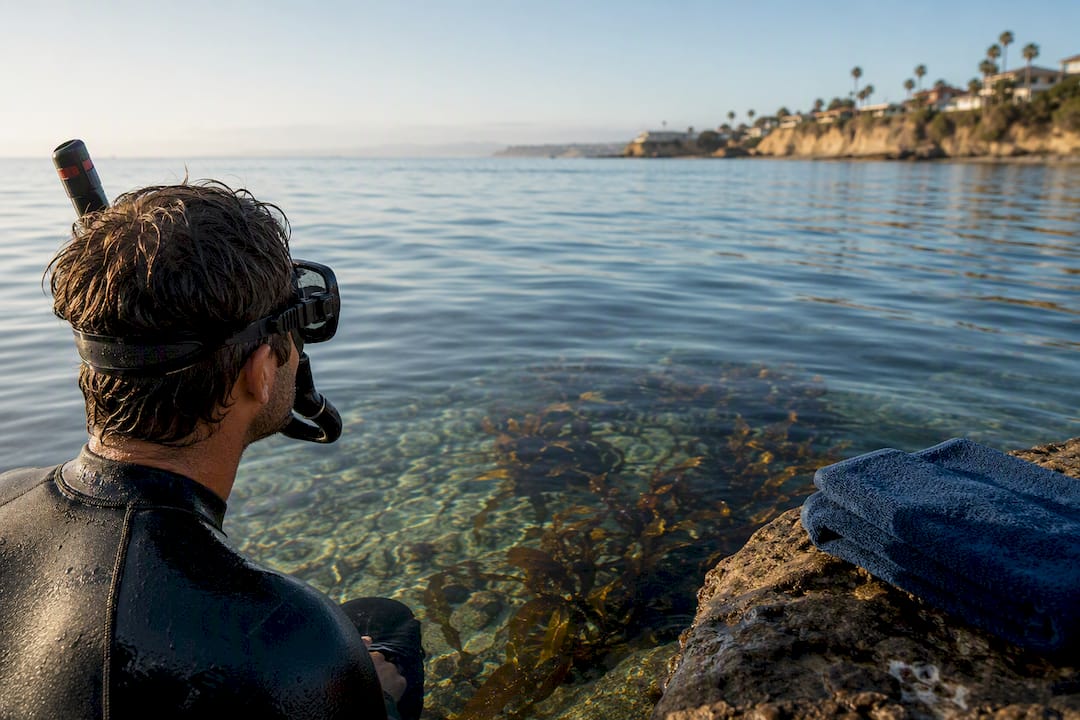
    Snorkeler checking calm morning water

    Seasonally, late summer into early fall (roughly July through September) brings the warmest water and often the calmest conditions, though La Jolla is snorkelable year-round with the right wetsuit. As a rough benchmark, swell under one to two feet is ideal. Anything larger starts to churn up the shallows and makes entries at the Cove genuinely tricky.

    Before you check anything else, check surf and wind forecasts on Surfline, then confirm with lifeguards on the beach, since they see the water conditions in real time. Tides matter too. Low tide exposes more rock at the Cove and can expose cave entrances, but it also means shallower water and a rougher shorebreak at Shores. Locals often time visits around the mid to lower tide window, since it tends to balance visibility against wave energy.

    Safety Rules and Marine Reserve Etiquette

    The Underwater Park is a protected reserve, not a free-for-all reef. That status comes with real rules, and ignoring them can mean a citation or, worse, a hurt animal.

    1. Check with lifeguards before you get in. They track real-time visibility, rip currents, and any closures, and they’re the single best source of current conditions on the beach.
    2. Never snorkel alone. Currents near the Cove’s rocky points can shift fast, and having a buddy nearby matters if you get tired or disoriented.
    3. Skip inflatable flotation devices in restricted zones. Check posted signage, since some areas limit them to protect swimmers and marine life alike.
    4. Leave everything where you found it. No collecting shells, no touching kelp, and absolutely no taking marine life. Recreational snorkeling and kayaking are allowed in the reserve, but fishing and removing wildlife are restricted or banned outright.
    5. Enter and exit carefully. At the Cove, time your entry between wave sets and watch your footing on wet rock. At Shores, shuffle your feet through the sand flats rather than stepping down hard, both to keep your balance and to avoid startling anything buried nearby.

    Pro Tip: If the water looks murky brown or you can’t see your fins while standing waist-deep, that’s your sign to wait it out on the sand rather than push into the water.

    What Marine Life Will You Actually See?

    La Jolla’s protected waters mean sightings here are far more reliable than at your average open beach. The bright orange garibaldi, California’s state marine fish, is essentially guaranteed among the kelp at the Cove, and it’s fully protected, so admire it and move on. Leopard sharks are the headline act at Shores, gathering on the shallow sand flats in the warmer months. They’re completely harmless bottom feeders) that mostly ignore snorkelers entirely.
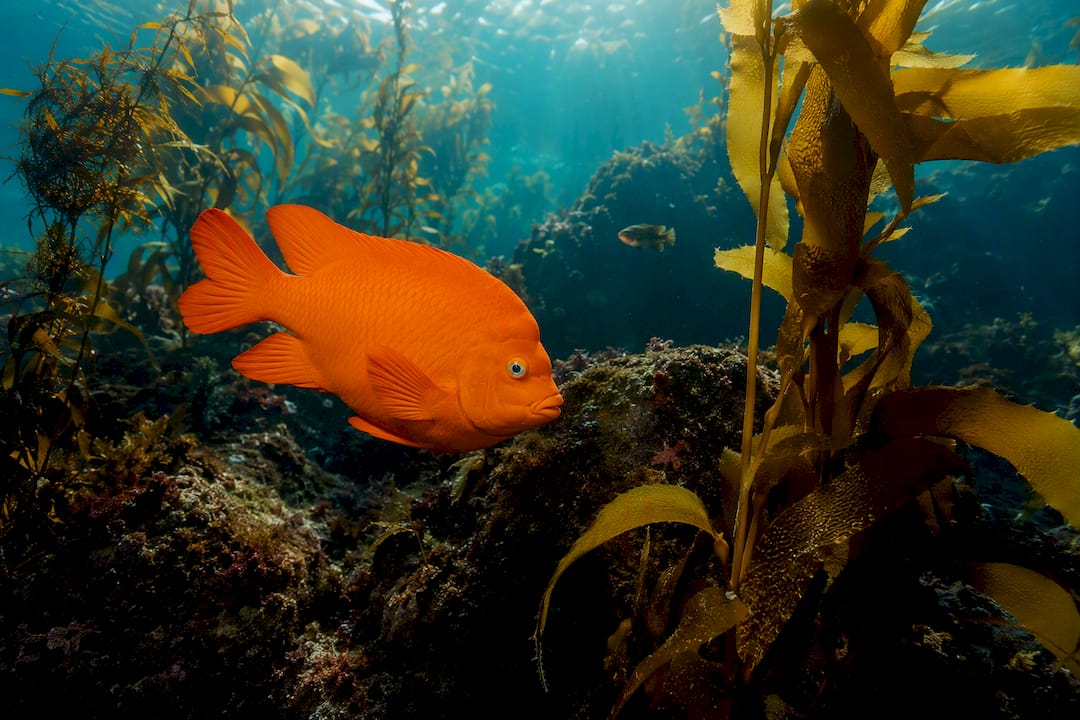
    Garibaldi swimming through La Jolla kelp

    Beyond those two, expect rays gliding just above the sand, kelp bass hovering in the reef shadows at the Cove, and sea lions that often steal the show by swimming curious loops around groups of snorkelers. Keep your distance from the sea lions. They’re wild animals, not aquarium exhibits, and getting too close can stress them or provoke a defensive nip. Never touch or feed anything you see, and try to swim around kelp strands rather than through them. It keeps the habitat intact for the next person in the water.

    Gear, Rentals, and When to Book a Guide

    You don’t need much to snorkel La Jolla well, but fit matters more than most people expect. A leaky mask or loose fins can turn a great morning into a frustrating one.

    • Mask and snorkel: Look for a silicone skirt that seals without pressing on your nose bridge.
    • Fins: Full-foot fins work fine in warmer months; open-heel fins with booties give more control in colder water.
    • Wetsuit: A shorty works for summer swims, but a full 3/2mm suit is worth it outside peak season, since the water rarely climbs past the mid-60s even in warm months.
    • Defog and reef-safe sunscreen: Both are cheap insurance against a ruined session.

    Shore-side rental shops near both beaches carry all of the above, and walk-up stands near the Shores parking lot are common in summer. If you’d rather skip the rental counter entirely, guided kayak and snorkel tours typically include a wetsuit, mask, snorkel, and a guide who knows exactly where the sea caves and calmer reef pockets are that day. A guide is worth the cost if you’re a first-timer, a weaker swimmer, or you specifically want to see the sea caves, since paddling out by kayak gets you to calmer water faster than swimming from shore.

    Getting There: Parking and Access Points

    Parking at the Cove is the tightest part of the whole plan. Street spots are metered and fill early, especially on weekends, so arriving before 9 a.m. genuinely makes a difference. Shores has more breathing room, with a larger lot near Kellogg Park and additional street parking along Camino del Oro.
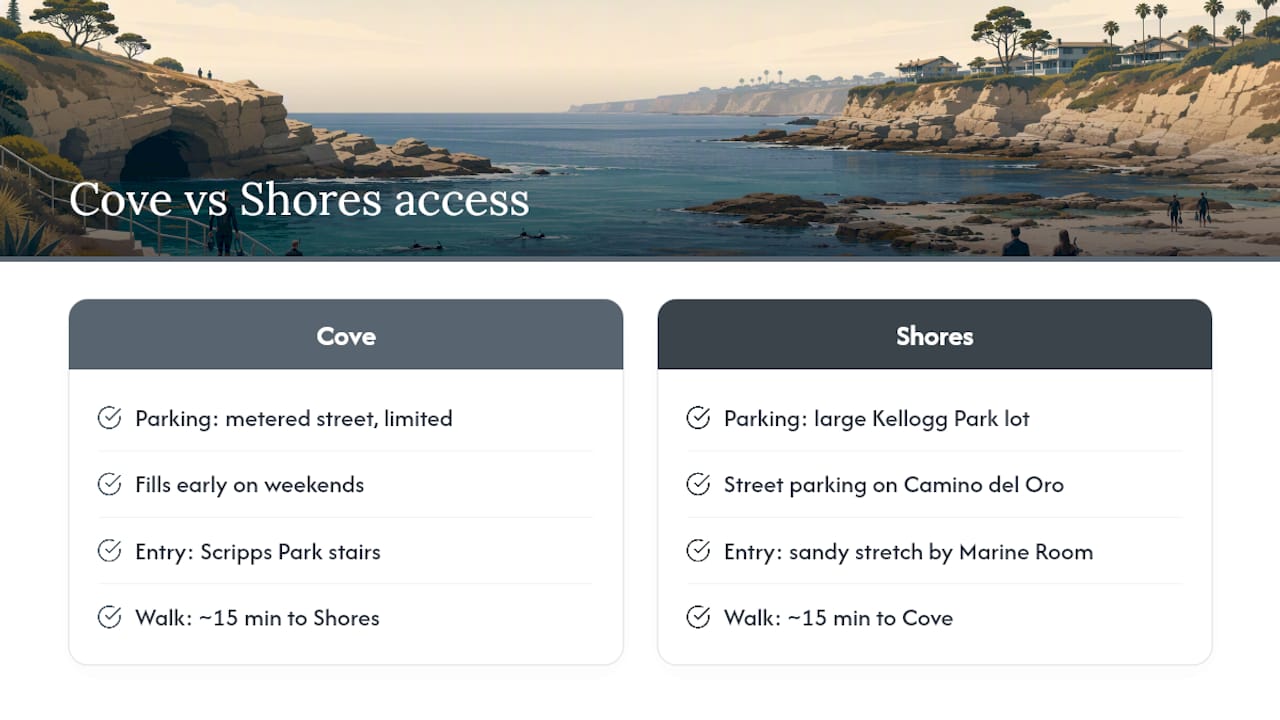
    La Jolla Cove and Shores access comparison

    For entry points, use the stairs at Scripps Park for the Cove and the sandy stretch near the Marine Room for Shores. The two beaches are close enough to walk between in about fifteen minutes along the coastline, so it’s realistic to check both before deciding where to get in. If you’d rather skip parking altogether, San Diego MTS bus line 30 runs along the coast and stops within walking distance of both beaches.

    Local Insider Tips From Joshua at Socalsights

    I always tell people to hit the Cove right at sunrise, before the wind and the crowds show up. That first hour of calm water is when visibility is at its best, and it’s also when you’ll have the clearest shot at cave views if the tide is cooperating.

    A trick for foggy masks: rub a drop of baby shampoo on the lens before you rinse it, since it works better than spit and lasts the whole session. After you’re done in the water, walk up to Scripps Park with something to eat and watch the pelicans, or check the tide charts and swing by the nearby tide pools if the tide’s low enough to expose them.

    How Snorkelers Help Protect La Jolla’s Marine Ecosystem

    The reason La Jolla’s water holds so much life comes down to protection, not luck. The reserve status limits fishing and collecting, and every snorkeler who respects that rule is part of what keeps the reef intact for the next visitor.

    Small habits matter more than people assume. Sunscreen with oxybenzone or octinoxate breaks down coral and disrupts fish reproduction, so reef-safe formulas are worth the switch even in a temperate kelp forest like this one. Kicking through kelp strands snaps growth that takes years to recover, so swimming around clusters instead of through them protects the habitat that draws garibaldi and leopard sharks in the first place.

    Staying off the rocks at low tide protects tidepool organisms that are easy to crush without realizing it. And the simplest rule carries the most weight: take nothing, leave nothing. Shells, rocks, and even dead kelp play a role in this ecosystem, and the reserve’s no-collection policy exists because removing even small amounts adds up across the thousands of people who visit every year. Snorkeling La Jolla responsibly isn’t complicated. It just means treating the water the way you’d want to find it next time.

    What Actually Matters When You Plan a La Jolla Snorkel Day

    Most guides to snorkeling in La Jolla treat the Cove and Shores as interchangeable, and that’s the biggest misconception in circulation. They’re not similar experiences with different scenery. They demand different skill levels, different entry techniques, and different expectations for what you’ll see.

    The conventional advice to “just check the weather” undersells how fast conditions change here. Wind at noon can wreck visibility that was excellent at 8 a.m., and a swell that looks minor on a forecast site can still generate a rough shorebreak at the Cove’s rocky entry. Reading actual conditions, not just glancing at a forecast, is the skill that separates a great morning from a scrapped one.

    If I had to prioritize one thing for a first-time visitor, it’s this: go early, and go with a plan for which beach fits your ability, not just which one looks better in photos. Confidence in the water matters more than gear, and the Shores’ sandy entry has saved plenty of beginners from a rough first impression the Cove might have given them.

    — Joshua

    Plan Your Full La Jolla Day With Socalsights

    Snorkeling is usually just one piece of a great La Jolla day, and figuring out where to eat, park, and wander afterward can eat up as much planning time as the snorkel itself. Socalsights builds curated, locally sourced guides for exactly this kind of day trip, so you’re not stitching together tips from a dozen tabs to figure out logistics.

    Socalsights

    Our guides pull together the kind of detail that only comes from actually knowing the area: which lots fill up first, which nearby spots are worth a stop, and how to string a morning snorkel into a full day without wasted driving. If you’re mapping out your visit, start with our guide to fun activities near you for a full rundown of La Jolla and the surrounding coast, then build your day around it.


    Sources

  • 12 Long Beach Hidden Gems With Reservation and Visit Tips

    12 Long Beach Hidden Gems With Reservation and Visit Tips

    Start with these: the Naples canals for a walk that feels borrowed from Venice, the Earl Burns Miller Japanese Garden for quiet you won’t expect in a college campus, the Blind Donkey for a proper speakeasy pour, the Skinniest House in America for the strangest photo op in the 562, and a taco counter that outshines half the sit-down spots in town. Below you’ll find a full curated list, plus the practical stuff (hours, reservations, closures) so you don’t waste a trip.


    TL;DR:

    • The Naples canals are best experienced during golden hour when crowds are thinner and wedding photographers are less present on weekends.
    • The Earl Burns Miller Japanese Garden, a peaceful spot on the CSULB campus, requires checking the event calendar before visiting to avoid private functions.
    • Many small, hidden bars like Blind Donkey and Tokyo Noir operate on walk-in or reservation-only policies, with hours that can shift unexpectedly.
    • The Skinniest House and Bixby Knolls National Park are private or miniature attractions that should be admired quietly from the sidewalk or within the neighborhood limits.
    • Popular “hidden” venues can become crowded quickly once shared on social media, so ongoing research and checking current status are essential for an authentic experience.

    Table of Contents

    Long Beach Hidden Gems: The Curated List

    Long Beach rewards people who wander a block off the main drag. Here’s where to point your car or your bike, grouped so you can build a route instead of bouncing around aimlessly.

    1. Naples Canals

    Long Beach’s Naples neighborhood has actual canals, gondola rides, and arched bridges that make you forget you’re minutes from the 405. Walk the loop at golden hour when the light hits the water and half the houses have string lights on. No reservation needed, it’s a public sidewalk, but weekend afternoons get crowded with wedding photographers staking out the best bridges.

    Gondola under Naples Canal arched bridge at sunset

    2. Earl Burns Miller Japanese Garden

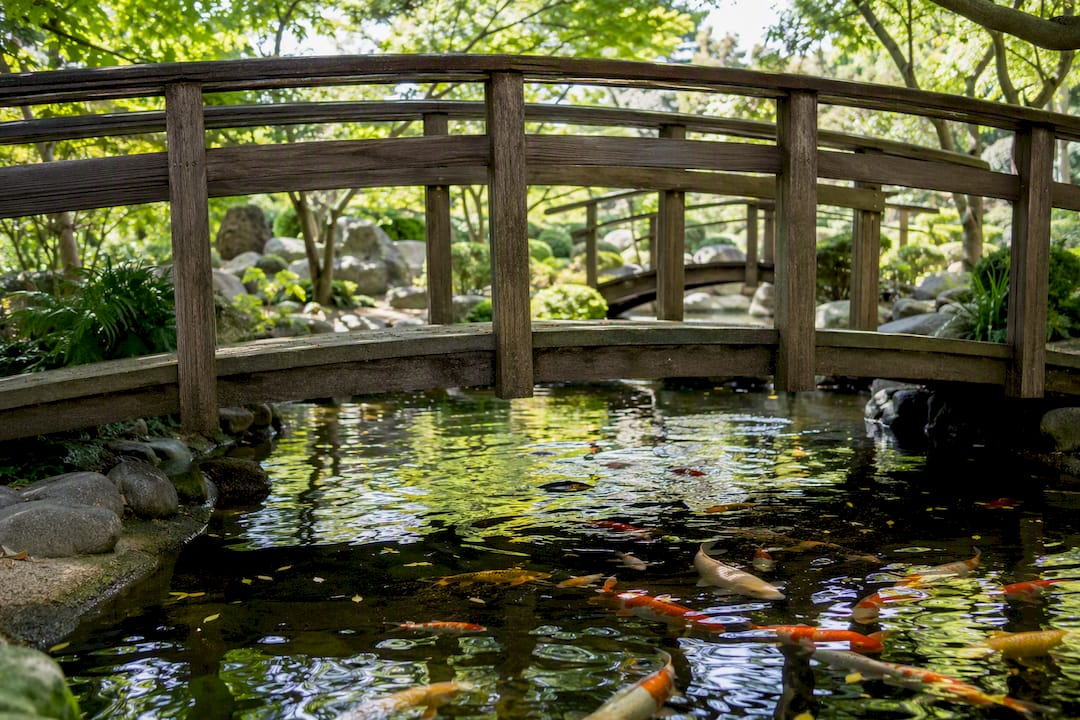
    Tucked into the CSULB campus, this garden centers on a koi pond with wooden bridges and offers enough shade to create a peaceful retreat. It’s one of the most peaceful spots in the city, and most tourists never find it because it’s not on the beach. Check the garden’s event calendar before you go, since it regularly closes for private events like weddings.

    Koi pond and wooden bridge at Japanese garden

    3. Blind Donkey

    This speakeasy sits downstairs at the Broadlind Hotel at 149 Linden Avenue, and the cocktail list rotates seasonally with a bartender crew that clearly cares about technique. Go on a weeknight if you want to actually talk to your date instead of shouting.

    4. Secret Island (Shannon’s on Pine)

    Hidden under Shannon’s on Pine Avenue, Secret Island leans tiki, with tropical drinks and a jungle-themed room that feels like a fever dream in the best way. Reservations help on Friday and Saturday nights.

    Tropical tiki cocktail in jungle-themed bar interior

    5. The Exhibition Room

    Slip behind Roxanne’s Bar on East Wardlow Road and you’ll find this dim, moody lounge built for people who want their cocktails stirred, not shaken, and their conversation uninterrupted.

    6. Tokyo Noir

    A Japanese cocktail bar at 1731 East 4th Street with a moody, neon-lit interior that photographs beautifully. Tokyo Noir runs Tuesday through Sunday starting at 5 p.m., so skip the Monday plan.

    7. Skinniest House in America

    At about 10 feet wide and three stories tall, this narrow Long Beach residence looks like an architectural dare. It’s a private home, so admire from the sidewalk and keep your voice down.

    8. Bixby Knolls National Park

    This is not a real national park. It’s a 0.05 acre patch of neighborhood whimsy in Bixby Knolls, complete with mock ranger signage and fairy doors tucked into the landscaping. Bring kids, bring low expectations of scale, and bring a camera.

    9. Queen Mary

    Everyone knows the ship, fewer people know it’s genuinely one of the best haunted history tours in Southern California, especially during the seasonal Dark Harbor event. Check the ship’s event calendar since hours shift around programming.

    10. Jergins Tunnel Remnants

    Long Beach once had a pedestrian tunnel connecting Ocean Boulevard to the beach, complete with shops inside it. It’s sealed now, but the entrance arch near the Villa Riviera still hints at what used to run underneath downtown.

    11. Museum of Latin American Art (MOLAA) Sculpture Garden

    Most visitors skip straight past the outdoor sculpture garden on their way inside. Give it 15 minutes on a weekday morning when it’s nearly empty.

    12. El Dorado Nature Center

    A pocket of wetlands and eucalyptus groves inside a city park, with trails quiet enough that you’ll forget you’re near a freeway. Best visited early, before the joggers and dog walkers show up in force.

    Where to Eat and Drink Off the Tourist Track

    Long Beach’s food scene has a habit of hiding its best stuff behind unremarkable storefronts. A taco truck parked outside a laundromat can outcook a restaurant with a wine list three pages long.

    • Papa’s Pizza on Anaheim Street draws a loyal local crowd for thin crust that doesn’t get tourist attention.
    • Roe in the East Village serves seafood-forward small plates that quietly compete with restaurants twice the price.
    • Number Nine Vietnamese Sandwiches on Anaheim delivers a banh mi that locals argue is the city’s best kept secret.
    • Alegria Cocina Latina mixes Puerto Rican and Mexican flavors in a way you won’t find replicated elsewhere in the city.
    • Happy hour at most of these spots runs 3 to 6 p.m., and brunch lines get long after 10 a.m. on weekends, so go earlier if you hate waiting.

    Worth remembering: a spot that feels undiscovered today might be packed in six months. Local reporting on Long Beach’s restaurant scene notes that social media shrinks the window for a place to stay quietly local, so treat any “hidden gem” restaurant list, including this one, as a living document rather than gospel.

    Pro Tip: If a bar or restaurant looks packed from the sidewalk, ask the host about seating at the bar itself. Most speakeasies and small-plate spots hold a few stools back that never show up on a waitlist app.

    Long Beach’s Speakeasy Scene, Decoded

    Long Beach has quietly built one of the better hidden-bar scenes in Southern California, and most of it clusters downtown and along Pine Avenue.

    • Blind Donkey sits below the Broadlind Hotel with no obvious signage, just a discreet stairwell.
    • Secret Island hides under Shannon’s, tiki-themed, best experienced with a reservation on weekend nights.
    • The Exhibition Room waits behind Roxanne’s Bar, a lounge built for slower conversation.
    • Tokyo Noir opens nightly except Monday, starting at 5 p.m., with a straightforward walk-in policy on weeknights.

    Access mechanics vary by bar. Some run entirely on walk-ins during the week, others want a reservation for Friday and Saturday. Visit Long Beach’s own roundup of these secret saloons confirms addresses and hours, worth a check before you head out. Whatever bar you land in, skip the flash photography, ask before you snap a bartender mid-pour, and tip like you mean it. These places survive on repeat locals, not one-time tourists.

    Quirky Sights Worth the Detour

    Long Beach’s oddities are half the fun of exploring past the beach.

    • The Skinniest House in America measures roughly 10 feet across, a private residence best admired from the street.
    • Bixby Knolls National Park is a whimsical 0.05 acre neighborhood project, not an actual national park, so expect fairy doors and mock signage rather than trails or rangers.
    • The Jergins Tunnel once ran shops beneath Ocean Boulevard; it’s sealed today, but the entrance arch still stands as a hint of old downtown.
    • The Queen Mary hosts recurring events, including its haunted Dark Harbor programming each fall, so check the schedule before assuming standard tour hours apply.

    Statistic Callout: Bixby Knolls National Park covers a very small area, smaller than most backyard gardens, which tells you exactly how tongue-in-cheek this “park” is meant to be.

    Quiet Corners for Nature and Reflection

    Long Beach doesn’t advertise its calm spots loudly, which is exactly what makes them worth finding.

    • The Earl Burns Miller Japanese Garden centers on a koi pond crossed by wooden bridges, tucked into a corner of CSULB most visitors never think to explore.
    • The Naples canals offer a similar slow-walk energy, with small footbridges and quiet water that feels far removed from the beach crowds a mile away.
    • Both spots photograph best in early morning or late afternoon light, when shadows are longer and crowds are thinner.
    • Always check the garden’s own event page before visiting, since CSULB regularly books it for weddings and private functions, which can close it without much notice.

    Pocket parks scattered through Bixby Knolls and Belmont Heights offer similar solitude if the garden happens to be booked.

    How to Plan a Half-Day Hidden Gems Route

    Sequencing matters more than people think when you’re chasing multiple offbeat stops in one day.

    1. Start at the Naples canals in the morning, when light and parking are both easier to find.
    2. Head to the Earl Burns Miller Japanese Garden next, since it’s a short drive from Naples and best visited before midday heat.
    3. Grab lunch at a taco spot or Vietnamese sandwich counter near downtown.
    4. Swing by the Skinniest House and Bixby Knolls National Park in the afternoon, both quick stops.
    5. End the night at a speakeasy like Blind Donkey or Tokyo Noir, once you’ve confirmed hours.

    Parking downtown gets tight after 6 p.m., so budget extra time. Some blocks near Anaheim Street are quieter after dark, so stick to well-lit streets if you’re walking between stops solo.

    Pro Tip: Check each venue’s Instagram or official site the morning of your visit. Speakeasies and small gardens change hours or close for private events more often than a standard restaurant would.

    Cultural Events That Don’t Make the Typical Tourist Guide

    Long Beach runs a handful of festivals that rarely show up on generic “things to do in Southern California” roundups, even though they’re some of the most distinctly local events in the region. The Bixby Knolls Art Walk, held periodically along Atlantic Avenue, turns storefronts into pop-up galleries for an evening, with local artists selling work directly out of shop windows.

    The Cambodia Town Parade and Culture Festival celebrates the largest Cambodian community in the country outside of Cambodia itself, with food stalls, traditional dance, and a parade route through the neighborhood that gives it its name. It’s one of the few festivals in Southern California built entirely around this community’s history and traditions.

    Smaller happenings, like pop-up night markets in the East Village Arts District and seasonal maker fairs near Retro Row, rotate throughout the year without much advance promotion. These tend to spread through word of mouth and local social accounts rather than citywide marketing, which is exactly why they still feel like discoveries rather than tourist traps. If you want to catch one, following neighborhood association pages or local event calendars beats searching generic event-listing sites, since those often miss the smaller community-run gatherings entirely.

    Artisan Shops and Galleries Worth Seeking Out

    Retro Row along 4th Street gets some tourist attention for its vintage shops, but the galleries and studios tucked between them stay largely under the radar. Small working-artist studios along this stretch open their doors during evening gallery walks, giving visitors a chance to talk directly with the people making the work.

    Bixby Knolls has quietly become a pocket for independent makers, with shops selling handmade ceramics, small-batch goods, and locally designed apparel spread across a few blocks of Atlantic Avenue. None of them draw the crowds a mall boutique would, which is part of the appeal. You get an actual conversation with the person who made what you’re buying.

    Downtown’s arts district has smaller studio spaces that occasionally open for open-studio nights, often tied to the same calendar as the East Village night markets mentioned earlier. These aren’t polished retail experiences. They’re closer to peeking into someone’s workshop, which is exactly the kind of texture that separates a real Long Beach visit from a checklist tour of the pier and the aquarium.

    Why “Hidden” Never Stays Hidden for Long

    Every one of these spots exists in a strange kind of countdown. The minute a speakeasy or taco counter gets tagged in enough Instagram Stories, it stops being a secret and starts being a destination, complete with lines and a watered-down version of whatever made it special. That shift happens faster in Long Beach than people expect, partly because the city sits close enough to Los Angeles that trends jump the county line overnight.

    I’d argue the real skill in exploring a city like this isn’t finding hidden gems once. It’s building the habit of rechecking your list every few months, because the Blind Donkey of 2026 might have a completely different crowd by 2027. SoCal Sights builds its lists through community-sourced tips and repeat visits rather than a one-time write-and-forget approach, which matters more than most travel guides admit. A list that never gets revisited is just a time capsule pretending to be current advice.

    Bookmark whatever you find useful here, but treat it as a living document. Check back before you build a whole itinerary around it.
    — Joshua

    Skip the Research, Get the Route

    Socalsights is the alternative to piecing together twelve different blog posts and three Reddit threads before a Long Beach day trip. Instead of guessing which “hidden gem” list is current, you get community-sourced picks that get revisited as spots change, close, or get discovered by everyone else first.

    Socalsights

    The 100+ SoCal Sights collection expands well past this Long Beach list into the rest of the region, organized so you can build a route instead of hopping between browser tabs. If you’re planning something shorter, the daycation guide is built specifically for exactly the kind of half-day route outlined above, sequenced so you’re not backtracking across town. And if you’re a local business owner reading this thinking your own hidden gem deserves a spot on a future list, the local business page is where that conversation starts. Pull up the daycation guide before your next weekend and build your route from there.

    Sources

  • 6 Southern California Super Bloom Spots: Live Status and Visitor Rules

    6 Southern California Super Bloom Spots: Live Status and Visitor Rules

    Limited to strong, depending on location. Right now, your best shots at a real display are Carrizo Plain National Monument, Death Valley National Park, Antelope Valley California Poppy Reserve, Anza-Borrego Desert State Park, Walker Canyon near Lake Elsinore, and Point Mugu State Park. Conditions shift week to week, so before you drive out, check the park’s official status page. That one step saves more disappointing trips than anything else on this list.


    TL;DR:

    • Peak wildflower blooms vary by elevation and location, with desert floors peaking from late February to early April and higher elevations sometimes not peaking until late April or May.
    • Rain, particularly multiple storms spaced across fall and winter, is critical for a super bloom, but temperature spikes and strong winds can quickly end the display.
    • Visiting early morning on weekdays and staying on designated trails helps prevent damage and secures a better experience for future blooms.
    • Conditions can change rapidly, so checking real-time park alerts, satellite imagery, and local social media updates is essential before planning a trip.
    • Focus on smaller, less crowded bloom sites and learn key species to enhance your experience while reducing ecological impact.

    Table of Contents

    Where To See The Southern California Super Bloom Now

    I’ve chased blooms across this region for years, and the honest truth is that no two spots peak on the same calendar. Here’s the current lay of the land, site by site, so you can pick the one that actually matches your travel dates.

    Carrizo Plain National Monument is having a moment. Landsat satellite imagery from NASA captured extensive yellow blooms spreading across the Soda Lake basin and up into the Temblor Range in early March. NASA scientists monitoring the imagery described the display as bigger than they expected. If you go, park at the Goodwin Education Center and walk the Painted Rock or Soda Lake overlook trails rather than pulling off along Soda Lake Road, where shoulder parking has damaged fragile crust in past seasons.

    Death Valley National Park rewards patience because its bloom moves with elevation. The National Park Service notes that lower-elevation flowers typically show from mid-February through mid-April, while higher basins like those near Dante’s View bloom weeks later. Badwater Basin and the areas around Furnace Creek are worth checking first this season. Expect gold desert dandelion and purple sand verbena rather than the poppy-heavy palette you’ll find further west.

    Antelope Valley California Poppy Reserve remains the classic postcard shot, rolling orange hillsides against the Tehachapi foothills. It’s also the most crowded site on this list on weekends, so if you can only go once, aim for a weekday morning.

    Anza-Borrego Desert State Park covers enough ground that something is usually blooming somewhere inside it, from Henderson Canyon Road’s poppy fields to the ocotillo stands near Blair Valley. Check individual trail conditions before heading out, since some backcountry roads wash out after the same rains that trigger the bloom.

    Walker Canyon (Lake Elsinore) has a complicated history. It produced one of the most photographed poppy hillsides in the state a few years back, and it also produced some of the worst crowd damage anywhere in Southern California, which led the city to close the trailhead entirely during peak years. If it reopens this season, expect strict shuttle-only access and zero tolerance for off-trail photos.

    Point Mugu State Park gives you the rare combination of coastal bluffs and wildflowers in the same frame. Look for lupine and California poppy along the La Jolla Valley Loop, with sweeping views toward the Pacific that the inland desert sites simply can’t match.

    A few things hold true across every site:

    When Does Each Region Typically Peak?

    Elevation drives everything about wildflower timing in Southern California, and understanding that pattern helps you avoid arriving two weeks too early or a month too late.

    1. Low desert floors (under 3,000 feet): Death Valley, Anza-Borrego’s lower valleys, and Carrizo Plain typically peak from late February into early April. These spots warm up fastest and burn out fastest, sometimes within a two-week window.
    2. Coastal and foothill zones (Antelope Valley, Walker Canyon, Point Mugu): These sites usually run a few weeks behind the low desert, often peaking in March into early April, though coastal fog at Point Mugu can push things slightly later than inland foothill sites.
    3. Mid-to-high elevation basins (Death Valley’s upper zones, mountain foothills above 4,000 feet): These areas lag well behind, sometimes not peaking until late April or into May, since cooler soil temperatures delay germination.

    Aspect matters almost as much as elevation. A south-facing slope soaks up more direct sun and often blooms a week or two ahead of a north-facing slope just across the same canyon. Microclimates explain why one side of Anza-Borrego can be finished blooming while another section twenty minutes away is just getting started.

    If you’re planning around a specific date, work backward from elevation. Booking a trip for early March? Stick to the low desert. Traveling in late April or May? Look toward the higher foothill and mountain-adjacent sites instead, where the show is often just getting going while the desert floor has already faded to brown.

    What Actually Causes A Super Bloom?

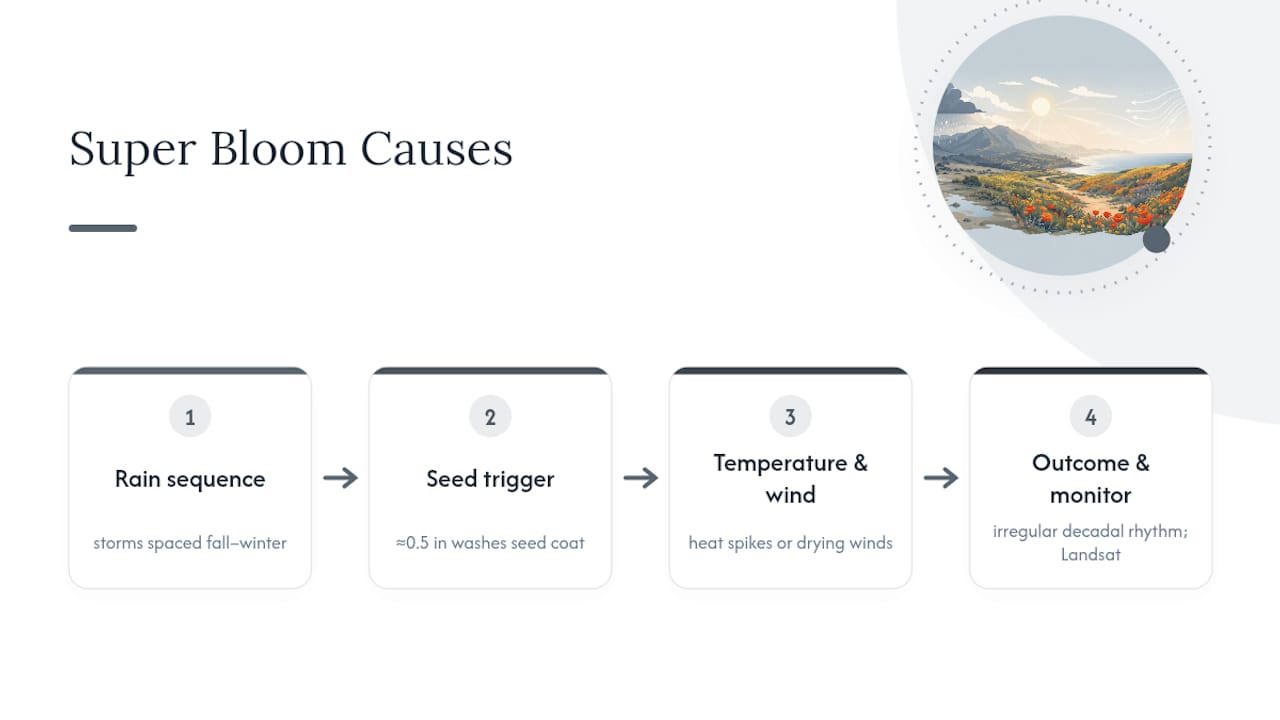
    “Super bloom” isn’t a formal scientific term. Britannica describes it as a descriptive label for the rare, large-scale wildflower events that happen when several environmental factors line up at once, rather than a category botanists use in research.

    Diagram of super bloom environmental causes

    The recipe starts with rain, but it’s not just about total rainfall. It’s about spacing. Desert seeds need a sequence of storms spread across fall and winter, not one big deluge and then nothing. Death Valley’s own park data notes that a half-inch storm can be the critical trigger that washes the hard seed coat off dormant seeds and kicks off germination, but that single storm only matters if more rain follows in the following weeks.

    Temperature and wind can undo all of it. A Salk Institute researcher explained to NBC San Diego that even with enough rainfall banked, an early heat spike or a run of strong drying Santa Ana winds can cut a bloom short before it ever peaks. That’s the piece most first-time visitors miss: rain gets a bloom started, but heat and wind decide whether it finishes.

    Notable bloom years tend to arrive on an irregular, roughly decadal rhythm rather than a predictable schedule, which is part of why satellite monitoring through programs like Landsat has become such a useful confirmation tool for scientists trying to track bloom extent in near real time.

    How To Visit Without Wrecking It For Next Year

    Every trampled hillside you’ve seen in a viral photo started with one person stepping off the trail for a better shot. UC Riverside plant ecologist Loralee Larios put it plainly when describing this year’s early bloom: staying on trails and leaving flowers unpicked is what allows those same plants to drop seed and bloom again next season.

    Here’s what that looks like in practice:

    • Stay on marked trails, even when the flowers just off the path look better.
    • Never pick flowers or dig up seeds. What looks like a few blossoms to you is next year’s seed bank for everyone.
    • Skip off-roading entirely, and check individual park rules before flying a drone.
    • Bring more water than you think you need. Desert sites offer little shade, and heat risk climbs fast even in cooler months.
    • Arrive early or go on a weekday to dodge both crowds and the worst midday heat.

    Crowding has real consequences. Trampling from heavy visitation has forced trail closures and shuttle-only access at sites like Diamond Valley Lake and Walker Canyon in past bloom years, and once a hillside gets stripped of topsoil by thousands of boots, it can take multiple seasons to recover its bloom density.

    If you want to support wildflower conservation beyond just visiting responsibly, look into volunteer restoration days through your local park district, or buy native seed from a reputable native plant nursery like Theodore Payne Foundation or California Botanic Garden instead of collecting anything from the field.

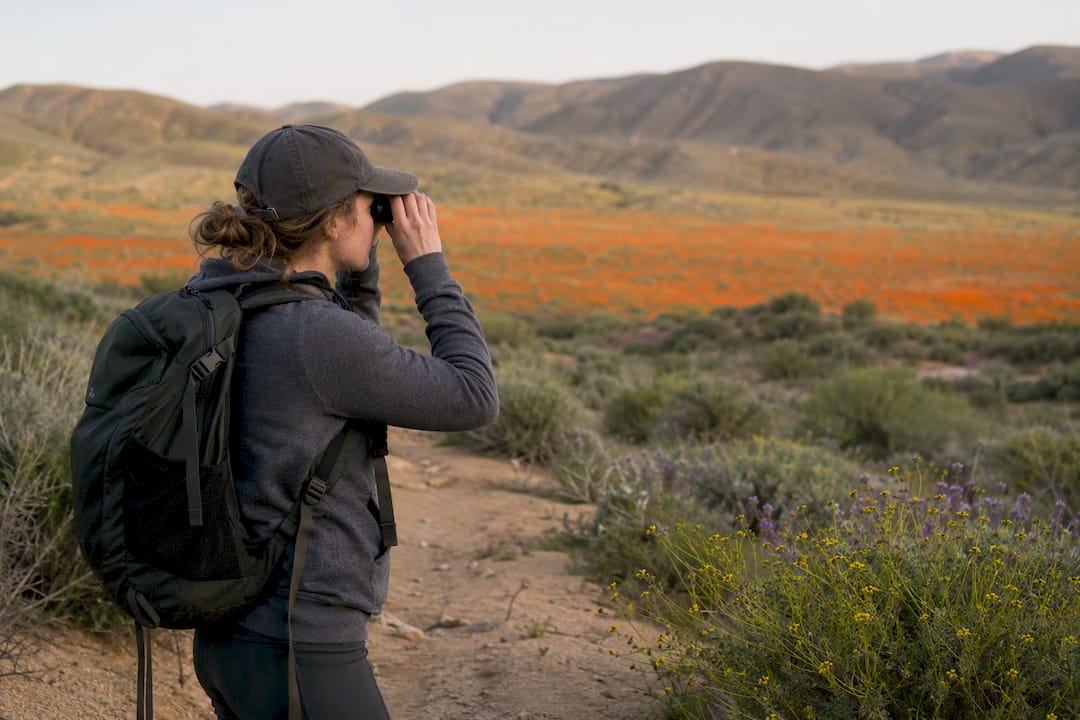
    Pro Tip: Pack a pair of compact binoculars. You get a closer look at delicate blooms without ever leaving the trail, and it beats the “just one step off the path” temptation every time.

    Hiker using binoculars on wildflower trail

    How To Check Real-Time Bloom Status Before You Go

    Bloom conditions change fast enough that a blog post from three weeks ago can already be wrong. Check these sources the week of your trip, not the month before.

    • NPS park pages, including Death Valley’s official alerts, post road closures and current bloom notes.
    • California State Parks’ wildflower bloom page tracks conditions across desert state parks and links out to individual park pages.
    • BLM district pages and local park district social media accounts often post the fastest on-the-ground updates, especially for sites like Carrizo Plain.
    • NASA’s satellite reporting through programs monitoring Landsat imagery offers a useful secondary confirmation of how widespread a bloom actually is, beyond what a single trail report can tell you.

    Before heading out, run through a short checklist: confirm parking availability, check for shuttle requirements at high-traffic sites, look up sunrise time for early light, and pack layers, since desert mornings run cold even when afternoons spike hot.

    Small Habits That Protect The Next Bloom

    Responsible viewing isn’t complicated, but it does take a little intention. Park in designated lots instead of pulling onto shoulders, since compacted roadside soil struggles to support seed germination the following year. Pack out everything you bring in, including fruit peels and tissue, since even biodegradable trash disrupts the desert’s delicate nutrient balance.

    Photograph from established viewpoints rather than walking into a field for the “editorial” shot. Drone rules vary by park and monument, so check before you fly, since disturbed wildlife and startled visitors are common complaints at popular bloom sites. If you’re traveling with a group, agree ahead of time to stick together on marked paths, since one wanderer often triggers a chain reaction of others following the same shortcut.

    Consider visiting less-publicized bloom pockets instead of the same handful of Instagram-famous hillsides. Spreading foot traffic across more sites reduces the concentrated damage that hits places like Walker Canyon during peak years. Smaller, quieter blooms often deliver just as much color with a fraction of the ecological cost, and you’ll likely enjoy the visit more without fighting for a parking spot or a clear sightline.

    Flowers You’ll Actually See On The Trail

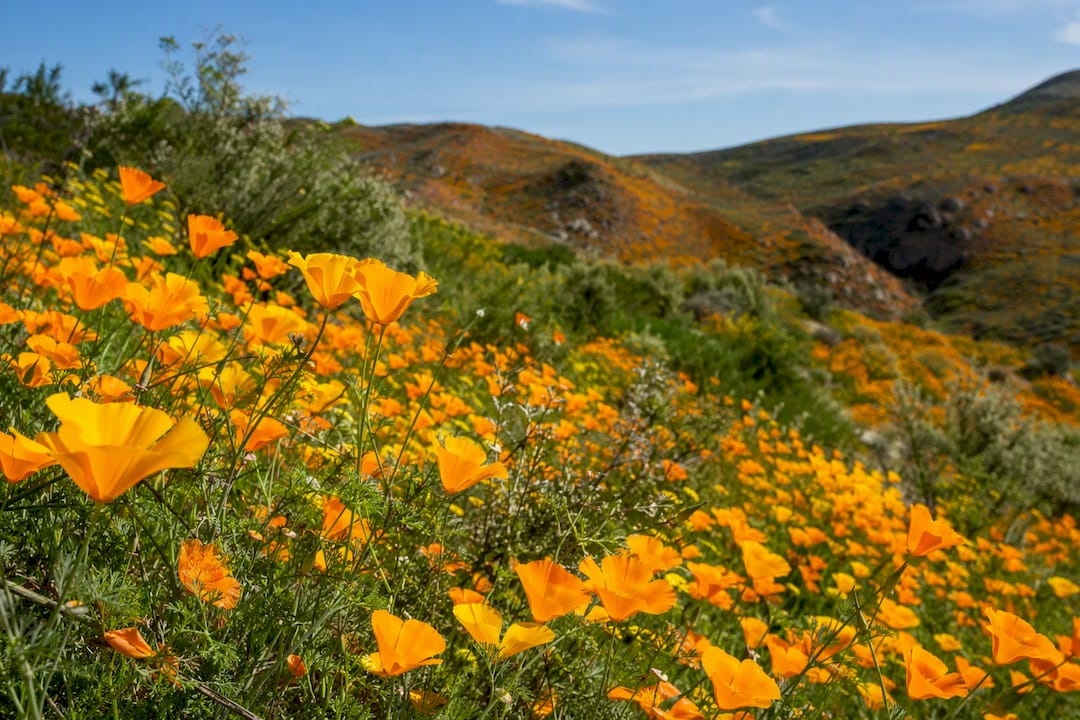
    Knowing a few species by sight turns a walk through color into something more memorable. California poppy is the icon, bright orange with a silky, almost papery petal that closes up on cloudy days and reopens in full sun. Desert sand verbena shows up as low mats of pink to magenta blooms, often the first color you’ll spot on a Death Valley hillside. Desert dandelion brings pale yellow, daisy-like flowers in dense carpets across low desert floors.

    Close-up of orange and pink desert flowers

    At Carrizo Plain, look for hillside daisy contributing much of that vivid yellow NASA’s satellite imagery picked up from orbit, often mixed with patches of purple phacelia. Coastal sites like Point Mugu add lupine, recognizable by its tall purple-blue spikes, alongside poppies along the same bluffs. In rockier desert terrain, keep an eye out for ocotillo, whose bright red tubular flowers top spindly, cactus-like stalks rather than growing low to the ground.

    Learning even five or six of these names changes how you experience a bloom. Instead of one undifferentiated wash of color, you start noticing the layered mix of species that makes each site distinct, and it makes for a far better story when you’re describing the trip later.

    SoCal Sights’ Take On Seeing The Bloom Right

    The single best trick for beating both crowds and heat is arriving before sunrise. I know that sounds brutal for a wildflower trip, but the light is softer, the parking lots are empty, and you get the hillside mostly to yourself before the tour buses show up around 10 a.m.

    Weekday mornings beat weekends every time, and choosing a secondary trailhead over the main one at a popular site often gets you the same view with a fraction of the foot traffic. Some of the best patches we’ve heard about from our community aren’t the famous hillsides at all. They’re smaller roadside pockets that never make it into a listicle, which honestly makes them better for conservation since fewer feet means less damage. If you want a curated list of these kinds of finds beyond wildflower season, our SoCal Sights collection is built around exactly that kind of local discovery, and our membership program gets you deeper access to community-sourced spots as they get shared.

    — Joshua

    Sources

  • A Channel Islands Day Trip Is Doable: Here’s How to Plan It

    A Channel Islands Day Trip Is Doable: Here’s How to Plan It

    Yes, you can absolutely pull off a Channel Islands day trip, but only if you pick one island and commit. Santa Cruz Island’s Scorpion Anchorage is your best bet for a first visit, with Anacapa as the backup if you want a shorter boat ride. Book your seat with Island Packers first, before you plan anything else, since the ferry schedule dictates your entire day. Expect a ferry crossing time of about one to one and a half hours each way, and a moderate amount of time for exploring once you’re ashore.


    TL;DR:

    • Santa Cruz Island’s Scorpion Anchorage offers the most activities and is easiest to reach, with ferry crossings taking about one to one and a half hours.
    • Booking early with Island Packers is essential to secure suitable departure times, especially for peak season, and a backup plan is crucial in case of weather cancellations.
    • Shorter crossings to Anacapa Island are better for those prone to seasickness, and it allows for a quick scenic loop rather than a full day of activities.
    • Focus on a single main activity, such as hiking or a guided water tour, to maximize your limited time and avoid missing your return boat.
    • Pack ample food, water, layered clothing, sun protection, sturdy shoes, and motion sickness medication for a smooth and safe trip.

    Table of Contents

    Which Channel Island Should You Visit in a Day?

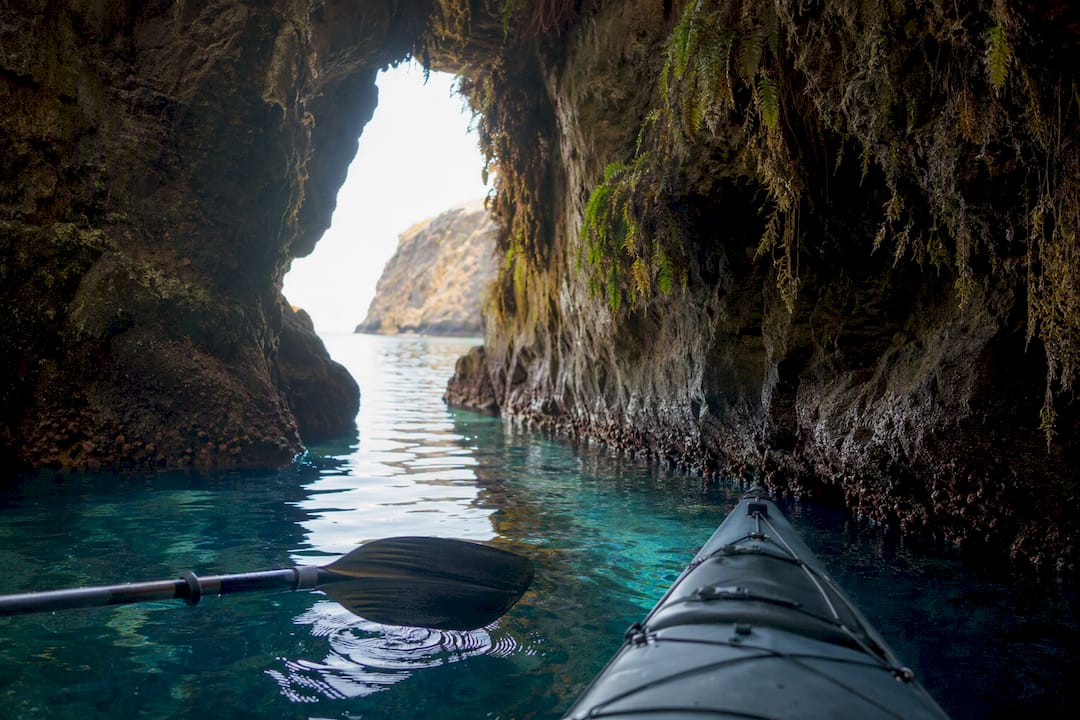
    Santa Cruz Island wins for most first-timers, and it’s not close. Scorpion Anchorage, the main landing on Santa Cruz, provides a wide mix of activities including hiking trails of various difficulty, guided kayak and snorkel tours through sea caves, potable water at the campground, and a visitor contact station with ranger assistance.

    Kayak paddle near sea cave entrance on Santa Cruz Island

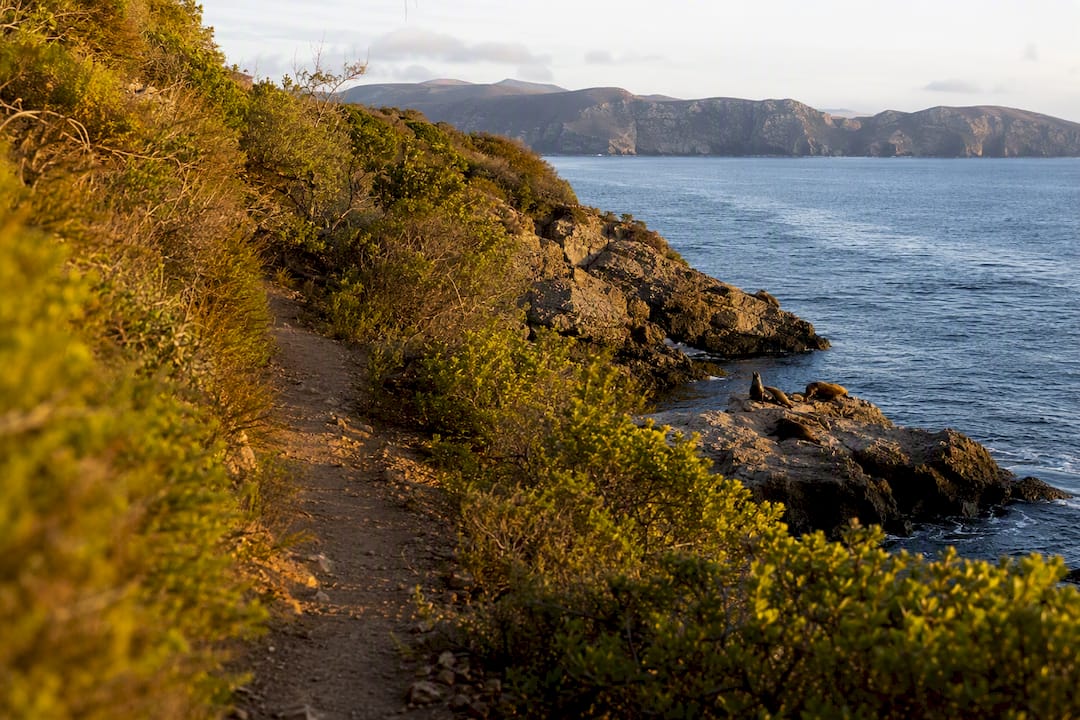
    Anacapa Island is the move if you get seasick easily or you’re working with a tighter window. The crossing is shorter than the Santa Cruz run, and the island itself is compact enough that you can do a scenic loop, check out the arch and the sea lion overlooks, and still make your return boat without feeling rushed. There’s no camping infrastructure to speak of and the terrain is steeper in spots, so it suits a shorter, simpler outing rather than a full activity-packed day.

    Trail and sea lions on rocky cliffs at Anacapa Island

    Santa Rosa, San Miguel, and Santa Barbara islands sit further out, and that distance changes the math. Ferry crossings run longer, schedules are thinner, and same-day round trips are far less reliable unless you’re chartering privately or catching one of the rare direct sailings. Unless you’ve got a flexible schedule or a specific reason to go (backpacking Santa Rosa, birding on Santa Barbara), these three belong on a multi-day trip list, not a day-trip list.

    A few things should drive your final call:

    • Seasickness tendency: shorter crossings (Anacapa) beat longer ones (Santa Rosa) if you’re prone to it.
    • Fitness level: Santa Cruz has flatter loop options alongside steeper overlook hikes, so it flexes either way.
    • Water activities: if kayaking or snorkeling matters to you, Santa Cruz is the only island with regular guided tours.
    • Time available: a shorter Anacapa crossing buys you more margin if your ferry window is tight.

    How Do You Book the Ferry and Get There?

    Island Packers is the National Park Service’s authorized concessionaire, and it’s the only practical way most visitors reach the islands without their own boat. Round-trip crossings take approximately one to one and a half hours depending on which island you’re headed to, and seats disappear fast in summer. Booking a month or more ahead isn’t overkill for peak season weekends; it’s just standard practice.

    Here’s how to book without leaving anything to chance:

    1. Pick your island and date first. Santa Cruz via Scorpion Anchorage has the most frequent sailings, so it’s easiest to slot into a specific weekend.
    2. Choose a departure that gives you several hours ashore. Early morning boats (often 8:00 or 9:00 AM departures in season) paired with a mid to late afternoon return give you real time on the island instead of a rushed lap.
    3. Reserve round-trip, not one-way. You want your return seat locked before you ever board the outbound boat.
    4. Arrive at the harbor 30 to 45 minutes before your scheduled departure. Check-in, ticket verification, and loading gear (especially kayaks) all eat into that window, and Island Packers won’t hold the boat for stragglers.
    5. Check the morning of your trip for weather-related schedule changes before you leave home.

    Cancellations happen, and they’re almost always about sea conditions rather than staffing. Swell out of the west or a building wind pattern can scrub a crossing with little notice, particularly in winter and early spring. If your ferry gets canceled, Island Packers typically offers a reschedule or refund. It’s worth having a backup day in mind if you’re traveling from out of state and can’t easily shift dates.

    Pro Tip: Book the earliest reasonable departure you can get. An 8:00 AM boat versus a 10:00 AM boat can be the difference between six relaxed hours on the island and four hours where you’re constantly checking your watch.

    If your goal is flexibility over cost, a private day charter is worth a look. A private charter lets you set your own departure and return times. It’s often the only realistic way to see the painted cave on Santa Cruz’s north shore, since that requires specific timing and conditions most scheduled ferries don’t accommodate. The trade-off is cost. Chartering runs well above a standard Island Packers fare, so it makes sense mainly for groups splitting the price or travelers with a narrow, non-negotiable schedule.

    Sample One-Day Itinerary for Santa Cruz Island

    Whether you’re chasing an active day or something more relaxed, the framework is the same: protect your return boat time and build everything else around it. Here are two templates that work well for Scorpion Anchorage.
    Active day template:

    1. 7:15 AM — Arrive at Ventura Harbor, check in with Island Packers.
    2. 8:00 AM — Depart for Santa Cruz Island (about 1 hour crossing).
    3. 9:00 AM — Land at Scorpion Anchorage, quick ranger orientation.
    4. 9:15 AM — Join a guided sea-cave kayak or snorkel tour, typically running 2 to 2.5 hours.
    5. 11:45 AM — Picnic lunch near the anchorage (pack it in, there’s no store).
    6. 12:30 PM — Hike out to Potato Harbor Overlook and back, roughly 4.5 to 5 miles round trip with moderate elevation gain.
    7. 4:00 PM — Return to the pier with buffer time before boarding.
    8. 4:30 PM — Depart for the mainland.

    Easier day template:

    • 8:00 AM departure, land by 9:00 AM.
    • Walk the Cavern Point Loop, about 2 miles with a steady but manageable climb and some of the best coastal views on the island.
    • Spend unhurried time at the visitor contact station, browsing exhibits and chatting with a ranger about wildlife sightings that week.
    • Picnic near the campground, refill water bottles at the potable water spigot there.
    • Wander shorter viewpoint trails near the anchorage in the afternoon rather than committing to a long hike.
    • Board the afternoon return boat with time to spare.

    A proven one-day structure like this, early ferry, short coastal walk, lunch, then one afternoon hike, keeps you from overcommitting to two big activities in the same day. On the return crossing, keep your eyes on the water. Late afternoon sailings are a solid window for spotting dolphins, and gray whales show up seasonally if your timing lines up.

    What Can You Actually Do in a Day on Santa Cruz Island?

    Match your activity choices to how much ground (and water) you actually want to cover, because trying to do everything is how people end up missing their boat.

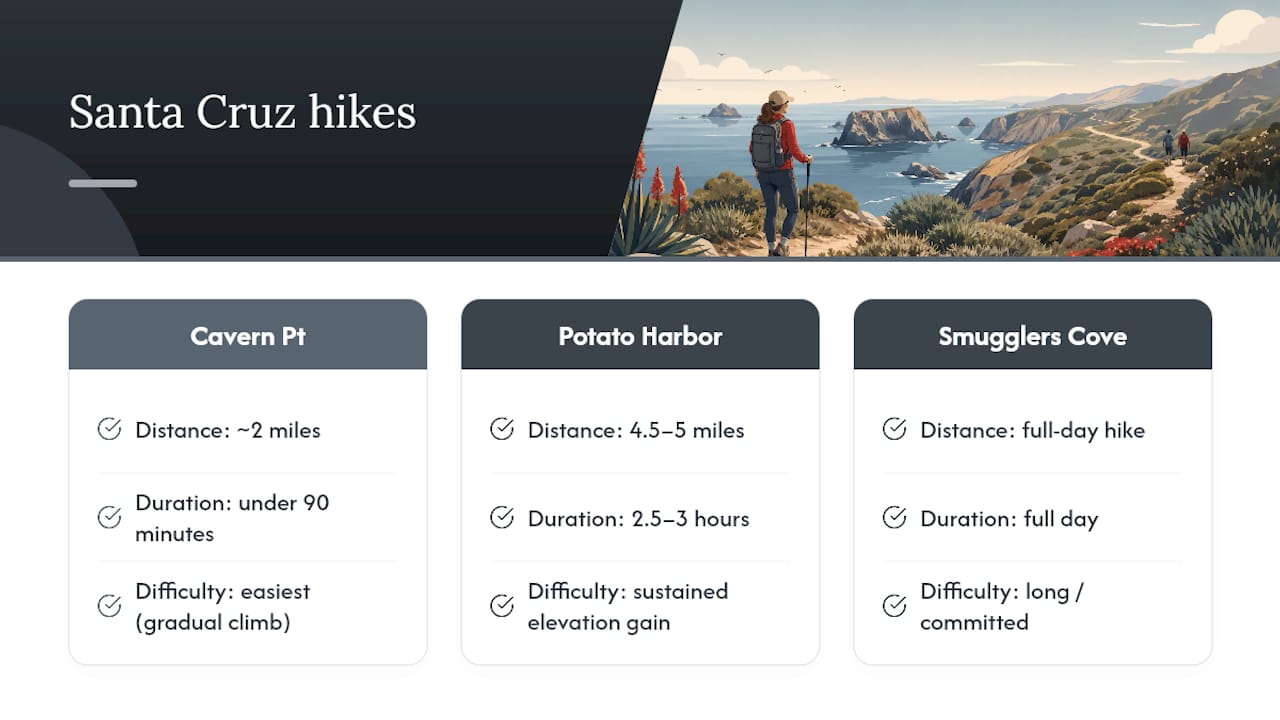
    Hiking options range from casual to committed. The Cavern Point Loop is your easiest win: about 2 miles round trip with a gradual climb to a bluff overlooking the channel, doable in under 90 minutes at a relaxed pace. Potato Harbor Overlook steps things up to roughly 4.5 to 5 miles round trip with more sustained elevation gain, best budgeted at 2.5 to 3 hours if you want time to actually sit and take in the view rather than turning around immediately. Smugglers Cove is the long option, a full-day commitment on its own, and pairing it with a morning water tour is a recipe for missing your return ferry.

    Comparison diagram of Santa Cruz Island hiking trails

    Water activities are guided-only at Scorpion. There’s no self-service kayak rental sitting on the beach waiting for you; guided sea-cave kayak tours and guided snorkeling are the standard options, typically running 2 to 2.5 hours. That duration pairs cleanly with the Cavern Point Loop or a shortened Potato Harbor visit, but it eats too much of your day to combine comfortably with the longer hike.

    Wildlife viewing rewards patience more than effort. Island foxes, found nowhere else on Earth outside the Channel Islands, tend to show up more readily in late afternoon near the campground when crowds thin out. Seabirds nest along the cliffs year-round, and gray whales pass through on a seasonal migration that peaks in winter and early spring, while dolphins are a near-daily sighting on the crossing itself.

    What Should You Pack for the Trip?

    Pack like nothing is available once you land, because almost nothing is. There are no restaurants, no stores, and no reliable cell service once you’re on the island, and potable water exists only at the Scorpion campground spigot, which isn’t something to count on as your primary supply.

    • Food for the entire day, plus snacks. Bring more than you think you’ll eat.
    • At least 2 liters of water per person, more if you’re hiking in warm weather.
    • Layered clothing: a wind jacket is non-negotiable, since the anchorage can be breezy even on a warm mainland day.
    • Sun protection: hat, sunscreen, sunglasses. There’s minimal shade on most trails.
    • Sturdy closed-toe shoes for the hikes; flip-flops don’t hold up on rocky, uneven trail sections.
    • A wetsuit or rash guard if you’ve booked a snorkeling tour; water temperatures stay cool most of the year.
    • Motion sickness medication, taken before boarding rather than after you start feeling queasy.

    Harbor logistics matter too. Ventura Harbor has paid parking near the Island Packers dock, and restrooms are available at the harbor before you board. If you’re driving in from out of town, booking a hotel near Ventura Harbor the night before takes the stress out of an early departure and removes the risk of a freeway delay costing you your boat.

    Pro Tip: Take your motion sickness medication the night before or first thing in the morning, not right as you’re boarding. Most non-drowsy options need 30 to 60 minutes to kick in, and by the time the boat clears the harbor breakwater, you want it already working.

    Safety, Accessibility, and What Could Change Your Plans

    Sea conditions call the shots more than anything else on this trip. A calm morning can turn windy and choppy by early afternoon, so build in time buffers rather than cutting things close. If your ferry gets rescheduled or canceled for swell, that’s the operator making a safety call, not an inconvenience to argue with. Emergency response from the mainland can take considerably longer than it would on a typical Southern California beach day, which is exactly why the park emphasizes preparation over improvisation.

    Accessibility is limited but not zero. Scorpion Anchorage’s pier and the immediate visitor area are manageable for visitors with mobility limitations, though most of the hiking trails involve uneven terrain and some elevation gain that rules out wheelchairs and mobility aids beyond the flattest sections. Every arriving group gets a brief ranger orientation covering the day’s rules, biosecurity steps (checking boots and gear for seeds or pests that could harm the native ecosystem), the no-pets policy, and single-use plastic restrictions. Watch the swell forecast and wind outlook the morning of your trip, and treat shortening winter daylight as a real constraint on your itinerary, not a minor detail.

    What I’d Prioritize if I Were Planning This Trip

    If you take nothing else from this guide, take this: book the earliest ferry you can get, then pick exactly one anchor activity for your day. Trying to squeeze in a kayak tour and a long hike and a leisurely lunch is how people end up sprinting for the return boat.

    My real-world priority order looks like this: lock the early ferry first, choose one signature activity (not three), pack more water and food than feels necessary, protect a 30 to 45 minute buffer before your return sailing, and take motion sickness medication early if you have any doubt about how you’ll handle open water. Late afternoon, right before the last boats load, tends to have the thinnest crowds around the anchorage, which is also your best window for spotting an island fox wandering near camp.

    — Joshua

    Plan Your Trip with SoCal Sights

    Skip the trial-and-error and let SoCal Sights hand you a plan that’s already been thought through, timed itinerary, packing checklist, and harbor logistics included, so you’re not piecing together five browser tabs the night before your trip.

    Socalsights

    Our daycation planning resources walk you through exactly how to structure a Santa Cruz Island day, down to which ferry departure gives you the most usable hours ashore and where to grab breakfast near Ventura Harbor beforehand. Members get early access to curated itineraries like this one, plus local tips on lesser-known viewpoints and the best times to beat the crowds at Scorpion Anchorage. If you’re weighing this trip against other Southern California day-trip ideas, the SoCal Sights adventure overview is a good place to compare options side by side. Ready to lock in your plan? Check the daycation page and start building your timeline today.

    Sources

    Live conditions change fast, so confirm details close to departure. Review the NPS Santa Cruz Island planning page for current rules and closures, and check Island Packers directly for real-time schedules. Do both the day before and again the morning of your trip.

  • The Best Hikes in Los Angeles, Sorted by What You Actually Want

    The Best Hikes in Los Angeles, Sorted by What You Actually Want

    If you want quick city views without much effort, head to Griffith Park (3 to 6 miles, easy to moderate). If waterfalls are the goal, Eaton Canyon or Sturtevant Falls deliver, both easy to moderate and family-friendly. For a serious wilderness river adventure, Bridge to Nowhere is the pick. And if you want to stand on top of something, Mount Baldy gets you above 10,000 feet.

    That’s the shortlist. Los Angeles hiking trails span two completely different mountain systems, which is why the “best hike” question doesn’t have one answer. The San Gabriel Mountains to the east hold alpine terrain that tops out over 10,000 feet at Mount Baldy, while the Santa Monica Mountains to the west offer lower, coastal ridge trails like Runyon Canyon and the paths to the Hollywood Sign. Same city, wildly different hikes.

    Here’s the quick-reference version before we get into the details:

    • Griffith Park — best for quick city views, 3 to 6 miles, easy to moderate
    • Runyon Canyon — best for dog walks and sunset views, under 3 miles, easy
    • Eaton Canyon Falls — best waterfall for beginners, 3.5 miles, easy to moderate
    • Sturtevant Falls — best waterfall with a real forest feel, 3.5 miles, easy to moderate
    • Echo Mountain — best ruins-and-views combo, 5.4 miles, moderate
    • Malibu Creek State Park — best for varied terrain and shade, 4 to 7 miles, moderate
    • Mount Baldy — best alpine summit, 10.7+ miles, hard

    Before any of these, check current trail status. Fire damage and seasonal creek flow close sections of the Angeles National Forest every year, sometimes with little warning.


    TL;DR:

    • Most LA hikes vary greatly in difficulty, with Baldy demanding at least 6 to 9 hours and proper winter gear for snow and ice.
    • Trail conditions frequently change due to fires, storms, or maintenance, making it essential to verify alerts before heading out.
    • Parking is often the biggest challenge at popular trailheads like Runyon and Griffith, requiring early arrival or alternative drop-off options.
    • Waterfalls like Eaton Canyon and Sturtevant Falls are seasonal, flowing best from late winter through spring, depending on rainfall.
    • Short trails like Runyon and Eaton Canyon are perfect for quick after-work outings, while Baldy and Bridge to Nowhere suit experienced hikers aiming for longer, strenuous days.

    Table of Contents

    Easy Hikes Los Angeles Hikers Can Do With Almost No Planning

    These are the trails you can do on a Tuesday afternoon after work, or bring visiting relatives to without worrying about anyone bailing halfway up.

    1. Griffith Park (Mount Hollywood and Wisdom Tree)

    Griffith Park is the default answer to “hikes Los Angeles” for a reason: it’s massive, centrally located, and flexible enough for a 30 minute stroll or a half day loop. The Mount Hollywood Trail runs about 3 miles round trip and takes 1.5 to 2 hours, a moderate climb that rewards you with a rare unobstructed view of the Griffith Observatory and the skyline beyond it. If you want more distance, the Hollywood Sign via Canyon Drive route stretches to roughly 6 miles and 3 to 3.5 hours, and it’s technically moderate rather than easy because the elevation gain, not the mileage, is what gets people breathing hard.

    The Wisdom Tree hike up to Cahuenga Peak is a shorter alternate that starts from the top of Lake Hollywood Park and gets you a solitary, wind-bent pine at the summit with a 360 degree view. Parking near the main Fern Dell or Observatory entrances fills up by mid-morning on weekends.

    2. Runyon Canyon Park

    Runyon is the city’s off-leash hiking spot, and it earns that reputation. The full loop is a little over 3 miles, but most people do the shorter out-and-back to the summit view, which clocks in under 2 miles. It’s genuinely easy in terms of terrain, though the direct route up from the Fuller Avenue entrance has some steep, sun-exposed switchbacks that catch people by surprise.

    Steep sunny switchback trail at Runyon Canyon

    Expect crowds, always. Runyon draws a social crowd of dog owners, joggers, and influencers chasing sunset shots, so if solitude is the goal, look elsewhere. Street parking around the Fuller and Vista entrances is limited and gets ticketed aggressively, so budget extra time to circle the block.

    3. Sturtevant Falls and Eaton Canyon Falls

    These two waterfall hikes near Los Angeles cover the same need but sit in different canyons. Eaton Canyon Falls in Altadena is about 3.5 miles round trip with mild elevation gain, following a wide, well-shaded creek trail to a 40 foot waterfall. It’s one of the most reliable easy hikes in LA for families with younger kids, though the final approach to the falls involves some rock scrambling that gets slippery when wet.

    Shaded creek trail at Eaton Canyon Falls

    Sturtevant Falls, near Chantry Flat above Arcadia, runs a similar 3.5 miles with a slightly more forested, shaded feel thanks to the oak and alder canopy along Big Santa Anita Canyon. Both waterfalls flow best from late winter through spring; by late summer, expect a trickle rather than a cascade.

    Pro Tip: Waterfall flow in Southern California depends entirely on the prior winter’s rainfall. Check a recent trip report before driving out in August or September, since a dramatic photo online might be from six months earlier.

    Moderate Hikes Los Angeles Hikers Pick for a Real Workout

    Once you’ve done the easy loops, these hikes step up the elevation gain while staying doable in a half day.

    1. Echo Mountain (Echo Mountain Ruins)

    This is one of the more underrated best hiking trails Los Angeles has to offer, because it combines exercise with actual history. The trail climbs about 1,400 feet over 2.7 miles one way (5.4 miles round trip) from the Sam Merrill Trailhead in Altadena, switchbacking up chaparral slopes to the stone ruins of a former mountaintop resort destroyed by fire in 1900. You’ll pass an old rusted railway car and the remains of a dance hall foundation, plus sweeping views over the San Gabriel Valley on a clear day.

    • Distance: 5.4 miles round trip
    • Elevation gain: roughly 1,400 feet
    • Time: 3 to 4 hours
    • Parking: free street parking near the trailhead, fills by mid-morning weekends

    2. Malibu Creek State Park

    Malibu Creek offers something the eastern canyons don’t: shade, water, and rock formations that feel more Central Coast than Southern California. Moderate routes here run 4 to 7 miles depending on whether you loop out to the old MAS*H filming site or just do the creek trail to Century Lake. The park charges a day-use parking fee, and rangers enforce leash rules strictly since the creek supports sensitive wildlife.

    3. Eaton Canyon and Bridge to Nowhere

    Beyond the easy falls hike, Eaton Canyon connects to longer routes for hikers wanting more mileage without full alpine commitment. Separately, the Bridge to Nowhere along the East Fork of the San Gabriel River deserves a mention here too, since some hikers treat its 10 mile round trip as a moderate day trip rather than a hard one, depending on pace. Multiple creek crossings mean wet feet are guaranteed, and flow levels after storms can make crossings genuinely dangerous.

    • Eaton Canyon and Malibu Creek both close temporarily after heavy rain due to flooding risk
    • Bridge to Nowhere requires fording the East Fork multiple times; check flow before committing
    • Echo Mountain has minimal shade, so avoid midday starts in summer

    Hard Hikes and Alpine Objectives for Serious Days Out

    This is where Los Angeles hiking trails stop being casual and start requiring real preparation.

    Mount Baldy (Mount San Antonio) is the region’s benchmark summit at 10,064 feet, and it’s genuinely a different category of hike than anything in the Santa Monica Mountains. The standard route via the ski hut trail runs about 10.7 miles round trip with roughly 3,900 feet of elevation gain; the Devil’s Backbone route from the ski lift area is longer but more exposed along a narrow ridge. Most hikers need 6 to 9 hours. Snow and ice typically coat the upper mountain from November through May, and unprepared hikers slipping on the icy summit approach account for a steady stream of mountain rescues every winter.

    For those building toward something even bigger, regional guides point to San Gorgonio (11,503 feet, outside LA County proper) as the next benchmark once Baldy feels manageable. The Bridge to Nowhere, at 10 miles with river crossings, also works as a longer training day for hikers building endurance toward alpine objectives.

    • Mount Baldy’s parking lot at Manker Flats fills before sunrise on fall weekends
    • Winter ascents require microspikes or crampons and ideally an ice axe above the ski hut
    • Start Baldy no later than 7:00 AM to avoid summit afternoon thunderstorms in summer

    Pro Tip: Don’t attempt Baldy’s Devil’s Backbone in winter without traction gear. The ridge gets a reputation every year for a reason, and it’s not exaggerated.

    How to Pick the Right LA Hike for Your Day

    Matching the hike to your actual constraints saves you from either an underwhelming stroll or an accidental death march.

    Start with three questions: how much time do you have, how much elevation gain can your legs and lungs handle, and what scenery do you actually want? A two-hour window points you toward Runyon or the Eaton Canyon Falls trail. A full day with real fitness behind you points toward Baldy or the Bridge to Nowhere.

    1. Short on time (under 2 hours)? Runyon Canyon or Eaton Canyon Falls.
    2. Want a waterfall payoff? Sturtevant Falls or Eaton Canyon, both easy to moderate.
    3. Want a summit and a workout? Mount Baldy, but only with proper gear and an early start.
    4. Bringing dogs? Runyon Canyon’s off-leash zones or Griffith Park’s fire roads.
    5. Want solitude over crowds? Skip Runyon entirely; longer wilderness routes like Baldy or Bridge to Nowhere thin out fast after mile two.

    The real trade-off across nearly every trail on this list is crowds versus distance. The easiest, most photogenic hikes near the city center are also the most crowded, while the solitude and dramatic scenery of the San Gabriels demand more mileage and elevation than most casual hikers want to sign up for.

    Checking Trail Status, Closures, and Permits Before You Go

    Trail conditions in the LA area change fast, and driving 45 minutes to a closed trailhead is a common, avoidable mistake. Fire recovery, storm damage, and routine maintenance close sections of these trails without much advance notice.

    Check these before leaving home:

    • Angeles National Forest alerts and notices for San Gabriel Mountains closures, including Baldy and Bridge to Nowhere
    • LA County’s Trails portal for maps, offline access, and general safety guidance
    • Malibu Creek State Park and Topanga State Park pages for park-specific rules and day-use fees
    • MRCA park listings for smaller Santa Monica Mountains parks with their own regulations

    Closures usually mean one of two things: the trailhead parking lot is gated shut, or a specific section is roped off while the rest stays open. Either way, showing up without checking wastes your morning.

    Safety basics that apply across almost every hike here: carry more water than you think you need, watch for rattlesnakes on sun-warmed rocks in spring and summer, never attempt a creek crossing during high flow, and tell someone your planned route and return time before you go.

    Parking, not the hike itself, is often the hardest part of a Runyon Canyon or Griffith Park morning. Arriving before 8:00 AM on weekends at Runyon or the Hollywood Sign trailheads is close to mandatory if you want a legal spot.

    For the Griffith Observatory area, the DASH Observatory shuttle runs seasonally and removes the parking problem entirely, connecting from Vermont/Sunset in Los Feliz. If you’re rideshare dropping off, use designated drop zones rather than blocking narrow residential streets, since neighbors near Runyon and the Hollywood Sign trailheads deal with real traffic problems and call parking enforcement often. When a lot is full, don’t circle for twenty minutes; nearby alternate trailheads (Fern Dell instead of the main Observatory lot, for instance) usually have similar views with a fraction of the congestion.

    What to Pack for LA Trails by Season

    Your kit changes more with the season than with the trail difficulty.

    • Summer: Carry 2 to 3 liters of water per person, start before 8:00 AM, and wear real sun protection, since shade is scarce on most LA hillsides
    • Spring: Watch for wildflower blooms in the Santa Monica Mountains and higher creek flows after winter rain
    • Winter: Layer clothing for cold summits, and bring microspikes for anything above 8,000 feet on Baldy
    • Every hike: Navigation (offline map or downloaded GPS track), a basic first-aid kit, snacks, and sun protection
    • Pack out everything you bring in, stay on marked trails, and give wildlife space, especially in less-trafficked canyons

    Why Trust SoCal Sights for LA Trail Guidance

    This guide comes from Joshua, a contributor at Socalsights with firsthand knowledge of Southern California’s trail systems and the quirks that don’t show up on a map (which lots fill first, which waterfalls dry up by July).

    Socalsights builds its guides through community input, not just static rankings, pulling in real reports from locals who hike these trails regularly. If a trail closes or conditions shift, readers can share updates that keep this guide accurate for the next hiker heading out the door.

    Ready to Explore More of Southern California?

    Los Angeles hiking is just one slice of what this region offers, and the same instinct that makes a great trail great, something local, a little unpolished, worth the drive, applies to the food spots and day trips around it too. Socalsights curates exactly that: the 100+ SoCal Sights list rounds up hidden gems across the region for anyone planning a weekend beyond the trailhead. If you’re building a full day around your hike, the SoCal Sights Adventure Overview is a solid starting point for pairing a trail with a nearby food stop or unexpected detour.

    What I’d Actually Tell a First-Time LA Hiker

    Most guides to hikes in Los Angeles treat every trail like it belongs on the same list, ranked purely by popularity. That’s backward. Runyon Canyon and Mount Baldy aren’t competing for the same hiker; they’re solving completely different problems, and the conventional “top 10” format obscures that.

    The bigger gap I see is in how casually people treat trail status. Fire recovery and creek flow change conditions here faster than most visitors expect, and skipping the Angeles National Forest alerts page before a San Gabriel Mountains trip is the single most common reason people show up to a locked gate.

    If you take one thing from this guide, let it be this: match the hike to your actual fitness and time, not to what looks best in photos. Runyon gives you a great sunset shot in 40 minutes. Baldy will humble you if you show up expecting the same effort level. Know which one you signed up for.

    — Joshua

    Key Takeaways

    Matching your fitness level and available time to the right trail matters more than chasing whichever hike ranks highest on a list.

    Point Details
    Match difficulty to goal Choose Griffith Park or Runyon for quick views, Baldy for a real summit challenge.
    Waterfall hikes are seasonal Eaton Canyon and Sturtevant Falls flow best from late winter through spring.
    Check alerts before driving Angeles National Forest closures can shut trailheads with little advance notice.
    Arrive early on weekends Parking at Runyon and the Hollywood Sign trailheads fills before 8:00 AM.
    Gear up for Baldy’s winter Microspikes and layered clothing are necessary above 8,000 feet from November through May.

    Sources

  • The Best Sunrise Spots in San Diego for Every Type of Morning

    The Best Sunrise Spots in San Diego for Every Type of Morning

    If you want coastal reflections, get to La Jolla Cove. If you want a 360-degree panorama that makes your morning feel epic, drive up to Mount Soledad. If you’re wrangling kids or just don’t feel like hiking before coffee, Coronado’s Glorietta Bay delivers gorgeous water views with zero effort. Whichever you pick, show up during blue hour, roughly 20 to 30 minutes before official sunrise, and double check park hours before you leave the house.

    • La Jolla Cove: calm water, dramatic cliffs, reliable reflections
    • Mount Soledad: elevated, wide open, usually above the fog
    • Glorietta Bay (Coronado): flat, paved, stroller and coffee-cup friendly

    Key Takeaways

    The best sunrise spots in San Diego split cleanly into coastal picks for reflections and drama and inland high points for guaranteed fog-free visibility.

    Point Details
    Pick by purpose Choose La Jolla Cove for reflections, Mount Soledad for panoramas, Coronado for easy access.
    Arrive during blue hour Get positioned 20 to 40 minutes before official sunrise, not at sunrise itself.
    Fog favors elevation Coastal spots risk marine layer; Mount Soledad, Mt. Helix, and Cowles Mountain usually clear it.
    Check fees and hours Cabrillo charges a vehicle fee and Torrey Pines has posted gate times that can block early access.
    Use SoCal Sights guides SoCal Sights curates local itineraries and access notes for planning a sunrise outing around San Diego.

    Table of Contents

    Where to Watch Sunrise in San Diego: A Spot-by-Spot Breakdown

    San Diego’s geography splits sunrise watching into two camps: coastal spots that trade elevation for dramatic water and cliff scenery, and inland high points that trade ocean views for guaranteed visibility above the marine layer. Here’s how the best sunrise spots in San Diego stack up.

    1. La Jolla Cove. The cove’s calm, protected water creates near-mirror reflections when the morning light hits right, and the sandstone cliffs frame the whole scene. Street parking along Coast Boulevard fills up fast, so arrive by blue hour. No hike required. Fog can roll in in late spring and early summer, so check conditions the night before.

    2. Sunset Cliffs Natural Park. Despite the name, sunrise here is just as good as sunset, with fewer crowds. The eroded cliffs and sea caves make striking silhouettes against the early sky. Park along Sunset Cliffs Boulevard and walk the paved paths, staying well back from the crumbling cliff edges.

    La Jolla Cove sunrise with mirrored water and cliffs

    3. Scripps Pier area, La Jolla. The pier itself is a research facility and off-limits to walk on, but the beach beside it gives you a long wooden foreground line stretching into the water. It’s one of the most photographed sunrise spots in San Diego for exactly that reason.

    4. Coronado, Glorietta Bay and Coronado Tidelands Park. This is the easy-access family pick. Flat paths, ample parking, and calm bay water facing east toward downtown’s skyline. No trail difficulty to speak of, which makes it a smart choice if you’re toting a stroller or just don’t want to hike in the dark.

    5. Shelter Island, Harbor Island, and Crown Point. These three spots share a job: framing downtown San Diego’s skyline across the water at dawn. Harbor Island Park, managed by the Port of San Diego, gives you an eastern-facing view where the skyline catches the first light. Crown Point in Pacific Beach offers a quieter, grassier alternative along Mission Bay.

    6. Balboa Park. The California Tower and Plaza de Panama area let you catch golden light hitting the Spanish Colonial architecture before the tour buses show up. It’s an urban pick, but a genuinely beautiful one, and parking is far easier at 6 a.m. than at noon.

    7. Mount Soledad. This is the panoramic pick. At roughly 822 feet, the summit clears the marine layer more often than not, giving you an unobstructed view stretching from the ocean to the inland valleys. Drive straight to the summit parking lot, no hiking involved, which makes it one of the best sunrise viewpoints in San Diego for anyone short on time or stamina.

    Panoramic sunrise view from Mount Soledad summit

    8. Cowles Mountain. The city’s highest point at roughly 1,593 feet, Cowles Mountain rewards a 45 to 90-minute round-trip hike with a genuine 360-degree view. Bring a headlamp. The trail is well-trafficked but uneven in spots, and it’s dark until you’re near the top.

    9. Mt. Helix Park. Another inland option that regularly sits above the marine layer, Mt. Helix has a short paved and stepped path to the amphitheater at the summit, making it more accessible than Cowles Mountain while still delivering an elevated, fog-free view.

    10. Torrey Pines State Reserve, Guy Fleming Trail. A short, relatively flat loop trail gives you ocean bluffs and sandstone formations lit up in early light. Check the reserve’s posted opening hours before planning around sunrise, since gates can open later than you’d expect, especially in winter.

    Sunrise lighting on sandstone cliffs at Torrey Pines

    11. Cabrillo National Monument. Perched on Point Loma, Cabrillo offers both bay and open-ocean views depending on where you stand, making it one of the more versatile sunrise photography spots in San Diego. It requires a vehicle entrance fee, covered in the planning section below.

    12. Lake Murray. A lower-key inland option in La Mesa, Lake Murray’s paved perimeter trail gives you calm water reflections without any real elevation gain. It’s a good choice if Cowles Mountain sounds like too much work but you still want an inland, fog-resistant option.

    Planning Your Sunrise Trip: Timing, Fees, and Safety

    Blue hour is the 20 to 40 minute window before the sun actually breaks the horizon, when the sky turns deep blue and soft pink before the harsh gold of full sunrise. Arrive during blue hour, not at the official sunrise time. That extra buffer gets you parked, positioned, and settled before the light gets good.

    Cabrillo National Monument charges $20 per non-commercial vehicle for a 7-day pass, $15 for motorcycles, $10 for walkers and cyclists, or $35 for an annual pass. Fees and hours change, so check the official page before you drive out.

    Torrey Pines and similar reserves post specific opening times that can genuinely block sunrise access if you arrive too early, particularly in winter months when sunrise comes later relative to gate schedules. Always verify current hours before committing to a trailhead.

    Quick safety checklist:

    • Bring a headlamp for any pre-dawn hike, even a short one
    • Stay back from cliff edges at Sunset Cliffs and Cabrillo, the sandstone crumbles more than it looks
    • Park in designated lots, not on private property or blocked driveways
    • Pack out everything you bring in, especially at less-visited spots like Lake Murray

    Pro Tip: Check the marine layer forecast the night before. If the coast looks socked in, pivot to Mount Soledad or Mt. Helix instead of gambling on a fogged-out ocean view.

    Roughly a quarter of San Diego’s summer mornings see enough marine layer to obscure a coastal sunrise, which is exactly why inland alternatives earn a permanent spot on this list.

    Quick Photography Tips for San Diego Sunrises

    Get on-site before blue hour begins so your camera or phone is set up while the light is still soft. On phones, lock exposure and focus on the horizon, then switch to HDR mode as the sun approaches to balance the bright sky against darker foregrounds.

    Use piers, rocks, and skyline silhouettes as foreground anchors instead of shooting empty horizon. At Harbor Island or Shelter Island, shoot from the eastern edge so downtown’s skyline catches reflected light on the water. A small tripod or a steady railing beats a shaky handheld shot every time, and burst mode gives you a few frames to pick from.

    Pro Tip: When fog rolls in thick along the coast, skip the beach entirely and head for Mount Soledad or Mt. Helix instead. Elevation above the marine layer usually delivers the more reliable shot. These same blue-hour framing principles apply well beyond San Diego, as detailed in this Haleakala sunrise guide for another dramatic coastal sunrise destination.

    Why Trust This San Diego Sunrise List

    I’m Joshua, a contributor at SoCal Sights, and this list draws on the same local, ground-level knowledge that shapes everything we publish there.

    • Curated insights built from actual visits, not just secondhand roundups
    • Community-driven tips, meaning locals help shape what makes the list
    • Access notes checked against official park and port sources, not guesswork

    Got a favorite sunrise spot we missed? Explore more San Diego guides on SoCal Sights, or submit your own find.

    What Actually Matters When Choosing a Sunrise Spot

    Most sunrise lists treat every spot as interchangeable, as if the only variable is how pretty the photo looks. That misses the real decision point: fog risk versus effort. A coastal spot can deliver the best photo of your year or a wall of gray mist, and you often can’t tell which until you’re standing there. Inland high points trade some of that drama for near-guaranteed visibility, and I think that tradeoff is underrated, especially for visitors who only get one shot at this before flying home.

    The conventional advice to “just check the spot with the best reviews” ignores that the marine layer doesn’t care about star ratings. If you’re inflexible on timing and only have one morning, an elevated inland pick like Mount Soledad or Mt. Helix is the safer bet. If you can chase conditions or you’re staying multiple days, save the coastal spots for the morning the forecast actually cooperates. Prioritize flexibility over any single “best” spot, because the same location can be spectacular one day and socked in the next.

    — Joshua

    Plan Your Whole Morning, Not Just the Sunrise

    Finding the spot is only half the outing. Pair it with a proper coffee stop or breakfast nearby, and a San Diego sunrise turns into a full morning worth the early alarm. SoCal Sights curates exactly that kind of local itinerary, matching sunrise viewpoints with nearby food spots and activities so you’re not piecing together a plan from five different browser tabs at 5 a.m.

    Socalsights

    Our 100+ SoCal Sights guide rounds up curated local picks across the region, sunrise spots included, so you can build a morning around more than just the view. Browse it before your next early start and pick your stops the night before.

    Sources

  • Guided Kayaking Trips Through the La Jolla Sea Caves

    Guided Kayaking Trips Through the La Jolla Sea Caves

    Guided sea-cave kayak tours from La Jolla Shores are the best pick for most visitors, and it’s not close. You get certified guides, a real safety briefing, and a shot at paddling into the caves themselves when the ocean cooperates. Confident paddlers who want to go it alone can rent and self-guide, but you won’t get the same access or the same stories to tell afterward.

    Here’s the deal before you book anything:

    • Guided tours from La Jolla Shores suit almost everyone, including first timers and families
    • Rentals and self-guided paddling work well if you’re already comfortable reading surf and swell
    • Cave entry is never guaranteed. It depends on ocean conditions and the guide’s call that day

    Key Takeaways

    Guided sea-cave kayak tours from La Jolla Shores give most visitors the safest, most complete experience, while cave entry itself always depends on that day’s ocean conditions.

    Point Details
    Choose guided for most trips Certified guides, safety briefings, and permitted cave approaches make tours the better fit for beginners and families.
    Cave access is never guaranteed Guides enter Clam’s Cave when swell allows; other caves need very calm water.
    Budget 2 hours, $59 to $64 per kayak Tours run about 2 hours total with roughly 90 minutes on the water.
    Prepare for a physical surf launch Comfort in the water matters more than swimming skill, but expect real exertion.
    Plan the rest of the day with SoCal Sights Use SoCal Sights’ Adventure Overview to pair your paddle with local food and sights.

    For booking details, current conditions, and cancellation policies, check directly with Bike and Kayak Tours, La Jolla Sea Cave Kayaks, or La Jolla Kayak. For local pairings and full-day itineraries, browse SoCal Sights’ own guides to the region.

    Table of Contents

    Where La Jolla Kayaking Actually Starts

    Every kayak trip in this stretch of coast begins at La Jolla Shores, a wide sandy beach that’s about as forgiving a launch point as Southern California offers. Most operators run out of small storefronts a block or two inland, so you’ll check in, get fitted for gear, and then walk your kayak down to the sand as a group.

    That short walk matters more than you’d think, because it’s your first real look at the water you’re about to paddle into. The beach itself sits right at the edge of the La Jolla Ecological Reserve, an underwater park that protects the reefs, kelp forests, and sea caves you’ll be exploring. That protected status is exactly why guides matter here. Some approaches and interactions inside the reserve are restricted, and a trained guide knows where those lines sit.

    A few things to expect at launch:

    • A brief walk from shop to beach, usually with an operator carrying or rolling the kayaks
    • A beach launch through small surf, not a calm dock or marina
    • Gear supplied by the operator, including the kayak, paddle, and PFD

    Guided Tours Or Self-Guided Kayaking: Which Fits You?

    The choice comes down to how much you value access, instruction, and not having to think about surf timing yourself.

    1. Guided sea-cave tours put you with a certified guide who runs a safety orientation, handles the launch, and steers the group toward cave entries when ocean conditions permit. These trips typically run about 2 hours total, with roughly 90 minutes actually on the water, and prices commonly start near $59 to $64 per kayak depending on whether you’re in a single or a double. Beginners and families do best here.
    2. Rentals and self-guided paddling give you total freedom to explore at your own pace, but you’re on your own for reading swell direction, timing a surf launch, and finding your way along the coastline. There’s no guarantee of cave access, since that call typically comes from a trained guide reading conditions in real time, not a solo paddler.

    Run through this before deciding: How’s your fitness level? Are you paddling with kids or a mixed-experience group? Do you actually want someone narrating the wildlife and cave history, or would you rather explore in silence?

    Pro Tip: If cave access is the whole reason you’re doing this, book a guided tour. Self-guided paddlers rarely get anywhere near the caves safely without local knowledge of the swell.

    Sea Lions, Garibaldi, And When The Caves Actually Open

    Wildlife shows up on almost every trip, which is part of what makes La Jolla kayaking feel different from paddling a lake or bay. Expect sea lions lounging on the rocks or cruising past your kayak, California’s bright orange state fish the garibaldi flickering through the kelp, and, depending on the season, dolphins passing offshore.

    Sea lions resting on rocks near sea caves

    Leopard sharks are the headline act from May through October, when they gather in the shallows near La Jolla Shores in numbers that make them easy to spot from a kayak. Outside that window, sightings get spottier.

    Cave access follows its own rules entirely. Guides commonly enter Clam’s Cave when swell direction and size cooperate, since it’s the most forgiving of the group. The other sea caves demand very calm water and don’t open nearly as often. If your guide skips a cave entirely, that’s not a bad tour. That’s a guide reading the ocean correctly.

    • Sea lions and garibaldi: common on nearly every outing
    • Leopard sharks: best odds May through October
    • Cave entry: conditional, weather and swell dependent, never promised

    What Keeps A La Jolla Kayak Trip Safe

    Launching through the surf is the first real test, and it’s more physical than people expect. You’re not stepping into a canoe on a still lake. You’re timing a push through breaking waves with a kayak under you, and while your guide walks you through it step by step, you should be reasonably comfortable getting a little wet and working your core to stay upright.

    Every reputable operator builds safety into the trip from the start:

    • Personal flotation devices for every paddler, no exceptions
    • A safety briefing covering paddle strokes, surf entry, and what to do if you flip
    • Liability waivers signed before you touch a kayak
    • Age and weight limits that vary by operator and kayak type

    Inside the ecological reserve, the rules extend to how you treat the marine life around you. Don’t touch or feed sea lions, don’t chase wildlife for a closer photo, and follow your guide’s lead on distance and behavior around the reefs.

    Pro Tip: If you’ve never handled a kayak in open water before, tell your guide before you launch. They’ll adjust pacing and positioning so you’re not struggling to keep up with a group of experienced paddlers.

    Picking Your Time Slot And Packing Right

    Morning tours give you the calmest water of the day, before wind picks up and chops the surface. Sunset tours trade a bit of that calm for genuinely beautiful light, and they’re popular with anyone bringing a camera. If leopard sharks are the goal, aim for a trip between May and October.

    Pack smart and you’ll enjoy the whole outing more:

    1. Reef-safe sunscreen, since standard sunscreen can harm the reserve’s marine life
    2. Quick-dry clothing and secure water shoes that won’t slip off in the surf
    3. A towel, a light layer for after you’re out of the water, and a water bottle
    4. A dry bag or a plan to leave valuables in the car, since you will get splashed

    Operators generally reschedule or refund trips canceled for unsafe conditions, so don’t panic if your morning slot gets bumped.

    Booking Details Worth Knowing Before You Reserve

    Most guided trips run about 2 hours door to door, with roughly 90 minutes spent actually paddling. Pricing starts around $59 to $64 per kayak and climbs from there depending on single versus double kayaks and the specific operator.

    A few practical notes before you lock in a date:

    • Weekends and summer afternoons fill up fast, so book several days ahead if you can
    • Check the cancellation policy. Legitimate operators won’t send you out in unsafe surf
    • Arrive 15 to 20 minutes early for check-in, gear fitting, and waiver paperwork
    • Minimum ages are typically set for young children around early school age., and weight limits depend on the specific kayak type used, so check the operator’s page if you’re traveling with kids or a larger group
    • Many shops offer changing rooms and lockers, handy if you’re heading somewhere else afterward

    Parking And Getting To The Launch Site

    Parking near La Jolla Shores is the one logistical headache worth planning around, especially if you’re booking a mid-morning or weekend slot. The streets closest to the beach, particularly Avenida de la Playa and the blocks around Kellogg Park, fill up fast once the day warms up. Free street parking exists, but it operates on a first-come basis and disappears quickly during summer and on weekends.

    Residential street parking near La Jolla Shores beach

    Your best bet is to arrive at least 30 minutes before your check-in time specifically to find parking, not just to check in. Circle the residential streets a few blocks up from the beach if the closer spots are taken. They’re a short walk but far more likely to have open spaces. Some visitors have better luck parking near the La Jolla Shores business district and walking down, since that area tends to turn over faster than the beachfront itself.

    If you’re staying anywhere in central La Jolla or downtown San Diego, rideshare services solve the parking problem entirely and drop you within a block or two of most operator storefronts. That’s especially worth considering for sunset tours, when you’ll be driving back after dark and dealing with the same competitive parking on the way out.

    Public transit is limited here. San Diego’s MTS bus system does serve La Jolla, but service to the immediate Shores area is infrequent enough that it’s not a reliable option if you’re on a tight tour schedule. Driving or rideshare remains the practical choice for most visitors.

    Why Local Timing Makes Or Breaks The Trip

    Weekday mornings are when La Jolla Shores feels like a secret, calm water, thin crowds, and guides who aren’t rushing between back to back groups. If you’re chasing photos instead of quiet, a sunset tour delivers golden light on the cliffs that a morning slot simply can’t match.

    Pair your paddle with a coffee stop or a beach picnic afterward and you’ve got a full morning without overplanning it. SoCal Sights keeps a running list of exactly these kinds of pairings in our Adventure Overview, built by locals who actually do this stuff on weekends.

    — Joshua

    Let SoCal Sights Plan The Rest Of Your Day

    A morning of sea-cave kayaking is a great start, but the question that usually follows is “now what?” That’s where SoCal Sights earns its keep. We’re not another booking engine competing with the operators you just read about. We’re the local layer on top, community-sourced recommendations for what to do before and after your paddle, so you’re not stuck Googling “coffee near La Jolla Shores” with wet hair and a rental deadline.

    Socalsights

    Our contributors have mapped out full daycation itineraries that pair a morning kayak trip with the kind of lunch spots and viewpoints that don’t show up on generic tourist lists. If you’d rather build a whole day around your time on the water instead of guessing at what’s nearby, check out our daycation itineraries and put together a plan before you even book your tour.

    Sources

  • The Best Summer Concerts in Los Angeles Right Now

    The Best Summer Concerts in Los Angeles Right Now

    If you only remember five names from this whole guide, make them these: Grand Performances, Marina del Rey Summer Concert Series, Jazz at LACMA, KCRW Summer Nights, and NextFest LA for free shows, and HARD Summer, BeachLife Festival, Just Like Heaven, and Head in the Clouds for the ticketed stuff worth planning your summer around. That’s the shortlist. Everything else in this guide is context, but if you’re standing in line at work trying to figure out what to do this weekend, that’s your answer.

    Here’s where to act on each one:

    • Grand Performances — RSVP through the official season page at California Plaza; popular nights fill fast.
    • Marina del Rey Summer Concert Series — RSVP via Beaches & Harbors for Burton Chace Park dates.
    • Jazz at LACMA — first-come plaza seating, no ticket needed, arrive with a picnic.
    • KCRW Summer Nights — check listings tied to venues across the city; some require RSVP.
    • NextFest LA — free county park programming, check the rolling schedule.
    • HARD Summer / BeachLife / Just Like Heaven / Head in the Clouds — buy general admission early, direct from the festival’s own site, before prices climb.

    Pro Tip: For any popular free series, get there 60 to 90 minutes before the music starts. Lawn space and shade disappear fast once word gets out.

    Key Takeaways

    The strongest summer concert plan in Los Angeles combines free community series for regular nights out with a handful of ticketed festivals reserved for the acts worth paying for.

    Point Details
    RSVP early for free series Grand Performances, Marina del Rey, and NextFest all fill fast on popular nights, so RSVP as soon as dates post.
    Buy festival tickets direct Purchase HARD Summer, BeachLife, and similar festival tickets from the official site to avoid resale markups and fraud.
    Arrive 60 to 90 minutes early Popular free series and festival headliners both require an early arrival window for parking and good seating.
    Match the venue to your vibe Pick lawn seating like Burton Chace Park for a picnic night, or an amphitheater like the Greek for reserved comfort.
    Use Socalsights for local picks Socalsights curates neighborhood-level concert guides and itineraries beyond what the big festival calendars cover.

    Table of Contents

    Summer Concerts Los Angeles: Month-by-Month Highlights

    Every June, LA’s outdoor music calendar wakes up all at once, and by August it’s running at full volume with something happening almost every night of the week. Here’s the shape of it.

    June kicks off the free-series season and the first big festival weekends.

    • Grand Performances opens its season at California Plaza, typically its 40th year running community-focused international lineups.
    • Marina del Rey Summer Concert Series begins its Burton Chace Park nights, usually Saturdays.
    • Jazz at LACMA restarts its Friday evening plaza series.
    • Early festival announcements and single-day ticketed shows start landing at outdoor amphitheaters.

    July is the busiest stretch, when free series and ticketed festivals overlap most heavily.

    • KCRW Summer Nights hits its stride with programming spread across cultural venues.
    • NextFest LA rolls out concerts across multiple county parks, often several per week.
    • Getty’s Off the 405 runs its Saturday evening series, pairing sunset views with live sets.
    • Major ticketed weekends, including festival-style multi-day events, tend to cluster here before the August heat peaks.

    August brings the season’s marquee ticketed weekends and the tail end of the free series.

    • HARD Summer and similar large festivals typically land in this window.
    • BeachLife-style coastal festivals and Just Like Heaven often schedule around Labor Day weekend.
    • Free series like Grand Performances and Marina del Rey wind down their final weeks.
    • Brand Summer Concert Series in Glendale often runs into late summer, giving latecomers one more free option.

    Schedules shift year to year, sometimes week to week, so don’t treat any of this as locked in. Check the organizer’s own page, not a secondhand calendar, and bookmark a roundup like Time Out’s LA summer concert schedule for cross-checking dates before you commit an evening to a drive across town.

    What Should You Know About LA’s Free Concert Series?

    Free doesn’t mean unplanned. Each of these series runs on its own rhythm, its own rules, and its own crowd, so knowing what you’re walking into makes the night better.

    1. Grand Performances anchors its season at California Plaza in Downtown LA, and it’s built its reputation on culturally diverse, international lineups rather than one genre. RSVP is usually recommended for high-demand nights, including its KCRW-branded evenings, and the plaza setting means you’re watching against a backdrop of fountains and downtown skyscrapers, not grass and trees.
    2. Marina del Rey Summer Concert Series happens at Burton Chace Park, right on the water, and it’s free with RSVP encouraged. Parking near the marina fills up fast on concert nights, so the organizer’s own parking notes are worth reading before you go.
    3. Jazz at LACMA keeps things loose. Plaza seating, no RSVP required, and it’s one of the most picnic-friendly nights on this list. Bring a blanket, bring wine if the venue allows it that season, and expect a crowd that skews toward people who actually came to listen.
    4. KCRW Summer Nights moves around, landing at different cultural venues across the city depending on the year’s programming, so check each date individually rather than assuming one home base.
    5. NextFest LA, sometimes framed under Sounds of L.A. County branding, spreads concerts across dozens of county parks specifically to put local and indie artists in front of neighborhood audiences rather than concentrating everything downtown.
    6. Brand Summer Concert Series in Glendale rounds out the list as a smaller, community-driven option, worth adding to your rotation if you’re on the east side of the basin and don’t want to fight traffic into DTLA.

    RSVP culture at these shows deserves a quick note. Signing up doesn’t guarantee entry once a lawn hits capacity, but it does put you on the list for last-minute updates, and that alone makes it worth the thirty seconds it takes.

    Which Ticketed Festivals Are Worth Buying Tickets For?

    If free series are the appetizer, LA’s ticketed festival lineup is the main course, and the price tags reflect that.

    • HARD Summer draws a massive electronic and hip-hop crowd, typically over multiple days, and general admission tends to sell out in tiers, meaning the earlier you buy, the less you pay.
    • BeachLife Festival leans into a rock, reggae, and Americana lineup with a coastal setting, and it often sells multi-day passes alongside single-day tickets for people who only want one headliner.
    • Just Like Heaven focuses on indie and alternative acts, usually as a single-day event, drawing a crowd that skews younger and more festival-savvy about arriving early for good stage positioning.
    • Head in the Clouds, built around Asian and Asian American artists, has grown into one of the more culturally specific and fast-selling festivals on the calendar.
    • Stadium and amphitheater headliner shows round out the summer, often priced and structured more like a standard concert than a festival, with clearer age policies and simpler entry logistics.

    Buy directly from the festival’s own site whenever possible. Resale marketplaces routinely list inflated or outright fraudulent tickets during peak summer months, and a festival’s official page is the only place guaranteed to honor a payment plan if one’s offered. Multi-day passes make sense if you’re committed to the full lineup; single-day tickets are the smarter move if you’re really there for one or two names. Age policies vary by festival, so check before you plan a night out for a teenager or bring a young kid expecting a family show.

    How Do You Plan Your Night: RSVP, Tickets, and Logistics?

    Getting into the show is only half the job. Getting there, parking, and knowing what to bring is where most people’s night actually goes sideways.

    1. Start with the RSVP question. If a free series offers RSVP, take it, even though it doesn’t guarantee a spot once capacity is reached. It’s still your best way to get day-of updates on lineup changes or weather calls.
    2. If it’s ticketed, buy from the organizer. Skip third-party resale unless you’re buying from a verified partner listed on the festival’s own page.
    3. Plan your arrival window. Give yourself 60 to 90 minutes before showtime for any popular free series or a festival headliner. That covers parking, walking distance, and finding a spot that doesn’t require craning your neck.

    Pro Tip: Check the organizer’s own parking page the morning of the show, not the week before. Lots fill, prices shift by time of arrival at hillside venues, and last-minute closures happen more often than people expect.

    Once you’re inside the planning window, a few more things make the difference between a smooth night and a frustrating one:

    • Rideshare staging areas exist at most major venues; use them instead of trying to get picked up curbside during a mass exit.
    • Bring a blanket or low chairs for lawn seating, but check each venue’s specific rules on chair height and alcohol.
    • If you need accessibility accommodations, contact the venue’s guest services line ahead of time rather than showing up and hoping.
    • Leave valuables in the car. Bag checks are common at ticketed festivals and increasingly common at free series too.

    Which Venue Fits Your Vibe?

    The venue shapes the night as much as the lineup does. Here’s the quick read on LA’s biggest outdoor stages.

    • Hollywood Bowl is seated, iconic, and unforgiving on traffic; plan for a long walk from parking or take the shuttle.
    • Greek Theatre sits in a canyon setting with reserved seating, so sightlines are consistent no matter where you land.
    • Getty Off the 405 pairs a Saturday concert with museum access and a hillside sunset view, and arriving earlier can mean lower parking costs and a better spot on the hill.
    • Burton Chace Park in Marina del Rey is lawn seating with water views, casual and picnic-friendly.
    • California Plaza in DTLA feels more like an urban block party than a concert, with fountains and skyline as the backdrop.
    • County parks hosting NextFest and Sounds of L.A. County shows vary widely, so check each specific park’s layout before assuming grass, shade, or parking.

    Hillside and amphitheater venues generally deliver better acoustics than open plazas, where sound can scatter in a crowd. If sightlines matter more to you than atmosphere, pick a seated venue over a lawn.

    SoCal Sights’ Picks for Under-the-Radar Summer Shows

    Socalsights builds its picks around three things: local roots, real accessibility, and lineups you won’t find on the big aggregator calendars. Here’s what we’re watching this year.

    • Brand Summer Concert Series (Glendale) — a genuinely community-feel night that doesn’t get the traffic Downtown pulls, which means easier parking and a friendlier crowd.
    • Smaller NextFest park dates outside the usual downtown radius — these countywide bookings are where you’ll actually catch rising local acts before anyone else does.
    • Weeknight Jazz at LACMA dates — quieter than the weekend crowd, better for an easy dinner-and-music combo.
    • Early-season Grand Performances nights — before word spreads and RSVP demand spikes.

    Pro Tip: If you’ve got a favorite neighborhood show that never makes the big lists, tell us. Socalsights takes reader tips seriously, and a good chunk of what we cover starts with someone emailing in a spot they love.

    Want a custom mini-itinerary built around a specific weekend or neighborhood? That’s exactly the kind of request Socalsights was built to handle.

    What Safety and Health Precautions Should You Take?

    Big outdoor crowds bring the same basic risks every summer: heat, dehydration, and packed spaces. Start with hydration. Bring a refillable water bottle, most venues allow empty ones through security, and refill at water stations rather than relying on concession lines.

    Filling refillable water bottle at concert water station

    Know your exits before the show starts, not during an emergency. Large festivals post medical tent locations on their maps; free series usually have staff or volunteers who can point you to help if needed.

    On illness protocols, most LA venues and festivals no longer enforce vaccination or testing requirements, but organizers can still adjust policies close to an event date based on public health guidance. If you’re feeling sick, the responsible move is skipping the show, especially at packed lawn seating where distance isn’t really an option. Check the specific event’s page in the days before you go. Policies at a county-run park series can differ from a privately promoted festival, and neither is guaranteed to match what you remember from last summer.

    Watch your group in dense crowds, especially at nighttime festivals. Set a meeting point before you split up, since cell service gets spotty once tens of thousands of people are all trying to text at once.

    How Should You Prepare for LA’s Summer Concert Weather?

    Los Angeles summer nights swing harder than people expect. A 90-degree afternoon can drop into the 60s once the sun sets, especially near the coast at spots like Burton Chace Park or up in the hills at Getty Off the 405.

    Person layering with jacket at outdoor summer concert

    Layer up. Bring a light jacket even if the day was scorching, and dress for sun exposure if you’re arriving before showtime. Sunscreen matters more than most people plan for, since a lot of these shows start while the sun’s still high.

    Marine layer season, roughly June through early July, brings overcast skies and cooler temperatures to coastal venues, while inland spots and Downtown stay warmer and drier. Check the specific evening’s forecast rather than assuming your whole summer will play out the same way. A hazy June night at the marina feels nothing like a clear August night at California Plaza.

    Rain is rare but not impossible. Most free series don’t cancel for light drizzle, so check the organizer’s page if weather looks questionable rather than assuming the show’s off. Bring a light rain layer if the forecast even hints at it, since these venues rarely offer shelter beyond scattered awnings.

    Where Should You Eat and Drink Around These Shows?

    Most free concert series either allow outside food or actively encourage the picnic culture that’s become part of the draw. Jazz at LACMA and Marina del Rey’s Burton Chace Park shows are both built around bringing your own spread, so a good cooler and a decent bottle of wine (where alcohol is permitted) go a long way.

    Picnic setup with food and drinks at outdoor concert

    Grand Performances at California Plaza sits in the middle of Downtown, which means you’re a short walk from Grand Central Market if you’d rather grab something ready-made than pack a cooler. Getty Off the 405 has on-site dining options built into the museum visit, which is part of what makes it feel like more than just a concert.

    Ticketed festivals run differently. Expect food vendor rows with a markup, and expect lines. If you’re at a multi-day event like BeachLife or HARD Summer, eating a real meal before you arrive saves both money and time you’d otherwise spend standing in a food line during a set you wanted to catch. Water is usually sold at a premium inside festival grounds, so bring an empty bottle if the venue allows refills.

    A local’s short note

    I still think about a random Tuesday jazz night at LACMA a few summers back, sax player I’d never heard of, a stranger’s dog sleeping on our blanket corner, and nobody in a rush to leave once the set ended. That’s the real draw of these free shows. A few things keep that vibe intact: pack out your trash, keep noise down walking to your car, and don’t block pathways with oversized setups. These are neighborhood events first. Treat them that way.

    How Socalsights Helps You Plan Your Concert Summer

    Figuring out which weekend has the best free show, which festival is worth the ticket price, and where to park without circling for twenty minutes takes real digging. That’s the gap Socalsights fills. Our guides pull together neighborhood-level picks, like the 100+ SoCal Sights list, so you’re not stitching together five different organizer pages just to plan one weekend.

    Socalsights

    If you want the fuller picture of what’s happening around a specific concert night, from nearby food spots to lesser-known parks hosting NextFest dates, our SoCal Sights Adventure Overview is built exactly for that kind of planning. Local businesses and event organizers looking to reach concertgoers directly can also check our sponsorship information page. Start there, pick your weekend, and build the rest of your night around it.

    Sources

  • The Best Day Trips From San Diego for Every Kind of Weekend

    The Best Day Trips From San Diego for Every Kind of Weekend

    If you want the short answer, here it is: the best day trips from San Diego break down by what kind of day you’re craving. Beach and boardwalk days point you toward La Jolla or Oceanside, under an hour away. Mountain air and pie mean Julian, about 1 to 1.5 hours out. Desert silence and stargazing send you to Anza-Borrego, with Joshua Tree as the bigger, 2-hour version. Wine tasting means Temecula, and if you want a passport-stamp kind of day, Tijuana and Rosarito are right across the border.

    The one thing that matters more than the destination itself is the drive-time band you’re working with. Under an hour gets you the coast. An hour to 90 minutes opens up mountains and wine country. Two hours gets you into true desert national park territory. And if Baja is on the table, bring your passport and check border wait times before you commit to a return time.

    • Coastal fix (under 1 hour): La Jolla, Oceanside, Carlsbad
    • Mountain escape (1 to 1.5 hours): Julian, Mount Laguna
    • Desert day (1.5 to 2 hours): Anza-Borrego Desert State Park, Joshua Tree National Park
    • Wine country (1 to 1.5 hours): Temecula
    • Cross-border culture (45 minutes to the line, plus wait time): Tijuana, Rosarito

    Key Takeaways

    The right day trip from San Diego depends on how much time you have and which micro-climate you want, with drive time and border logistics deciding the rest.

    Point Details
    Match time to distance Keep half-day trips under 45 minutes away and save Julian, Temecula, or the desert for a full day.
    Pack for micro-climates Bring a jacket for the coast, water and sun protection for the desert, and layers for the mountains.
    Use transit where you can The Coaster and Pacific Surfliner make Oceanside and Carlsbad easy without a car.
    Bring a passport for Baja Tijuana and Rosarito require a passport or passport card, and return crossings run slower than entry.
    Check fees and conditions first Anza-Borrego charges day-use fees at some sites, and Mount Laguna roads can close for winter snow.

    Table of Contents

    Day Trips From San Diego: What to Know Before You Go

    A few logistics decide whether your day trip feels smooth or stressful, and most of them come down to timing.

    Here’s what to sort out before you leave the driveway:

    1. Pad your drive time. A trip that Google Maps says takes 55 minutes can stretch past an hour and a half if you’re leaving during morning rush on I-15 or I-8. Weekend afternoon returns from the mountains or desert also crawl, especially on Sunday evenings.
    2. Consider the train for coastal trips. The Pacific Surfliner and Coaster both run along the coast, making Oceanside and Carlsbad genuinely easy without a car. You skip parking hassles entirely and get ocean views the whole ride.
    3. Plan your Baja border crossing carefully. Walking across at San Ysidro can take anywhere from a few minutes to over an hour depending on time of day, and returning into the US is almost always the slower direction. Cross Border Xpress offers a pedestrian bridge terminal that connects directly to the Tijuana airport terminal, which can save serious time if you’re flying in or out or just want a faster, more predictable crossing.
    4. Bring ID. US citizens need a passport or passport card for Baja day trips. Don’t assume a driver’s license will get you back across.
    5. Check park fees ahead of time. Anza-Borrego Desert State Park charges day-use fees at some sites, and popular trailheads like Borrego Palm Canyon fill up fast on spring weekends when the wildflowers bloom.
    6. Pack for the micro-climate, not just the season. Southern California can hand you three completely different weather systems in one day depending on where you point the car.

    Pro Tip: Keep a “go bag” in your trunk with a light jacket, a couple of water bottles, and sunscreen. Coastal fog, desert heat, and mountain chill can all show up on the same weekend, sometimes on the same day if you’re covering ground.

    12 Best Day Trips From San Diego, Picked by Distance and Vibe

    This is the heart of it: a rundown of the destinations that consistently deliver, organized so you can scan for what fits your mood and your clock.

    1. La Jolla
    La Jolla is the coastal day trip that never gets old, and it’s barely 20 to 30 minutes from downtown San Diego. Walk the coastal bluffs, watch sea lions haul out on the rocks near the Cove, or grab a table at one of the seafood spots along Prospect Street. Go early on weekends. Parking near the Cove disappears by 10 a.m. in summer, and metered spots along Coast Boulevard fill fast.

    2. Torrey Pines State Natural Reserve
    Right next to La Jolla, Torrey Pines gives you sandstone cliffs, ocean views, and a genuinely tough little hike up the Guy Fleming or Razor Point trails. It’s about 25 minutes from downtown. Go at sunset if you can swing it. Parking in the reserve’s own lot fills early, but the North Beach lot across the highway is a solid backup with a short walk in.

    3. Oceanside
    Oceanside sits about 40 minutes north and gives you one of the longest wooden piers on the West Coast, a laid-back surf town feel, and some of the best fish tacos in the county. The Coaster train drops you within walking distance of the pier, which makes this one of the easiest car-free trips on this whole list. Best season is nearly any time; it’s mild enough year-round that summer crowds are the main thing to plan around.

    Oceanside wooden pier and beach scene

    4. Carlsbad
    Just south of Oceanside, Carlsbad is home to the Flower Fields, roughly 50 acres of ranunculus blooms that peak from early March through early May. Outside bloom season, the beaches and Carlsbad Village shopping district still make for an easy half-day. The train stops right in the village, so this pairs naturally with an Oceanside trip if you want to string two coastal towns into one day.

    5. Julian
    Julian is the mountain town everyone in San Diego eventually visits for the apple pie, and it earns the hype. It’s about 1 hour to 1 hour 15 minutes northeast, up into oak and pine country that feels nothing like the coast. Walk the short main street, grab pie at one of the town’s bakeries, and if you’re up for more, tour one of the old gold mines just outside town. Best visited in fall for foliage or winter for the rare San Diego snow, though it gets crowded on weekends either season. Parking along Main Street is limited, so side streets are your friend.

    6. Mount Laguna
    Mount Laguna sits about 1 hour east and offers pine forest, hiking trails, and genuine elevation change from the desert floor below. Stargazing here is excellent thanks to minimal light pollution. Winter can bring snow and occasionally ice on the roads, and locals often skip snowy weekends because parking gets scarce and the drive up slows to a crawl.

    7. Anza-Borrego Desert State Park
    Anza-Borrego is roughly 1.5 to 2 hours east and delivers California’s largest state park, with badlands, slot canyons, and the famous metal sculptures scattered around Borrego Springs. Spring wildflower blooms (usually February through April, weather dependent) draw crowds, and the park charges day-use fees at some sites. Borrego Palm Canyon is the trail most people hike first, leading to a small palm oasis and seasonal waterfall. Go early to beat the heat, especially April through October when afternoon temperatures regularly top 100 degrees. Stargazing here rivals anywhere in the state; Anza-Borrego is an International Dark Sky Community.

    Slot canyon and metal sculpture in Anza-Borrego Desert

    8. Joshua Tree National Park
    Joshua Tree runs about 2.5 hours from San Diego, which pushes it past the typical day-trip comfort zone and into “long day or short overnight” territory. If you go, leave before sunrise and expect a late return. The park’s boulder fields, twisted namesake trees, and desert quiet are worth the drive, but this is the one entry on this list where an overnight in Joshua Tree or nearby Yucca Valley makes more sense than a rushed there-and-back.

    9. Temecula Wine Country
    Temecula sits about an hour north on I-15 and hosts dozens of wineries spread across rolling hills that feel more Central Coast than Southern California desert edge. The city’s official wine country page lists current tasting rooms, events, and visitor guidance, which is worth checking before you go since hours shift seasonally. Hot air balloon rides at sunrise are a genuine local favorite here. Book a designated driver or a tour van; the wineries are spread out enough that walking between them isn’t realistic.

    10. Lions, Tigers & Bears
    This wildlife sanctuary in Alpine, about 40 minutes east of downtown, rescues big cats and other exotic animals from situations like failed roadside zoos and abandoned properties. It’s a strong pick for families who want something different from a beach day. Visitor hours and tour options are listed on the sanctuary’s site, and tours are limited in size, so booking ahead matters more here than at almost any other stop on this list.

    11. Tijuana
    Tijuana is a 30 to 45 minute drive to the border, plus crossing time, and gives you a genuinely different cultural day: Avenida Revolución’s shops and street food, Telefónica Gastro Park for a rotating lineup of taco stands, and a craft beer scene that’s grown fast over the past decade. Bring your passport. The Cross Border Xpress terminal is worth considering if you want a faster, more predictable crossing than the walk-in line at San Ysidro.

    12. Rosarito
    About 20 minutes past the Tijuana border, Rosarito trades city hustle for beach town calm, with wide sandy beaches and lobster dinners that are a genuine Baja tradition. Combine it with a Tijuana stop for a fuller Baja day, or go straight there if beach relaxation is the whole point. Same border rules apply: passport required, and factor in return crossing time on your way back.

    How to Pick the Right Day Trip for Your Weekend

    With a dozen solid options, the fastest way to narrow it down is to work backward from your constraints instead of scrolling the whole list again.

    1. Start with your clock. Got a half-day? Stick to La Jolla, Torrey Pines, or Oceanside, all under an hour away. A full day opens up Julian, Temecula, Mount Laguna, or Anza-Borrego.
    2. Factor in how you’re getting there. No car, or don’t want to deal with one? Oceanside and Carlsbad work great by train. Everywhere else on this list realistically needs a car.
    3. Match the trip to your mood, not just the map. Want to move your body? Torrey Pines or Anza-Borrego. Want to eat and relax? Julian or Temecula. Want culture and something different entirely? Tijuana or Rosarito.

    Three quick itinerary matches: a family with young kids does well with Oceanside’s pier and beach, or Lions, Tigers & Bears for something educational. An active hiker should aim for Torrey Pines at sunrise followed by lunch in La Jolla, or a full day at Anza-Borrego during wildflower season. A food-and-wine visitor should give Temecula the whole day, starting with a morning tasting flight before the tour buses arrive.

    Watch for a few red flags regardless of which trip you pick. Wildflower weekends at Anza-Borrego and pie season in Julian both bring weekend gridlock. Desert heat from May through September can turn an afternoon hike dangerous fast. Border wait times spike on Sunday evenings as day-trippers head home. And mountain roads around Mount Laguna occasionally close for snow in winter, so check conditions before committing to that route.

    Pro Tip: If you’re torn between two options, pick based on transit access first. A trip you can reach by train removes the parking headache entirely and tends to feel more relaxed from the moment you leave the house.

    SoCal Sights’ Local Picks You Won’t Find on Most Lists

    The spots everyone already knows are worth visiting, but the ones locals actually return to are usually a little quieter. Here’s what our community keeps pointing us toward.

    • Tidepools south of La Jolla Cove, near the tide pools by Coast Boulevard’s southern stretch, tend to draw a fraction of the crowd that gathers right at the Cove itself, especially on weekday mornings.
    • The Palm Canyon Trail alternate approach at Anza-Borrego, hiking in from the far end of the parking lot rather than the main trailhead, cuts down on the crowd bottleneck that forms near the entrance during peak wildflower weekends.
    • Small family-run tasting rooms tucked off De Portola Road in Temecula, away from the main Rancho California Road strip, often mean shorter lines and a more personal pour than the biggest-name wineries.
    • Sunset at Swami’s Beach in Encinitas, a short detour off the coastal route between San Diego and Oceanside, is a favorite quiet stop that a lot of day-trip guides skip entirely.

    Our community’s whole reason for existing is that the best version of a day trip usually comes from someone who’s actually been there recently, not from a list that hasn’t been updated since last spring.

    Got a spot like this? SoCal Sights runs on tips from people who actually live here. Check out our full Adventure Overview and the growing 100-plus SoCal Sights collection for more community-sourced finds across the region.

    Plan Your Next Day Trip With SoCal Sights

    Picking a destination is only half the job. Knowing where locals actually eat, which trail entrance to use, and which weekend to avoid is the part that turns a decent day trip into a great one, and that’s exactly what SoCal Sights was built to hand you.

    Our guides go beyond the obvious picks to cover the local businesses across Southern California worth your time, whether that’s a taco stand in Tijuana or a bakery in Julian nobody’s put on a “top 10” list yet. If you’re the type who wants a full day mapped out rather than pieced together from five different browser tabs, our daycation guides do exactly that. And if you want something to bring home from the trip itself, our shop has a few SoCal-made picks worth browsing before you head out the door.

    What Most Day-Trip Guides Get Wrong

    Most lists treat every destination as interchangeable, ranked by some vague “best of” order that ignores the one variable that actually decides whether your day goes well: how much slack you built into your schedule.

    The conventional advice leans hard on drive time alone, and that’s a mistake. A 45-minute drive to Julian on a fall Saturday can turn into a two-hour parking hunt once you arrive, while a supposedly longer trip to Oceanside by train can feel effortless start to finish. Distance tells you less than access does.

    If there’s one thing worth prioritizing over everything else on this list, it’s this: pick the trip that matches your tolerance for friction, not just your tolerance for driving. A desert day with a fee station and a two-hour drive can feel easier than a “quick” mountain trip that turns into gridlock on Main Street. Read the logistics section as carefully as the destination list, because that’s usually where a day trip actually gets decided.

    Frequently Asked Questions

    What’s the best day trip from San Diego for someone with only half a day?
    La Jolla or Torrey Pines are your best bets. Both sit under 30 minutes from downtown, so you can squeeze in a real hike or beach walk and still be home for dinner.

    Do I need a passport for a day trip to Tijuana or Rosarito?
    Yes. US citizens need a passport or passport card to cross back into the United States, even for a short day trip. Bring it every time; border agents won’t accept a driver’s license alone.

    What’s the best time of year for Anza-Borrego Desert State Park?
    Late winter through spring, roughly February through April, gives you the best shot at wildflower blooms and comfortable hiking temperatures. Summer heat regularly exceeds 100 degrees, which makes daytime hikes risky.

    Can I get to Oceanside or Carlsbad without a car?
    Yes, and it’s one of the easiest car-free day trips from San Diego. The Pacific Surfliner and Coaster both run along the coast and drop you within walking distance of the pier and beach in both towns.

    Is Joshua Tree really doable as a day trip from San Diego?
    It’s possible but tight. The drive runs about 2.5 hours each way, so you’re looking at a very early departure and a late return. Many visitors choose to stay overnight nearby instead of rushing it.

    How long should I budget for crossing the border into Tijuana?
    Entering Mexico is usually quick, often just a few minutes. Returning to the US can take anywhere from 20 minutes to over an hour depending on time of day, so plan your return before the Sunday evening rush if you can.

    Sources

    Check these before you finalize plans, since hours, fees, and closures shift with the season.

  • The Best Vegan Restaurants in Riverside Right Now

    The Best Vegan Restaurants in Riverside Right Now

    If you want the short answer: Monty’s Good Burger is your pick for a fully vegan burger and shake, Oasis Vegetarian Cafe wins for a relaxed vegan brunch, and Veg & Go Plant Based Fast Food is the fastest campus-friendly bite near UC Riverside. Want variety for a group? Head to Riverside Food Lab, where multiple vendors mean everyone finds something. Craving Indian-inspired plates or need catering? Tulsi Riverside covers that. Round out your list with Vegan Korner and Vegan Vatoz for more casual, local options.

    1. Monty’s Good Burger — best vegan burger and shake, 100% plant-based menu
    2. Oasis Vegetarian Cafe — best for a leisurely vegan brunch and vegan ice cream
    3. Veg & Go Plant Based Fast Food — best quick bite near UC Riverside
    4. Riverside Food Lab — best for groups who want variety under one roof
    5. Tulsi Riverside — best for catering and vegetarian Indian-inspired dishes
    6. Vegan Korner and Vegan Vatoz — best for casual, neighborhood vegan meals

    Most of these spots offer dine-in, takeout, and delivery through third-party apps, though hours and delivery zones shift, so it’s worth a quick call before you drive across town.

    Key Takeaways

    Riverside’s strongest vegan choices split cleanly by occasion: Monty’s for burgers, Oasis for brunch, Veg & Go for speed, and Riverside Food Lab for groups.

    Point Details
    Best vegan burger Monty’s Good Burger serves a fully vegan menu of burgers and shakes at budget prices.
    Best vegan brunch Oasis Vegetarian Cafe is known for breakfast bowls and vegan ice cream, best on weekends.
    Best quick campus bite Veg & Go near UC Riverside offers fast, affordable plant-based sandwiches and burgers.
    Best for groups Riverside Food Lab’s multiple vendors let mixed-diet groups order separately and eat together.
    Discover more local picks Socalsights curates additional Riverside food spots and daycation ideas beyond this shortlist.

    Table of Contents

    Curated Profiles of Riverside’s Best Vegan Spots

    Riverside’s vegan scene isn’t huge, but it’s dense with quality, and each spot earns its spot on this list for a different reason. Here’s what makes each one worth the drive.

    Monty’s Good Burger built its whole identity around proving vegan fast food doesn’t have to taste like a compromise. The shop describes itself as 100% vegan, serving smash-style burgers, crispy chicken sandwiches, and thick shakes that regulars compare favorably to the real dairy versions.

    • Best for: burgers, shakes, and quick comfort food
    • Price level: $ (budget-friendly)
    • Service: dine-in, takeout, delivery through standard apps
    • Signature dish: the Good Burger with vegan cheese and special sauce

    Oasis Vegetarian Cafe operates more like a neighborhood brunch spot than a strict “health food” cafe. Its Yelp listing shows a steady stream of reviews and photos praising the vegan breakfast bowls, hearty plates, and a vegan ice cream that keeps people coming back for dessert alone.

    • Best for: brunch, breakfast bowls, and dessert
    • Price level: $$ (moderate)
    • Service: primarily dine-in, with takeout available
    • Signature dish: vegan breakfast bowl and house-made vegan ice cream

    Trust signal: The Highlander Newspaper’s local roundup named both Oasis and Monty’s among Riverside’s standout plant-based restaurants, a solid indicator these aren’t just tourist-trap picks. They’re the places locals actually recommend to each other.

    Veg & Go Plant Based Fast Food sits close enough to UC Riverside that it’s practically an extension of campus life. Reviewers consistently point to friendly, fast service and a menu built for people who need to eat and get back to class or work, according to a Restaurantji review roundup.

    • Best for: students and anyone wanting a fast, affordable meal
    • Price level: $ (budget-friendly)
    • Service: dine-in, takeout, delivery
    • Signature dish: the “crispy chick” sandwich and pea-protein burger patties

    Riverside Food Lab solves the classic group-dining problem: what happens when one friend is vegan, another wants tacos, and a third just wants fries? As a multi-vendor food hall, Riverside Food Lab lets everyone order from a different stall and still sit at the same table.

    • Best for: groups, families, and mixed-diet outings
    • Price level: $ to $$ depending on vendor
    • Service: dine-in and takeout across multiple stalls
    • Signature dish: varies by vendor, rotating vegan-friendly options

    Tulsi Riverside leans into vegetarian and plant-friendly Indian-inspired cooking, and it’s one of the few local spots set up for catering and on-site events. If you’re planning a party or need a vegetarian-forward caterer, this is where to look first.

    • Best for: catering, private events, and vegetarian Indian flavors
    • Price level: $$
    • Service: dine-in, catering, event bookings
    • Signature dish: vegetable-forward curry plates and rice bowls

    Vegan Korner and Vegan Vatoz round out the shortlist as smaller, casual options for readers who want a straightforward vegan meal without the campus crowd or the food-hall bustle. Both lean into comfort-food staples and work well for a low-key weeknight dinner or a quick vegan takeout run.

    How Do You Pick the Right Vegan Spot in Riverside?

    Not every vegan restaurant fits every occasion, so run through this quick checklist before you decide where to go.

    1. Match the cuisine to your mood. Want fast food? Monty’s or Veg & Go. Want a sit-down brunch? Oasis. Planning an event? Tulsi.
    2. Check speed versus ambiance. Quick-service spots near campus move fast during lunch rushes; cafes like Oasis are better for lingering over coffee.
    3. Confirm the price fits your plan. Budget spots run $, food halls and cafes trend $$, and catering through Tulsi is priced per event.
    4. Ask about allergen handling. Vegan doesn’t automatically mean nut-free or gluten-free. Call ahead if you have additional restrictions.
    5. Check parking and proximity. Spots near UC Riverside get crowded during the school year, so factor that into your timing.

    Red flags worth noting: inconsistent posted hours across Google and a restaurant’s own site, no clear answer when you ask about substitutions, or repeated complaints about slow service during a specific time window. Any of those is a good reason to call ahead rather than just showing up.

    Pro Tip: Call or check the app 15 to 20 minutes before you plan to order during lunch rush near campus. Veg & Go and similar quick-service spots can back up fast between classes.

    What Should You Order, and When Should You Go?

    Ordering the right dish matters almost as much as picking the right restaurant. At Monty’s, go straight for the classic burger and tots combo. At Oasis, the vegan breakfast bowls and ice cream are the draw, best enjoyed on a slower weekend morning rather than a rushed weekday lunch. At Veg & Go, the crispy chick sandwich is the one reviewers mention most often.

    • Weekday lunch near campus gets busy fast between 11:30 a.m. and 1:00 p.m.
    • Weekend mornings are the better window for a relaxed brunch at Oasis
    • Riverside Food Lab is more comfortable on weeknights when crowds thin out

    Pro Tip: Ask about vegan cheese swaps and combo deals when you order. Several Riverside spots offer bundled pricing on burgers, sides, and shakes that isn’t always listed clearly on the menu board.

    For readers who travel often and want to keep eating plant-based on the road, this practical guide to plant-based travel dining covers habits worth building beyond just Riverside.

    How Socalsights Built This Riverside Shortlist

    This list came together the way most good local recommendations should: by cross-checking local reviews, community tips, and actual menus rather than trusting a single source. A Highlander Newspaper feature and repeated Yelp praise both pointed to the same core group of spots, which told us these weren’t flukes.

    Community input matters just as much. Socalsights leans on locals who’ve actually eaten at these places, and if you’ve got a favorite Riverside vegan spot that didn’t make this list, we want to hear about it.

    Why Riverside’s Vegan Scene Rewards Slowing Down

    Here’s what most guides miss: the best vegan meal in Riverside isn’t always the flashiest one. It’s the one that matches the moment. A rushed lunch near campus calls for Veg & Go, not a sit-down cafe you’ll rush through anyway. A Sunday morning with nowhere to be is wasted on fast food when Oasis exists just a few minutes away.

    Brunch plate at vegan cafe table

    The other overlooked factor is hospitality. Reviewers keep pointing to friendly, family-run service at spots like Veg & Go as a reason they return, not just the food itself. That’s worth weighing heavier than most rankings suggest. A restaurant that remembers your order or treats a rushed weekday lunch like it matters builds the kind of local loyalty that a slick menu alone never will.

    Pouring plant-based latte in cafe

    Find More Riverside Favorites With Socalsights

    Socalsights is built for exactly this kind of question: where do locals actually eat, and why. Beyond vegan spots, our curated guides cover local businesses across Southern California worth your time, plus ideas for a full day out if you’re turning this meal into a bigger outing.

    Socalsights

    If you run a Riverside restaurant or know one that deserves more attention, check out how featured business placements work on Socalsights. And if you’re already planning a visit around one of these vegan spots, browse our daycation ideas to build a full Riverside itinerary around your meal.

    Sources