Category: Uncategorized

  • Pacific Surfliner Day Trips: Easy Stops Right Off the Train

    Pacific Surfliner Day Trips: Easy Stops Right Off the Train

    The best Pacific Surfliner day trips are the ones where you step off the train and you’re already somewhere good: Old Town in San Diego, the pier in Oceanside, the Mission town of San Juan Capistrano, or State Street in Santa Barbara. Pick one stop, book a round trip, and let the train do the driving. I’ve built this guide around the stops that make the most sense for a single day, what to do within reach of each station, and the planning details that keep the day relaxed.

    Socalsights
    Find More SoCal Stops Worth Exploring
    Explore local recommendations for memorable Southern California activities, food spots, and lesser-known places near your next day trip.

    Visit

    TL;DR

    Table of Contents

    How a Pacific Surfliner day trip works

    A day trip by train is simple in theory: ride out in the morning, explore on foot, ride back in the evening. The part that trips people up is timing. The Surfliner runs on a schedule, not on demand, so your day is shaped by the last train that gets you home.

    Pacific Surfliner says its online booking tool lets you choose “One-Way” or “Round-Trip,” enter your starting and ending stations, pick dates and see the available trains. That’s the first thing I do, even when I’m only daydreaming. Seeing the actual departure and return times tells you right away whether a stop gives you four hours on the ground or eight.

    A few habits that help:

    1. Start with the return train. Pick the last departure you’re comfortable taking, then work backward to decide how long you can stay.
    2. Read the timetable, not just the search results. Pacific Surfliner advises using the northbound or southbound timetable PDF to match departure and arrival times by station, checking Alerts, and noting that bus connections appear in orange.
    3. Remember the north end of the route. Service there is supplemented with Amtrak Connection services, so a trip toward San Luis Obispo may involve a bus leg.
    4. Use the ticket window if you have questions. Pacific Surfliner notes that many stations are staffed, with an Amtrak ticket window you can speak with.

    One more thing: if you want to hop off at more than one place, Pacific Surfliner says a multi-city ticket lets you stop at multiple destinations along the way at no additional cost. It also says connections aren’t guaranteed, so build in enough time between trains. That’s great for a long, slow day, and a bad idea if you have a dinner reservation at 7.

    The stops at a glance

    Here’s how I’d sort the route for day trippers. The station list comes from Pacific Surfliner’s own stop list. The “vibe” column is my take as a local.

    Station Best for Vibe
    San Diego – Old Town History, Mexican food, museums Walk off the platform and you’re in the neighborhood
    San Diego – Downtown Waterfront, Gaslamp, ballpark area Big-city day with easy transit
    Solana Beach Beach town, cafes, shops Relaxed and coastal
    Oceanside Pier, beach, casual eats Surf town with a long sandy beach
    San Clemente Pier, beach walks, surf shops Small-town beach day
    San Juan Capistrano Mission, historic downtown, restaurants Easy and charming
    Irvine Transit hub for Orange County Best as a launch point
    Fullerton / Anaheim Downtown dining, big attractions Mix of old downtown and theme-park energy
    Los Angeles Union Station area, Olvera Street, downtown Starting point for a city day
    Santa Barbara State Street, beach, wharf Classic coastal day
    Ventura / Oxnard Harbor, downtown, beaches Quieter and more local

    If you’re staying in Southern California and want to see how these stops fit into a bigger plan, our guide to Southern California road trip routes and stops shows how the coast fits together.

    South end day trips: San Diego County

    San Diego Old Town: a history day without a car

    Old Town is my pick for first-timers who want a day that feels like travel without any logistics. Pacific Surfliner’s destination page says the San Diego – Old Town station is directly across the street from Old Town San Diego Historic Park, which houses museums and historic buildings. The station address is 4005 Taylor St., San Diego, CA 92110.

    A simple plan: arrive mid-morning, walk the historic park, then have a long lunch at one of the Mexican restaurants in the neighborhood. The park gives you a free-feeling wander through old adobe-style buildings and museum rooms, and you can be back on the platform in about a minute when it’s time to leave.
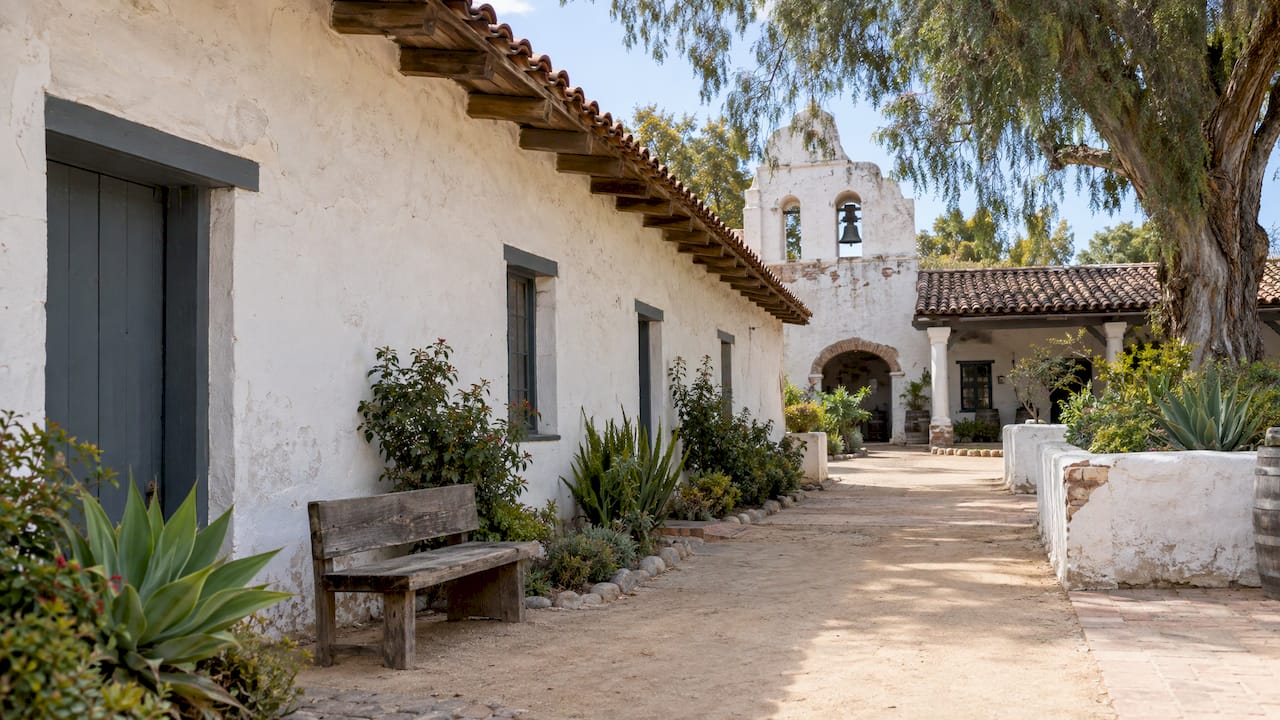
    Adobe-style historic buildings in Old Town San Diego

    If you’d rather build a longer San Diego stay around the coast, our San Diego weekend itinerary covers views and local flavor, and the free San Diego picks are worth a look if you’re keeping costs down.

    Solana Beach: a half-day that doesn’t feel rushed

    Solana Beach is the stop people ask about when they want something small. It’s a beach town with a compact center, and the station sits close to the coast. It works well as a half-day trip: coffee, a walk toward the water, a casual lunch, and an afternoon train back. If you’re traveling from Los Angeles and want a full day, it also makes a good second stop on a San Diego round trip.

    For quieter sand, take a look at our guide to San Diego’s secret beaches, and if you’re thinking beyond the train, the best day trips from San Diego lays out options for every kind of weekend.

    Oceanside: pier first, everything else second

    Oceanside is the one I send people to when they ask for a beach day with the least planning. The pier and the beach are an easy walk from the station, and there are plenty of places to eat along the way. Bring a light layer, since the ocean breeze cools things off fast once the sun dips, and plan your return train before you sit down for that long lunch.

    Orange County day trips

    San Juan Capistrano: small town, big history

    This is the stop I’d pick if you only get one. The station sits in the middle of the historic downtown, so you can walk to the Mission, restaurants and shops without a rideshare. It’s a popular San Diego-to-Orange County round trip for a reason: the pace is easy, and the downtown is made for strolling.

    Here’s how I’d spend a day:

    • Morning: Arrive, grab breakfast near the station, then head to the Mission grounds while it’s quiet.
    • Midday: Wander the downtown streets and have lunch on a patio.
    • Afternoon: Browse the shops, pick up something sweet, and leave time to be back at the platform early.

    Because service here is frequent enough on most days, you can usually choose between a late-afternoon or early-evening train, but check the timetable first.

    San Clemente: surf town energy

    San Clemente is the classic walk-to-the-pier stop. If you’re into long beach walks and casual food, it’s a good one. Pair it with San Juan Capistrano on a multi-city ticket and you’ve got a full day with two very different moods: historic and sleepy in one, salty and sandy in the other.

    Irvine, Fullerton and Anaheim: hubs with a payoff

    Irvine Station is more of a launchpad than a destination. The City of Irvine says it’s a transportation hub served by Amtrak and Metrolink passenger rail plus express, local and rail-feeder bus services run by OCTA. The station is at 15215 Barranca Parkway, Irvine, CA 92618, and the lobby is open 6 a.m. to midnight daily. That’s handy if you’re arriving early or running late.

    Fullerton has a walkable downtown with restaurants and bars that make for a good evening-out day trip. Anaheim is the obvious pick for theme-park trips and sports events, and the train is a stress-free way to skip the parking.

    If you want to dig into Orange County without spending much, our list of Orange County hidden gems you can visit for under $20 pairs well with a train day.

    Los Angeles and the north: Santa Barbara and beyond

    Los Angeles: a city day, car-free

    Riding into Los Angeles is a great way to explore downtown without circling for parking. You can build an entire day around food and neighborhoods, and if you like street-level discovery, our unique things to do in Los Angeles and Los Angeles food halls will keep you busy. Heading out of the city for the weekend instead? The best weekend getaways from Los Angeles shows where the train and a little planning can take you.

    Santa Barbara: the scenic one

    Santa Barbara is the day trip that feels like a vacation. According to Visit Santa Barbara, the station at 209 State Street is two blocks from the beach and Stearns Wharf. That means you can be on the sand within minutes of arriving.

    Because it’s farther north, the ride is longer, so treat this one as a full day. A few things worth knowing:

    • Food on the train: SBCAG says that on Pacific Surfliner trips to Santa Barbara County you can visit the Sea View Café for salads, sandwiches, snacks, craft beer, cocktails and wine. It also says travel saves 20% to and from all five Santa Barbara County stations with the associated thruway buses.
    • Getting around once you’re there: The Santa Barbara Independent reports that three free MTD shuttle services are available: Line 92 for Santa Barbara, Line 91 for East Goleta and UCSB, and Line 90 for West Goleta.
    • Parking at Ventura: The same report notes free parking arrangements at Seaside Park, with 20 short-term and 20 overnight spots for Amtrak riders in the Ventura County Fairgrounds lot.

    My ideal Santa Barbara day: ride up in the morning with a coffee, walk State Street, have lunch, spend the afternoon at the wharf and beach, then grab an early dinner before heading back.

    Ventura and Oxnard: the quieter coast

    Ventura is where I’d go if I wanted a coastal day without crowds. The harbor, the downtown and the beaches all feel more local than Santa Barbara. It’s also a nice halfway point if you want to break up a trip toward Santa Barbara with a stop on a multi-city ticket.

    Planning tips that save the day

    Pick one anchor. One main stop per trip works better than three. Trains don’t wait for you to finish dessert.

    Five practical tips for planning a train day trip

    Pack light. You’ll walk more than you expect. A small bag with water, sunscreen and a layer is plenty.

    Check Alerts the morning of your trip. The timetable PDFs and the Alerts page are the official way to see changes, so look before you leave the house.

    Time your meals around the train. Lunch at a place near the station is the easiest way to avoid a mad dash.

    Think about the whole day, not just the stop. If you’re traveling with kids, our guide to San Diego family activities locals use shows how to dodge the busiest hours.

    Consider staying the night. If a day trip starts to feel too short, a coastal resort stay turns the same train ride into a mini vacation. These destination details for a resort getaway show one way to plan it.

    A sample one-day plan from San Diego

    Here’s a simple template you can adapt to any stop:

    1. Book a round trip from San Diego – Old Town or San Diego – Downtown to San Juan Capistrano.
    2. Take a morning train and use the ride to look at the timetable for your return options.
    3. Spend the morning at the Mission and in the historic downtown.
    4. Have a long lunch, then head to San Clemente on a multi-city ticket if you’ve booked one.
    5. Walk the pier, grab a snack, and take the last comfortable train home.

    Swap in Oceanside or Solana Beach for a lighter day, or ride north from Los Angeles to Santa Barbara for a scenic one.

    Our take: why the train and local knowledge go together

    We built SoCal Sights because there’s too much information out there and too little of it comes from people who actually live here. A Pacific Surfliner day trip is the perfect example. Anyone can tell you the train exists. What helps is knowing which station puts you within walking distance of lunch, which stops feel sleepy in a good way, and where to find the places that never make the mainstream lists.

    Our guides cover hidden attractions, local food spots and itineraries by county, and they’re shaped by locals who share their favorite places. That’s how a train stop becomes a real day out instead of a pin on a map. Start with one station, explore it slowly, and come back for the next.

    Joshua

    Run a local business near a train stop?

    If your cafe, shop, tour or event is a short walk from a Surfliner station, the people stepping off the train are exactly who you want to reach. SoCal Sights offers advertising, featured placements and memberships for Southern California businesses and event organizers who want to be found by visitors and residents looking for things to do. You can see the options on our Advertise With SoCal Sights page.

    Socalsights

    FAQ

    Which Pacific Surfliner stops are best for a day trip?

    The easiest ones are where the main sights are within walking distance of the station: San Diego – Old Town, Oceanside, San Juan Capistrano, San Clemente and Santa Barbara. Old Town is directly across from a historic park, and Santa Barbara’s station is two blocks from the beach and wharf. Choose based on whether you want history, surf or scenery.

    How many stops does the Pacific Surfliner have?

    Pacific Surfliner lists 29 stations between San Diego and San Luis Obispo. They include San Diego, Solana Beach, Oceanside, San Clemente, San Juan Capistrano, Irvine, Anaheim, Fullerton, Los Angeles, Burbank, Ventura, Santa Barbara and Grover Beach. The full list is on its train travel FAQ page.
    Can I do a round trip between San Diego and Los Angeles in one day?

    Pacific Surfliner states there are daily round trips between San Diego and Los Angeles, and some trips extend to Santa Barbara or San Luis Obispo. Use the booking tool to see departure and return times for your date. Work backward from the last train you’re comfortable taking so you know how long you can stay.
    Can I stop at more than one place on the same trip?

    Yes. Pacific Surfliner says a multi-city ticket lets you stop at multiple destinations along the way at no additional cost. Connections aren’t guaranteed, so leave enough time between trains. Two nearby stops, like San Juan Capistrano and San Clemente, make the most sense for a single day.

    Where do I check for delays or schedule changes?

    Pacific Surfliner advises checking Alerts and using the northbound or southbound timetable PDF to match times by station. Look the morning of your trip, and again before you head back to the station for your return.

    Sources

  • Inglewood Open Studios Announces Return of Art Walk

    Inglewood Open Studios Announces Return of Art Walk

    After a one-year hiatus, Inglewood Open Studios (IOS) announces the return of its signature Art Walk on Saturday, November 14 and Sunday, November 15, from 12–5 PM. The free, self-guided event invites the public to explore Inglewood’s creative community through local artists’ workspaces, galleries, cultural organizations, workshops, performances, and other artist-led experiences.

    The Art Walk will bring together studios, galleries, and cultural spaces, giving visitors a chance to experience the breadth of Inglewood’s creative community. Visitors can use the new online mapping tool to shape their own experience, moving between artists’ studios, exhibitions, performances, workshops, and other participating locations. There is a complimentary shuttle transportation connecting participating locations.

    Visitors can start planning on the IOS website, where the Art Walk map will continue to grow as artists and studios are confirmed.For more information, to explore participating artists and locations, and to create a personalized Art Walk itinerary, visit inglewoodopenstudios.org

  • Desert Hikes in Palm Springs: Canyons, Oases and Peaks

    Desert Hikes in Palm Springs: Canyons, Oases and Peaks

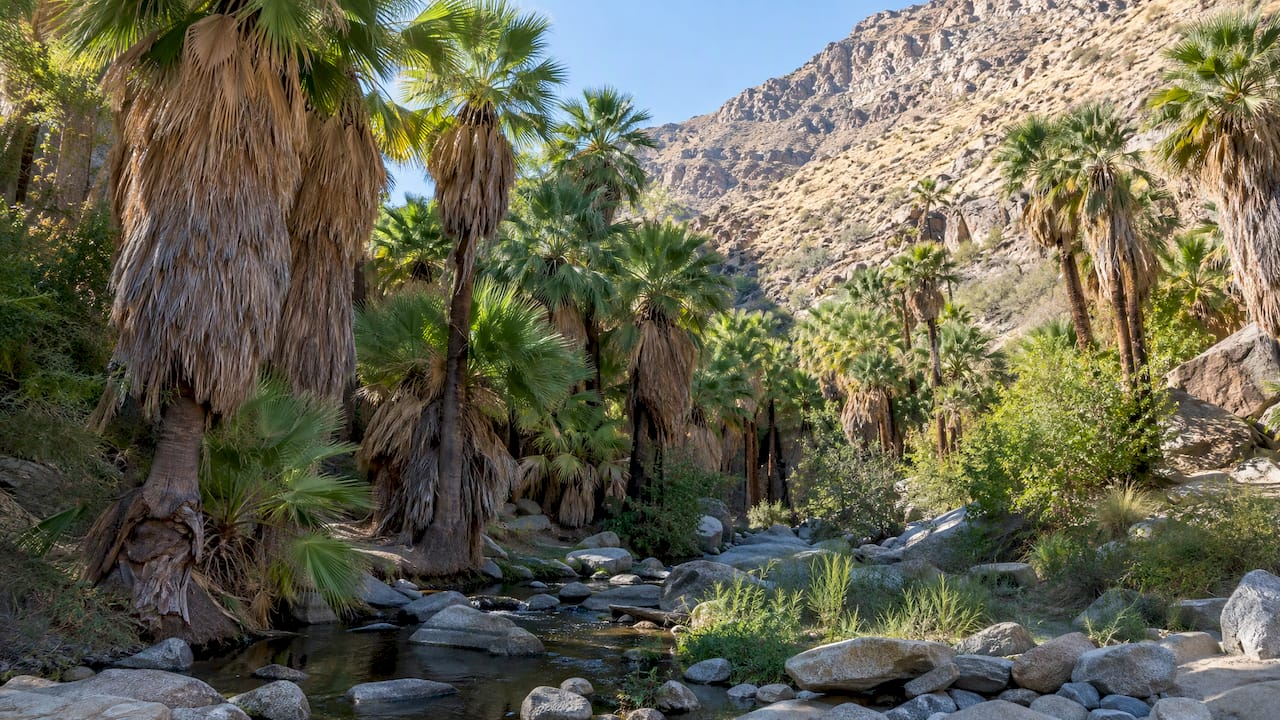
    The best desert hikes in Palm Springs are the palm-filled canyons at Indian Canyons, a handful of ridge trails with big valley views, and a few longer routes in the hills around Palm Desert and Rancho Mirage. If you want shade, water and green, start with Andreas Canyon. If you want a workout and a view, pick a ridge trail. Whatever you choose, go early, bring more water than you think you need, and check the seasonal hours before you drive out.

    I’ve spent plenty of mornings out here, and the thing I love most is how fast the scenery changes. One minute it’s bare rock and creosote, the next you’re under a canopy of fan palms next to a running creek. Below is how I’d sort the options, what each one costs in time and effort, and how to stay safe.

    Socalsights
    Find More Southern California Hidden Gems
    Explore curated local insights on fun activities, popular food spots and unique itineraries across Southern California.

    TL;DR

    • Easiest and prettiest: Andreas Canyon at Indian Canyons is a 1.2-mile loop with about 200 feet of gain, running through a huge fan palm oasis.
    • Most distinctive scenery: Palm Canyon, Murray Canyon and Victor Canyon each give you a different version of the oasis, from easy strolls to a waterfall destination.
    • Hardest and most rewarding: the Art Smith Trail is 8.3 miles with 1,465 feet of gain, and Tahquitz Canyon packs 350 feet of climbing into 1.8 miles.
    • Timing matters: hike at sunrise or late afternoon, and note that Indian Canyons runs a limited schedule in summer.
    • Pack for heat: water, sun protection, real shoes and a plan someone else knows about.

    Table of Contents

    How to choose your Palm Springs hike

    The Coachella Valley has a hike for nearly every mood, so it helps to decide what you want first.

    You want shade and water. Go to Indian Canyons. The creeks and palm groves make it feel ten degrees cooler than the open desert, even if that’s partly in your head.

    You want a short, scenic walk. Andreas Canyon is the classic. Victor Canyon is a good step up if you want a little more climbing.

    You want a real workout. The ridge trails and the Art Smith Trail are for you. They’re exposed, so they belong in the cool part of the day and the cool part of the year.

    You want something close to the pool. The trailheads on the edge of town, including the ones along the foothills, let you squeeze in a sunrise hike and be back for breakfast.

    The quick comparison below uses the distances and elevation gains published by the managing agencies. Where a source doesn’t give a number, I’ve left it out rather than guess.

    Hike Distance Elevation gain Difficulty What you get
    Andreas Canyon 1.2-mile loop 200 ft Easy Fan palm oasis, creek, rock formations
    Victor Canyon 2.7 miles 365 ft Moderate Quieter canyon walking
    Murray Canyon 4.7 miles 450 ft Not rated Creek crossings, waterfall at the end
    Tahquitz Canyon 1.8 miles 350 ft Strenuous Rocky canyon climb
    Art Smith Trail 8.3 miles 1,465 ft Strenuous Valley, mountain and Joshua Tree views

    Distances and gains come from Indian Canyons, the Tahquitz Canyon ticket page and the BLM Palm Desert and Rancho Mirage trail guide.

    Indian Canyons: the hikes everyone asks about

    If you only have time for one stop, make it Indian Canyons. It sits about five miles south of central Palm Springs on land belonging to the Agua Caliente Band of Cahuilla Indians, and it holds three main canyons: Palm, Murray and Andreas. A separate area, Tahquitz Canyon, is run on the same tribal lands.

    Andreas Canyon

    This is the one I send first-timers to. The trail is a 1.2-mile easy loop with around 200 feet of gain, following Andreas Creek through what the Indian Canyons site describes as the second largest California fan palm oasis in the world. You’ll see rock formations, sycamores, cottonwoods, willows and, of course, plenty of palms.

    The loop is short, so you can slow down. Bring a camera, sit on a rock by the creek and let the desert go quiet around you. It’s a great pick for kids, grandparents and anyone who hasn’t hiked in a while.

    Palm Canyon

    Palm Canyon is the big one. The canyon stretches about 15 miles, which means you can treat it as a short stroll to the first grove or as a serious day out. Most visitors walk in as far as feels fun, then turn around. You don’t have to do the whole thing to get the payoff, because the palms start early.

    Victor Canyon

    Victor is listed at 2.7 miles and moderate, with about 365 feet of gain. If Andreas feels too short and Palm too open-ended, this is the in-between hike. Expect a bit more climbing and, usually, fewer people.

    Murray Canyon

    Murray Canyon is 4.7 miles with roughly 450 feet of gain. It’s the one to choose if you like a destination. The trail ends at Seven Sisters Waterfall, and travel reviewers note you may get your feet wet along the way. Wear closed-toe shoes you don’t mind soaking, and skip it if you’d rather keep your socks dry.

    Tahquitz Canyon

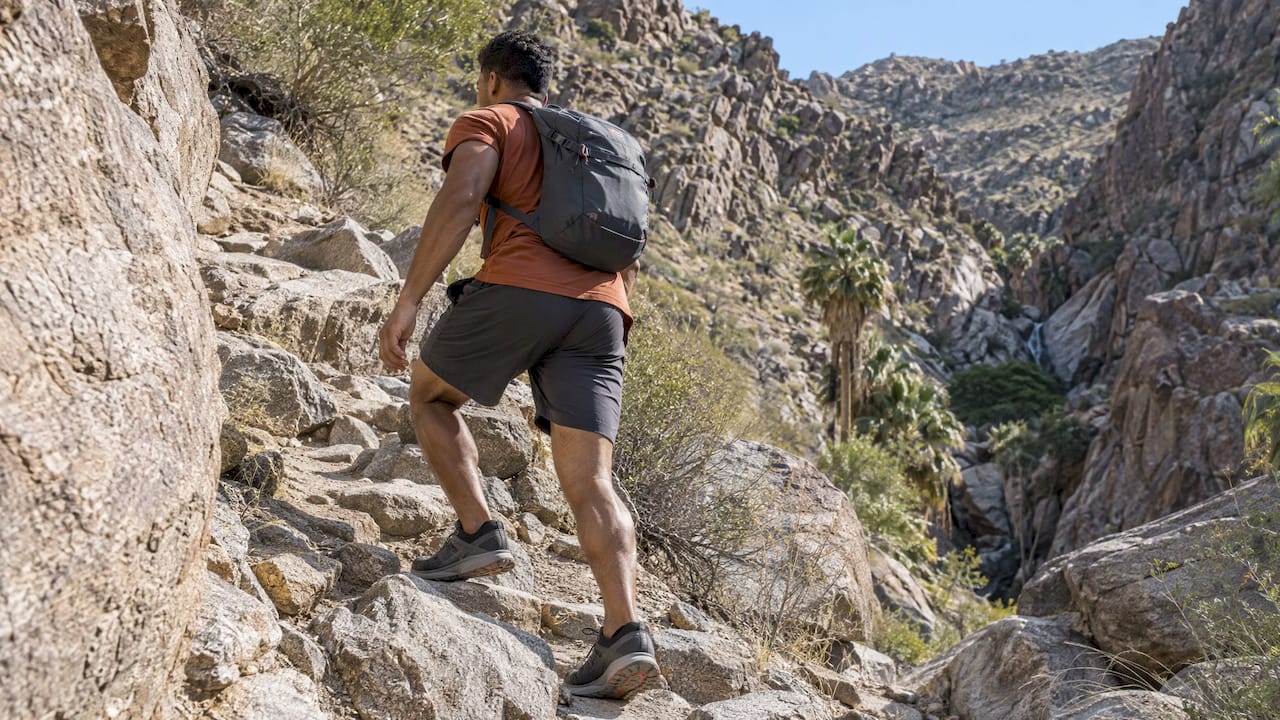
    Tahquitz is a different animal: one trail, 1.8 miles, labeled strenuous, with about 350 feet of elevation gain, according to the official ticketing page. It’s short but steep and rocky, so start early and take it slowly. Check the ticket page for current hours and entry details before you go, since access here works differently from the main Indian Canyons gate.

    Hiker climbing Tahquitz Canyon's rocky trail

    Fees, hours and seasonal closures at Indian Canyons

    Admission has been listed at $12 for adults, with lower prices for seniors, students and children 6 to 12, according to U.S. News. Prices can change, so confirm on the official site before you leave.

    Here’s the pattern worth knowing:

    • Indian Canyons is open daily from early October through early July, from 8 a.m. to 5 p.m., with the last vehicles admitted at 4 p.m., per the same U.S. News listing.
    • In the hottest stretch, from early July to the end of September, visitors are only allowed Friday through Sunday.
    • The canyons close on certain days for tribal ceremonies and observances, so check the Agua Caliente website the morning you plan to go.

    Because this is managed tribal land, the rules are part of the experience. Stay on the marked trails, don’t pick plants and don’t disturb the creek beds. These places have been cared for for a very long time, and a few minutes of respect keeps them that way.

    Ridge and mountain hikes with the big views

    The canyons are the postcard, but the ridges give you perspective. Popular trails on the edge of town, like the South Lykken Trail, are known for sweeping views over downtown Palm Springs. They’re exposed, with very little shade, so sunrise is the right time.

    For longer routes, the BLM’s trail guide for the Santa Rosa and San Jacinto Mountains National Monument is the best planning document I know. Two entries stand out:

    • Art Smith Trail. At 8.3 miles with 1,465 feet of gain, it’s strenuous. You get views across the Coachella Valley to the Little San Bernardino Mountains and Joshua Tree National Park, plus hidden canyons and the occasional lush fan palm oasis, per the BLM guide.
    • Hopalong Cassidy Trail. It’s known for panoramic views over Palm Desert’s neighborhoods and golf courses, and for the cross on the mountain. Great for people who like a viewpoint finish.

    If you’re staying in Palm Desert, our Palm Desert things to do guide pairs nicely with these routes for what to eat and see after.

    Coachella Valley hikes beyond Palm Springs

    The valley is bigger than the city that gives it its name. Within an easy drive you’ll find preserves with their own palm oases, birding spots and flat desert walking, which suits mornings when you don’t want to climb. The trail guides that Google surfaces often mention Thousand Palms Oasis Preserve and Big Morongo Canyon Preserve for exactly this reason. I’d check each preserve’s own page for current hours, since these can shift.

    If you have a spare day, Joshua Tree is close enough to combine with a Palm Springs stay. Our Joshua Tree itinerary lays out one- to three-day plans so you can decide how much of the park to squeeze in.

    When to go

    The short answer: fall through spring. Summer afternoons here are no joke, which is the whole reason Indian Canyons limits its summer schedule. Even in the cooler months, I like to be on the trail near sunrise.

    A few seasonal notes from my own routine:

    • October to April is prime hiking. Mornings are crisp, and midday is fine for shorter loops like Andreas.
    • Late spring gets warm quickly. Move your start time earlier and pick shorter hikes.
    • Summer is for sunrise-only outings or skipping the trails entirely. Spend afternoons at a pool, a museum or a cool restaurant. Our heat smart Palm Springs weekend guide has local picks for exactly that.

    Staying safe on desert trails

    The desert is forgiving when you prepare and unforgiving when you don’t. This is my checklist, and none of it is complicated.

    1. Start early, or finish late. Avoid midday heat. Pick your hike based on the temperature forecast, not on how much you want to do it.
    2. Carry more water than you think. Bring plenty for the whole outing, plus extra in the car. Sip steadily instead of waiting until you’re thirsty.
    3. Cover up. Hat, sunglasses, sunscreen and breathable long sleeves. Shade is rare on the ridge trails.
    4. Wear real shoes. Rocky trails and creek crossings are rough on flip-flops and fashion sneakers.
    5. Watch where you put your hands and feet. Snakes, spiders and scorpions look for shade in bushes, tall grass and rock crevices, so don’t reach into places you can’t see.
    6. Tell someone your plan. Share the trailhead, your route and when you’ll be back. Cell service drops out in canyons.
    7. Turn around early. Heat exhaustion creeps up. If you feel dizzy, nauseated or stop sweating normally, get to shade and call 911 if you don’t recover quickly.

    If you’re hiking with an older relative or helping someone who lives alone, the extreme heat safety plan for solo agers is a clear one-sitting read on how to prepare for hot days. People over 65 and anyone with a heart condition or on medications that affect hydration should talk with their doctor before a strenuous desert hike.

    Our take on desert hiking in Palm Springs

    We built SoCal Sights because we kept watching visitors skip the places locals love most. Palm Springs is a perfect example. Most people see the same two or three trails on every list, and they’re great, but the region is full of quieter corners that reward you for looking.

    Our approach is simple. We pick hikes by what you actually want from the day: shade, a waterfall, a workout or a view. Then we pair them with the stops that make the day feel complete, like a good lunch, a hot spring soak or a sunset drive. That’s what we mean by curated.

    We also lean on community tips. Locals tell us which trailhead has parking at 6 a.m., which grove is quiet on Sunday and which spot is worth the extra mile. If you’ve got a favorite desert trail, we’d love to hear about it.

    Joshua

    Make a day of it

    A hike is better with a plan around it. Here’s how I’d build three easy days.

    The easy day. Andreas Canyon in the morning, then lunch in town and a slow afternoon by the pool. It works for families and first-timers.

    The big views day. Hit a ridge trail at sunrise, then breakfast, then rest. If you still have energy later, drive to a viewpoint for sunset.

    The waterfall day. Murray Canyon to Seven Sisters Waterfall, with dry shoes in the car. Plan on a half day.

    After a long hike, a soak feels incredible. Our hot springs in Southern California list has options within reach of the desert. And if you’re thinking about wildflower season out here, see our Anza-Borrego wildflowers guide for a desert trip with a different kind of color.

    Run a local business near the trails?

    If you own a cafe, a shuttle, a gear shop, a hotel or a tour experience that serves Palm Springs hikers, we’d love to help people find you. SoCal Sights offers advertising, featured placements and memberships for Southern California businesses and event organizers, so readers planning a hike can discover you at the right moment. Pricing isn’t published, so reach out through the page below to ask about options.

    Socalsights

    Learn more on our advertise with SoCal Sights page.

    FAQ

    What is the best easy desert hike in Palm Springs?

    Andreas Canyon at Indian Canyons is my pick. It’s a 1.2-mile loop with about 200 feet of gain, and it winds along a creek through a large fan palm oasis. Most people finish it in an hour or so, depending on how many photo stops they make.

    Are the Indian Canyons open year-round?

    They’re open daily from early October through early July and only Friday through Sunday from early July through September, according to U.S. News. They also close on some days for tribal ceremonies. Always check the Agua Caliente website the day you go.

    How much does it cost to hike Indian Canyons?

    Adult admission has been listed at $12, with reduced rates for seniors, students and children. Fees can change, so confirm the current price on the official site before you drive out.

    What is the hardest hike near Palm Springs?

    Of the routes covered here, the Art Smith Trail is the biggest challenge at 8.3 miles and 1,465 feet of elevation gain. Tahquitz Canyon is much shorter at 1.8 miles but is rated strenuous because of its steep, rocky climb. Start either one at sunrise and bring extra water.

    What time of day is best for desert hikes in Palm Springs?

    Early morning is best, and late afternoon works in cooler months. Midday sun on exposed ridge trails gets hot fast, so save that time for shade, lunch or a pool.

    Sources

  • Dog Beaches in San Diego: Where Your Pup Can Run Free

    Dog Beaches in San Diego: Where Your Pup Can Run Free

    San Diego has real off-leash beach options, but only a few, and the rules change from one stretch of sand to the next. The short version: Ocean Beach’s Dog Beach is the all-day, always-off-leash classic, Fiesta Island and Coronado are the other leash-free picks, and Del Mar is off leash only in certain seasons and hours. Everywhere else, think leash and timing.

    I’ve sorted the spots below by how much freedom your dog gets, with the hours, the leash rules and the little details that keep a beach day from ending in a citation.

    Socalsights
    Find More Local Southern California Gems
    Explore curated local insights into fun activities, food spots, and unique itineraries across Southern California.

    TL;DR

    • Ocean Beach Dog Beach is San Diego’s only 24-hour beach for dogs, and dogs may be off leash there at all times.
    • Fiesta Island (Mission Bay) is leash optional, open daily from 4 a.m. to 10 p.m.
    • Coronado Dog Beach at 200 Ocean Boulevard allows off-leash play in the designated area, but your dog needs a leash on the way there.
    • Del Mar’s North Beach switches between off-leash and leashed depending on the season and the time of day.
    • On most other City of San Diego beaches, dogs are only allowed in the evening, and always with leash rules in play.

    Table of Contents

    The Quick Comparison

    Here’s the whole picture on one screen. Details for each spot follow.

    Beach Leash rule Good to know
    Ocean Beach Dog Beach Off leash, always Open around the clock
    Fiesta Island, Mission Bay Leash optional 4 a.m. to 10 p.m. daily
    Coronado Dog Beach Off leash in the designated area Leash up before you reach the sand
    Del Mar North Beach Off leash in the off-season; limited hours in summer Seasons set by the city
    Cardiff State Beach On leash Six-foot leash, south of Tower 16
    Imperial Beach On leash Only between Imperial Beach Blvd and Palm Ave
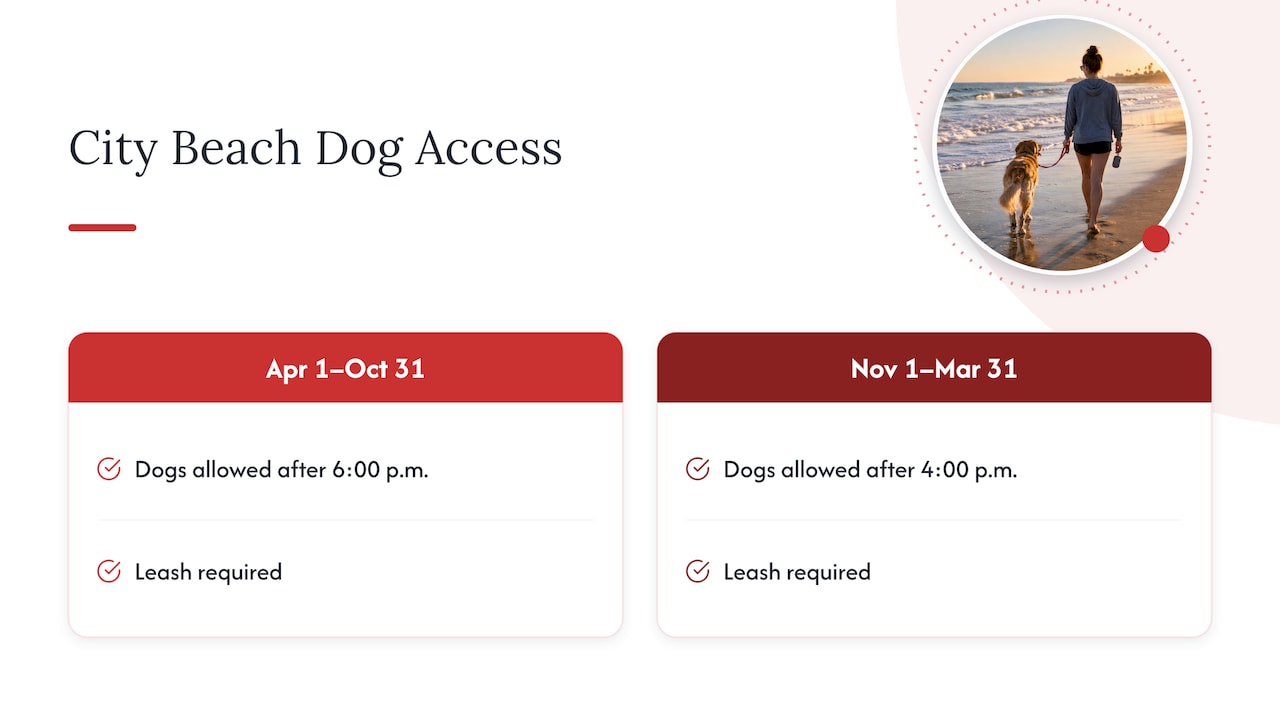
    Other City of San Diego beaches On leash, evening only After 6 p.m. in summer, 4 p.m. in winter

    Ocean Beach Dog Beach: The Local Classic

    If you only visit one, make it this one. Dog Beach sits at the north end of Ocean Beach, and it’s the only beach in the city that dogs can enjoy 24 hours a day. Dogs are always permitted without a leash, and you’re responsible for keeping control of your dog and picking up after it.

    The city describes it as a designated leash-free exercise area at the west end of the San Diego River Floodway, also called the Ocean Beach Flood Control Channel. That’s useful to know when you’re typing it into your maps app.

    Why do I love it? The mix. You get big retrievers charging into the surf, tiny dogs doing zoomies on dry sand and owners who clearly all know each other. Because it’s open at every hour, it’s also the easiest answer when your schedule doesn’t line up with evening-only beach rules elsewhere. Sunrise visits are quiet and calm. Late afternoons are a social scene.

    A few habits make it better:

    • Bring more water than you think you need. Dogs drink a lot when they play hard, and salt water isn’t a substitute.
    • Pack plenty of bags. Cleanup is on you.
    • Keep your eyes on your dog. Off leash means voice control and attention, not a free pass to look at your phone.

    After your walk, Ocean Beach itself is a fun neighborhood to wander. If you want more coast beyond the dog zone, my local guide to San Diego’s secret beaches is a good next stop for your own solo or human-only outings.

    Fiesta Island: Room to Roam in Mission Bay

    Fiesta Island in Mission Bay Park is a leash-optional area, open daily from 4 a.m. to 10 p.m. It’s a different feel than Ocean Beach: more open, more bay water, calmer waves. That makes it a good fit for dogs who are a little unsure about crashing surf but love to splash and fetch.

    What I like is the flexibility. You can go early before work or stay into the evening, and the hours are generous. Just remember the gates and hours are real. The city notes that violations of leash laws and restricted hours can bring citations from Park Rangers, police, the Humane Society or lifeguards, so don’t plan a midnight visit here the way you could at Ocean Beach.

    If you’re building a whole day, you can pair a Fiesta Island morning with something human-friendly nearby. Our San Diego weekend itinerary has coastal views and local food ideas you can adapt around a dog-walk schedule.

    Coronado Dog Beach: A Leash-Free Pocket on the Island

    Coronado is known for being strict about dogs, which is what makes its dog beach special. The city’s parks guide lists North Beach/Dog Beach as off leash, while Central and South beaches are listed as not allowing dogs.

    The address to know is 200 Ocean Boulevard. Per the city, dogs may be off leash in the designated beach area but must be on leash before reaching it. The spot sits across from Sunset Park, bordering North Island, so you’ll want to leash up as you walk over from the street and unclip once you’re on the sand.

    Because only part of the beach allows dogs, double-check where you are before letting go. If you’re not sure, Coronado’s official dogs page lists where dogs are allowed on and off leash on city property.

    Del Mar North Beach: Great, With Seasons

    Del Mar’s North Beach, locally just called Dog Beach, lies north of 29th Street and extends nearly half a mile to the Solana Beach border. It’s gorgeous, and it’s popular, which is why the rules shift through the year.

    The city splits the calendar in two:

    That means summer visits are early-bird territory. If you’re a morning person, you’ll love having a quiet beach to yourselves before the crowds roll in. If you’re not, plan a fall or spring trip instead.

    Del Mar has a few other rules worth knowing, all from the city’s dog-friendly beaches page:

    • Dogs must wear a current license.
    • Where leashes are required, they can be no longer than six feet.
    • In designated off-leash areas, dogs must remain under voice control.
    • You must clean up after your dog.
    • Penalties for leash-law violations start at $285.

    That last one is a good motivator. If your dog’s recall is shaky, a bit of practice before beach season goes a long way. Ideas like loose leash training steps can make the leashed part of the day (and the walk back to the car) a lot less stressful.

    On-Leash Beaches: Cardiff and Imperial Beach

    Not every dog beach is a free-for-all, and that’s fine. Plenty of dogs are perfectly happy on a long walk by the water with you holding the leash.

    Cardiff State Beach

    Dogs are allowed at Cardiff Reef and Seaside, south of Tower 16, on a leash no longer than 6 feet. NBC 7 also reports Cardiff permits dogs on leash at all times. Parking matters here: the state’s vehicle day-use fees are demand-based, ranging from $12 to $25 per vehicle. Check the official page for what’s current before you go.

    Imperial Beach

    At Imperial Beach, dogs are permitted only south of Imperial Beach Boulevard and north of Palm Avenue, and they must stay on leash at all times. It’s a compact stretch, so it’s easy to stray outside the allowed zone if you’re not paying attention.

    Everywhere Else in the City of San Diego

    Here’s the rule that surprises visitors. Outside the two designated San Diego leash-free areas (Ocean Beach Dog Beach and Fiesta Island), the City says dogs on beaches are generally allowed only after 6:00 p.m. from April 1 through October 31, or after 4:00 p.m. from November 1 through March 31, with leash rules applying.

    Seasonal San Diego beach access hours for dogs

    So a sunny midday walk along a typical city beach with your dog isn’t going to work, even on a leash. Plan evening strolls instead. Sunset walks are lovely anyway, and the crowds thin out.

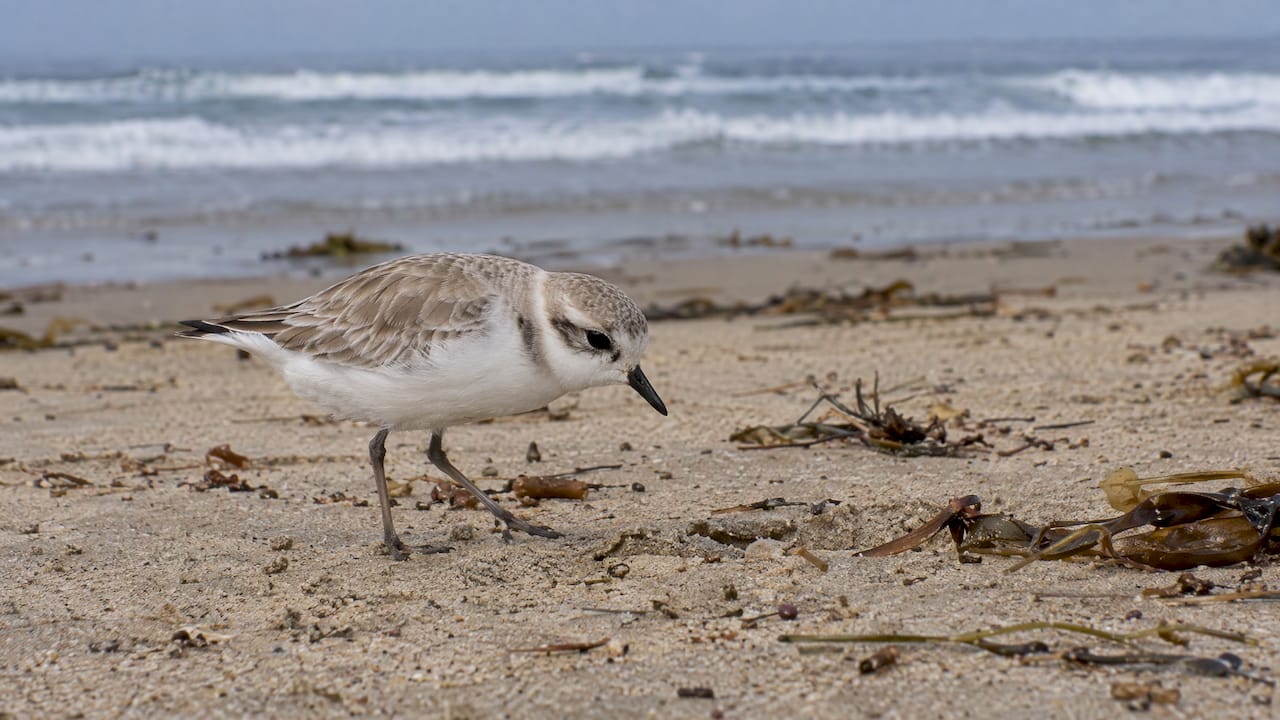
    Some areas are off limits entirely. California State Parks notes that many coastal areas prohibit dogs year-round to protect sensitive wildlife habitat, including threatened or endangered species and breeding grounds. At Silver Strand State Beach, for example, access is restricted because dogs, leashed or not, are a threat to the threatened snowy plover.

    Snowy plover foraging on Silver Strand beach

    It’s easy to feel those rules are about being strict. They’re really about shared space. Birds nest right on the sand, and a dog that looks like it’s just playing can look like a predator to them. If you want to understand more about beach safety for dogs, including why wildlife protections matter, it’s worth a read before your trip.

    The City also lists seasonal nesting-area closures on its dog beach page, so check it before heading out.

    Service Animals Are Different

    The City of San Diego clarifies that service animals individually trained to perform tasks for a person with a disability are exempt from these beach restrictions under the Americans with Disabilities Act. That’s not the same as a pet or an emotional support animal, so only count on the exemption if your dog meets that definition.

    A Simple Beach Day Checklist

    The best dog beach days are boring in the best way: nothing goes wrong. Here’s what I bring and check.

    1. Check the rules the day you go. The City of San Diego’s dog beach page, Coronado’s dogs page and Del Mar’s dog-friendly beaches page are the official sources, and hours, closures and seasons can change.
    2. Bring a six-foot leash even if you’re headed somewhere off leash. You’ll need it in parking lots, walkways and the Coronado approach.
    3. Carry your dog’s license info. Del Mar requires a current license.
    4. Pack water, a bowl and cleanup bags. Every site above makes cleanup your responsibility.
    5. Plan timing. Summer at Del Mar means early mornings. Most other city beaches mean evenings.
    6. Watch your dog around other dogs. Off-leash zones are social, and not every dog wants to be greeted.

    If you’re staying overnight in the area, you may also like our guide to San Diego beach camping, though check every campground’s pet policy yourself. And if your pup isn’t beach-bound, our list of free things to do in San Diego has plenty of options for the humans.

    Our Perspective

    We built SoCal Sights because most guides throw a hundred names at you and leave you to sort out which ones are actually worth the drive. Dog beaches are a perfect example. The list of places is short, the rules are specific, and the details are what make or break your day.

    Our approach is to lean on what locals know. Ask anyone in Ocean Beach and they’ll tell you the same thing: go early, bring water, and keep an eye on your dog. That kind of practical, lived-in advice is what we try to collect and share, and it’s why we invite locals to send in their favorite spots and tips.

    We think the best way to enjoy Southern California is to slow down, pick one great place and do it right. A well-chosen dog beach and a good plan beat a rushed tour of five.

    Joshua

    Get Your Local Business in Front of SoCal Explorers

    Run a dog-friendly cafe, groomer, pet shop or beach-adjacent business in Southern California? Our readers are locals and visitors looking for exactly the kind of places that make a day out better. You can reach them through advertising, featured listings and memberships with SoCal Sights.

    Socalsights

    Pricing isn’t published on the page, so reach out through the site to learn what fits your business.

    FAQ

    Can you take your dog to the beach in San Diego?

    Yes, but where you go matters. Dogs are welcome at Ocean Beach’s Dog Beach and on Fiesta Island, according to the City of San Diego, and are restricted at other beach and bay locations. Elsewhere in the city, dogs are generally only allowed in the evening.

    Which San Diego beach is best for off-leash dogs?

    Ocean Beach’s Dog Beach is the easiest pick since dogs may be off leash there at any hour. Fiesta Island and Coronado Dog Beach are great alternatives, and Del Mar’s North Beach works well in the off-season. Which is best really depends on whether your dog prefers surf, calm bay water or a quiet morning.

    Are dogs allowed on Del Mar beaches in summer?

    Yes, with limits. During peak season, June 16 through Labor Day, dogs may be off leash from dawn to 8 a.m. at North Beach and must be leashed after that, per NBC 7 San Diego’s guide. Check Del Mar’s official page for the current rules.

    What happens if I break the leash rules?

    Park Rangers, police, the Humane Society or lifeguards can issue citations for leash-law and restricted-hours violations in San Diego. In Del Mar, penalties for leash violations start at $285.

    Sources

  • Bonfire Beaches in San Diego: Where to Find Fire Rings

    Bonfire Beaches in San Diego: Where to Find Fire Rings

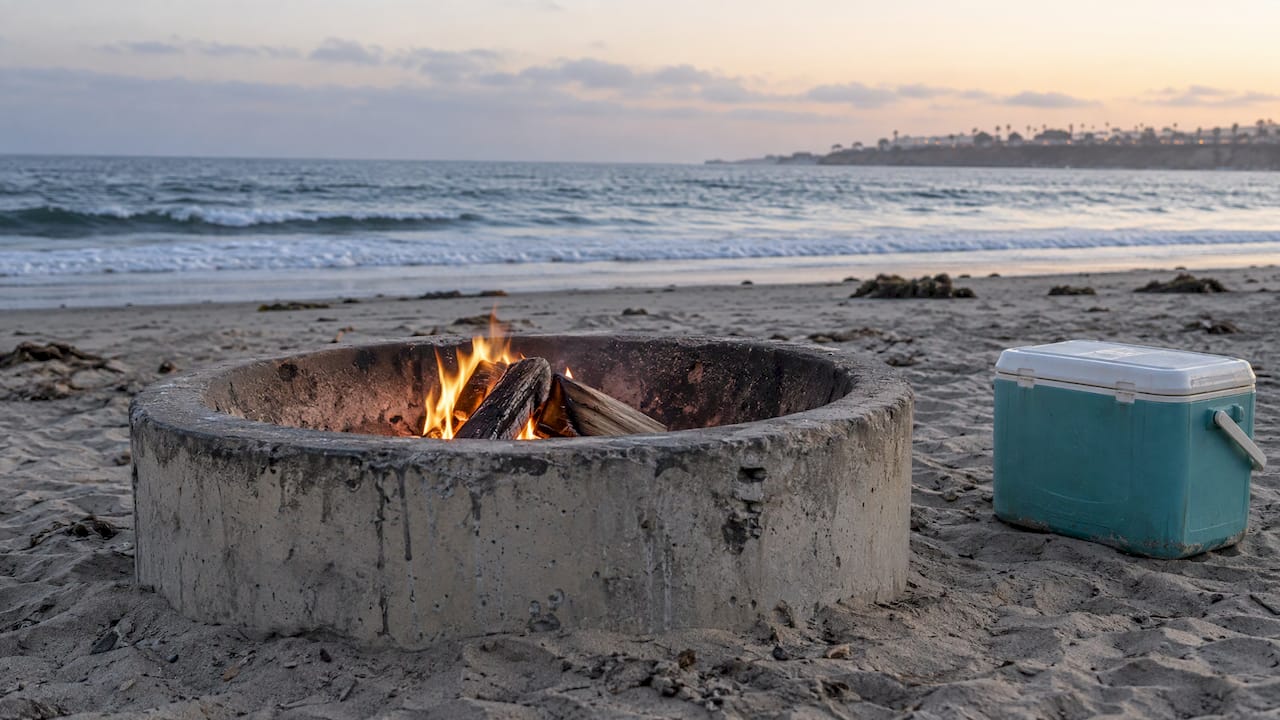
    Yes, you can have a beach bonfire in San Diego, but only in the city’s fire rings. Open fires on the sand are not allowed. The easiest year-round spots are around Mission Bay, while La Jolla Shores, Mission Beach and Ocean Beach have rings in the warmer months only. Every ring is first come, first served, so a little planning goes a long way.

    I’ve spent plenty of evenings around these rings, and the best ones always start with the same thing: knowing where to go and showing up early. Here’s how it all works, plus where to go if you’re crossing into Orange County.

    Socalsights
    Find More San Diego Experiences
    Explore SoCal Sights for curated local recommendations, from fun activities and food spots to unique Southern California itineraries.

    Explore SoCal Sights

    TL;DR

    • Beach fires in the City of San Diego are legal only in city-provided fire rings (or a contained portable propane device), never directly on the sand.
    • Mission Bay has the most rings and keeps them year-round. La Jolla Shores, Mission Beach (Belmont Park) and Ocean Beach are summer only, roughly mid-March to mid-September.
    • Fires are not allowed between midnight and 5 a.m. Rings are first come, first served, with no reservations.
    • Orange County has big ring counts at Huntington Beach, Bolsa Chica and Doheny, with rules that differ beach by beach.

    Table of Contents

    The Short Answer on Beach Bonfires in San Diego

    The City of San Diego says open beach fires outside containers are prohibited, and fires aren’t allowed between midnight and 5 a.m. Where fire pits are provided, they’re first come, first served. There’s no booking system and no way to hold a ring, so if you want one, you go early and stake your claim.

    The city’s own shoreline fire-ring rules document adds that beach fires can only be built in city-provided rings or inside a portable propane-fueled device. That’s the whole legal picture in two lines. Everything else is about picking the right spot.

    Where the Public Fire Rings Are

    The same city document lists every ring by location. Here’s the breakdown, as I’d group it for planning a night out.

    Summer-only rings on the ocean beaches

    These are the classic “sunset by the Pacific” options. According to the city, “summer only” runs from mid-March to mid-September, so check that window before you haul firewood to the coast in the cooler months.

    Beach Fire rings Season
    La Jolla Shores 7 Summer only
    Mission Beach (Belmont Park area) 5 Summer only
    Ocean Beach 7 Summer only

    A few notes from each:

    Mission Bay: the year-round favorite

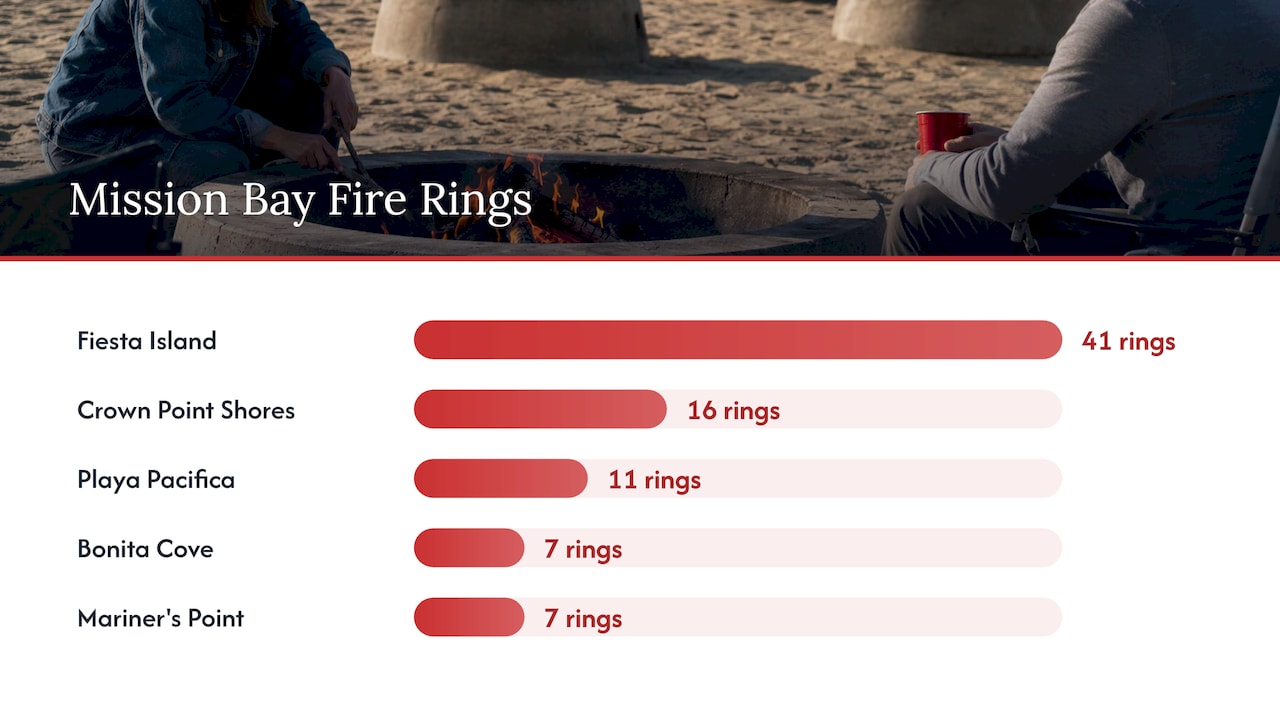
    If I had to pick one area for a bonfire, it’d be Mission Bay. Mission Bay Park covers more than 4,235 acres with 27 miles of shoreline, 19 of them sandy beach. Most of the city’s fire rings live here, and the city’s list covers a lot of ground:

    Mission Bay location Fire rings
    Fiesta Island 41
    Crown Point Shores 16
    Vacation Isle, Paradise Point 15
    Vacation Isle, Southside 11
    Playa Pacifica 11
    Bonita Cove 7
    Mariner’s Point 7
    Ventura Cove 7
    De Anza Cove 5
    Vacation Isle, North Cove 4
    Sunset Park 3
    Hilton-South 3
    Dana Landing 2
    De Anza Boat Launch 2
    Hilton-North 2
    South Shores 2
    Mission Point 1

    Fiesta Island is the numbers play. With 41 rings, you have the best odds of finding one open on a busy night. Crown Point Shores and Paradise Point also have deep ring counts, which makes them good for bigger groups who can spread out across a few pits.

    The bay is calmer than the open ocean, the water is flat, and you get that glowing sunset over the water. You don’t get waves crashing behind you, but you do get a very easy evening with kids, dogs and a cooler.

    Mission Bay: the year-round favorite

    Fewer rings than last year

    The ring count is shrinking a little. Times of San Diego reported in August 2026 that the city has 16 fewer rings than the 185 available in 2025. The paper also noted that a one-time county grant kept the rings going through July 1, 2026, and that they’re now funded through the city’s general fund. La Jolla’s local news outlet covered the earlier push to keep the three rings at La Jolla Shores. The city also says ring availability is subject to maintenance and replacement, so a ring you used last year may be gone or being swapped out.

    My takeaway: don’t count on a specific ring. Have a backup in mind, ideally in the same area.

    The Rules in Plain English

    San Diego’s rules are short, and they’re enforced. Here’s what the city’s Mission Bay beaches page and the shoreline rules document lay out:

    1. Hours. Fires are permitted between 5 a.m. and midnight. Nothing between midnight and 5 a.m.
    2. Fuel. Only wood, charcoal or paper products. No rubbish, and no pallets.
    3. Height. Keep fuel no higher than 12 inches above the upper edge of the ring.
    4. Put it out. Fires must be completely extinguished before you leave. Coals get removed or put in the hot coal containers where provided.
    5. Containers only. No digging your own pit, no open fire on the sand.

    If you’d rather bring your own heat, the city allows a portable propane-fueled device. That’s worth knowing when every ring is taken.

    Where fires are off the table

    Not every beach with a gorgeous sunset is a bonfire beach. At Torrey Pines State Beach, California State Parks’ posted orders prohibit wood fires. They allow only self-standing charcoal or propane stoves with at least 6 inches of clearance. Coronado Beach is another one to check before you go: the city is smoke-free on public property, per the City of Coronado, and I’d confirm the current fire rules with the city before planning anything there.

    How to Get a Ring (and Keep Your Night Smooth)

    Because nothing can be reserved, timing is the whole game. A few habits that work for me:

    • Go early. On a warm summer weekend, aim for the afternoon. Someone in your group can grab a ring while the rest of you handle food and parking.
    • Weekdays are easier. The same ring that’s packed on Saturday is often empty on a Tuesday.
    • Pick Mission Bay for big groups. More rings in one place means your group can sit together or split up without drama.
    • Bring dry wood. Check the fuel rules first, and pack the wood in the car, not in your hands on the walk down.
    • Plan for the midnight cutoff. You want the fire out well before you leave, so budget time to let it burn down.
    • Bring water for the finish. The rule is that the fire is fully out before you go.

    If you’re planning to make a full evening of it, the beach is only half the story. For the sunset and the days around it, my San Diego weekend itinerary pairs coastal views with local flavor. And if you’re staying overnight, our guide to beach camping and fire rules goes deeper on tides and what to expect.

    Accessibility

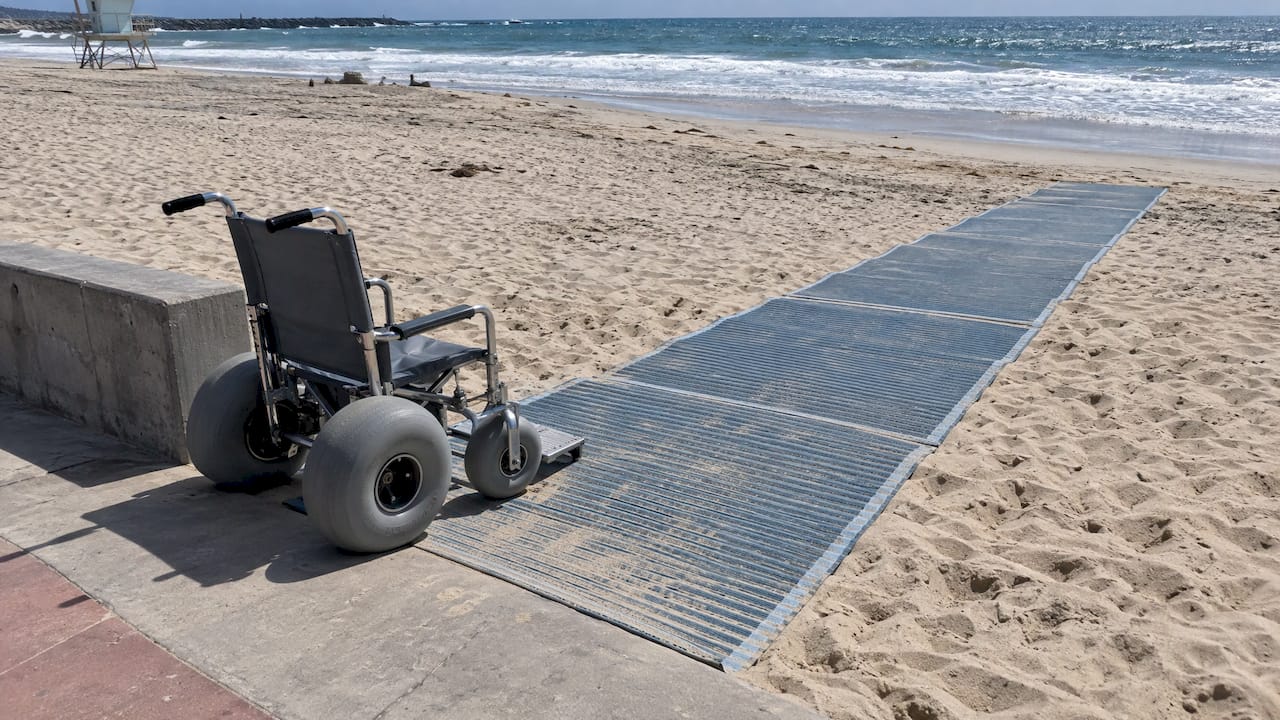
    The city provides accessible beach mats at nine city beach and Mission Bay locations from May through September. Manual beach wheelchairs can be checked out from lifeguards at Ocean Beach, Mission Beach, Pacific Beach and La Jolla Shores. The city lists reservations for Freedom Trax, Access Trax mats and rollators at Mission Beach at (619) 980-1876 during operating hours. If someone in your group needs this, call ahead.

    Accessible beach mat and manual beach wheelchair

    Cooler months

    Since it’s November as I write this, the summer-only rings at the ocean beaches are out of season. Mission Bay is your winter answer. Chilly evenings are actually when a ring feels best, and the beach is quieter. Winter and early spring beach days can be bright and sunny, too, as this March beach day recap shows.

    Beach Bonfires in Orange County

    Many people searching for San Diego fire pits also look north, and Orange County has a lot to offer. The rules change from city to city and between city and state beaches, so read the specifics.

    Beach What to know
    Huntington City Beach 127 fire pits from south of First Street to Beach Blvd; barbecues must be within 6 feet of a fire pit and up off the sand
    Huntington State Beach Fire rings year-round, 6 a.m. to 10 p.m., first come, first served; coal and wood only, no charcoal grills
    Bolsa Chica State Beach Close to 200 fire rings year-round, 6 a.m. to 10 p.m., first come, first served
    Doheny State Beach Fire rings year-round, 6 a.m. to 10 p.m., first come, first served unless reserved with a picnic area
    Newport Beach (Balboa Pier, Corona del Mar State Beach) Fire rings 6 a.m. to 10 p.m., first come, first served; portable barbecues not allowed on city beaches

    Two OC places to skip if a wood fire is the plan. Salt Creek Beach prohibits all fires. At Crystal Cove State Park, charcoal and wood burning are strictly prohibited, and fire pits on the beach and in the Moro Campground are propane only.

    One big difference from San Diego: the OC state beaches close at 10 p.m., not midnight. Huntington State Beach also states that alcohol is prohibited unless approved through a special events permit. Know the closing time before you light up.

    Our Perspective

    We built SoCal Sights because the usual lists of bonfire spots are copied from each other, and they’re often out of date. A ring that was there two summers ago might not be there now. That’s why we lean on what locals actually see on the sand, plus what the city and state post.

    Our take: a good beach bonfire isn’t about the most famous beach. It’s about the right ring at the right time. Pick Mission Bay when you want reliability, pick Ocean Beach or La Jolla Shores when it’s summer and you want the open Pacific, and always have a plan B within a few minutes’ drive.

    We also think the best nights come from the little local details: which side of Fiesta Island clears out early, where parking is easy, which sunset angle is best. That’s the kind of thing our community shares, and it’s what we’re here to collect. If you’ve got a favorite ring, send it our way.

    Joshua

    Want Your Business in Front of Beach-Goers?

    We help local businesses and event organizers reach people planning their days out across Southern California. If you run a beachside food spot, a gear rental or an event, you can advertise with SoCal Sights and show up where locals and visitors are already looking for things to do.

    Socalsights

    Membership pricing isn’t published, so use the page above to get in touch.

    More Ways to Round Out the Day

    A bonfire is the perfect end to a longer beach day. Here are a few ideas from our guides:

    FAQ

    Can you have a bonfire on any San Diego beach?

    No. In the City of San Diego, open beach fires outside containers are prohibited. You can build a fire only in a city-provided fire ring, or inside a portable propane-fueled device. Some state beaches, like Torrey Pines, ban wood fires altogether.

    Do I need a permit or reservation for a San Diego beach fire ring?

    The city’s rings are first come, first served, and the city’s rules document doesn’t describe a reservation system. Arrive early and have a backup ring in mind. Check the city’s page before a special trip, since ring availability is subject to maintenance and replacement.

    What can I burn in a San Diego fire ring?

    Only wood, charcoal or paper products, and the burning of rubbish is prohibited. Keep fuel no more than 12 inches above the top edge of the ring. Fires must be fully extinguished before you leave the beach.

    Which beaches have fire pits in Orange County?

    Huntington City Beach, Huntington State Beach, Bolsa Chica, Doheny and the Newport Beach spots near Balboa Pier and Corona del Mar all have public fire rings. Salt Creek and Crystal Cove do not allow wood or charcoal fires. Check each beach’s page for current hours.

    Sources

  • Tide Pools in Los Angeles: Where to Go and When

    Tide Pools in Los Angeles: Where to Go and When

    The easiest place to start with tide pools in Los Angeles is White Point and Royal Palms Beach in San Pedro. The rocky shore has pools to explore at low tide, and the bluff above has picnic tables, restrooms and metered parking. Go on a low tide, move slowly, look more than you touch, and bring lunch for the bluff afterward.

    I love this kind of outing because it costs almost nothing and feels like a tiny expedition. Here’s how I’d plan it, from picking a tide to packing the cooler.

    Socalsights
    Find More Southern California Gems
    Explore local recommendations for unique activities, food spots, and itineraries that can help you plan more authentic Southern California outings.

    Explore local recommendations

    TL;DR

    • White Point / Royal Palms Beach in San Pedro is the most convenient LA-area tide pooling and picnic combo, with bluff-top tables and restrooms.
    • Tide pools only show up around low tide, so check the tide table first and plan to arrive before the lowest point.
    • Never turn your back on the ocean. Sneaker waves can hit suddenly, even on a calm day.
    • Look, don’t take: leave animals, rocks and shells exactly where you found them.
    • Pair the tide window with a picnic on the bluff, and check the county beach page for current construction notes before you drive.

    Table of Contents

    Where to go for tide pools in Los Angeles

    Los Angeles County doesn’t have one famous tide pool beach the way La Jolla does in San Diego. It has a handful of rocky stretches, and the best ones sit along the Palos Verdes Peninsula and up the Malibu coast. If you’re heading south instead, our guide to the best tide pools in San Diego covers that side.

    White Point and Royal Palms Beach, San Pedro

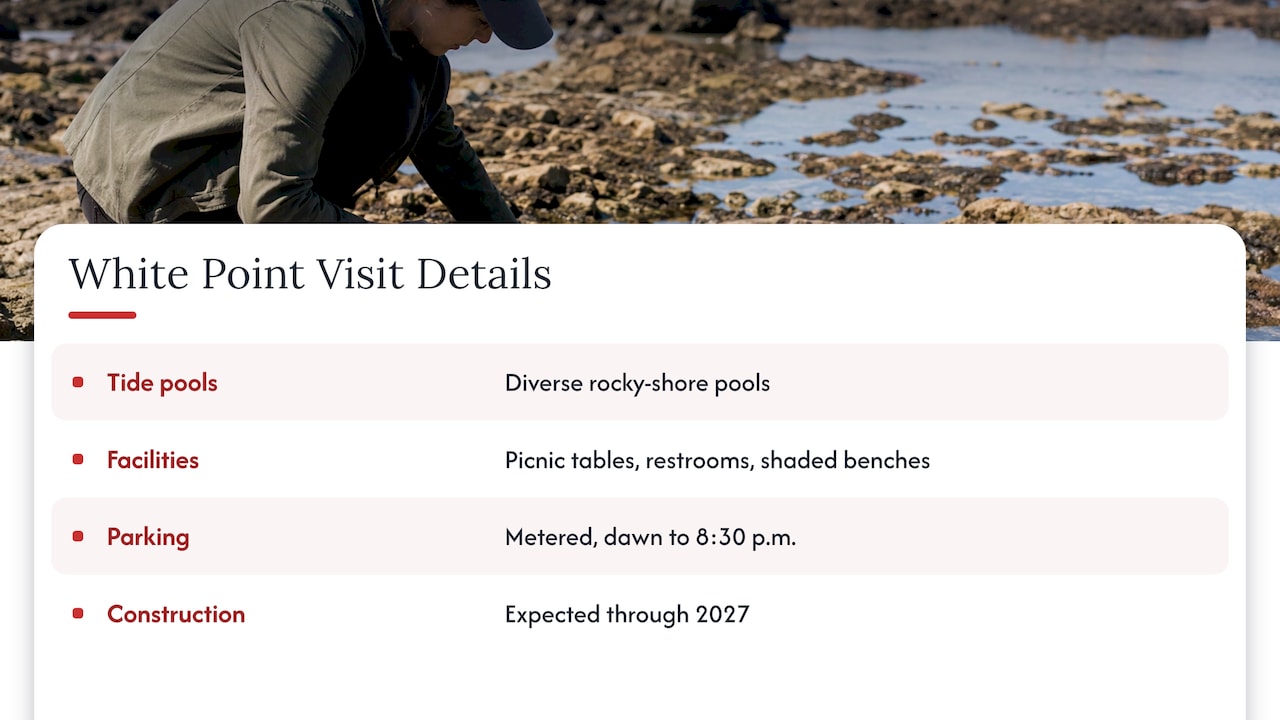
    This is my pick for first-timers. According to the Los Angeles County Beaches & Harbors page, the rocky shore at White Point / Royal Palms has diverse tide pools. The bluff-top area has picnic tables and restrooms, and there are shaded benches on the Royal Palms patio. Metered parking is available from dawn to 8:30 p.m.

    The county page also notes construction expected through 2027, so look at it before you go to see what’s open that day.

    What I like: you can split the day in two. Spend the low-tide window down on the rocks, then climb back up to the tables for lunch with an ocean view. If you’re making a whole day of San Pedro, our list of San Pedro hidden gems has more stops nearby.

    White Point and Royal Palms Beach, San Pedro

    Palos Verdes shoreline

    The rest of the peninsula is full of rocky coves, and I could write a whole separate piece about it, so I did. Our Palos Verdes tide pools guide goes through best times, parking and family safety for the area. If White Point is busy, that guide is where I’d look for your next option.

    Malibu and the north county coast

    Further up the coast, spots like El Matador State Beach and Little Dume Cove get mentioned often by local tide pool fans. Little Dume Cove sits inside a state marine reserve where all marine life is protected, which is one more reason to keep your hands to yourself there. These stretches mean more driving from central LA, so I’d treat them as a full-day trip instead of a quick after-work stop.

    Hidden beaches worth a look

    If you like the idea of a quieter shoreline, browse our roundup of hidden Southern California beaches locals use. Not every one of them has tide pools, but rocky coves and low-tide exploring often go together.

    When to go: reading the tides

    Tide pools are basically puddles the ocean leaves behind. At high tide they’re underwater, so the whole trick is timing.

    Here’s how I plan it:

    1. Pick a day with a low tide. Use a tide chart app or a local tide table for the nearest station. The lower the number, the more rock you can safely explore.
    2. Arrive early. Aim to be on the rocks before the lowest point, since the water will start creeping back in afterward. Our Laguna Beach guide makes the same point about arriving 30 to 45 minutes early, and it works anywhere on this coast.
    3. Check the swell and weather. A low tide with big surf isn’t a good tide pooling day.
    4. Know your exit. Notice where you climbed down and keep watching the waterline as it changes.

    Season matters too. Many locals say the lowest daytime tides cluster in the cooler months, and the Los Angeles Times has covered how king tides make certain winter weekends exceptional for visiting tide pools. Those pieces change every year, so use the current tide table instead of trusting a rule of thumb.

    Safety: the ocean is the boss

    The rocks are wet, the algae is slippery and the Pacific doesn’t care about your schedule.

    • Never turn your back on the ocean. California State Parks warns that sneaker waves can come suddenly, even on calm days.
    • Wear shoes with grip. Old sneakers or water shoes beat flip-flops every time.
    • Keep kids within arm’s reach near the waterline. If you want to get little ones excited before the trip, a few nature play ideas for toddlers can turn the car ride into a warm-up.
    • Watch your footing, not just the pools. Most slips happen when people stare at a crab and keep walking.

    If you’re craving water without the surf, our guide to swimming holes in Los Angeles covers where to cool off and stay safe.

    What you might see

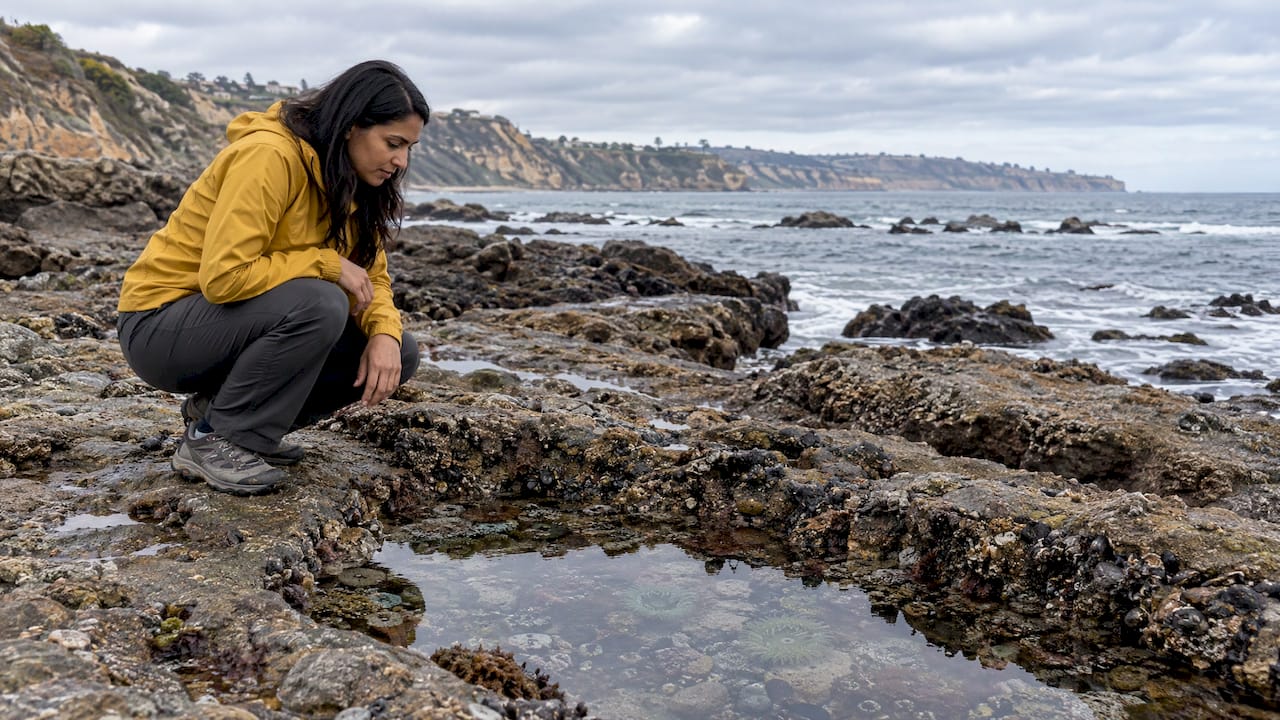
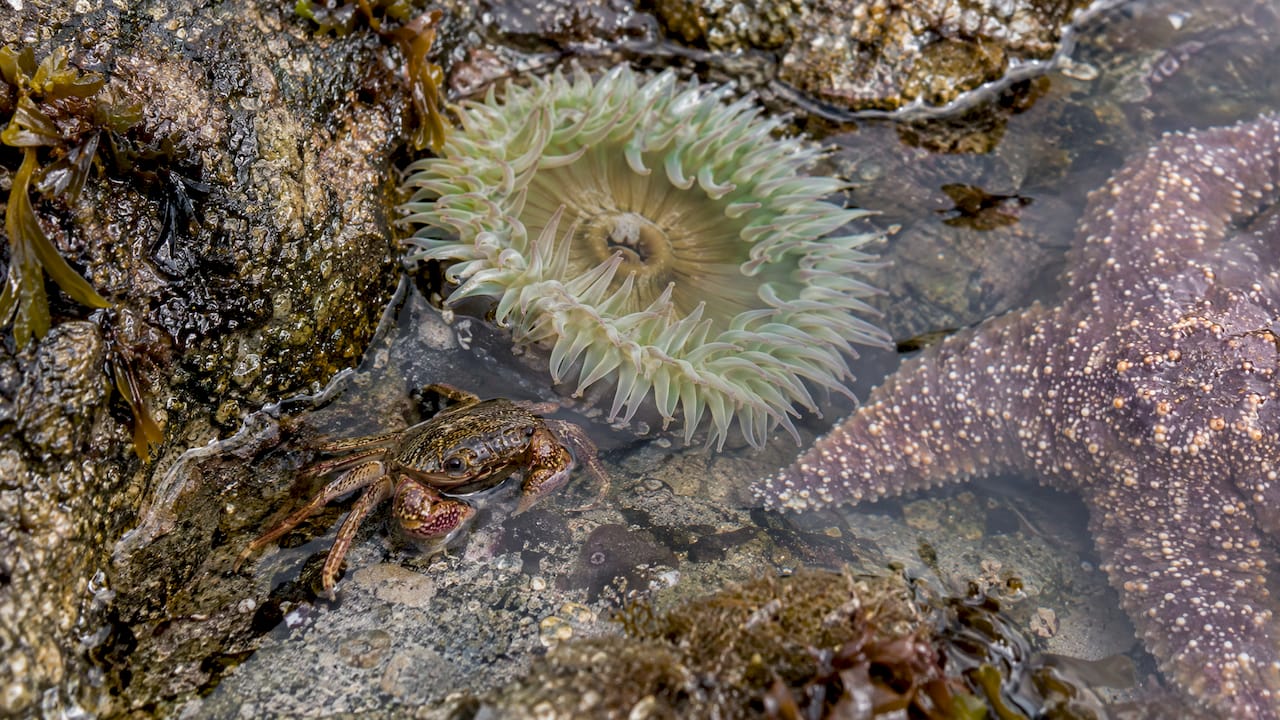
    Common residents of LA-area pools include sea stars, anemones and crabs, and now and then an octopus, according to the Los Angeles Times. You’ll also see limpets, snails and mussels clinging to the rock.

    Crab, anemone and sea star in a tide pool

    My trick is to pick one pool and sit by it for five minutes. Things start to move once you’re still. A hermit crab “rock” suddenly walks off, an anemone opens up, and what looked empty turns out to be crowded.

    How to explore without harming anything

    Tide pool animals live in a tight space between wave crash and sun exposure, and a lot of foot traffic hurts them.

    • Look first. Most of the fun is watching.
    • If you touch, wet your hands and be very gentle. The Monterey Bay Aquarium’s tide pooling tips recommend wet hands and a light touch, and leaving animals and rocks just as you found them.
    • Don’t flip rocks. The critters underneath rely on that shade and moisture. The Cabrillo Marine Aquarium’s research page notes that limpets and anemones can be harmed by trampling or disturbance.
    • Take nothing home. The same Cabrillo page says not to take anything from Southern California tide pools, including rocks or shells. Photos only.
    • Step on bare rock where you can, not on living cover.

    Picnic spots near the tide pools

    A lot of people searching for picnic areas in Los Angeles want somewhere with a view and real tables, and the White Point bluff delivers both. The county lists picnic tables and restrooms up top, plus shaded benches at the Royal Palms patio, as noted on the Beaches & Harbors page.

    Here’s my low-effort picnic plan:

    Part of the day What to do
    Before the low tide Park, grab a table early if you can, drop the cooler
    Around low tide Head down to the rocks with water shoes and a camera
    After the tide turns Climb back up for lunch on the bluff
    Late afternoon Stay for the light, or drive on to a sunset view

    For that last step, photo-ready sunset spots in Los Angeles lists places with parking and transit tips.

    What I pack

    • Sandwiches, fruit and things that don’t melt
    • Plenty of water, plus a small trash bag (pack out everything)
    • A towel and a dry change of socks
    • Sunscreen and a hat, since the bluff has little cover apart from the shaded benches
    • A small bucket-free kit: no collecting, just a magnifying glass if you have kids

    Planning the whole day

    This is the part most guides skip, so here’s a simple order of operations:

    1. Look up the low tide and choose a window that fits your schedule.
    2. Check the county page for White Point / Royal Palms for construction and parking details.
    3. Plan to arrive an hour or so ahead of the low point, so parking and picnic tables aren’t a scramble.
    4. Tide pool first, picnic second. The tide won’t wait for lunch.
    5. Tack on one more stop. A Long Beach hidden gem or a dessert stop from our LA dessert spots list makes a nice finish.

    If you’d rather build a longer outing, our Southern California road trip routes and weekend getaways from Los Angeles can stretch a tide pool morning into a bigger trip. Catalina is another option, covered in our Avalon day trip guide.

    Our perspective

    Most people think tide pooling means a long drive and a lot of planning. We think it’s one of the easiest, cheapest hidden gems in Southern California, because the best version of it is a short walk down some rocks and a lunch on a bluff.

    That’s why we built SoCal Sights around local knowledge instead of long generic lists. We’d rather tell you which tide window to aim for, where to sit for lunch and how to leave the pools as you found them than give you fifty places you’ll never visit.

    We also lean on the community. Locals know which corner of the rocks is quiet on a Tuesday morning, and that’s the kind of tip we want on the site. If you’ve got a favorite spot, we’d love to hear it.

    Joshua

    Want to reach LA beachgoers?

    If you run a local business or organize events, you can put your name in front of people planning outings like this one. We offer advertising, featured placements and memberships for Southern California businesses and event organizers. Pricing isn’t published, so the best way to see what fits is to take a look at the Advertise With SoCal Sights page.

    Socalsights

    You can also browse everything we cover on our types of SoCal Sights page.

    FAQ

    What is the best time to visit tide pools in Los Angeles?

    Go around a low tide, and arrive before the lowest point so you have time to explore as the water pulls back. Check a current tide table for your beach, since the best days change from week to week. Winter weekends with very low tides can be especially good.

    Are there picnic spots near LA tide pools?

    Yes. White Point / Royal Palms Beach in San Pedro has bluff-top picnic tables and restrooms, and shaded benches at the Royal Palms patio. Metered parking is listed from dawn to 8:30 p.m., and the county page has current construction notes.

    Can I touch the animals in tide pools?

    Looking is best. If you do touch, wet your hands first and be extremely gentle, and never pull animals off the rock or flip rocks over. Leave everything where you found it.

    Can I take shells or rocks home?

    No. The Cabrillo Marine Aquarium advises visitors not to take anything from Southern California tide pools, including rocks and shells. Take photos instead.

    Sources

  • Apple Orchards in Julian: Where to Pick and What to Expect

    Apple Orchards in Julian: Where to Pick and What to Expect

    Julian’s apple orchards are small, family-run and a little different from one another. Some let you wander the rows, one puts you on a guided tour, and a few take cash or an app and nothing else. Apple season here runs from late summer into fall, and the 2026 season has now wrapped up. So this guide gives you the orchards, what each one charged this year, and how to plan the next one, using the 2026 details as a guide to what a typical visit looks like.

    I’ve been sending friends up the hill for apples for a while now, and the same questions come up every time: Where do I go? What does it cost? Do I need to book? Let’s get into it.

    Socalsights
    Find More Local Southern California Gems
    Explore SoCal Sights for curated ideas on activities, food spots, and unique itineraries across Southern California.

    TL;DR

    • Julian apple picking is a late-summer-to-fall activity. In 2026, orchard seasons started as early as late August and the last U-Pick days landed in mid-October.
    • Expect to pay about $5 to $12 per person for entry, and about $20 for a bag of apples at the larger U-Pick orchards.
    • Several orchards are cash, Zelle or Venmo only, so bring a little cash and check the payment note before you drive up.
    • Julian Farm and Orchard requires a pre-booked Apple Tour for U-Pick, and 2026 tours sold out.
    • Check each orchard’s own page for the current season before you go, because weather can shorten or cancel a harvest.

    Table of Contents

    Julian’s orchards at a glance

    Here is how the four orchards we researched compared in 2026. Seasons and prices are set by each orchard every year, so treat this as a snapshot of a typical visit.

    Orchard Where 2026 pricing How it works
    Volcan Valley Apple Farm 1284 Julian Orchards Drive, about 2.4 miles north of town $5 per person (ages 6+), $20 per bag Open U-Pick, one bag per group
    Peacefield Orchard 3803 Wynola Road $5 per adult, $20 per half-peck bag Timed Saturday pick slots, cash or Zelle only
    Mesa Blooms 1711 Highway 78, historic downtown $12 per person for admission and a 1/4 peck bag Walk-ins Friday to Sunday, cash and Venmo only
    Julian Farm and Orchard 4381 Julian Highway, about 3 miles west of downtown Apple Tour ticket, includes general admission Pre-booked guided tour only

    When is apple season in Julian?

    Think late August through October, with the heart of it in September and early October. Here is how 2026 played out, since it shows how much the orchards differ:

    The lesson: there isn’t one “Julian apple season.” Each orchard picks its own dates based on how the fruit ripens. Mesa Blooms even notes that it is open until the day’s ripe apples run out, so earlier in the day is safer.

    Because dates move every year, check the orchard’s own page in late summer for the current schedule. If you are reading this in the off-season, now is a great time to pencil in a September weekend for next year.

    What it costs and how to book

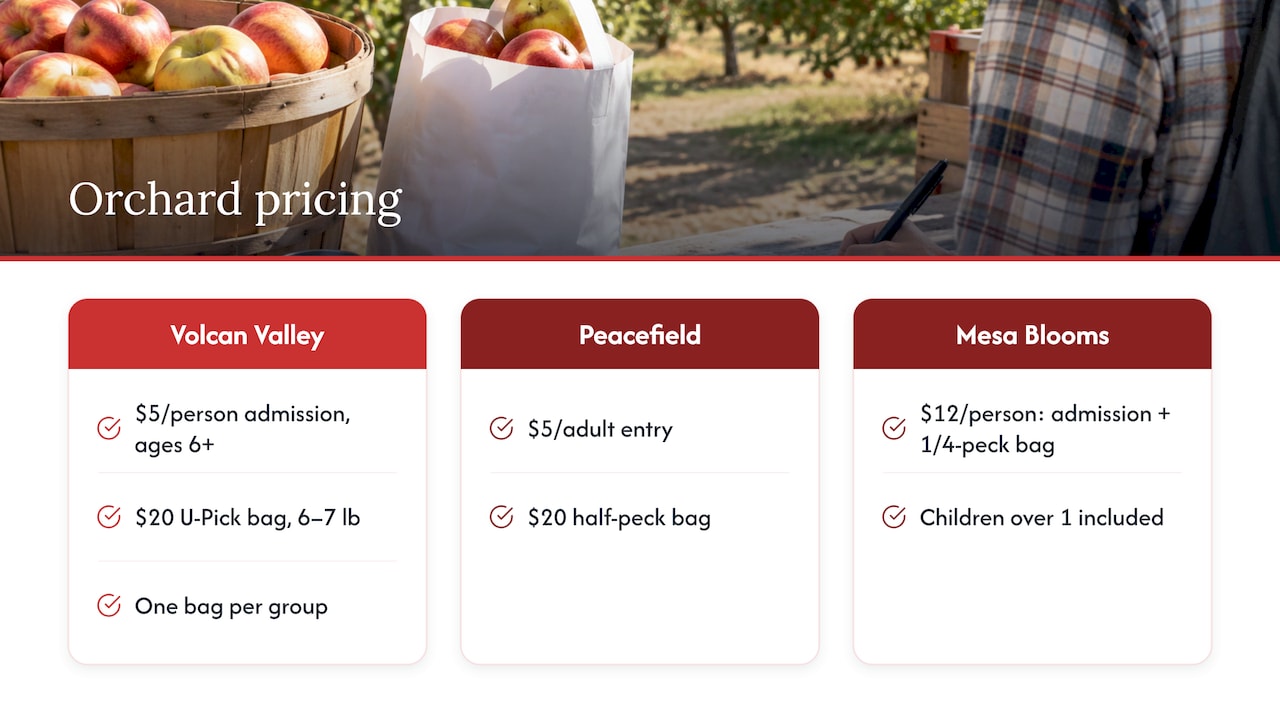
    Most Julian orchards charge a small entry fee plus a bag price. At Volcan Valley, admission was $5 per person for ages 6 and up, with children 5 and under free. A U-Pick bag was $20 and held 6 to 7 pounds of apples. Only one bag is needed per group, which keeps a family outing affordable.

    Peacefield Orchard charged $5 per adult and $20 for a half-peck bag. Mesa Blooms kept it simplest: $12 per person, children over 1 included, covers admission and a 1/4 peck bag.

    Comparison of entry and apple-picking costs

    Payment and reservations

    This is where visitors get caught out. Peacefield took cash or Zelle only, and Mesa Blooms took cash and Venmo only. Don’t count on a card reader or on cell service up the hill. Stop at an ATM in town or set up your payment app before you leave home.

    Peacefield also runs on timed slots. Saturday picking in 2026 started at 9, 10, 11 AM or noon, with a few midweek slots in September. Show up on a slot, not whenever you feel like it.

    The one that needs a ticket

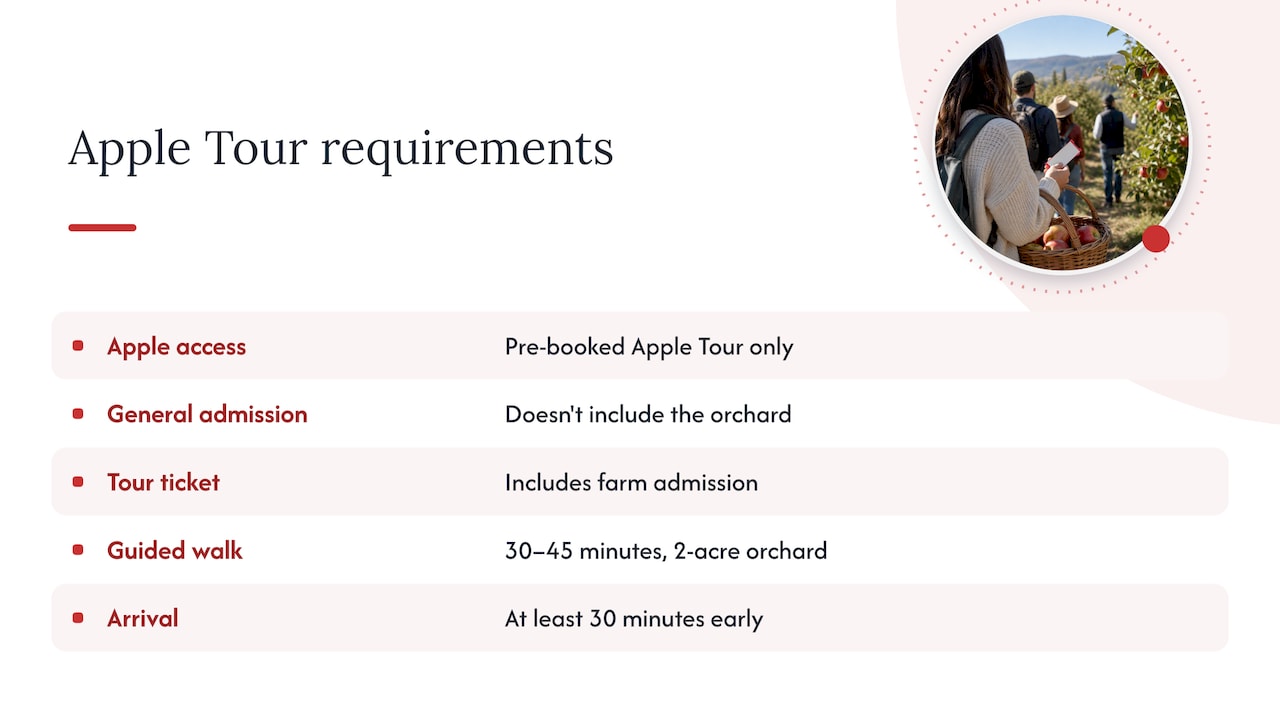
    Julian Farm and Orchard works differently. U-Pick apples there are only for guests with a pre-booked Apple Tour, and general admission or farm activity packages do not include the apple orchard. The tour ticket does include general admission to the farm.

    The tour is a 30 to 45 minute guided walk through a 2-acre orchard. You need to arrive at least 30 minutes before your tour, and tours start on time, with no late arrivals accommodated or refunded. In 2026, the farm announced apple picking was sold out, though it stayed open Friday to Sunday for the pumpkin patch, petting zoo and hayrides through mid-November. If you want apples there, book early in the season.

    If you are planning a group outing with kids, family-friendly local events are a good reminder that booking requirements go hand in hand with a smooth day, so read the booking page before you set out.

    The one that needs a ticket

    The orchards, one by one

    Volcan Valley Apple Farm

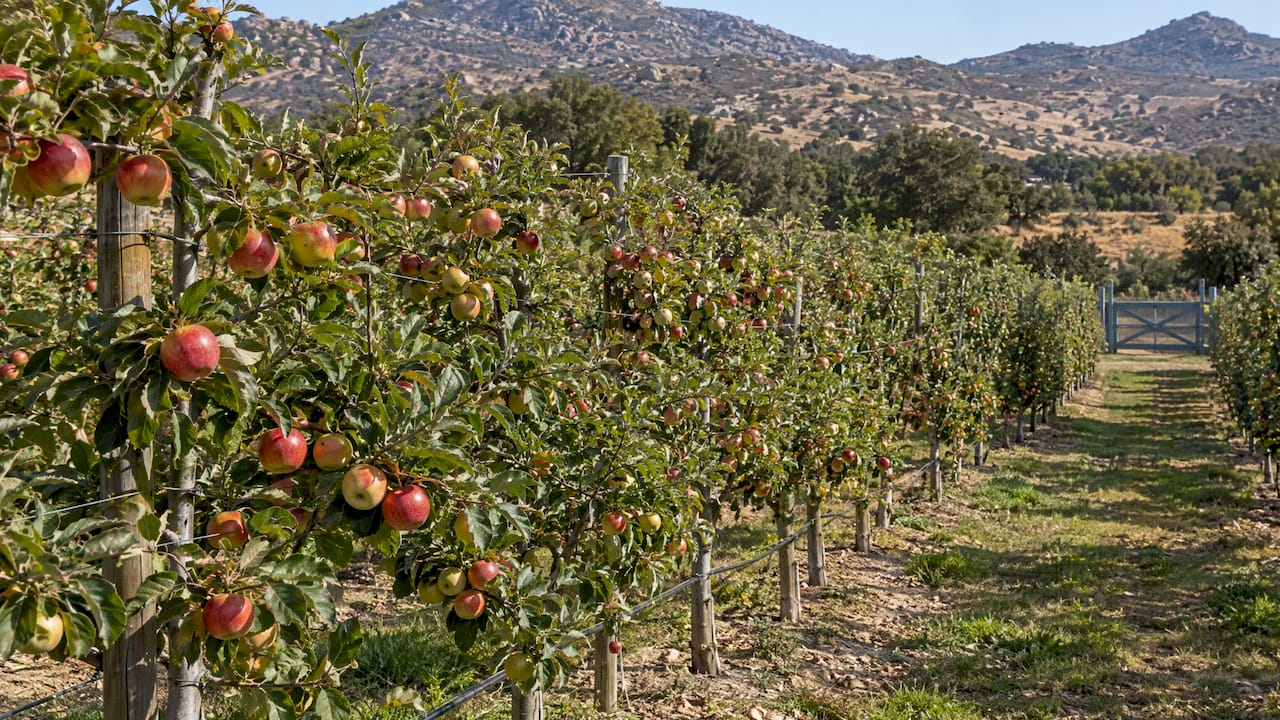
    This is the easiest pick for a first-timer. The farm has 7,000+ trellis-grown trees across 10 acres and 7 apple varieties. Trellis-grown trees keep the fruit within reach, so it works well for little kids. It is grown without chemicals, and leashed dogs and strollers are welcome. That makes it a good fit if you are bringing the whole crew, four-legged members included.

    Peacefield Orchard

    Peacefield is the small, quiet one on Wynola Road. The pick times are limited and the season is shorter, so it feels like a neighborhood secret. The listing calls it fresh, organic and local. Plan around the time slot, bring cash, and you are set.

    Mesa Blooms

    Mesa Blooms is the only orchard in historic downtown Julian, at 1711 Highway 78, across from the high school and county library. That means you can park once and combine apples with a walk through town. The varieties it lists include Hawkeye Reds, Northwest Greening, Rome Beauties, White Winter Pearmain, Golden Delicious and Winesap. Several of those are old-school baking apples, so pie night is practically decided for you. Walk-ins are welcome Friday to Sunday, 9 AM to 4 PM.

    Julian Farm and Orchard

    This is the most “day out” option. Beyond the Apple Tour, the farm has a pumpkin patch, petting zoo and hayrides, so it suits families who want more than apples. Book the tour ahead and arrive early, since tours begin promptly.

    Make a day of it

    Apples are only half of the Julian story. Once the bag is in the trunk, head into town for the other reason people drive up here. We pulled together three Julian pie shops for San Diego day trips, including a quiet detour for when downtown is packed.

    A few tips from experience:

    • Go on a weekday if you can. Weekend traffic on the way in gets heavy in fall.
    • Pick first, pie second. Apples ride better than a warm pie in a hot car.
    • Bring a cooler bag if you are picking early and sightseeing late.
    • Keep a little cash on you for the orchards that don’t take cards.

    If Julian is one stop on a bigger trip, our Southern California road trip routes and weekend getaways from Los Angeles will help you build the rest of it.

    Our take on Julian apple picking

    At SoCal Sights, we think the best Julian orchard is the one that fits your day. If you want a relaxed wander with kids and a dog, we’d start with a big trellis orchard. If you want a pie-and-apples combo on foot, we’d pick the one in town. If you like a plan, book a guided tour.

    What we love about Julian is that it is still small. These are family-run places with their own hours, their own payment quirks and their own favorite varieties. That is exactly the kind of local knowledge we built SoCal Sights around: the spots that don’t always show up in the big guides, shared by people who actually go.

    So treat this page as a starting point, then tell us what you found. Locals know which orchard had the sweetest Golden Delicious and which road has the best view, and we want to hear it.

    Joshua

    Thinking about wine country too? Santa Ynez and Los Olivos

    A lot of people who search for apple picking in Julian are also hunting for fall food-and-drink trips, and Santa Ynez Valley wine tasting comes up often. It is a different part of California from Julian, so plan it as its own getaway rather than a quick add-on. Here is what the tasting rooms we researched charged.

    Tasting room Location Tasting fee Good to know
    Sunstone Winery 125 N Refugio Rd, Santa Ynez $30 per person, five wines, about 90 minutes Daily 11 AM to 5 PM, reservations optional but recommended on weekends, 21+ to taste
    Gainey Vineyard 3950 East Highway 246, Santa Ynez $30 Daily 11 AM to 5 PM, last tasting at 4 PM, walk-ins and reservations welcome
    Gainey’s Evan’s Ranch room 2901 Grand Avenue, Los Olivos $25 Daily 12 to 5 PM
    Carucci Wines 2923 Grand Ave, Suite A, Los Olivos $25 for 5 to 6 wines, about 60 minutes Friday to Sunday 12 to 5 PM, groups of 8 or fewer
    Carhartt Family Wines 2939 Grand Avenue, Los Olivos $25 for five wines Open daily, fee waived with a three-bottle purchase

    Planning tips for Los Olivos

    Grand Avenue in Los Olivos packs several tasting rooms close together, so you can walk between them. That makes it a natural spot to skip the driving, which matters when you are tasting.

    Carucci welcomes walk-ins but recommends reservations on weekends, and a reservation there needs a refundable deposit that you can cancel 24 hours ahead. Carhartt also offers a two-hour private winery and vineyard tour and tasting at its ranch for $80 per person, or $40 for club members, with a refundable deposit.

    Last-seating times are early at most rooms, so aim to arrive by mid-afternoon. Tasting rooms require guests to be 21 or older, and you should arrange a designated driver, a rideshare or a tour before you start.

    Want your business in front of SoCal explorers?

    If you run a local business or put on events, SoCal Sights is built to put you in front of people who are actively looking for things to do in Southern California, from apple-picking weekends to date nights and day trips.

    We offer advertising, featured placements and memberships for local businesses and event organizers. Pricing isn’t published, so the best next step is to see how to advertise with SoCal Sights.

    Socalsights

    And if you just want more ideas, our 9 Southern California hidden gems is a good place to keep exploring.

    FAQ

    When can I pick apples in Julian?

    Generally from late August through October, with September the busiest stretch. In 2026, orchards opened between August 22 and September 11 and the last U-Pick days came in mid-October. Each orchard sets its own dates, so check its page before you drive up.

    How much does it cost to go apple picking in Julian?

    Expect about $5 per person admission plus a $20 bag at larger U-Pick orchards, or a flat $12 per person at the one in downtown Julian. At Julian Farm and Orchard, you pay for a pre-booked Apple Tour instead. Prices change from season to season.

    Do I need reservations?

    It depends on the orchard. Julian Farm and Orchard requires a pre-booked Apple Tour for U-Pick, and Peacefield Orchard uses timed pick slots. Mesa Blooms welcomed walk-ins on Friday through Sunday in 2026.

    Do Julian orchards take credit cards?

    Don’t count on it. In 2026, Peacefield took cash or Zelle only and Mesa Blooms took cash and Venmo only. Bring cash and have a payment app ready.

    Can I bring my dog or stroller?

    At Volcan Valley Apple Farm, leashed dogs and strollers are welcome. Policies differ by orchard, so check before you go, especially for the guided tour.

    Sources

  • Strawberry Picking in Orange County: Farms, Season, Costs

    Strawberry Picking in Orange County: Farms, Season, Costs

    Orange County has three solid places to pick your own strawberries: Tanaka Farms in Irvine, South Coast Farms in San Juan Capistrano, and the Ecology Center, also in San Juan Capistrano. The main season runs spring into early summer, and the sweet spot is April through June. Plan on $27 to $29 per person for a Tanaka tour, or a few dollars per pound if you’re picking at a walk-in field. I’ve put together what each farm is like, what it costs, and how to pick the right one for your crew.

    Socalsights
    Find More Southern California Gems
    Explore SoCal Sights for local recommendations on activities, food spots, and unique itineraries across Southern California.

    Explore local recommendations

    TL;DR

    • Best months: April, May and June, when California’s coastal berry districts are all producing at once. Some farms start picking as early as late January.
    • Easiest first-timer pick: Tanaka Farms in Irvine. It’s a guided tractor tour, and you take home a pound. Book ahead.
    • Most laid-back pick: South Coast Farms in San Juan Capistrano has charged $5 per car plus $5 per pound, with walk-ins welcome.
    • Best for kids who like to learn: The Ecology Center in San Juan Capistrano pairs picking with a short talk about how the berries are grown.
    • Always check first: Hours, prices and reservations change by year and by weather, so confirm on the farm’s own page before you drive.

    Table of Contents

    Where to pick strawberries in Orange County

    Strawberries have deep roots here. Commercial strawberry farming in Orange County first gained momentum in the 1910s and 1920s, and the county is still one of five strawberry-growing regions in California, alongside San Diego, Oxnard, Santa Maria and Watsonville/Salinas.

    The tricky part is that a lot of the old fields are now neighborhoods. So the list of true pick-your-own spots is short. These are the three I’d start with.

    Farm City Style Reported cost Reservations
    Tanaka Farms Irvine Guided tractor tour, pick 1 lb $27 weekdays, $29 weekends and holidays Strongly recommended
    South Coast Farms San Juan Capistrano Open field, pick at your own pace $5 per car, $5 per pound (2022 report) Walk-ins welcome
    The Ecology Center San Juan Capistrano Organic farm event with a short talk Check the farm’s page Check the farm’s page

    That table is a starting point, not a promise. Farms adjust prices and hours from year to year, so treat the numbers as what to expect and confirm before you go.

    Tanaka Farms in Irvine: the classic first trip

    If you’ve never picked strawberries before, this is the one I’d send you to. Tanaka Farms is a working farm in Irvine that’s open to the public year-round, with tours built around what’s in season. The strawberry tours run from March through June, and the farm has been known to kick things off earlier. NBC Los Angeles reported that its strawberry tours usually start in late January.

    How it works: You sign up for a tractor tour. You ride out to the fields, learn a little about the farm, and get to pick a pound of strawberries to take home. NBC’s 2026 preview listed admission at $27 on weekdays and $29 on weekends and holidays.

    What I like: Everything is organized for you. You don’t have to figure out which rows to hit or how much to pick. It’s great for kids, grandparents and anyone who wants a no-stress outing.

    What to know: Tours fill up. NBC’s write-up strongly recommended booking ahead and noted that walking up on the day may not get you a spot. Book a weekday if you can, since it’s less crowded and a couple of dollars cheaper.

    South Coast Farms in San Juan Capistrano: the walk-in field

    On the Orange County subreddit, this is the farm locals keep naming when someone asks where to go. Its U-Pick fields sit near Tree of Life Nursery at 33201 Ortega Hwy, San Juan Capistrano, CA 92675.

    When the farm opened its U-Pick season in 2022, it reported being open Thursdays through Sundays from 10 a.m. to 4 p.m., charging $5 per car at the entrance and $5 per pound for berries, with walk-ins welcome and no reservations needed. Hours and prices may have shifted since then, so check the farm before you go.

    What I like: It feels like picking, not a tour. You wander the rows, choose your own berries and pay by weight. If you only want a pound or two, it’s the cheapest way to do it. If you want a flat for jam, it’s still easy on the wallet.

    What to know: This is the one with the most bending. Strawberries grow low to the ground, and locals often mention how much your back will notice it. Wear comfortable clothes and bring a hat.

    Since you’re already in San Juan Capistrano, you can pair the trip with the Mission and the shops downtown. If you like that kind of low-key day, my roundup of Orange County spots under $20 has more ideas that fit the same mood.

    South Coast Farms in San Juan Capistrano: the walk-in field

    The Ecology Center: picking with a purpose

    The Ecology Center is a 28-acre regenerative organic farm in San Juan Capistrano, and its strawberry events are a little different. According to the Daily Pilot, U-Pick Strawberry events begin at the grandstand, where the team explains how the berries are grown without chemical fertilizers or pesticides. The same report said the farm was producing more than 30,000 pounds of strawberries of different varieties in 2026.

    Farm educator explaining strawberry growing to visitors

    The events are meant to be fun and family friendly, with an educational element built in. If your kids ask a million questions, or you’re curious why the berries taste the way they do, this is a great fit.

    When is strawberry season in Orange County?

    The short answer: spring. The longer answer is that California’s coastal season is long. According to UC Agriculture and Natural Resources, the California strawberry season extends from January through November along the coast, peaking in April, May and June, when all five growing districts produce berries at the same time.

    For picking, here’s how I’d think about it:

    1. Late January to March: The early start. Some farms open tours, but crowds are smaller and berries can be hit or miss depending on the winter weather.
    2. April to June: The sweet spot. Plenty of fruit, long days and the best odds that the field you picked will be loaded.
    3. July onward: Farms shift gears. Tanaka Farms, for example, moves to melon and corn tours in July and August, a pumpkin patch in September and October, and a holiday tour in December.

    It’s early November as I write this, which is the quiet stretch for pick-your-own strawberries here. Use the fall to plan your spring trip, and watch each farm’s page for the new season’s opening announcement.

    What strawberry picking really costs

    The price depends on the style of farm, not just the size of the haul.

    • Tour-style (Tanaka Farms): You pay admission per person, which, per NBC Los Angeles, was $27 on weekdays and $29 on weekends and holidays in 2026. That covers the tour and a pound of berries to take home.
    • Field-style (South Coast Farms): You pay a per-car entry fee and then by the pound. At the 2022 rate of $5 a car and $5 a pound, a family of four with a car and three pounds of berries would pay about $20. That’s my own math from the reported rates, so check current prices before you plan around it.

    So which is the better deal? If you want a full experience with a guide, the tour wins. If you’re berry-hungry and want a big haul for jam, pies or freezing, the pay-by-the-pound field is hard to beat.

    How to plan your visit

    A little prep makes the morning smoother. Here’s my checklist.

    1. Go early. Cooler temperatures, softer light and the best berries. Mornings also mean fewer crowds and less sun on your neck.
    2. Book or confirm first. Tanaka Farms tours can sell out, while South Coast Farms has welcomed walk-ins. Either way, look at the farm’s own page for the current schedule.
    3. Dress for dirt. Closed-toe shoes you don’t mind staining, a hat, sunscreen and clothes that let you crouch.
    4. Bring a cooler or a bag. Berries are delicate. Keep them out of a hot car trunk.
    5. Bring cash and a card. Small farms and stands can be picky about payment.
    6. Pick the red ones. Look for berries that are fully red with a bright green cap. They won’t ripen much after they come off the plant.
    7. Plan the next stop. A farm morning pairs nicely with lunch nearby.

    Most of these trips take 1 to 2 hours, so you’ll have the afternoon free. If you’re building a whole day, our offbeat Orange County guide has plenty of ideas, and the food hall guide is handy for a post-pick lunch.

    What to do with all those berries

    Strawberries are best within a couple of days. Don’t wash them until you’re ready to eat. Keep them cold, and if you picked a lot, slice and freeze the extras on a tray before bagging them.

    Some easy ideas:

    • Slice them over yogurt or oatmeal.
    • Make a quick jam with sugar and lemon juice.
    • Blend a few into a smoothie.
    • Dip them in chocolate for a date night (the date ideas in Orange County list has more where that came from).

    And if you like the idea of eating with the calendar, here’s a good read on the benefits of seasonal produce and why spring fruit tastes so good.

    Making it a family day

    Strawberry picking works for most ages, but some tips help. Toddlers will eat as many as they pick, so set expectations early. Older kids like having their own container and a goal. If anyone in your group has trouble bending or kneeling, the tour format at Tanaka Farms or the guided events at the Ecology Center may be easier than a long open field.

    For more kid-friendly outings, see our list of fun family activities around the region.

    Our take on picking your own

    We started SoCal Sights because the best days out in Southern California are rarely the ones on the first page of every guide. Strawberry picking is a perfect example. It’s simple and it’s local, and it’s best when someone who knows the area tells you which farm fits your group.

    Our approach is to point you toward places with real character, like a family-run farm that’s been part of the county’s story for decades, and to keep the details practical: what it costs, when to go and what to bring. We also lean on locals. If you’ve found a field or stand we should know about, we want to hear it.

    Our advice: pick one farm, go early, and make a morning of it. You’ll remember the warm berry you ate in the row long after the ones from the store.

    Joshua

    If you run a farm stand, a seasonal event or a local business in Southern California, we’d love to help visitors and locals find you. SoCal Sights offers advertising, featured placements and memberships for businesses that want to reach people planning their next outing. Pricing isn’t published, so the best next step is to head to our advertising page and get in touch.

    Socalsights

    Learn about advertising with SoCal Sights

    FAQ

    What is the best month to go strawberry picking in Orange County?

    April, May and June are the safest bets. UC Agriculture and Natural Resources says the California strawberry season peaks in those months, when all five growing districts are producing at once. Some Orange County tours start as early as late winter, so check each farm’s page.

    Do strawberries grow in California?

    Yes, in a big way. California grows approximately 83 percent of the nation’s strawberries, about 1.4 billion pounds a year on more than 25,000 acres. Orange County is one of the five growing regions.

    Do I need a reservation to pick strawberries?

    It depends on the farm. Tanaka Farms tours can fill up, and NBC Los Angeles strongly recommended booking ahead. South Coast Farms has welcomed walk-ins without reservations, but confirm the current policy before you go.

    How much does it cost to pick your own strawberries?

    At a tour-style farm like Tanaka, admission has been $27 on weekdays and $29 on weekends and holidays, including a pound of berries. At a field-style farm like South Coast Farms, the reported rate was $5 per car plus $5 per pound in 2022. Prices change, so check before you head out.

    Sources

  • Swimming Holes in Los Angeles: Where to Cool Off and Stay Safe

    Swimming Holes in Los Angeles: Where to Cool Off and Stay Safe

    Los Angeles has real freshwater swimming spots, but they’re mostly creek pools in the mountains and canyons around the city, not a tidy list of lakes with lifeguards. The best-known ones are Malibu Creek’s Rock Pool, Switzer Falls in the San Gabriel Mountains, and, a longer drive south, Cedar Creek Falls near San Diego. I’ve pulled together what each one is like, what it costs to park, and the closures and water-quality notes that change how you plan your day.

    Socalsights
    Find More Southern California Gems
    Explore local recommendations for memorable activities and food spots across Southern California, including places beyond the usual travel guides.

    Explore SoCal Sights

    TL;DR

    • Malibu Creek State Park’s Rock Pool is the closest classic swimming hole to LA, with all-day parking at $12 per car. Swimming comes with water-quality cautions, and diving is against state law.
    • Switzer Falls (Angeles National Forest) needs an Adventure Pass or America the Beautiful Pass, and you can reach Arroyo Seco Creek from the picnic area.
    • Eaton Canyon’s waterfall trails remain closed until December 31, 2027 after the Eaton Fire, so skip it for now.
    • Cedar Creek Falls requires a permit and is best in fall, winter and spring, not summer.
    • For a lifeguarded swim, LA County runs three designated freshwater swim beaches, normally open Memorial Day to Labor Day.

    Table of Contents

    What a “swimming hole” means around LA

    If you’re picturing a deep, clear pool with a rope swing, adjust your expectations a little. Around Los Angeles, swimming holes are usually wide spots in a creek, often at the bottom of a hike, and what you get depends on the season and the last rainstorm. In a dry summer some are shallow and warm. After winter storms they can be cold and fast.

    There’s also a safety reality. The LA County Department of Public Health says that many places where people get in the water, including swimming holes, creeks, ponds and rivers, aren’t designated swim areas. They usually have no restrooms or lifeguards, and runoff can carry high bacteria counts from animal and human sources. That doesn’t mean you can’t have a great day. It means you pick your spot, check conditions and go in with your eyes open.

    Malibu Creek Rock Pool

    This is the one most people mean when they say swimming hole in LA. The Rock Pool sits inside a volcanic rock canyon in Malibu Creek State Park, about an hour from much of the city depending on traffic, and it’s popular with hikers and climbers. The park is at 1925 Las Virgenes Rd, Calabasas, CA 91302, and the gates open 8am to 10pm.

    Parking and fees

    State Parks lists parking per car at $12 all day, $9 for 3 hours, $6 for 2 hours and $3 for 1 hour. Bring a plan for how long you’ll stay, because the hike in and the time at the pool add up faster than you expect.

    Malibu Creek parking fees by stay length

    Rules and water quality

    Here’s what I’d want you to know before you pack the car:

    • Dogs are not allowed on the hiking trails or at the Rock Pool, per the park’s visitor page. Leave them home.
    • Diving at the Rock Pool is against state law because of shallow water and submerged rocks. Same page, same message: no jumping or diving.
    • California State Parks’ 2018 brochure notes poor water quality from urban runoff in Century Lake and the Rock Pool and describes swimming there as unhealthy because of bacteria levels.
    • On the other side, Heal the Bay’s 2025 River Report Card gave Malibu Creek at Rock Pool an A+, with a median E. coli concentration of 41 MPN/100mL, below the state health standard.

    Those findings come from different years and different testing, so the practical move is to check the latest numbers on the day. More on that below.

    Why it’s worth the trip anyway

    The canyon scenery is the draw. There are climbs from 5.8 to 5.10c around the pool, including Planet of the Apes Wall, plus some fun bouldering, according to the park’s visit guide. Even if you only wade in to your knees, it’s a gorgeous place to spend a few hours. If you’re making a whole day of it, the park also has a 62-site main campground with flush toilets and heated showers.

    Switzer Falls, Angeles National Forest

    Switzer Falls is a classic San Gabriel Mountains outing above La Cañada Flintridge. The Forest Service manages the Switzer Picnic Site, which has 26 picnic sites with tables and BBQ pedestal grills and access to Arroyo Seco Creek for swimming.

    What you need to know

    • Day use runs 6 a.m. to 10 p.m.
    • The cost is $5 per vehicle per day or $30 annually.
    • You need an Adventure Pass or America the Beautiful Pass displayed in your vehicle.
    • The site connects to the Gabrielino National Recreation Trail and has a view of Switzer’s Falls.

    All of that comes from the official Forest Service page. For questions, the Los Angeles Gateway District office is at 12371 N. Little Tujunga Canyon Road, San Fernando, CA 91342, and you can call 818-899-1900.

    This is a creek you’ll enjoy in spring after rain, when it’s flowing and lively. In late summer, expect less water. If you like waterfall hikes in general, our guide to Los Angeles waterfall hikes sorts them by who they suit best, from families to swimmers.

    Eaton Canyon: still closed

    Eaton Canyon was a go-to waterfall for decades. The January 2025 Eaton Fire changed that. According to the LA County Department of Parks and Recreation, Eaton Canyon and surrounding trails remain closed until December 31, 2027, including the Eaton Canyon Waterfall, Altadena Crest Trail, Chaney Trail and Hasting Debris Basin Trail.

    If a blog or map app still points you there, trust the county. Go to Malibu Creek or Switzer Falls instead, and check the county page before any trip in that area.

    Cedar Creek Falls: the day-trip worth planning

    Cedar Creek Falls in Cleveland National Forest is a bit of a drive from LA, so I’d treat it as an overnight or a big day. It features an 80-foot waterfall dropping into a large swimming hole, and the hike is 5 to 6 miles round trip, with trail access in Julian and Ramona.

    Cedar Creek Falls above its swimming hole

    Permit and timing

    This one doesn’t let you wing it. Recreation.gov lists a $6 non-refundable reservation fee per permit, which covers the permit holder and up to four additional group members. Permits for the next calendar year are released December 1 of the previous year. The cliffs above and around the falls are closed to climbing, jumping and diving.

    Season matters too. The same page says the falls typically don’t flow in the summer, and the pool at the base becomes stagnant and filled with algae. Fall, winter and spring are the better seasons. It also strongly recommends at least one gallon (four liters) of water per person. Plan a cooler-weather visit and book your permit early.

    Lifeguarded options when you want an easy swim

    Sometimes you just want to swim without wondering about bacteria or rocks. LA County maintains three designated freshwater swim beaches, at Puddingstone Lake, Santa Fe Dam and Castaic Lake. They have restrooms, lifeguards and chlorinators, and they’re normally open for swim season from Memorial Day to Labor Day.

    Lifeguard watching Puddingstone Lake swim area

    They’re not wild and hidden, but they’re a solid pick for kids, big groups or anyone who wants a relaxed afternoon. Check the county page for current hours and conditions before you go.

    Deep Creek and Aztec Falls

    Aztec Falls near Lake Arrowhead shows up in plenty of lists. Before you make plans, know that the Forest Service has listed an active Deep Creek Area Closure (Aztec Falls) alert. Check the San Bernardino National Forest page for the current status. If hot water sounds good instead, our roundup of Southern California hot springs covers soaking spots.

    Quick comparison

    Spot Best for Cost or permit Heads up
    Malibu Creek Rock Pool Scenery, climbing, a short outing from LA $12 all day per car No dogs at the pool, no diving
    Switzer Falls Creek wading, picnics, hiking $5 per vehicle per day, or $30 annually; Adventure Pass or America the Beautiful Pass required Less water in dry months
    Cedar Creek Falls A big waterfall and deep pool $6 permit fee covering up to five people Needs a permit, best outside summer
    LA County swim beaches Easy, lifeguarded swims Check county page Normally open Memorial Day to Labor Day
    Eaton Canyon Not available None Closed until December 31, 2027

    Before you get in the water

    This is the checklist I run through every time.

    1. Look up the water quality. The LA County Department of Public Health says high bacteria counts can happen at any time and risk increases for 72 hours after significant rainfall. It recommends checking a site’s water quality history at Heal the Bay or the LA County Public Works Watershed page before you go.
    2. Stay out of the water after rain. If it rained in the last three days, wade or hike instead.
    3. Wading beats dunking. The same county guidance notes that swimming and getting your head in the water is riskier than wading.
    4. Skip the jumps. Diving and jumping are off the table at Malibu Creek’s Rock Pool and at Cedar Creek Falls, and shallow water can hide rocks anywhere.
    5. Carry water. Take a gallon per person if you’re hiking in. Cedar Creek’s permit page makes the same call.
    6. Pack your pass. If you’re heading into a national forest, keep your Adventure Pass or America the Beautiful Pass on the dash.
    7. Have a backup. If a spot is crowded or the water looks murky, a shaded trail is a fine plan B. Our best hikes in Los Angeles guide has options for every mood.

    If you’re bringing little ones

    Creek pools and kids can be a great combination with the right setup. A swim aid is only one part of it, and it helps to know common mistakes with swim aids so that you pick and fit them well. Keep little ones within arm’s reach and stick to the shallow edge, especially at spots with no lifeguard.

    Our take on finding the good stuff

    We started SoCal Sights because there’s too much information out there and not enough of it comes from people who actually go. Swimming holes are a perfect example. One blog says a spot is a paradise, another says it’s closed, and the map app has no idea.

    Our approach is to lean on local knowledge and the agencies that manage the land. That’s why we keep pointing you to the official page, the county alert or the park’s own visit guide, then add the stuff only locals tell you: which spot to try on a mild weekday, which to save for after the rain, which to skip this year.

    We also love hearing from you. If you’ve found a creek, pool or quiet corner that works, send it our way. The best tips we publish tend to come from the community, and they’re the ones that never make the mainstream lists.

    Joshua

    Get your business in front of SoCal explorers

    Run a campground, outfitter, café or tour company near the trails? Readers use SoCal Sights to plan outdoor days, and local businesses and event organizers can reach them through memberships, featured placements and advertising. Learn more on our advertise with SoCal Sights page.

    Socalsights

    Pricing isn’t published on the page, so reach out through the site to ask what fits your business.

    Make it a whole weekend

    Once you’ve picked your swim spot, build a trip around it. Our weekend getaways from Los Angeles list is useful if you’re heading toward Cedar Creek’s side of the region. If you’d rather get salt water instead, try Malibu’s legally accessible hidden beaches for a tide-aware alternative.

    FAQ

    Can you swim at the Malibu Creek Rock Pool?

    People do, but the guidance is mixed. California State Parks’ 2018 brochure calls the water unhealthy for swimming because of high bacteria levels, while Heal the Bay’s 2025 report card gave the creek at Rock Pool an A+. Diving is against state law, and dogs aren’t allowed at the pool. Check the latest water-quality data before you go and avoid the water for 72 hours after rain.

    Are there swimming holes near Los Angeles open in summer?

    Switzer Falls and Malibu Creek are accessible in summer, though water levels vary. Cedar Creek Falls typically doesn’t flow in summer and its pool can become stagnant, so save it for cooler months. For a guaranteed swim, LA County’s three designated swim beaches are normally open from Memorial Day to Labor Day.

    Do I need a permit or pass for LA swimming holes?

    It depends on the spot. Switzer Picnic Site requires an Adventure Pass or America the Beautiful Pass, and costs $5 per vehicle per day or $30 annually. Malibu Creek charges for parking, at $12 all day per car. Cedar Creek Falls needs a $6 permit that covers you and up to four others.

    Is Eaton Canyon Falls open?

    No. Eaton Canyon and the surrounding trails damaged by the January 2025 Eaton Fire remain closed until December 31, 2027, according to the LA County Department of Parks and Recreation. Check the county trail alert page for updates.

    Sources

  • Beginner Surf Spots in San Diego: Where to Learn

    Beginner Surf Spots in San Diego: Where to Learn

    If you’re learning to surf in San Diego, start at La Jolla Shores, then move to Tourmaline Surfing Park in Pacific Beach once you’re catching whitewater and want your first green waves. San Elijo in North County is a good next step when you’re ready for a reef break. I’ll walk you through what makes each spot friendly, when to go, and the safety basics I’d want a friend to know before paddling out.

    Socalsights
    Find More Ways to Explore San Diego
    Explore Southern California recommendations and local insights to complement your surf outing with authentic places and activities.

    Explore local recommendations

    TL;DR

    • La Jolla Shores is the classic day-one beach: a sandy bottom, a long stretch of beach and permanent lifeguard stations.
    • Tourmaline Surfing Park is the place for your first unbroken waves, especially in the quieter stretch near Law Street.
    • San Elijo’s Tippers is the mellow end of a reef break in Encinitas, good once you have some sand-bottom time.
    • Check swell, wind and tide before you go, and always paddle out near a lifeguard tower.
    • Know what a rip current looks like, and know the rule: swim parallel to shore, not against it.

    Table of Contents

    What makes a beach good for learning to surf

    I look for four things when I send someone out for their first session: gentle waves, a soft bottom, lifeguards and easy logistics. Waves that break slowly give you time to stand up. Sand is a lot kinder than rock when you fall, and you will fall. Lifeguards mean someone is watching. And parking, restrooms and showers mean you’re not stressed before you even get in the water.

    Four checks for choosing a beginner surf beach

    San Diego has plenty of beaches, but only a handful tick all of these boxes. Here are the ones I’d actually point you to.

    La Jolla Shores: the best first day

    If you only remember one name from this guide, make it La Jolla Shores. The City of San Diego describes it as a roughly one-mile sandy beach where summer waves are usually the gentlest of any San Diego beach, with permanent lifeguard stations, parking, restrooms and showers. That combination is hard to beat when you’re carrying a board and a bag and have no idea where anything is.

    Surfline rates La Jolla Shores beginner-to-intermediate, with a sandy bottom. Its guide lists a west or west-northwest swell, east, southeast or south wind, and a medium tide as the best setup. It also notes the spot is less tide-sensitive than Mission Beach or Pacific Beach, which is a nice bonus when you can’t pick your schedule.

    What to look for at the Shores

    • Small, soft waves. Waist-high is plenty for a first session. Overhead days exist here too, and those are not for you yet.
    • Light wind from the land. Offshore or light winds keep the surface cleaner and the waves easier to read.
    • Medium tide. It’s the sweet spot Surfline lists for this beach.
    • Water quality after rain. Surfline says it’s typically okay but can get dicey after rain. If it just poured, I’d wait a bit.

    The Shores is also a busy place. Snorkelers, kayakers and swimmers share the water, so pay attention to which zone is for surfing (more on that below). If you’re curious about the other side of this beach, I wrote up local rules for La Jolla snorkeling and a guide to La Jolla’s seven sea caves, which makes a great post-surf adventure.

    Tourmaline Surfing Park: your first green waves

    Tourmaline, up in Pacific Beach, is where a lot of San Diego surfers cut their teeth. San Diego Magazine calls it a consistent beach break that suits beginners and longboarders, and it points beginners toward the less-crowded sections around Law Street down to the pier.

    That’s good advice. The main peak at Tourmaline can be a crowd of experienced longboarders who know exactly where to sit. As a beginner, you’ll have a better time on the quieter stretch, where you can work on paddling, timing and standing up without feeling like you’re in anyone’s way.

    A few things I’d do here:

    1. Arrive early so you aren’t circling for a spot with a board under your arm.
    2. Watch the lineup for ten minutes before you paddle out. Notice where people sit and where the waves break.
    3. Stay away from the busiest peak, and give anyone already riding a wave plenty of room.

    One local-style tip on tide: a surf rental company’s spot guide suggests medium-high or high tide is best at Tourmaline, while medium tide suits La Jolla Shores. So if you’re doing both, plan the Shores for a different part of the day than Tourmaline.

    San Elijo and Tippers: a step up into North County

    Once you’re comfortable standing up and turning, North County has some fun options. San Diego Magazine describes San Elijo as a consistent rocky reef break with peeling lefts and rights for surfers of all levels. Tippers is the mellow southernmost peak, and Pipes is the more advanced part of the break.

    I’d call this a second-stage spot. A reef is different from a sandy beach: the bottom is harder and the waves break in more predictable places, which is great for learning to read a wave, but falls are less forgiving. Go with a friend who knows the break, or after a few lessons, and stick to Tippers.

    Peeling wave over the rocky reef at San Elijo

    If you’d rather spend a day exploring the coast around here than chasing waves, our San Diego weekend itinerary pairs nicely with a morning session.

    Other beaches people mention

    You’ll hear a few other names in surf shops and online forums: Mission Beach, Ocean Beach and the Oceanside Harbor area, for example. They can all work on the right day, and the city’s beaches have public parking lots at Mission Bay, Mission Beach, Ocean Beach, Pacific Beach and South Mission Beach, according to the City of San Diego’s beach regulations page. But I’d start at the Shores or Tourmaline, because they’re where beginners and their gear fit in most easily. Some of these other beaches also draw bigger crowds, which means a crowded lineup and less room to fall.

    Quick comparison

    Spot Bottom Best for What to know
    La Jolla Shores Sand Day one, first lessons Lifeguards, restrooms, showers; medium tide is best
    Tourmaline Surfing Park Sand (beach break) First unbroken waves Stay near Law Street toward the pier; busy main peak
    San Elijo (Tippers) Rocky reef Progressing beginners Mellow southern peak; Pipes is more advanced

    How to pick a session

    Choosing the right day matters more than choosing the perfect beach. Here’s how I’d think about it.

    Waves

    Small and slow is the goal. If the surf looks like a wall of water to you, it is probably too big. Surfline lists waist-high to overhead at La Jolla Shores, and the lower end of that range is what you want.

    Wind

    Surfline lists east, southeast or south wind for La Jolla Shores. In general, light wind from the land keeps things tidy. Strong onshore wind chops everything up and makes paddling tiring.

    Tide

    Tide changes how and where waves break. At the Shores, medium tide is the pick. At Tourmaline, the higher end is better. If you only remember one rule, plan around the tide for the beach you chose, not the other way around.

    Your experience level

    Be honest about it. If you can’t yet paddle onto a wave and pop up on whitewater, you’re not ready for a reef break or a crowded peak. Spending a few sessions at the Shores is the fastest way to get there.

    Check before you drive

    Before I leave the house, I look at the forecast and then at a camera. You can compare what you see on live surf webcams with the forecast, which helps you spot whether the surf is smaller or messier than predicted. It’s an easy way to avoid a wasted trip.

    Where to learn: lessons and what a first one looks like

    There are a few ways to learn in San Diego: group lessons run by local surf schools, private instruction, or going out with a friend who surfs. For your first day, I’d go with an instructor. They’ll choose a beginner-friendly spot for the conditions, size a board for you and keep an eye on you in the water.

    A typical first lesson includes a few basics:

    • A beach briefing. You learn how to carry the board, how to lie on it and how to read the waves.
    • Pop-up practice on sand. You rehearse going from lying to standing before you ever get wet.
    • Whitewater time. You practice on waves that have already broken, which are slower and more forgiving.
    • Water safety. Rips, lineup etiquette and how to fall safely.

    Looking for gear? Beginners usually start on a soft, wide foam board and a wetsuit for comfort. A rental from a local shop is a fine way to start, and you can buy later once you know what you like. Since I’m not going to rank businesses here, ask the staff at a shop near your chosen beach what they recommend for the day’s conditions.

    Safety basics before you paddle out

    San Diego is a friendly place to learn, but the ocean is still the ocean. These are the things I would tell my own family.

    Stay near lifeguards

    The City of San Diego says to swim near lifeguards and use signs or ask which zone is for surfing. A checkered flag normally divides zones: one side is for surfboards, the other for swimmers. At permanent lifeguard stations, lifeguards are generally on duty from 9 a.m. to dusk. That’s one more reason to pick the Shores or a beach with a staffed tower. The same city page says the chance of drowning at a lifeguard-protected beach is much lower, at an estimated 1 in 18 million at USLA-affiliated locations.

    Know rip currents

    According to the City of San Diego, rip currents account for about 80% of lifeguard rescues at ocean beaches. If one catches you:

    1. Stay calm.
    2. Swim parallel to the shore until you’re out of the current.
    3. Wave to a lifeguard for help.

    The city also points out that “rip tides” and “undertows” are misnomers: rip currents move seaward and don’t pull people under. That’s a useful thing to know, because it means you don’t have to fight it or panic.

    Don’t dive in headfirst

    In unknown water, check depth and look for obstructions, and enter feet first. The city’s summer safety page warns that diving in headfirst can cause serious injury. Even if you’re excited, wade in.

    Etiquette in the lineup

    Surf etiquette sounds fussy, but it’s mostly common sense:

    • Don’t paddle in front of someone already riding a wave.
    • Keep hold of your board. A loose board is a hazard to people around you.
    • Sit on the shoulder of the crowd, not in the middle of it, while you’re learning.
    • Say sorry when you mess up. Everyone’s been there.

    Parking, timing and making a day of it

    The best beginner beaches are popular, so a bit of planning goes a long way. Public parking lots are available at La Jolla Shores, Mission Bay, Mission Beach, Ocean Beach, Pacific Beach and South Mission Beach, per the city’s beach regulations. I’d still arrive early on weekends and summer days, when lots fill up. Early morning also tends to be calmer than afternoon, though always check the day’s wind and tide.

    After you’re done, there are plenty of ways to round out the day without spending much. Our list of free things to do in San Diego is a good place to start. If the tide is low, tide pools in San Diego are a fun way to spend the rest of the morning. And if you’re a sunrise person, one of our best sunrise spots can make the early alarm worthwhile. For something off the main path, our guide to San Diego’s secret beaches is worth a look once you’ve got your sea legs.

    Staying for the night? We also put together tips on beach camping in San Diego, including tide and fire rules.

    A simple plan for your first month

    Here’s how I’d build skills without rushing.

    1. Session one: Take a lesson at La Jolla Shores. Focus on paddling and popping up in whitewater.
    2. Sessions two to four: Return to the Shores on small days, medium tide. Practice turning your board toward the beach and catching waves earlier.
    3. Sessions five and beyond: Try the quieter stretch near Law Street at Tourmaline and aim for your first unbroken wave.
    4. Later: If you’re feeling steady, visit Tippers at San Elijo with someone who knows the break.

    There’s no hurry. Surfing rewards time in the water more than anything else.

    Perspective: why we send beginners to the Shores first

    We built SoCal Sights around a simple idea: visitors and locals shouldn’t have to dig through endless lists to find the places that feel right. For learning to surf, that means pointing you to the beach where the odds are on your side, and then showing you what else is nearby once the session is done.

    Our community-driven approach is the reason we like this topic. Locals know which stretch of Tourmaline is quiet on a Tuesday, and which corner of the Shores gets crowded with snorkelers. We want those details to reach you, rather than only the headline spots every mainstream guide repeats.

    So our advice is simple: start where there are lifeguards, sand and room to fall, check the conditions, and treat each session as practice. Then explore. San Diego’s coast has far more to offer than waves.

    Joshua

    Want your business in front of San Diego visitors?

    If you run a local business or organize events in Southern California, SoCal Sights is built to put you in front of people who are actively looking for things to do. We offer advertising, featured placements and memberships for local businesses and event organizers. You can read about it on our advertising page.

    Socalsights

    If you’d like to keep exploring first, our Southern California hidden gems guide is a good place to start.

    FAQ

    Is La Jolla Shores beginner surf friendly?

    Yes. Surfline rates it beginner-to-intermediate, and it has a sandy bottom. The City of San Diego says its summer waves are usually the gentlest of any San Diego beach, and it has permanent lifeguard stations. Check conditions first, since water quality can get dicey after rain.

    Where can I learn to surf in San Diego?

    La Jolla Shores is the easiest place to start, followed by the quieter stretch of Tourmaline Surfing Park near Law Street. Many people book a lesson with a local surf school for their first session, so an instructor can pick the spot and board for the day.

    What is the best tide for beginners?

    It depends on the beach. Surfline lists medium tide as best at La Jolla Shores, and a local surf spot guide suggests medium-high or high tide at Tourmaline. Check the forecast for your chosen beach before heading out.

    Is it safe to surf at a beach without a lifeguard?

    I’d stick to beaches with a staffed lifeguard tower while you’re learning. San Diego lifeguards are generally on duty from 9 a.m. to dusk at permanent stations, and the city advises swimming near them and asking which zone is for surfing.

    What should I do if I get caught in a rip current?

    Stay calm, swim parallel to the shore, and wave to a lifeguard for help. The City of San Diego says rip currents move seaward and don’t pull people under, so there’s no need to fight them.

    Sources