Category: Uncategorized

  • Apple Picking in Oak Glen: Season, Orchards and Tips

    Apple Picking in Oak Glen: Season, Orchards and Tips

    Yes, you can pick your own apples in Oak Glen, and it’s one of my favorite fall days in Southern California. The season runs roughly from late summer into late November, with the busiest weeks in September and October. Orchards here sell u-pick fruit by the pound, so you fill a bag, weigh it and pay for what you picked. Below you’ll find when to go, what to pick, what to expect at the gate and how to turn a quick orchard stop into a whole day.

    Socalsights
    Find More Southern California Gems
    Planning an Oak Glen apple-picking day? SoCal Sights shares local insights into activities, food spots and unique itineraries across Southern California.

    Explore local recommendations

    TL;DR

    Table of Contents

    When Is Apple Season in Oak Glen?

    Short answer: late summer through November, with the sweet spot from mid-September to late October.

    The farms don’t all say it the same way, which is normal for a crop that depends on weather. Los Rios Rancho lists Oak Glen apple season as August through November. Parrish Pioneer Ranch says its season peaks from September 1 through the end of November, and notes that apples and cider are usually available until January or February. The Los Angeles Times described the traditional season as running from Labor Day to late November.

    Put those together and you get a simple plan:

    • Late August to early September: early varieties start showing up. Fewer crowds, but fewer choices.
    • Mid-September through October: the classic Oak Glen experience. More varieties, more activities, more people.
    • November: the tail end. U-pick can wrap up, and farms may shift toward cider, baked goods and holiday stuff.

    I’m writing this in early November, and that’s a good reminder of how it goes. Los Rios Rancho’s season page says its 2026 apple picking has concluded. If you’re reading this in the off-season, save it for next year and aim for September or October.

    For context, apples nationwide are generally available from late July through early November, according to Food Network. Oak Glen’s season runs a little later than that, which is part of why it feels like such a good fall tradition.

    Where to Pick Your Own Apples

    Oak Glen is a small mountain community above Yucaipa in San Bernardino County, and the orchards are spread along the main road. You’ll see signs for several farms. Two have clear, current information online, so I’ll start there.

    Riley’s Farm

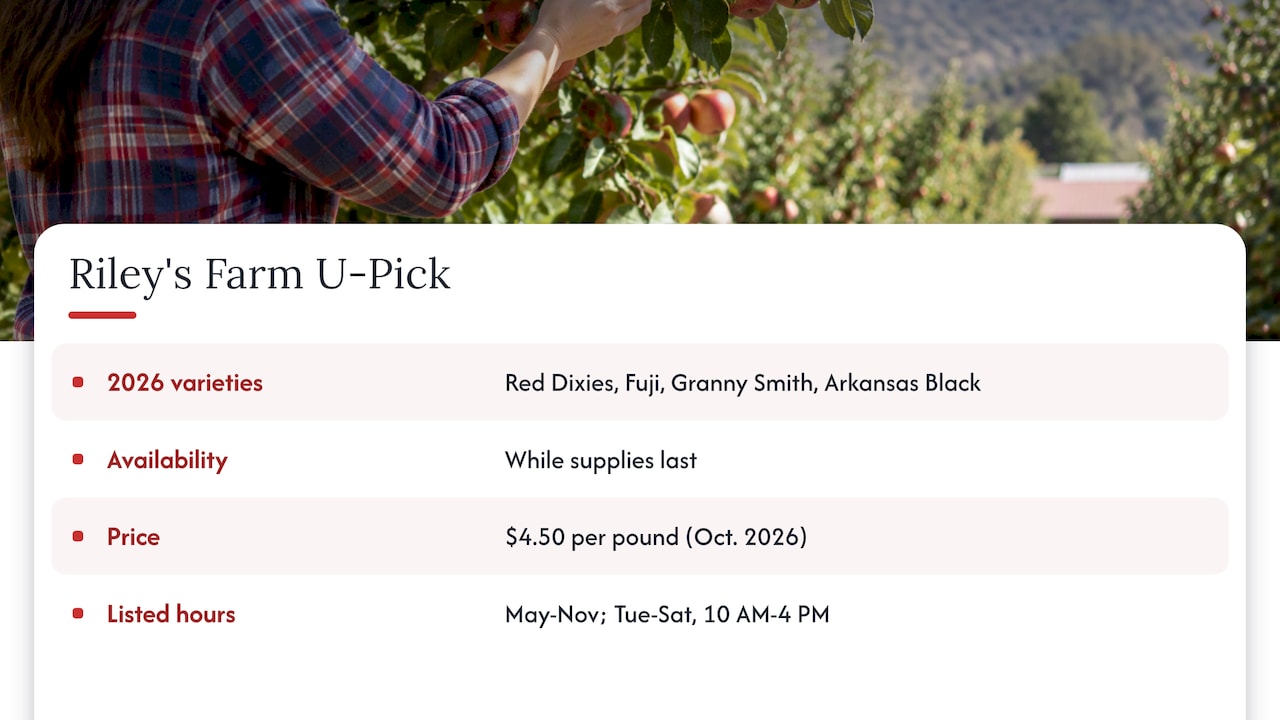
    Riley’s Farm’s official U-pick page posts a 2026 schedule for several apple varieties, including Red Dixies, Fuji, Granny Smith and Arkansas Black. It also says u-pick fruit is available while supplies last, which is the key phrase for the whole area. When a variety is done, it’s done.

    What I like about Riley’s is the focus on flavor. The farm specializes in heirloom apples and, according to its own page, favors varieties for their taste and uses over pretty apples that sit on shelves for months. If you’ve only ever bought apples at the grocery store, an heirloom you pick yourself can taste like a different fruit.

    On price, the same page lists u-pick apples at $4.50 per pound as of October 2026. Prices can change from year to year, so treat that as a guide and check before you go.

    For hours, Riley’s hours and FAQ page has listed u-pick from May to November, Tuesday through Saturday, 10:00 AM to 4:00 PM, and closed on Sundays. That page is older than the u-pick page, so confirm the current days before you plan around a Sunday.

    Riley’s is also known for living-history education and dinner theater, so if you want more than apples, there’s a lot to explore.
    Riley's Farm

    Los Rios Rancho

    Los Rios Rancho is at 39611 Oak Glen Road, Yucaipa, and the farm describes itself as operating year-round. Here’s what its official visitor info says:

    • No reservations required.
    • No admission or parking fees.
    • U-pick apples are sold by the pound.
    • Hours are generally daily from 10:00 AM to 5:00 PM, though u-pick depends on crop availability and seasonal changes.

    That makes it an easy, low-pressure choice when you decide to go on a whim. There’s also a farm kitchen, and the farm lists items like tri-tip sandwiches, BBQ and fresh baked goods. Honestly, that’s a solid lunch plan right there.

    The farm also says that u-pick works as an educational tool, giving families a way to connect with the process that grows their food. If you’re bringing kids, that’s the best part. They get to see where an apple actually comes from.

    Parrish Pioneer Ranch and the others

    Parrish Pioneer Ranch is another Oak Glen stop with its own apple season page, and it’s worth a look if you’re building a day around cider and the late season. You’ll pass other orchards, apple sheds and shops too. Each one has its own rules for u-pick, so ask at the entrance what’s ripe that day.

    What Apples Can You Pick?

    It depends on the week. Each variety has its own ripening window, so a farm might have Granny Smith one weekend and Fuji the next. A few things I tell friends:

    • Check the variety schedule first. Riley’s posts one on its U-pick page. If you want a specific apple, plan around it.
    • Pick for how you’ll use them. Tart apples like Granny Smith are great in pie. Sweeter ones like Fuji are better for snacking.
    • Don’t skip the lesser-known varieties. An apple like Arkansas Black is the kind of thing you won’t often find at a chain grocery store.
    • Pick a little less than you think. At about $4.50 a pound, a big bag adds up, and apples are heavier than they look.

    Here’s a quick cheat sheet for matching an apple to what you want to make.

    What you’re making What to look for Varieties from the posted schedule
    Pie or baking Firm, tart apples Granny Smith
    Snacking Sweet and crisp Fuji
    Something different Heirloom flavor Arkansas Black, Red Dixie

    If you’re not sure, ask the staff. They pick these trees all season and will point you to what’s best that day.

    What to Expect When You Go

    Bring the right stuff

    • A sturdy tote or reusable bag, in case the orchard’s bags run out or you want to carry more.
    • Comfortable closed-toe shoes. Orchard ground can be uneven, and in the fall it can be dusty or damp.
    • Layers. Oak Glen sits up in the mountains, so mornings can feel cooler than the valley below.
    • A card and a little cash, since small stands and shops can differ in what they take.
    • A cooler bag if you plan to pick, then keep exploring for hours.

    Timing your visit

    Weekday mornings are the calmest. Weekends in October are the busiest of the year, so give yourself extra time for parking, lines and a slower pace on the road. If you only have a Saturday, arrive near opening and plan to eat lunch a bit early.

    Keep in mind that Riley’s u-pick days are listed as Tuesday through Saturday, and it’s closed Sundays. Los Rios lists daily hours, so a Sunday trip points you there. Either way, hours can change, so look at the orchard’s page the morning you go.

    Picking etiquette that keeps everyone happy

    • Twist and lift the apple gently instead of pulling hard. It keeps the branch healthy for the next picker.
    • Pick from the trees you’re pointed to, and leave the fallen fruit unless staff say it’s okay to take it.
    • Keep little kids close. Orchards have ladders, tractors and uneven ground.
    • Wash your apples at home before you eat them.

    If the picking is over

    It happens. You get there in November and the trees are bare. Don’t turn around. Parrish says apples and cider are usually available into January or February, and farm kitchens and bakeries keep going after the trees are picked. A warm slice of pie or a cup of cider is still a very good reason to drive up.

    Apple pie and cider at a farm bakery

    Make It a Full Day in Oak Glen

    Apple picking takes an hour or two. The rest of the day is up to you, and Oak Glen is good at filling it.

    1. Start with the u-pick. Go early, fill your bag, and put it in the car or a cooler.
    2. Eat at the farm. Los Rios’s kitchen has tri-tip sandwiches and BBQ, and the baked goods are a perfect dessert.
    3. Do something besides apples. Walk the main road, browse the shops and stands, and stop at whatever catches your eye. If you want history, Riley’s does living-history programs.
    4. Finish with cider. Grab a jug on your way out.
    5. Bake something when you get home. Apples you picked that morning make a very different pie.

    If you’re feeling pie-minded, our guide to Julian pie shops for San Diego day trips is a great next trip for the same craving. Traveling with kids? Our family activities roundup has more ideas for keeping them busy the rest of the weekend.

    Turn It Into a Fall Getaway

    Oak Glen works as a day trip from much of Southern California, but it also pairs well with a longer fall weekend. If you want to build one, our list of weekend getaways from Los Angeles is a good place to start. If you’re the type to stretch a fall trip across state lines, Oak Creek Canyon trip ideas in northern Arizona show how a canyon-and-red-rock weekend can follow an orchard day. And if you’d like more off-the-beaten-path stops closer to home, check out our Southern California hidden gems.

    Want something seasonal and a bit different? Our Oktoberfest in Orange County guide pairs nicely with an October apple weekend.

    Our Take on Oak Glen

    We built SoCal Sights around a simple idea: the best days out in Southern California are usually the ones you don’t see on every top-ten list. Oak Glen is a good example. Yes, plenty of people know about it, but the real fun is in the details: which orchard has the variety you want, where to grab lunch, and which weekday morning is the quiet one.

    That’s why we lean on locals. Our community-driven approach means people who live here share the spots they actually love, and we pass those tips along in plain language so you don’t have to wade through information overload.

    For apple picking, our advice is to pick one orchard as your anchor, check its own page for the current season, then build a day around it. Add a good meal, a slow walk and a stop for cider. That’s an authentic Southern California fall day, and it doesn’t take much planning.

    Joshua

    Get Your Business in Front of Fall Visitors

    If you run a business or organize events in Southern California, the readers who search for things like this are exactly who you want to reach. They’re planning days out, and they’re looking for places to eat, shop and explore.

    SoCal Sights offers advertising, featured placements and memberships for local businesses and event organizers. Pricing isn’t published, so use the page to see how it works and get in touch.

    Socalsights

    If you’d like to see more of what we cover first, browse our local businesses page to see the kinds of places we feature.

    Frequently Asked Questions

    Is there apple picking in Oak Glen?

    Yes. Riley’s Farm lists u-pick apples on its official page, available while supplies last, and Los Rios Rancho sells u-pick apples by the pound during the season. Availability depends on the crop and the week, so check the orchard’s page before you go.

    How much does u-pick cost in Oak Glen?

    Both Riley’s Farm and Los Rios Rancho sell u-pick apples by weight. Riley’s listed $4.50 per pound as of October 2026. Los Rios says it charges no admission or parking fee, though prices can change from year to year.

    Do I need a reservation to pick apples?

    At Los Rios Rancho, no. Its visitor page says reservations aren’t required. Other orchards set their own rules, so check each farm’s page. If a farm lists specific u-pick days, as Riley’s does, plan around those.

    What’s the best month for apple picking in Oak Glen?

    September and October are the peak, with the most varieties and the most activity. Late August can work for early apples, and November is the tail end, when some u-pick wraps up. If you want a calmer visit, go on a weekday morning.

    Can I still get apples if u-pick is finished?

    Often, yes. Parrish Pioneer Ranch says apples and cider are usually available until January or February. Farm shops and kitchens also sell baked goods, so it’s still worth a trip.

    Sources

  • Christmas Markets in Los Angeles: Where to Go in 2026

    Christmas Markets in Los Angeles: Where to Go in 2026

    Los Angeles doesn’t have one big, old-world Christmas market with a clock tower and a chestnut cart. What it has is better suited to the city: a patchwork of craft fairs, artist mercados, light festivals and neighborhood pop-ups spread from Santa Monica to Arcadia to Santa Clarita. For 2026, the big names to know are Enchant Los Angeles at Santa Anita Park, the Renegade Craft Fair in Santa Monica, Jingle Fest in Santa Clarita and the Dreamers Markets pop-ups. I’ll walk you through each, plus a few year-round markets that feel extra cozy in December.

    Socalsights
    Find More SoCal Experiences
    Explore curated insights into Southern California’s activities, food spots, and unique itineraries, including hidden gems shared by locals.

    TL;DR

    • Biggest holiday experience: Enchant Los Angeles at Santa Anita Park in Arcadia, November 20 through December 27, 2026, with a light maze, ice skating and a shopping village.
    • Best for handmade gifts: the Renegade Craft Fair (November 7-8, 2026, Santa Monica) and Jingle Fest in Santa Clarita (November 14, 2026).
    • Most European feel: Think of a pop-up village format, not a permanent market. Pop-up series like Dreamers Markets run across LA, Orange County and San Diego in November and December.
    • Dates shift every year: always confirm on the organizer’s page before you drive. Most of these markets are one- or two-day events.

    Table of Contents

    What a Christmas market means in LA

    If you grew up picturing Nuremberg or Vienna, adjust your expectations before you go. LA’s holiday markets are mostly curated pop-ups: a parking lot, a park or an airport field fills with makers’ booths, food trucks and a DJ or a live band. You get 60-degree sunshine instead of snow, and honestly I love it. You can browse in a T-shirt, grab a warm drink and still feel the season.

    Three flavors show up again and again:

    1. Craft fairs with hundreds of independent artists (think ceramics, prints, candles, jewelry).
    2. Light-and-lights destinations with a shopping village attached, where the market is part of a bigger night out.
    3. Community mercados and neighborhood markets that run on a holiday theme, often free and very local.

    Reddit threads on this topic ask the same thing every year: is there a European-style market near LA? People usually end up pointing to farm-based events outside the city, so it helps to know the pop-up calendar and plan around it.

    The 2026 markets worth planning around

    Here is the quick rundown of what the organizers say for this season. Dates were published for 2026, but small events change hours and locations, so check the linked page the week you go.

    Market Where 2026 dates Best for
    Renegade Craft Fair Santa Monica Airport Interim Open Space November 7-8 Indie makers, free onsite parking
    Jingle Fest Central Park, Santa Clarita November 14, 10 a.m. to 5 p.m. Families, food trucks, big maker crowd
    Enchant Los Angeles Santa Anita Park, Arcadia November 20 to December 27 Lights, skating, shopping village
    Dreamers Markets holiday pop-ups LA, Orange County, San Diego November and December Handmade gifts, packaged treats
    Little Tokyo Farmers’ Market Isamu Noguchi Plaza, Little Tokyo Saturdays through December 26 Produce, culture, a weekly stroll

    Renegade Craft Fair, Santa Monica

    If you want a big dose of independent makers in one afternoon, the Renegade Craft Fair is the one. It lands at the Santa Monica Airport Interim Open Space on November 7-8, 2026, with 275+ curated artists. Parking onsite is free, and the organizers also encourage carpooling, ride services, biking or public transit, which is smart advice on a busy weekend near the Westside.

    This is an early-November event, so it’s perfect for people who like to finish their gift list before December gets chaotic. Bring a tote bag and cash for small booths, just in case.

    Jingle Fest, Santa Clarita

    A little drive north, Jingle Fest ’26 takes over Central Park in Santa Clarita on Saturday, November 14, from 10 a.m. to 5 p.m. The listing mentions 275 artisans and crafters, holiday décor, wood items, custom gifts, food trucks, cocktails, wine and craft beer. Add live entertainment, dancing, Santa, permanent jewelry, face painting, caricatures, magic, juggling, balloon twisting and even snow, and you’ve got an easy family day.

    It’s the closest thing to a festival-style Christmas market on this list, and a good pick if you want kids and adults both entertained.

    Enchant Los Angeles, Arcadia

    Enchant Los Angeles returns to Santa Anita Park from November 20 through December 27, 2026. It’s built around what the organizers call the world’s largest Christmas light maze, plus ice skating, a shopping village and seasonal food and drinks. It’s less a market and more a full evening out, so I’d treat the shopping village as a bonus stop rather than the main event.

    Skater gliding across the Santa Anita rink

    Public ticket sales opened September 8 at 10 a.m. local time, with a choice between General Admission and Premier Passes plus add-on experiences. Popular nights tend to sell out, so book before you commit to a weekend.

    Dreamers Markets pop-ups across SoCal

    If you want a market near where you live, Dreamers Markets runs curated holiday pop-ups across Orange County, Los Angeles and San Diego in November and December. Expect handmade jewelry, ceramics, candles, leather goods, art prints, toys, apparel, packaged chocolate and baked goods, sauces, coffee, tea, beauty products, ornaments and décor. There are usually food trucks, warm drinks, seasonal menus and live music too.

    The organizer says to check its events calendar for the current lineup, and I’d do exactly that, since locations rotate between weekends.

    Markets that feel festive all season

    Some of my favorite December outings aren’t “Christmas markets” at all. They’re regular LA markets that add a little holiday energy.

    LA Plaza de Cultura y Artes: Holiday Artist Mercado

    Downtown, LA Plaza has hosted a free Holiday Artist Mercado with handmade local goods: jewelry, clothing, candles, home décor, prints, ceramics, plants and small-batch treats. The 2025 listing also mentioned DJs, live screen-printing, warm drinks, community booths and a free creative gift-wrapping workshop. Since that’s the most recent listing I could verify, treat it as a pattern to watch for and confirm the 2026 date on the venue’s page.

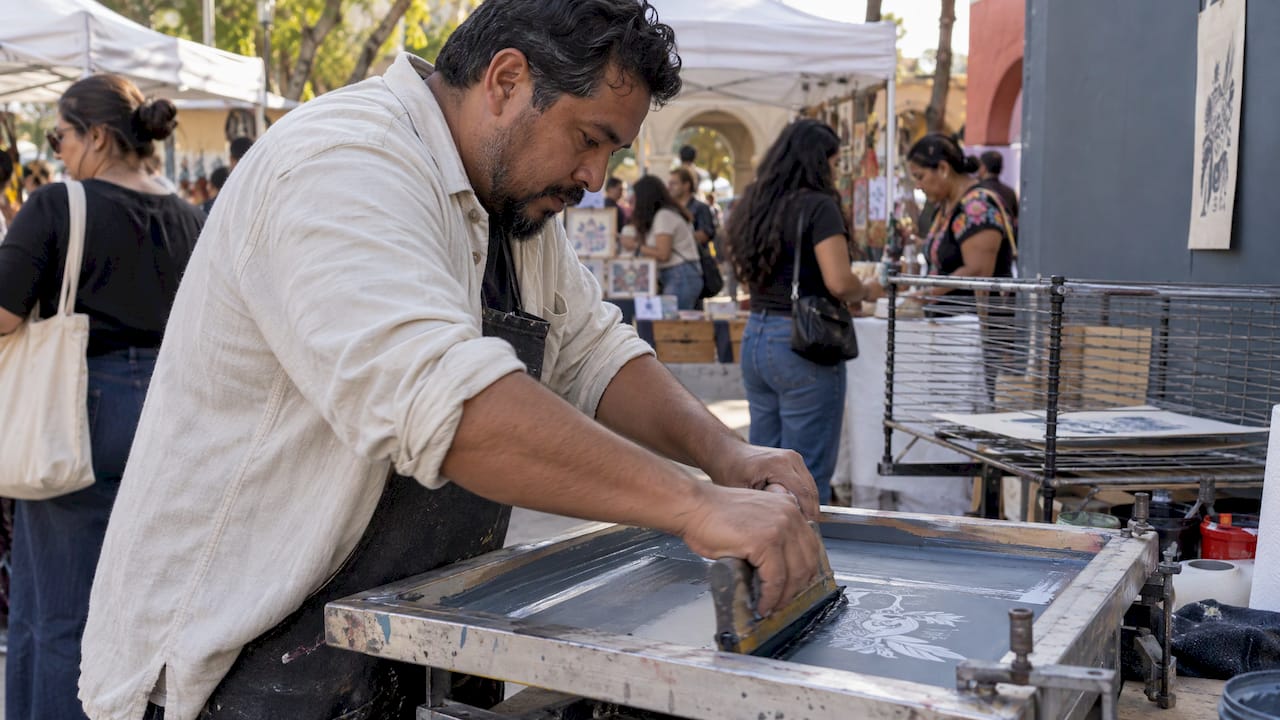
    Printmaker making a screen print at LA Plaza

    Melrose Trading Post

    On Sundays, Melrose Trading Post brings around 260 local makers, live music, handcrafted goods, vintage fashion, antique furniture and original art. The vendor mix and music change weekly, which is exactly why it’s fun to return. Every ticket supports free arts education for Fairfax High students, so your gift shopping does a little extra good.

    Mercado La Paloma

    In South LA, Mercado La Paloma is a marketplace of family-run stalls serving Ethiopian, Oaxacan, Thai and Yucatán food, alongside vendors selling jewelry, pottery, clothing and folk art from Mexico, Central and South America. It also hosts workshops, dance classes, live music and yoga. Grab lunch, find a handmade gift and call it a day.

    Little Tokyo Farmers’ Market

    Every Saturday through December 26, 2026, the Little Tokyo Farmers’ Market sets up at Isamu Noguchi Plaza with fresh produce, cultural experiences and a real neighborhood feel. Pair it with a walk around the district for a low-key holiday morning.

    Hollywood Farmers’ Market

    The Hollywood Farmers’ Market is an open-air market with seasonal California produce, honey, jams, cheeses, handmade soaps, jewelry, knitted goods, vegan food and gourmet tamales. It also has chef talks, cooking demos, book signings, crafts and tastings. It’s a great place to build a holiday brunch spread or pick up edible gifts.

    How to plan a market day

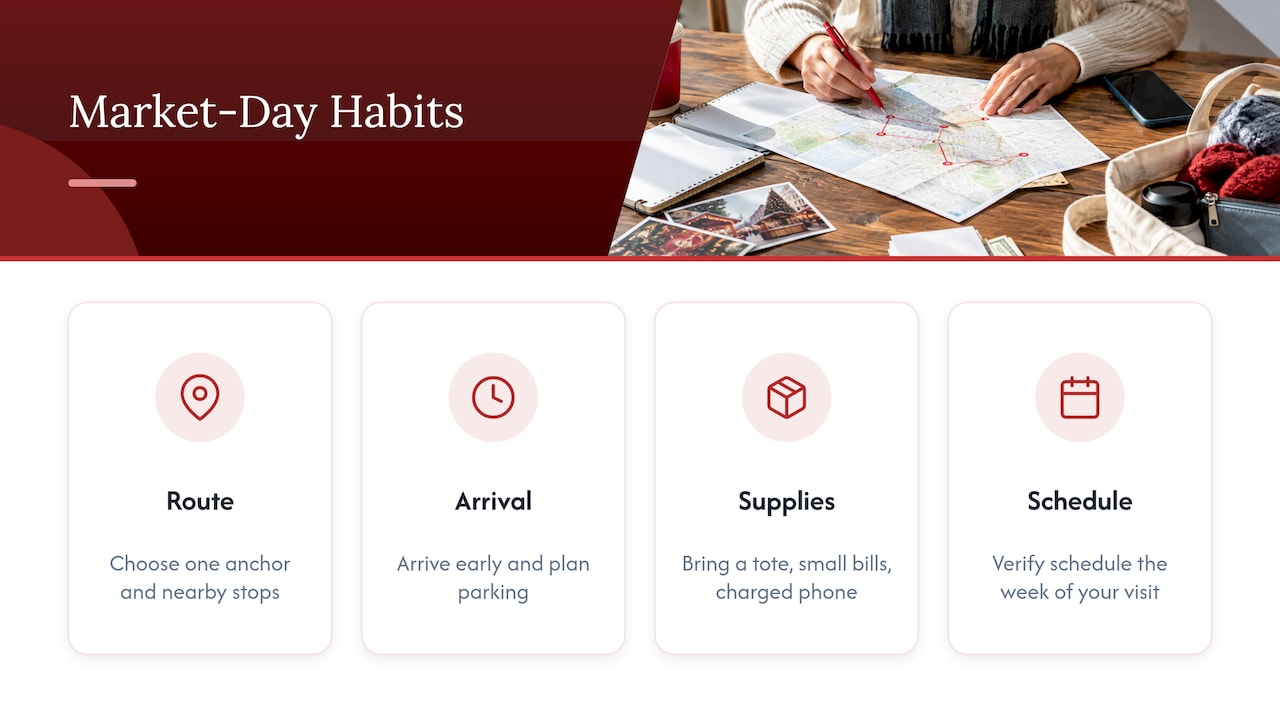
    A good market day in LA is mostly about logistics. A few habits make a big difference.

    Four practical steps for planning a market day

    Pick one anchor and build around it

    Traffic is the real boss in Southern California. Choose one anchor market, then add one or two nearby stops. A Santa Monica craft fair pairs well with a coastal walk, and a Little Tokyo morning pairs well with lunch downtown. For more ideas on where to eat while you’re out, try our guide to Los Angeles food halls.

    Arrive early, park smart

    Big fairs fill up by midday. The Renegade organizers offer free parking in the main lot and additional lots, but they still recommend rideshare, biking or transit. For smaller neighborhood events, assume street parking is tight and give yourself 20 extra minutes.

    Bring a plan for your haul

    Carry a sturdy tote, small bills and a charged phone. Many makers take cards, but connections at outdoor events can be shaky.

    Check the schedule the week you go

    Most of these events are annual or recurring, but exact dates and hours move. Use the organizer pages linked above, not a social media repost from last year.

    Other things to do near the markets

    A market is a good excuse to see the rest of LA in holiday mode. Local travel guides commonly point visitors to The Grove, Rodeo Drive and Beverly Hills lights, Grand Central Market holiday eats, Griffith Observatory and Universal Studios Hollywood as seasonal outings. The Grove’s big tree and festive décor also came up repeatedly when Angelenos shared their favorite photo spots.

    If you’d like something less obvious, a few of our own guides can help:

    Visiting from out of town? Our weekend getaways from Los Angeles can help you stretch the trip.

    Our perspective

    When people ask me for a Christmas market in LA, I understand the picture in their head: mulled wine, wooden stalls, a big tree. I’d gently suggest a different picture. Southern California’s version is made of makers, neighborhoods and sunshine.

    That’s why we built SoCal Sights around local knowledge and community tips rather than a single top-ten list. The best holiday day I’ve had here wasn’t at the biggest event. It was a small mercado where I met a ceramicist, ate something I couldn’t pronounce and left with a gift no mall could match.

    Our approach is to point you toward the markets with real character, explain the practical bits like parking and timing, and leave room for the surprises locals love to share. If you know a pop-up that deserves a spot on this page, we want to hear about it.

    Joshua

    Running a holiday market or local shop?

    If you organize a holiday market, run a shop with seasonal products or host an event for Southern California visitors, you can reach the readers who use guides like this one. We offer advertising, featured placements and memberships for local businesses. See the details on our advertise with SoCal Sights page.

    Socalsights

    We don’t publish a price for this, so reach out through that page to learn what fits your event.

    FAQ

    Is there a European-style Christmas market in Los Angeles?

    LA doesn’t have one permanent, traditional European market. The closest experiences are seasonal pop-ups, such as curated holiday markets and festival-style craft events, plus big light-and-shopping destinations like Enchant at Santa Anita Park. Watch organizer calendars each fall, since village-style markets tend to be one-day events.

    When do Christmas markets in Los Angeles start?

    The 2026 season starts early. The Renegade Craft Fair runs November 7-8, Jingle Fest in Santa Clarita is November 14, and Enchant opens November 20 and runs through December 27. Many pop-up markets cluster in late November and December, so check each organizer’s page for the current schedule.

    Are LA holiday markets free?

    It depends on the event. Community mercados and some pop-ups are free to enter, while light festivals like Enchant use ticketing with General Admission and Premier options. The Little Tokyo Farmers’ Market is a weekly outdoor market, and Renegade offers free onsite parking. Always check the organizer’s page for entry details.

    What can I buy at a holiday market in LA?

    Mostly handmade and small-batch goods: jewelry, ceramics, candles, art prints, apparel, ornaments, leather goods, toys, packaged chocolate and baked goods, coffee and tea. Many markets add food trucks, warm drinks and live music, so you can eat and shop in the same trip.

    Are there holiday markets outside central Los Angeles?

    Yes. Jingle Fest is in Santa Clarita, Enchant is in Arcadia, and Dreamers Markets hosts holiday pop-ups across Orange County, Los Angeles and San Diego. If you’re heading south, our Orange County food halls guide is handy for a lunch stop.

    Sources

  • San Pedro Hidden Gems: 15 Local Spots Worth Finding

    San Pedro Hidden Gems: 15 Local Spots Worth Finding

    San Pedro is the part of Los Angeles where the cliffs, the working port and a tight-knit arts scene all share a few square miles. The best way to see it is to look past the big waterfront names: wander the downtown galleries, find the old neighborhood café, and catch the sunset from a clifftop park most visitors drive right past. Here are the spots I’d send a friend to, with the hours, costs and little tips that make a visit easier.

    Socalsights
    Find More Southern California Hidden Gems
    Explore curated local recommendations for activities, food spots, and unique itineraries across Southern California.

    TL;DR

    • Downtown San Pedro’s First Thursday art walk, House 1002 and the Corner Store are the easiest way to feel the neighborhood’s character.
    • Point Fermin Park, Angels Gate Park and White Point give you ocean views without the crowds of the bigger beaches.
    • Cabrillo Marine Aquarium is free to enter, with a suggested donation, and nighttime grunion viewing at Cabrillo Beach is a local favorite.
    • West Harbor is the new waterfront hangout, with a promenade, rentals and the relocated fish market.
    • Always check hours before you go: park lots, construction and events change.

    Table of Contents

    Start Downtown: Art, Records and Vintage Finds

    Downtown San Pedro is where I’d begin, because it’s walkable and full of places that don’t look like much from the street. Park once, then wander.

    First Thursday ArtWalk

    The First Thursday ArtWalk has been bringing people to the historic core of downtown for nearly 25 years, with more than 30 galleries and studios taking part. As the name says, it happens on the first Thursday of the month. Galleries stay open into the evening, shops put out their best stuff, and the sidewalks fill up with neighbors. Go hungry and plan to wander without a schedule. For the current month’s lineup, check the event’s official page before you head over.

    House 1002

    House 1002 is a home emporium at 1002 S. Pacific Ave., set in a 1920s building that used to be a supermarket. Its 6,000-square-foot showroom is stocked with vintage items, artisanal jewelry, architectural salvage, collectibles, garden accessories and fine art. It’s open Wednesday through Sunday, around noon to 5ish, and closed Monday and Tuesday, so don’t plan it for early in the week. Even if you leave empty-handed, it’s a fun way to spend an hour.

    Warner Grand Theatre

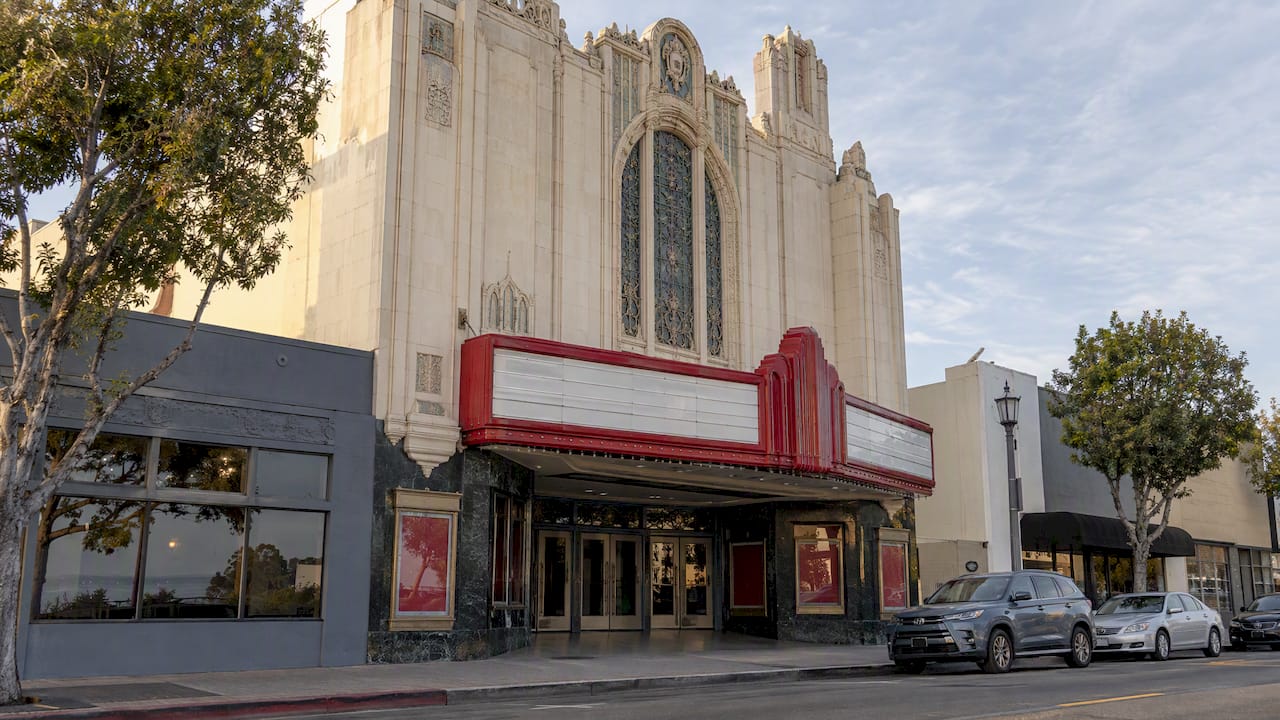
    The historic Warner Grand Theatre is one of downtown’s landmarks. Even a walk past the building tells you this part of town has some history behind it. Check what’s on the calendar if you’d like to see the inside.

    Record shops, guitars and other small stops

    Local roundups of downtown often mention spots like the Arcade Building, a guitar shop and a record store tucked along the same few blocks. I’d treat these as bonus stops between galleries: they come and go, and hours vary, so a quick look at each shop’s own page or social feed before you go saves a wasted trip.

    Neighborhood Food Spots With Real History

    San Pedro’s food scene is a mix of old-school and new. A few places stand out for feeling like they belong to the neighborhood.

    The Corner Store

    The Corner Store is a neighborhood café at 1118 W. 37th St. San Pedro Today reported in November 2023 that it had been open since 1947 and, under new ownership, was offering bottled sodas, candy, gifts, pastries and coffee to go. It’s the kind of stop where you grab a pastry and a soda and feel like a local for ten minutes.

    The Norwegian Church coffee and waffle stop

    Here’s one most visitors don’t know about. San Pedro Today’s local roundup of hidden treasures includes the Norwegian Church’s coffee-and-waffle stop alongside a few other favorites. That list is from 2019, so confirm the current schedule with the church before you make a special trip.

    Green Girl Farms

    The same roundup also points to Green Girl Farms as a local favorite. If you like seeing where your produce comes from, add it to your list, and check its current hours first.

    West Harbor and the fish market

    West Harbor is the newest waterfront destination. It has a walkable promenade, a food collective, and the San Pedro Fish Market in a new 1,500-seat waterfront location while permanent facilities are finalized. You can also rent Surrey bikes and kayaks along the promenade. It’s busier than the other spots on this list, so I’d go on a weekday if you can. Bring a jacket, because the harbor breeze picks up at dusk.

    Parks and Overlooks Without the Crowds

    This is where San Pedro really shines. The cliffs along Paseo Del Mar give you big Pacific views, and most visitors don’t stay long.

    Point Fermin Park

    Point Fermin Park sits at 807 Paseo Del Mar and is run by the City of Los Angeles Department of Recreation and Parks. According to the city, it has hiking trails, ocean views, walking paths, picnic tables and open and shaded space. The park is open 6:30 a.m. to 10:00 p.m., and the parking lot is open seasonally from sunrise to sunset. That last detail trips people up: if you stay for sunset, you may need to park on the street or arrive earlier. Picnic and ceremony permits go through the contact info on the park’s page.

    The historic lighthouse is right there, so it’s an easy pairing. If you like spooky old places, here’s a guide to visiting haunted places in Los Angeles the respectful way, without trespassing.

    Angels Gate Park

    Angels Gate Park is open from 6:30 a.m. to 10:00 p.m., and its parking lot is open from sunrise to sunset. Same tip as above: if you’re planning a late visit, don’t count on the lot.

    White Point and Royal Palms Beach

    White Point/Royal Palms Beach remains open to the public during infrastructure improvements through 2027, though parking is limited because of construction. Go early, expect a short walk, and check the county page for current conditions.

    Peck Park Canyon

    Peck Park Canyon’s Ray Patricio Trails made the San Pedro Today hidden treasures list. It’s a good pick if you want a quieter walk that feels a world away from the harbor.

    Averill Park

    Averill Park comes up again and again when locals share their picks for visitors, including in a Reddit thread of recommendations. It’s a laid-back neighborhood park, perfect for a break between bigger stops.

    Beach, Tide and Wildlife Stops

    Cabrillo Marine Aquarium

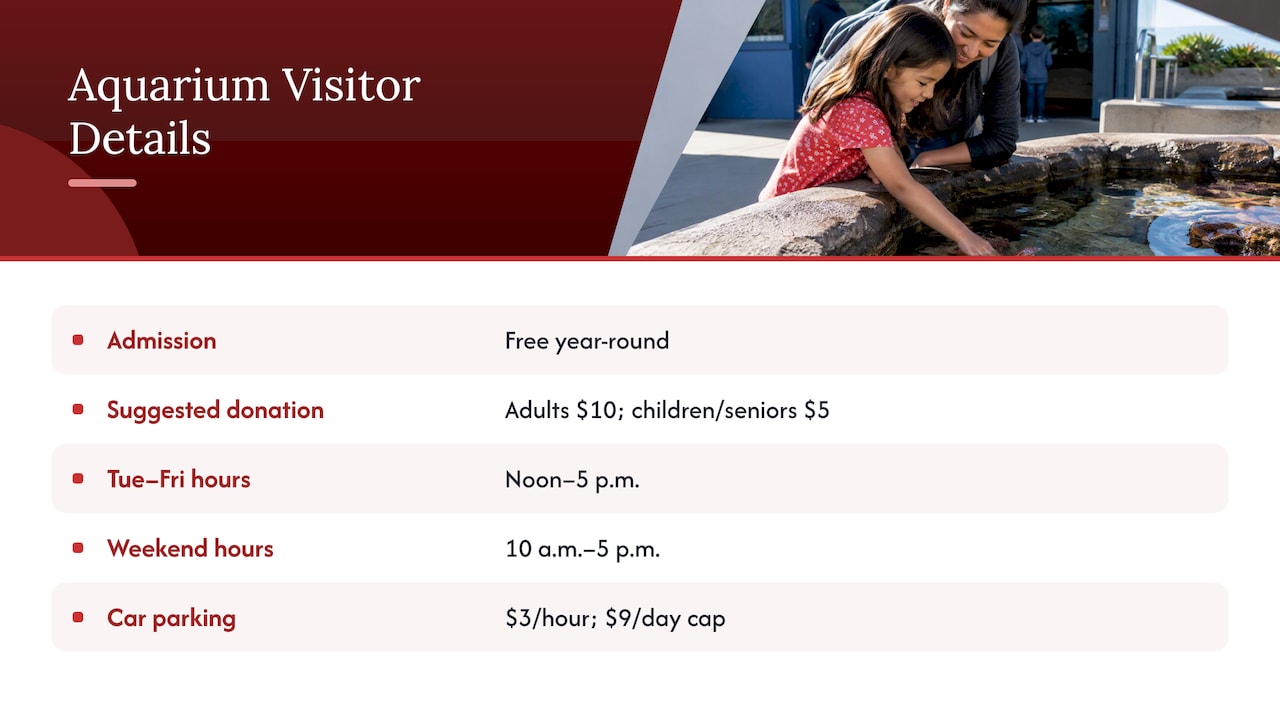
    This one’s a favorite of mine because it costs so little. Cabrillo Marine Aquarium, at 3720 Stephen M. White Drive, is free year-round, with a suggested donation of $10 for adults and $5 for children and seniors. Hours are Tuesday to Friday noon to 5 p.m. and Saturday and Sunday 10 a.m. to 5 p.m. Groups of more than 15 need a reservation. Cabrillo Beach parking is $3 per hour, capped at $9 a day for cars, and it’s card payment only.

    If tide pools are your thing, our guide to Palos Verdes tide pools covers best times and family safety, and it’s just up the coast.

    Cabrillo Marine Aquarium

    Grunion viewing at Cabrillo Beach

    Nighttime grunion viewing at Cabrillo Beach shows up on San Pedro Today’s list of lesser-known things to do. Grunion runs happen on specific nights, so check the official grunion run schedule from the state before you plan an evening around it, and dress warmly.

    Salinas de San Pedro Salt Marsh

    The same list recommends birdwatching at the Salinas de San Pedro Salt Marsh. Bring binoculars and go in the morning, when it’s quiet.

    Waterbird foraging in the Salinas de San Pedro Salt Marsh

    Murals, Classes and Offbeat Experiences

    If you like your travel a little off the map, a few other ideas from San Pedro Today’s activity roundup:

    • Julie Bender 25th Street Mosaic Mural: a colorful public art piece you can enjoy for free.
    • Blue Water Clay: ceramics classes if you’d rather make something than just look.
    • Local events: the Mary Star Fiesta Ferris wheel and the annual Polar Bear swim are fun to watch, or join if you’re brave.

    Another worthwhile local tradition is San Pedro’s Day of the Dead celebration, which lists music, art, food, altars, a Catrina contest, kids’ activities and free trolley rides. It’s held in late October, but dates shift, so use the official site for the current year.

    Two more places from the hidden treasures list are worth knowing: the San Pedro World War II Memorial at Green Hills Memorial Park and the Los Angeles Maritime Museum’s commercial-fishing exhibit. Both tell the story of a town built around the water and the work done on it.

    A Simple Way to Plan Your Day

    Here’s a relaxed route that mixes a bit of everything:

    1. Morning: Coffee and a pastry at the Corner Store, then a walk at Point Fermin Park.
    2. Midday: Cabrillo Marine Aquarium, then a stroll on the beach.
    3. Afternoon: Browse House 1002 and the downtown galleries (Wednesday through Sunday).
    4. Evening: Dinner at West Harbor, then a walk along the promenade. On the first Thursday of the month, swap dinner for the ArtWalk.

    A few practical notes:

    • Parking lots at several parks close at sunset, so build your timeline around that.
    • The aquarium is closed Mondays, so avoid that day for the Cabrillo stops.
    • Bring layers. The coast is often cooler than inland LA.

    Our Perspective

    San Pedro is one of those places that rewards curiosity. The big attractions get plenty of attention, but the stuff I love most is small: a café that has been around for decades, a gallery you stumble into, a park with no line at the gate.

    That’s why we built SoCal Sights around local knowledge. We want to cut through the information overload and point you to places that feel real, and we want locals to chime in with their own favorites. If you know a corner of San Pedro that deserves a mention, that’s exactly the kind of tip our community is for.

    If you like this style of guide, our pieces on unique things to do in Los Angeles and hidden Southern California beaches work the same way.

    Joshua

    Run a Local Business or Event in San Pedro?

    If you own a shop, café, gallery or event in San Pedro, our readers are exactly the people looking for places like yours. We offer advertising, featured placements and memberships for local businesses and event organizers who want to reach visitors and residents across Southern California. You can see the options on our advertise with SoCal Sights page.

    Socalsights

    To go further, try our Long Beach hidden gems guide, which is a short drive east, or our Southern California hidden gems roundup.

    FAQ

    What is San Pedro best known for?

    San Pedro is known for its working port, cliffside parks, the Point Fermin area and a strong arts community downtown. Most visitors come for the waterfront, but the neighborhood’s galleries and old-school cafés are what make it special.

    Are there free things to do in San Pedro?

    Yes. Cabrillo Marine Aquarium is free year-round, with a suggested donation, and parks like Point Fermin and Angels Gate are free to enter. Murals and the downtown art walk cost nothing either, though beach parking at Cabrillo has a fee.

    When is the best time to visit San Pedro’s parks?

    Mornings are usually quietest. Both Point Fermin and Angels Gate are open 6:30 a.m. to 10:00 p.m., but their parking lots only run from sunrise to sunset, so plan around that.

    Is White Point open?

    White Point/Royal Palms Beach is open to the public during improvements through 2027, but parking is limited due to construction. Check the county’s page before you go.

    What should I do on a first visit?

    Pair a clifftop park with the aquarium, then spend the afternoon downtown. If it’s the first Thursday of the month, stay for the ArtWalk.

    Sources

  • Catalina Camping Guide: Campgrounds, Booking and Packing

    Catalina Camping Guide: Campgrounds, Booking and Packing

    Camping on Catalina Island means picking one of five designated campgrounds, booking it ahead, and getting yourself and your gear there by ferry and on foot. Three are run by the Catalina Island Conservancy (Black Jack, Little Harbor and Parsons Landing), and two sit close to the island’s two towns (Hermit Gulch above Avalon and the campground at Two Harbors). I love this trip because you get a Southern California island at night, after the day-trippers have gone home. Here is how to choose a campground, book it, and show up ready.

    Socalsights
    Find More Southern California Gems
    Explore local recommendations for memorable activities, food spots, and lesser-known places across Southern California.

    Explore local recommendations

    TL;DR

    • Catalina has five campgrounds. Hermit Gulch and Two Harbors are the easiest. Black Jack, Little Harbor and Parsons Landing are the hike-in, more remote options.
    • Book early. The Conservancy says to reserve as early as you can, ideally in January, because sites fill fast.
    • Fees are charged per person, per night. A free hiking permit from the Conservancy is required for hikers.
    • Fires are allowed at Little Harbor, Two Harbors and Parsons Landing, but not at Black Jack. Water and firewood are ordered with your reservation.
    • Pack for hills, wind and no shortcuts: you carry in what you need, and you carry out your trash.

    Table of Contents

    The five Catalina campgrounds at a glance

    Most of Catalina is protected wilderness, so camping happens at a short list of designated sites. The Conservancy manages three of them along the Trans-Catalina Trail: Black Jack, Little Harbor and Parsons Landing. The other two are Hermit Gulch and Two Harbors. Here is how I would sort them.

    Campground Setting How you get there Best for
    Hermit Gulch Canyon just above Avalon Walk uphill from town First-timers, families, an easy base for Avalon
    Two Harbors Village at the island’s narrow isthmus Ferry to Two Harbors, then a short walk Beginners who want a store, beaches and water sports nearby
    Black Jack Pines and eucalyptus, inland and high Hike-in (or reach by trail) Quiet nights, big views, trail hikers
    Little Harbor Sandy beachfront on the west side Hike-in Beach camping with room to roam
    Parsons Landing Secluded beach, primitive sites Hike or kayak Solitude and sunsets

    None of these is a drive-up campground. Even the easy ones involve a ferry and a walk, which is a big part of the charm.

    Hermit Gulch: the in-town option

    If you want camping without giving up Avalon’s restaurants, Hermit Gulch is the one. It is the only campground near the main town, and it makes a good first Catalina trip because you can wander down for dinner and be back in your tent by dark.

    The Conservancy notes that for midweek stays at Hermit Gulch from November through March, you book by phone with the Catalina Island Company booking office at 310-510-4205. Outside that window, reserve online. Check the Catalina Island Company’s official page for the current fees and rental gear, since those change.

    If Avalon is your focus, our Avalon-focused Catalina day trip and the Friday to Sunday Avalon weekend itinerary pair nicely with a night or two at Hermit Gulch.

    Two Harbors: the easy “real island” camp

    Two Harbors is the island’s small, laid-back village on the isthmus. It is my pick for people who want the quiet side of Catalina without a long backpack. You get a camp within walking range of a small village, beaches, and snorkeling and kayaking nearby. The Conservancy’s own trail guide treats Two Harbors as a key stop on the Trans-Catalina Trail, with Little Harbor sitting 5 miles away and Parsons Landing 6.5 miles in the other direction.

    It is also the natural base if you want to try just one hike-in night. Sleep at Two Harbors, hike to a more remote beach for a night, and come back.

    Black Jack: pines, ridgeline and no campfires

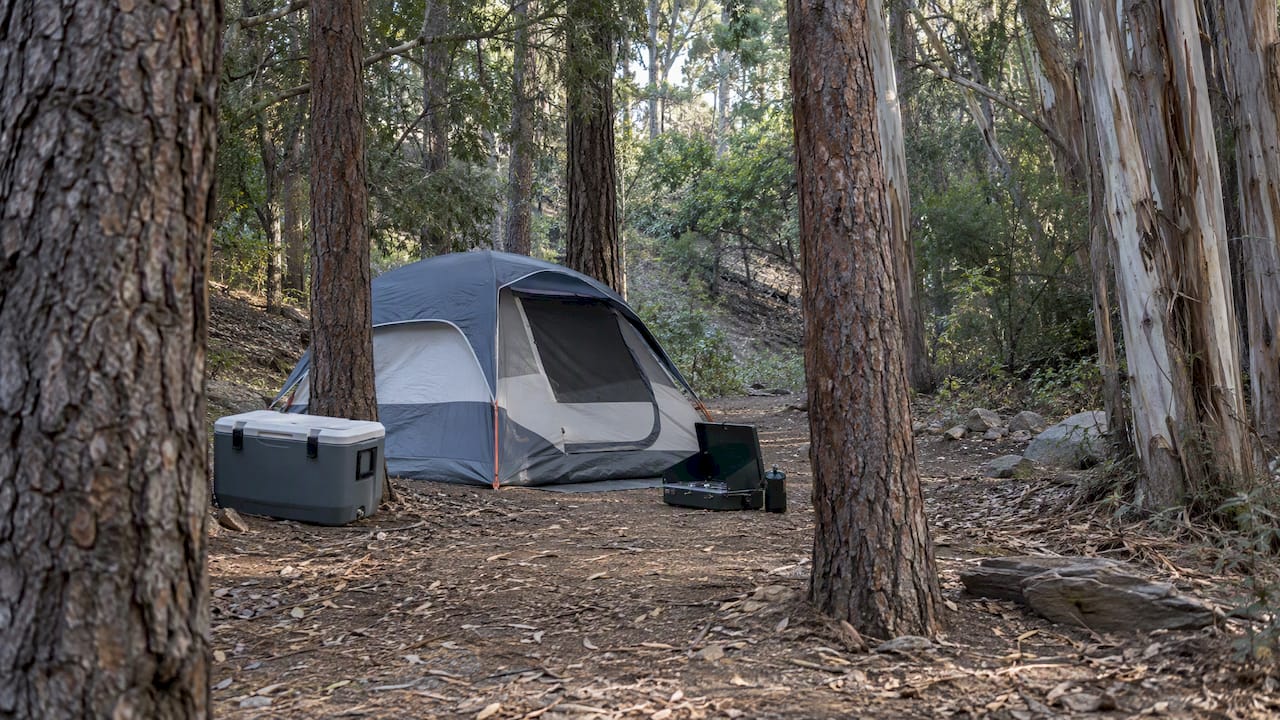
    Black Jack sits among pine and eucalyptus trees near Mt. Orizaba, the island’s highest peak, at about 1,600 feet above sea level with eleven campsites. It feels completely different from the coast: cooler, quieter, and a long way from either town.

    One rule to plan around: no fires are allowed at Black Jack, while they are allowed at Little Harbor, Two Harbors and Parsons Landing. Bring a stove and warm layers, because evenings up high can feel colder than you expect from a Southern California beach trip.

    Tent and stove among Black Jack trees

    Little Harbor: beachfront and easy to love

    Little Harbor is the one the Conservancy calls out as a blend of camping and beach fun, and it has a reputation to match. It sits about seven miles east of Two Harbors and 16 miles from Avalon, with a sandy beachfront and plenty of recreation. On the Trans-Catalina Trail, the stretch from Black Jack to Little Harbor is 8 miles, which gives you a sense of how much walking is involved from the interior.

    What I like: you can drop your pack, then spend hours swimming, beachcombing, and watching the sunset from sand rather than a parking lot. Fires are allowed here, so campfire dinners are on the table (see the rules below).

    Parsons Landing: the remote beach

    Parsons Landing is the most secluded of the group. It is a beach camp about seven miles west of Two Harbors, and its eight primitive campsites each accommodate up to eight people. You get there by a moderately difficult hike or by kayak.

    Be ready for primitive. There is no running water and only a pit toilet, so water comes from the lockers you order with your reservation. In return, you get a quiet beach and one of the best sunsets I know of in Southern California.

    How to book a Catalina campsite

    The booking rhythm matters more than anything else on this trip, so here is the order I would follow.

    1. Pick your nights and your campground. Decide whether you want the easy route (Hermit Gulch or Two Harbors) or a hike-in night.
    2. Book campsites first, then the ferry. The Conservancy advises planning and booking as early as possible, with January the best time to book because sites fill quickly. If you are stringing campgrounds together on consecutive nights, that is where it gets tricky. If your dates are taken, the Conservancy suggests trying the route in reverse.
    3. Order water and firewood with your reservation. On the trail, each locker has 2 gallons of water and one bundle of firewood when you book water.
    4. Get your free hiking permit. A mandatory, free hiking permit is required for all hikers on the island, provided by the Conservancy.
    5. Adjust numbers if plans change. Fees are per person, per night, and you can change the number of occupants after booking by calling or emailing the Conservancy’s office.

    No spontaneous “find a spot and pitch a tent” camping here. Everything is reserved, and the permit is part of how rangers keep hikers safe: permits let rangers contact hikers in danger, for example during wildfires, damaging winds or heavy rain.

    What camping on Catalina costs

    Fees at every campground are charged per person, per night, not per site. Exact amounts change with the season and with the operator, so confirm them on the booking page when you reserve. Here is what I can tell you without guessing:

    As a rule of thumb, budget for campsite fees for every person every night, plus ferry fares, plus food that costs island prices. The cheapest trips are the ones where you bring most of your food from the mainland.

    Getting to the campgrounds

    Catalina is an island, so every trip starts with a boat. Most campers ferry from the mainland to Avalon or Two Harbors, then travel from there.

    To Hermit Gulch: ferry to Avalon and walk uphill from town. If your gear is heavy, ask about a luggage service at the landing, since a hilly walk with a full bag is no fun.

    To Two Harbors: ferry directly to the village and walk to the campground. You still go up and down hills, so a small foldable wagon can help, though some sites are a bit of a haul.

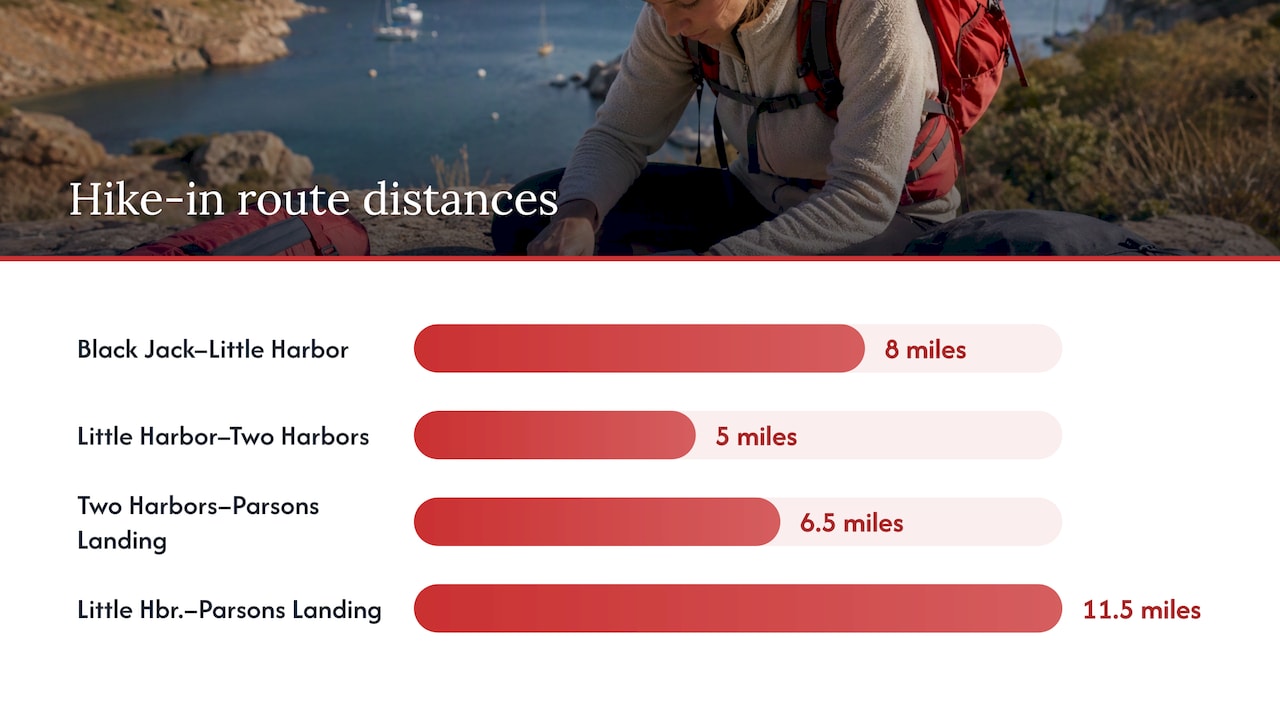
    To the hike-in sites: you walk. A few distances from the Conservancy’s route breakdown are useful for planning a day’s effort:

    • Black Jack to Little Harbor: 8 miles
    • Little Harbor to Two Harbors: 5 miles
    • Two Harbors to Parsons Landing: 6.5 miles
    • Little Harbor to Parsons Landing: 11.5 miles

    Those are real miles with real elevation, in sun. Start early and carry more water than feels sensible. If you would rather skip the trail, Parsons Landing can also be reached by kayak.

    If you are comparing island camping trips, our guide to staging for Channel Islands camping walks through how to plan around boat schedules and cancellations, and much of that thinking applies here too.

    Getting to the campgrounds

    Rules that keep Catalina wild

    Catalina’s interior belongs to the Conservancy, and the rules are simple and worth following. Visitors to Conservancy lands must obey posted signs and instructions from rangers, and may not feed, approach or harass wildlife. The bison and foxes are wild, however relaxed they look.

    If you bring a dog, the Conservancy requires that pets stay on a leash, that you collect all waste, and that vaccinations are current (rabies, distemper combo and Bordetella). Check the permits page before you go, since requirements are updated.

    A few habits I follow on every trip:

    • Store food in the provided lockers or your sealed bags, never in your tent.
    • Pack out all trash.
    • Keep fires small and only where allowed, in the provided rings.
    • Stay on trails and give animals space.

    What to pack for Catalina camping

    This trip is easier if you pack for wind, sun and steep trail, and then trim. Here is my list.

    Shelter and sleep

    • A tent that handles wind, with good stakes
    • Sleeping bag rated for cool nights, especially at Black Jack
    • Sleeping pad and a small pillow

    Food and water

    • A compact stove and fuel (essential at Black Jack, where there are no fires)
    • Pre-ordered water for sites without running water, plus a refillable bottle
    • Simple meals you can cook in one pot

    No matter where you camp, water is the thing that sneaks up on you. This packing list for remote campsites is a good reminder of how much to plan for each day when taps are far away.

    Trail and safety

    • Sturdy shoes and a hat
    • A headlamp with spare batteries
    • Sunscreen and a first-aid kit
    • A printed or offline map
    • Your confirmed permit and reservation details

    Comfort extras

    • A foldable wagon for the walk-up sites
    • A warm layer, even in summer
    • A small trash bag to pack out your trash

    If you do not own camping gear, ask the campground operator what it rents. Some Avalon and Two Harbors options offer gear, which is a good way to try Catalina camping without a big purchase.

    What to do once you are camped

    The campground is the base, and the island is the activity.

    • Hike a piece of the Trans-Catalina Trail. You don’t need to do all of it. A day hike from camp covers some of the best views.
    • Swim and snorkel. Little Harbor and Two Harbors both put you right near the water.
    • Kayak. Parsons Landing is reachable by kayak, and Two Harbors is a natural launch point.
    • Watch the sunset from the sand. Beach camps make this the daily event.
    • Stargaze. With no city glare, Black Jack and Parsons Landing get dark in a way coastal Southern California rarely does.
    • Add a town day. Spend a day in Avalon for food and shops; our Catalina weekend itinerary shows one way to do it.

    If you love getting away from the crowds, see our list of hidden Southern California beaches locals use for more quiet shoreline ideas back on the mainland.

    Our take on camping Catalina

    We built SoCal Sights because most travel guides send everyone to the same handful of places, and the best parts of Southern California tend to be the ones people mention to a friend. Catalina camping is one of those.

    Our advice is to pick your campground for the kind of night you want, not the kind of trip you think you should take. A first-timer who sleeps at Hermit Gulch and wanders Avalon at dinner has a better trip than someone who overreaches on a long hike-in and spends the weekend exhausted.

    We also think local knowledge beats information overload. That is why we focus on curated, community-driven picks, with logistics you can actually use: book early, order your water, and bring a stove. If you have a favorite Catalina site or a tip that worked for you, that is exactly the kind of thing we want to share.

    Joshua

    Reach Southern California travelers with SoCal Sights

    If you run a local business, tour, rental shop or event that serves Southern California visitors and residents, SoCal Sights is built to put you in front of people looking for authentic things to do. Featured placements, advertising and memberships are available through our advertising and membership page.

    Socalsights

    We do not publish a price for it, so reach out through the page to learn what fits your business.

    FAQ

    Can you camp anywhere on Catalina Island?

    No. Camping happens at designated campgrounds, and every site needs a reservation. Hikers also need the Conservancy’s free hiking permit. Plan your campground and dates before you board the ferry.

    Which Catalina campground is best for beginners?

    Hermit Gulch and Two Harbors are the easiest because they are the two that are not remote hike-in camps. Hermit Gulch keeps you close to Avalon, and Two Harbors gives you a quieter village feel with beaches nearby.

    Are campfires allowed on Catalina?

    Sometimes. Fires are allowed at Little Harbor, Two Harbors and Parsons Landing, but not at Black Jack. Order firewood with your reservation, since a bundle costs $14, and always follow posted signs and ranger instructions.

    When should I book a Catalina campsite?

    As early as you can. The Conservancy recommends booking in January because the campsites fill quickly, especially if you want consecutive nights along the trail. If your dates are taken, try the route in reverse.

    Can I bring my dog camping on Catalina?

    On Conservancy lands, dogs must be leashed, owners must collect all waste, and vaccinations must be current for rabies, distemper combo and Bordetella. Check the Conservancy permits page for the latest rules before you go.

    Sources

  • Bioluminescence in Orange County: Where and When to See It

    Bioluminescence in Orange County: Where and When to See It

    You can see bioluminescence in Orange County when a bloom of glowing plankton shows up offshore, and no one can promise the date. When it does, the best bets are Newport Beach, Laguna Beach (Crescent Bay and Crystal Cove get a lot of love) and Huntington Beach. Go to a dark stretch of sand at least two hours after sunset, check the surf report first, and keep your expectations flexible. I’ve stood on cold sand for an hour and seen nothing, and I’ve also watched a wave light up like a neon sign. That’s the deal.

    Socalsights
    Find More Southern California Gems
    Explore SoCal Sights for local recommendations on activities, food spots, and unique itineraries across Southern California.

    Explore local recommendations

    TL;DR

    • Orange County’s blue glow comes from microscopic dinoflagellates that light up when the water moves. They bloom unpredictably, so there is no guaranteed season or night.
    • Newport Beach, Laguna Beach and Huntington Beach are the names that come up most. Pick a darker beach over a bright, crowded one.
    • Arrive at least two hours after sunset. Local guidance suggests the window between 9 p.m. and 3 a.m.
    • Most California red tides aren’t considered dangerous, but check CDPH alerts and OC beach advisories before you wade in.
    • Daylight reddish-brown water is a decent hint that a glow might follow after dark.

    Table of Contents

    What is actually making the water glow?

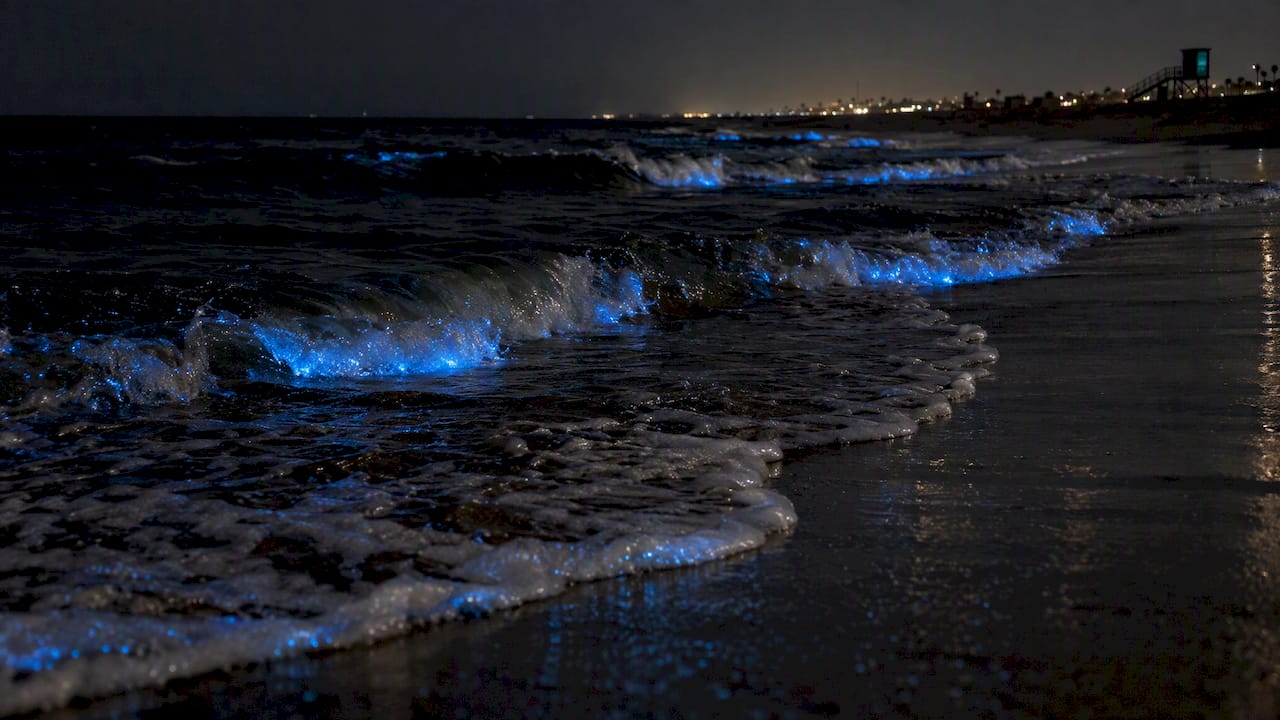
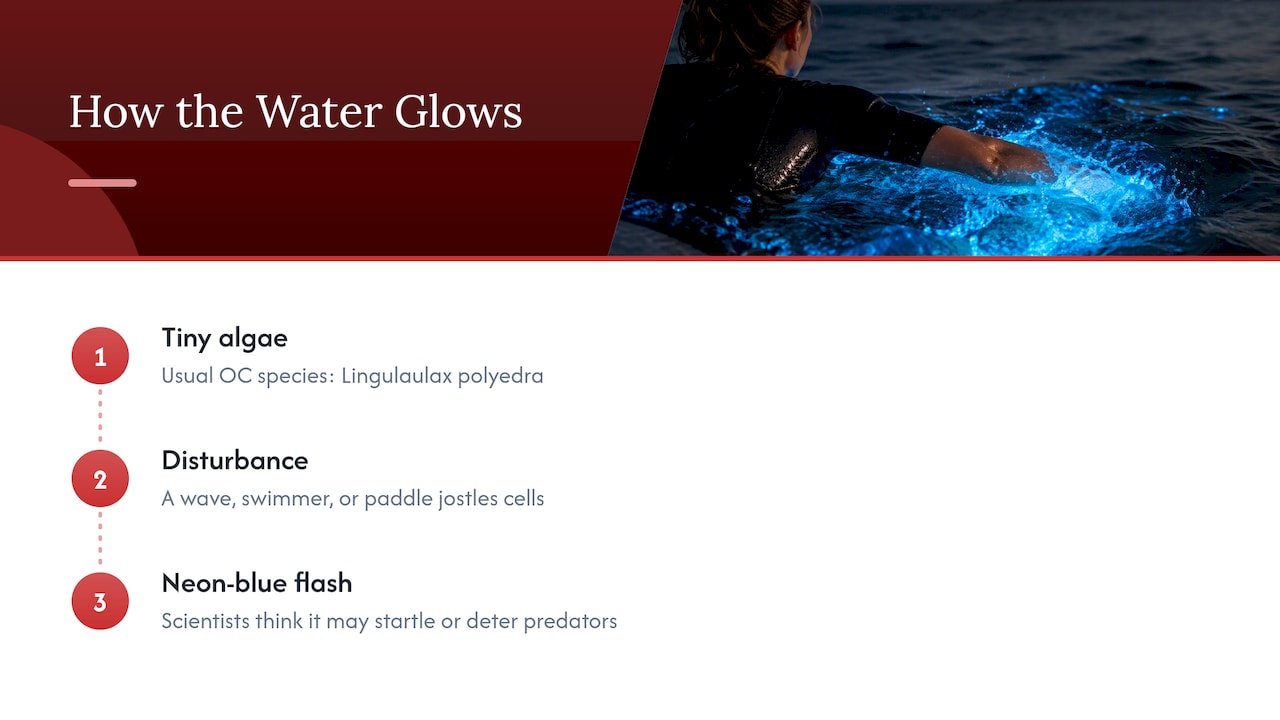
    The blue light comes from tiny single-celled algae called dinoflagellates. In Orange County, the usual suspect is a species called Lingulaulax polyedra (formerly Lingulodinium polyedra). According to Scripps Institution of Oceanography, when these organisms get jostled by a breaking wave, a swimmer or a paddle, they give off a neon-blue flash. Scientists think it works as a way to startle or avoid predators.

    So the glow isn’t a steady light. It’s a reaction. Wave crests that crash or churn are where it pops, which is why surf lines and wet sand footprints look the most dramatic. Calm, flat water may show only a faint shimmer where you splash.

    What is actually making the water glow?

    Why it’s called a red tide too

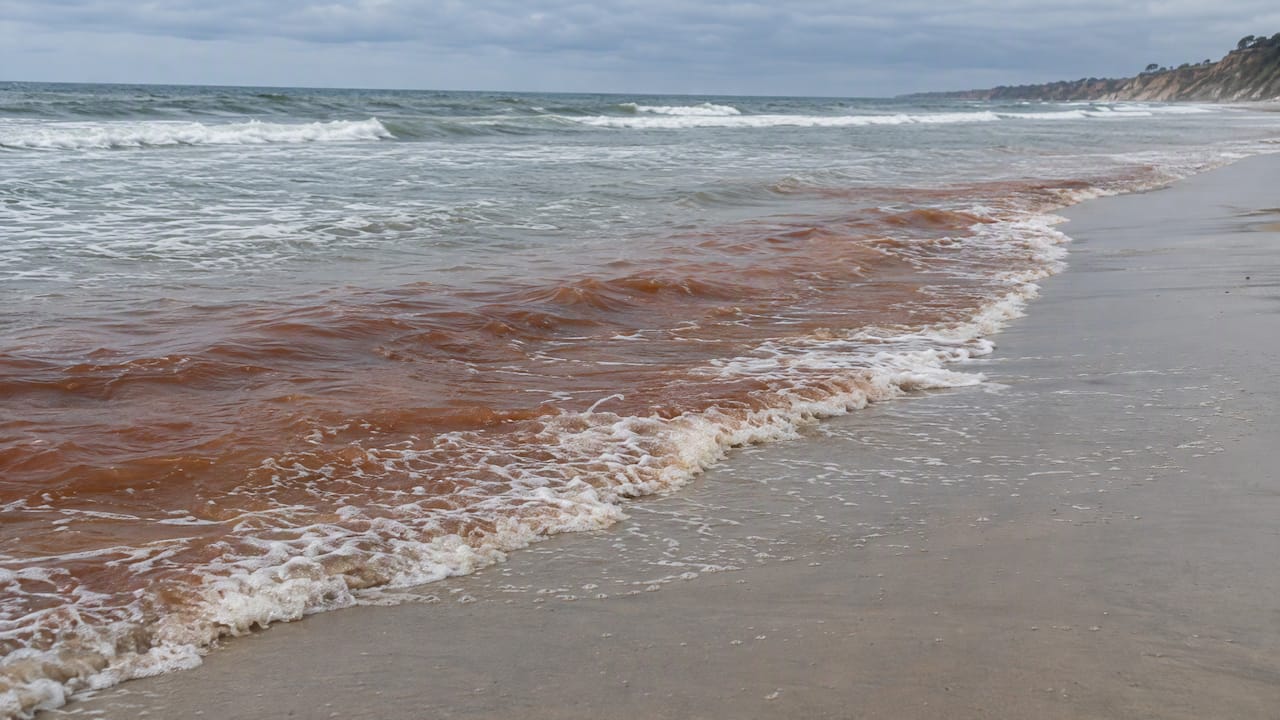
    Here’s the twist that surprises people. When the same organisms are packed in thick, the water often turns reddish-brown in daylight. That’s why these events are also called red tides, as Scripps explains. If you see rusty, tea-colored water at the beach in the afternoon, it’s worth coming back after dark.

    Rusty brown red-tide water along a beach

    What sets off a bloom

    Nobody can schedule these. Warmer water, nutrients washed in by rainstorms and the way the ocean circulates all seem to play a part, according to reporting in the Los Angeles Times. The right mix of those things can be there one week and gone the next.

    When bioluminescence shows up in Orange County

    Short answer: it’s a gamble, but you can improve your odds.

    Historically, Southern California red tides leaned toward late summer and early fall. In recent years, Scripps notes, they’ve most often happened in spring. The same page says past events have lasted anywhere from a few days to a few weeks, and sometimes a month or more. A local guide to OC glow spots also points out that sightings can happen at any time of year, with a better chance in warmer months.

    Here’s how I think about it:

    Situation What it means for your plans
    Reddish-brown water in daylight Good sign. Plan a night visit within a day or two.
    Local reports and photos from the past 24 hours Best signal. Go that same evening.
    Spring or early fall with warm water Better odds, but still no promise.
    Nothing reported, flat seas, bright full moon Low odds. Go for dinner instead.

    A streak can run for days or weeks, so if you hear that it’s “on,” you often have more than one night. Still, I wouldn’t wait. Intensity changes from night to night and from beach to beach.

    Where to look: Newport Beach, Laguna Beach, Huntington Beach and more

    Orange County has about 42 miles of coastline, and the glow doesn’t light up all of it evenly. Bloom patches drift. What follows is where people most often report seeing it, so treat it as a starting list, not a guarantee.

    Newport Beach

    Newport Beach gets named as one of the prime viewing spots in the county, and a 2026 Newport Beach Signal story on a national list of glowing-wave destinations puts the city in that conversation. Locals share photos of electric-blue waves along the shoreline whenever it happens. The beaches near the Balboa Peninsula are easy to reach, but they also have city lights. Walk away from the pier and the brightest streetlights if you can.

    Laguna Beach

    Laguna’s coves are naturally darker, with cliffs blocking a lot of light. Crescent Bay and Crystal Cove keep coming up in local enthusiast reports as favorites during active streaks, though it varies from week to week. Access is tight, though, and parking is limited. If you’re new to Laguna’s coves, my guide to Laguna Beach hidden coves, parking and tides covers the practical side. Stairs and uneven paths in the dark are no joke, so bring a headlamp with a red-light mode for the walk down.

    Huntington Beach

    Huntington Beach is wide and open, with long stretches of sand and big breaking waves, and breaking waves are exactly what make the glow flash. Reports have come from around the pier area north toward Sunset Beach. The wide shoreline gives you room to get away from the lit pier and fire rings, and a long walk north or south often makes the difference.

    Dana Point and other options

    The same Orange County guide lists Dana Point Harbor among spots worth trying. Harbors are calmer, so you may see glow mostly where oars, paddles or boat wakes disturb the water. Those guided by-boat outings are a popular alternative when the surf is quiet, and they are worth looking up if you don’t want to stand on a beach hoping.

    If you want to round out a coastal weekend, my list of hidden Southern California beaches has quieter stretches that are often darker after sunset.

    How to check before you go

    Checking costs you five minutes and can save a two-hour round trip.

    1. Check the surf and tide reports. Local guidance says to look at them before heading out (Newport Beach Signal). Gentle surf is good, since you still want waves to break. Rough, dangerous surf is not worth it.
    2. Look for fresh reports. Social media posts and local outdoors groups from the last day are the most useful signal. Anything older than two days is background noise.
    3. Look at the water in daytime. Reddish-brown patches are a hint.
    4. Check beach advisories. The OC Health Care Agency runs ocbeachinfo.com, which lists current closures and warnings, and a hotline at (714) 433-6400.
    5. Check the moon. A bright full moon washes out the glow. A new moon is ideal.

    Want a broader refresher on reading conditions before you go near the water? This ocean safety checklist is a handy rundown on conditions, closures and advisories.

    The best way to see it

    Timing matters more than gear.

    • Wait for full dark. Scripps says displays are best seen from a dark beach at least two hours after sunset (Scripps). A local guide recommends the 9 p.m. to 3 a.m. window (Newport Beach Signal).
    • Let your eyes adjust. Give it 15 or 20 minutes without checking your phone. You’ll see much more.
    • Watch the breaking waves. The brightest flashes happen right as a wave crests and crashes.
    • Walk the wet sand. Footsteps can leave brief blue glints, which is a fun bonus.
    • Bring a jacket. Orange County nights by the ocean get cold, even in summer.

    Don’t expect what you see in long-exposure photos. Cameras gather light for seconds, so a photo can look far brighter than what your eyes saw. To the naked eye, it’s usually a soft electric-blue flicker. That’s still magical.

    If you want a second perspective on the same routine down the coast, I wrote about waiting two hours after sunset for bioluminescence in San Diego, and most of the advice carries over.

    Is it safe to get in the water?

    Getting your feet wet is a personal call. According to Scripps, most California red tides aren’t considered dangerous, but they can sometimes cause skin or eye irritation or breathing discomfort, especially for people with asthma. If you have asthma, or a child with it, stay on the sand and talk to your doctor if you’re unsure.

    A few more things I keep in mind:

    • Check the alerts first. The California Department of Public Health runs a Phytoplankton Monitoring Program that uses volunteer-collected samples to help warn the public about harmful algal blooms.
    • Think about recent rain. After significant storms, runoff can affect Orange County waters, and health agencies advise against water contact for at least 72 hours, according to the OC Health Care Agency. Rain can also feed blooms, so the best glow nights sometimes come right when the water is least inviting.
    • Skip night swimming. Dark water, rip currents and cold temperatures are a bad combination. Standing ankle-deep or on the sand gives you the same show.
    • Go with someone. Beaches empty out late, and the cliffs near coves are hard to navigate in the dark.

    Other places in the U.S. with glowing water

    Orange County isn’t the only place to see this. Florida’s Space Coast lagoons and Puerto Rico’s famous bays are known for glowing water, and Southern California neighbors like San Diego see the same blooms we do. Those spots have different organisms and tend to be more predictable, while our OC blooms are the wild-card kind. That unpredictability is part of why a good night here feels like winning a small lottery.

    A few ways to turn a glow hunt into a full night out

    Since the glow can disappoint, I like to build an evening around it so the night works either way.

    • Start with dinner or dessert early. Eat in Laguna, Newport or Huntington, then walk down at 9 p.m.
    • Make it a date. Sand, stars and a possible light show beat most restaurant plans. My Orange County date ideas have more options for every budget.
    • Mix in something daytime. The next morning, Laguna Beach tide pools are a great low-key follow-up, if you go early and check the tides.
    • Try something offbeat. If the ocean doesn’t cooperate, offbeat things to do in Orange County gives you a plan B.
    • Keep it cheap. Plenty of spots in my Orange County hidden gems under $20 work for a lazy beach day before the night shift.

    What we think about chasing the glow

    We’ve spent a lot of time exploring Southern California for SoCal Sights, and the thing we keep coming back to is that the best local experiences aren’t the ones you can reserve. Bioluminescence is a perfect example. It rewards people who pay attention: those who notice the rust-colored water at lunch, who read the surf report, who have a friend text them “it’s glowing at Crescent Bay.”

    That’s why we built SoCal Sights around community tips. A single recent report from a local is worth more than any article, including this one. Our advice is to treat a glow hunt like a bonus. Plan a good evening, pick a dark beach, bring a warm layer, and if the waves light up, great. If they don’t, you still had a night at the beach. We’d rather you leave happy and a little curious than disappointed because you were promised a sure thing.

    — Joshua

    Run a local business or event in Orange County?

    If you run a coastal tour, a restaurant near the beach or an evening event, the people searching for night-time ocean activities are exactly who we reach: visitors and locals looking for things to do that feel authentic. SoCal Sights offers advertising, featured placements and membership options for local businesses and event organizers.

    Socalsights

    You can see how it works on our Advertise With SoCal Sights page. If you’d rather browse first, our guide to local businesses in Southern California shows the kind of places we feature.

    FAQ

    Can you see bioluminescence in Orange County right now?

    It depends on whether a bloom is offshore this week, and the only way to know is to check fresh local reports and surf conditions. Blooms can last days, weeks or more than a month, according to Scripps. If you see reddish-brown water in daylight, that’s a hint. Then head to a dark beach after full dark.

    What time of night is best to see the glow?

    Go at least two hours after sunset, when the sky is fully dark. Local guidance suggests the window from 9 p.m. to 3 a.m.. Give your eyes about 15 minutes to adjust, and avoid bright phone screens.

    Is bioluminescent water dangerous to touch?

    Most California red tides aren’t considered dangerous, but they can sometimes cause skin or eye irritation or breathing discomfort, especially for people with asthma (Scripps). Check CDPH alerts and OC beach advisories before you go in. If you have asthma or a medical condition, stay on the sand and ask your doctor.

    Where is the best place to see bioluminescence in Newport Beach or Huntington Beach?

    There’s no single best spot, because the glow shifts along the coast. In Newport Beach, walk away from pier and street lights. In Huntington Beach, use the long stretches of sand to get away from the lit pier and fire rings. Check recent photos and reports to see which beach is lit up that week.

    Does it only happen in Orange County?

    No. It shows up along much of the Southern California coast, including San Diego, and in other U.S. places such as Florida’s lagoons and Puerto Rico. Each place has its own organisms and its own timing. In Orange County, it comes and goes with blooms.

    Sources

  • Tiki Bars in Los Angeles: Where to Sip Rum Drinks in LA

    Tiki Bars in Los Angeles: Where to Sip Rum Drinks in LA

    Los Angeles is one of the best places in the country to drink a Mai Tai under a thatched roof, because tiki culture basically started here. If you only have one night, start with Tiki-Ti in Los Feliz for the tiny, legendary classic, or Tonga Hut in North Hollywood for the oldest surviving tiki bar in town. Below I’ll walk you through the bars worth your time, what each one is like, and how to choose.

    Socalsights
    Find More Local Southern California Gems
    Explore curated recommendations for fun activities, food spots, and unique itineraries across Southern California with SoCal Sights.

    TL;DR

    • Want the classic? Tiki-Ti on Sunset Boulevard has been going since 1961 and seats about a dozen people, so expect a squeeze.
    • Want the oldest and the biggest personality? Tonga Hut in North Hollywood opened in 1958 and is LA’s oldest surviving tiki bar.
    • Want something livelier or more modern? Look at The CanTiki, Cha Cha Lounge and the theatrical Lucky Tiki in Highland Park.
    • Go early, bring cash for the tiny spots, and confirm hours before you drive across town. Tiki bars change hours and menus more than you’d think.

    Table of Contents

    What makes a tiki bar different from a regular cocktail bar

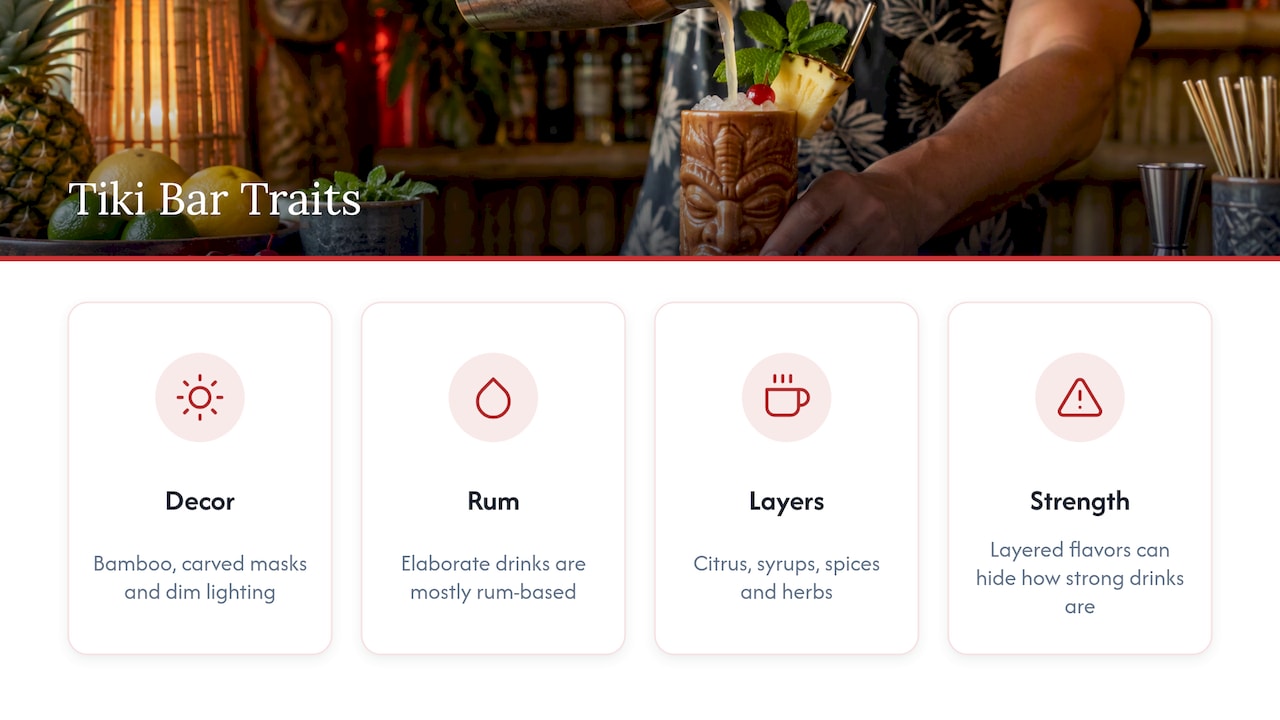
    A tiki bar is a themed bar. The décor leans on a romanticized idea of tropical cultures, most often Polynesian, and the menu is built around elaborate, mostly rum-based drinks, according to the general reference entry on tiki bars. Think carved wooden masks, bamboo, fish floats, dim lighting and a drink that arrives with a garnish bigger than your hand.

    The drinks are the real difference. The Oxford Companion to Spirits & Cocktails describes tiki drinks as layered, Caribbean-style cocktails that can combine several citrus juices, sweeteners and rum, plus house-made syrups, fresh fruit, spices and herbs. Serious Eats points out that spices like nutmeg and cinnamon are a big part of the layered flavor, along with juices, liqueurs and bitters.

    In plain terms: a good tiki drink tastes like several things at once, and it usually hides how strong it is. Pace yourself.

    What makes a tiki bar different from a regular cocktail bar — overview diagram

    A very short LA origin story

    The tiki boom has deep Hollywood roots. Atlas Obscura notes that tiki culture began in California when Don the Beachcomber opened in Hollywood in 1934, and copycats like Trader Vic’s followed. By the 1950s and 60s, tiki bars were all over the country. That history is why LA still has a handful of true survivors, and why the newer bars here feel like they have something to live up to.

    The classics you should know first

    Tiki-Ti, Los Feliz

    If someone says “LA tiki bar,” this is usually the one they mean. Filipino immigrant Ray Buhen opened Tiki-Ti at 4427 Sunset Boulevard in 1961, and the LA Conservancy notes the Buhen family still runs it. It’s a twelve-seat bar in a former violin repair shop, and the exterior has barely changed.

    A few things I love about it:

    • It’s small enough that you end up chatting with the people next to you.
    • The Conservancy says that on Wednesday nights at 8:30 p.m. the family rings a bell and leads the room in a toast to the founder. If you can catch it, it’s a memorable moment, though I’d call ahead to make sure the tradition is still going on the night you plan to visit.
    • Atlas Obscura describes it as cramped and cash-only, so hit an ATM first.

    The bar’s own listings advertise a new menu and a phone number, (323) 669-9381, so a quick call is the best way to check days and hours. Because of the size, plan for a wait on weekends and don’t show up with a big group.

    Tonga Hut, North Hollywood

    Tonga Hut is the one I send people to when they want a longer evening. The bar says it’s LA’s oldest surviving tiki bar, established in 1958 by brothers Ace and Ed Libby, at 12808 Victory Blvd. in North Hollywood. It describes itself as the “original” tiki hut, with indoor and outdoor lanai seating.

    The bar is famous for the Grog Log challenge. Jeff Berry’s 1998 book collected tropical recipes, and in 2009 the bar started the Order of the Drooling Bastard, a challenge to drink all 78 cocktails from the Log in one calendar year. Finishers get their name immortalized on the wall, which LA Weekly also called out as part of why LA is a tiki capital.

    You don’t need to attempt all 78. For a first visit, pick a Mai Tai, look up at Big Mo, the ten-foot tiki by the door, and ask your bartender what they’d make if it were their night off.

    Big Mo tiki figure by Tonga Hut entrance

    Newer and more playful spots

    The CanTiki, North Hollywood

    The CanTiki is a good pick when you want options. Its menu lists classic and contemporary cocktails, originals, traditional tiki drinks, non-tiki cocktails and no-ABV options. That last part matters if your group includes a designated driver or someone who doesn’t drink. The menu page lists hours of Monday to Friday from 3 p.m. and Saturday and Sunday from 1 p.m., each to close, so it works for an early weekend afternoon too.

    Since it’s in the same part of the Valley as Tonga Hut, you could easily pair them in one night with a rideshare in between.

    Cha Cha Lounge, Silver Lake

    Cha Cha Lounge is at 2375 Glendale Blvd. in Silver Lake, per the Los Angeles Parrot Head Club’s tiki list. It has a dive-bar-meets-tiki-hut reputation, more neighborhood hangout than shrine. If your idea of a great night involves red lighting and a jukebox rather than a reverent cocktail history lesson, this is your place. Silver Lake and Los Feliz sit close together, so it’s an easy follow-up to Tiki-Ti.

    Lucky Tiki, Highland Park

    For showmanship, Lucky Tiki in Highland Park is the one. One bar listing describes theatrical drinks, including one that arrives in a ship and sets off lights, thunder and animatronics, plus tableside fire shows. It’s the one I’d pick for a birthday or a group that wants photos. Check the bar’s own channels for current hours before you go, since I couldn’t confirm a schedule from an official page.

    Savage Seas at the Fonda

    Savage Seas was a tiki-inspired pop-up cocktail experience at the Fonda Theatre, 6126 Hollywood Blvd. Beverly Press reported that it was 21-and-over, reservation-required, with a fixed cocktail tasting menu when it was set to open in June 2026. Pop-ups come and go, so check the Fonda’s site to see if it’s still running before planning around it.

    If pop-ups and hidden bars are your thing, a guide like this look at hidden speakeasies and dive bars in Kansas City shows how another city’s bar scene hides its best spots. LA works the same way.

    Quick comparison

    Bar Neighborhood Best for Good to know
    Tiki-Ti Los Feliz The classic, historic experience About twelve seats, cash-only, family-run since 1961
    Tonga Hut North Hollywood Longer evenings, Grog Log fans Opened 1958, indoor and lanai seating
    The CanTiki North Hollywood Big menu, non-alcoholic options Opens at 3 p.m. on weekdays, 1 p.m. on weekends
    Cha Cha Lounge Silver Lake Casual, dive-bar vibe 2375 Glendale Blvd.
    Lucky Tiki Highland Park Theatrical drinks, groups Fire shows and drinks with special effects
    Savage Seas Hollywood Reservation-only tasting menu 21+, pop-up, confirm it’s still running

    How to choose your bar

    For a classic night: Tiki-Ti first, then Tonga Hut on another night. Both are old enough to be part of the city’s story.

    For a lively group: Lucky Tiki or Cha Cha Lounge. Big parties are easier at the roomier places, and tiny Tiki-Ti isn’t built for them.

    For a first-timer: The CanTiki, because the menu has both traditional tiki drinks and approachable non-tiki cocktails, so nobody feels lost.

    For something unusual: Look at pop-ups and tasting-menu experiences, and book ahead.

    For a tiki crawl: Cluster by area. Los Feliz and Silver Lake pair naturally, and the North Hollywood duo works for a Valley night. Don’t try to cross the whole city in one evening.

    What to know before you go

    I couldn’t find a reliable, current price list across these bars, and prices shift, so I won’t quote numbers I can’t back up. What I’d tell a friend: tiki cocktails cost more than a basic well drink, since they use fresh juice and several spirits, and the showy group drinks cost more again. Look at each bar’s menu page where one exists, like the one for The CanTiki.

    A few practical habits that save a night:

    1. Have a ride plan. These drinks are strong and sweet enough to hide it. Use a rideshare or designate a driver.
    2. Bring cash and a card. At least one classic is cash-only.
    3. Go early. Small bars fill fast, and a 5 p.m. arrival often beats a 9 p.m. line.
    4. Eat first, or find out about food. Menus vary a lot, so don’t assume a full kitchen.
    5. Check hours the same day. Tiki-Ti lists a closed Monday and Tuesday on at least one listing I saw, which is exactly the kind of thing that ruins a trip.
    6. Ask the bartender. Tiki bartenders love to steer you toward a drink you haven’t tried.

    Our take on LA tiki

    We spend a lot of time asking locals where they actually go, and tiki is one of the few categories where the answer hasn’t changed much. People still point to the old rooms first. What we like is that the newer spots add something rather than copying the old ones: more non-alcoholic choices, more show, more room to sit.

    Our advice is simple. Pick one old bar and one new one, go on a weeknight when you can, and treat the drink list as a conversation with the bartender rather than a menu to conquer. Tiki is supposed to feel like a short vacation, so don’t rush it.

    And if you have a favorite tiki spot we missed, that’s exactly the kind of tip our community sends in, and we love adding them.

    — Joshua

    Make a night of it

    Tiki bars pair well with the rest of LA. Start the evening at one of our photo-ready sunset spots in Los Angeles, then head to a bar as the lights come on. If you want something sweet before or after, our guide to LA dessert spots and what to order has you covered. Visiting for a few days? Our list of unique things to do in Los Angeles will fill the daytime, and the rainy day ideas for LA are handy when the weather turns and a tiki hut sounds even better.

    The morning after, a good cup helps: see our neighborhood guide to coffee in Los Angeles.

    Own a bar or run events in Southern California?

    If you run a tiki bar, a restaurant or an event and want people who are actively looking for things to do in SoCal to find you, we offer featured placements and memberships for local businesses. You can see how it works and get in touch on our advertising page.

    Socalsights

    We’d love to feature the spots locals already rave about.

    FAQ

    What is the oldest tiki bar in Los Angeles?

    Tonga Hut in North Hollywood calls itself LA’s oldest surviving tiki bar, and it says it was established in 1958 by brothers Ace and Ed Libby. Tiki-Ti on Sunset Boulevard opened a few years later, in 1961, and is still family-run. Both are worth visiting for different reasons.

    Which LA tiki bar is best for a first-timer?

    The CanTiki is a friendly place to start, since its menu mixes traditional tiki drinks with non-tiki cocktails and no-alcohol options. If you want the full historic experience, Tiki-Ti is the iconic choice, but it’s very small, so go early and be ready to wait.

    Do LA tiki bars take cards?

    Not all of them. Atlas Obscura describes Tiki-Ti as cash-only, so bring cash there. For other bars, check the bar’s own page or call ahead, since payment policies can change.

    Can I go to a tiki bar if I don’t drink?

    Often, yes. The CanTiki’s menu lists no-ABV options alongside its cocktails. Ask any bar about its non-alcoholic drinks before you go, since tiki bars vary a lot in how much they offer.

    Sources

  • Catalina Island Weekend Itinerary: Friday to Sunday in Avalon

    Catalina Island Weekend Itinerary: Friday to Sunday in Avalon

    The best Catalina Island weekend is two nights on the island: take a Friday ferry to Avalon, spend Saturday on the land and the water, take Sunday slow, and catch an afternoon boat home. Catalina sits about 22 miles south-southwest of Los Angeles, and that short hop is why a weekend works so well. Below is the plan I’d hand a friend, with ferry basics, a day-by-day schedule, and the things worth booking before you go.

    Socalsights
    Find More SoCal Gems
    Explore curated local recommendations for fun activities, popular food spots, and unique itineraries across Southern California.

    Explore local recommendations

    TL;DR

    • Take a Friday ferry and stay two nights. A day trip only covers Avalon’s highlights, while a weekend gets you quiet mornings and sunsets without watching the clock.
    • Book in this order: ferry, then a place to sleep, then tours and activities.
    • Friday is Avalon’s waterfront, Saturday is hiking, the garden and a sunset boat ride, and Sunday is snorkeling or a museum before an afternoon ferry.
    • Fall is a sweet spot: warm water, fewer people, comfortable hiking weather.
    • Some fun stuff, like the Cyclone to Two Harbors and outdoor movies, is seasonal. Check before you count on it.

    Table of Contents

    How long to stay and how to get there

    I’m a big believer in staying overnight. One day covers Avalon’s highlights, but two days leave room for Two Harbors, a tour, or a longer hike. The island’s own tourism company puts it nicely: staying multiple nights lets you drop the hurried day-tripper mindset and settle into island pace. If a single day is all you’ve got, our Avalon day trip guide has two itineraries and the Conservancy rules.

    Ferries from the mainland

    You can reach Catalina by ferry from San Pedro, Long Beach, Newport Beach or Dana Point. The ride takes about an hour, and helicopter service takes about 15 minutes if you’d rather splurge on time. According to U.S. News Travel, one ferry line serves Avalon from San Pedro, Long Beach and Dana Point and serves Two Harbors from San Pedro, while a second line serves Avalon from Newport Beach. Crossings generally run one to one and a half hours.

    Pick the departure port closest to where you’re staying or parking. If you’re coming from Orange County, Dana Point or Newport Beach saves you a drive up the 710. If you’re coming from the Westside or the South Bay, San Pedro is usually easier.

    On fares, the 2026 schedule on Catalina Express’s fares page lists an adult round trip from Long Beach or San Pedro to Avalon at $103, which is $93 for the fare plus $10 for island wharfage fee and tax. Prices and departure times shift by season, so check the current schedule when you book.

    My ferry advice:

    • Take an early Friday boat if you can. An extra afternoon in Avalon feels like a bonus day.
    • Book your Sunday return when you book your outbound trip. Afternoon boats fill up on busy weekends.
    • Pack light. You’ll be walking from the dock, and Avalon is small enough that you won’t need much.

    What to book first

    Love Catalina’s planning advice is to reserve transportation first, then lodging, then activities. Lodging includes hotels, vacation rentals, bed-and-breakfasts and campgrounds. That order makes sense: a ferry seat is what actually limits your dates, and tours are easier to fit around it.

    If you’re stringing Catalina onto a bigger trip, a California road trip itinerary can help you decide how many nights the island deserves compared with the mainland stops.

    When to go

    Catalina works year-round. In my experience, September and October are the sweet spot: warm water, fewer crowds and comfortable hiking weather. Summer has the warmest water and the most ferry departures, but also the biggest crowds.

    The seasonal stuff matters for planning. The island’s own itinerary page notes that some activities run seasonally, including the Cyclone to Two Harbors and the outdoor movies, so confirm availability with operators before you build your weekend around them.

    Friday: arrive in Avalon and ease in

    The plan for day one is simple: get off the boat, drop your bags, and wander. Love Catalina’s sample plan has you exploring the waterfront, shops, the Casino, the pier and the beach, then dinner and a walk along the bay. I’d follow almost exactly that.

    Late morning or midday: Check in or at least stash your bags. Walk Crescent Avenue along the harbor. Avalon is compact, so you’ll find the shops, the pier and the beach all within a few minutes on foot.

    Afternoon: Walk out to the Casino building at the end of the bay. It’s the island’s icon, and the curved waterfront views are worth the stroll even if you don’t go inside for a tour or a show.

    Early evening: Grab a drink or an ice cream and sit near the pier. Catching the light shift over the water is the whole point of staying overnight.

    Dinner: Pick a place on or near the waterfront and then walk it off along the bay. Nothing is far, and nothing needs a car. I’d keep Friday night easy, since Saturday is the big day.

    Saturday: hike, garden and a sunset boat ride

    Saturday is the day to get out of town and onto the water. The same itinerary suggests hiking or biking, visiting the Wrigley Memorial and Botanic Garden, relaxing at the beach or a hotel pool, and taking a sunset boat tour.

    Morning: Wrigley Memorial and Botanic Garden

    Start early, before it gets warm. The garden covers 38 acres of native plants and canyon views, about a mile and a half from downtown Avalon, and it’s open daily from 8 a.m. to 5 p.m. The Conservancy lists adult admission at $13.58, with lower prices for seniors, students and kids, and the garden is self-guided. It’s a nice quiet change from the busy waterfront, and you get the memorial and the canyon at the same time.

    Wrigley Memorial above native plants in the garden

    If you want a longer walk, make it a hike or bike ride on the way up. Admission supports the Conservancy’s native plant restoration work, so it’s a good place to spend a few dollars.

    Midday: beach, pool or a bite

    Come back down for lunch and a break. This is where staying overnight really pays off. You can sit by a hotel pool or on the beach while the day-trippers rush through their one-day checklist. If you want something more active, rent a golf cart: the island’s golf-cart drive around Avalon is one of the activities AFAR recommends for a weekend.

    Late afternoon: sunset boat tour

    AFAR suggests splitting an ideal weekend between land and sea, and a boat ride is the easiest way to do the sea part: snorkeling, scuba, a semi-submersible or other boating activity. A sunset cruise gives you the coastline from the water, with the town lights coming on as you head back. Book it ahead on busy weekends and confirm departure times with the operator.

    Tour boat returning along Avalon at sunset

    Sunday: snorkel, history and a stress-free ride home

    Day three is for the water and a little history, with your departure time always in the back of your mind. Love Catalina’s sample day has you snorkeling or diving, visiting a museum or taking a guided tour, and confirming your departure time.

    Morning: Snorkel or kayak while the water is calm. If you’re not into the ocean, a guided tour or a museum visit is a great alternative.

    Midday: Have a last lunch and pick up souvenirs. Don’t leave this for the last ten minutes, because the dock gets crowded.

    Afternoon: Head to the terminal early. A relaxed Sunday afternoon ferry is the reward of staying overnight, since you aren’t sprinting to catch the last boat.

    Want to swap in Two Harbors?

    If you’ve been to Avalon before, or you want a quieter piece of the island, replace Sunday’s plan with Two Harbors. Love Catalina’s three-day sample puts it on the final day: take the seasonal Cyclone from Avalon, kayak or paddleboard, eat at Harbor Sands or Harbor Reef, walk across the 770-meter isthmus, and return to Avalon for dinner or an outdoor movie.

    Kayakers exploring a quiet Two Harbors cove

    The Cyclone takes about 40 minutes in summer and early fall, and Two Harbors offers boating, kayaking, snorkeling, fishing and dining at Harbor Reef. It’s the better choice if you like campground energy and quiet coves. It’s a bigger commitment of time, so I’d only do it if you leave Avalon on Friday morning or are staying a third night.

    Other activities if the plan changes

    Not every weekend goes as written. Here are things from AFAR’s list of Avalon activities that you can swap in:

    If you want… Try this in Avalon
    Water time Snorkeling, scuba diving or a semi-submersible boat ride
    Something active Hiking, ziplining or a golf-buggy loop around town
    A little history A historic bus tour or a guided Jeep or Hummer tour
    A slow afternoon Shopping on Crescent Avenue and a beach or hotel pool break

    Our take on a Catalina weekend

    At SoCal Sights, we spend our time looking for places that feel like the region’s best-kept secrets, and Catalina is a funny one. It’s famous, but most people only see it from the dock for a few hours. The island changes when you stay the night. Mornings are quiet, the sunset boats are mellow, and you can walk to a garden above town while everyone else is queued for the ferry.

    Here’s what we’d tell a friend. Don’t try to do everything. Pick one active thing, one slow thing, and one big meal per day. Book the ferry first. Leave a little gap before your return boat. And if the weather or the seasonal schedule changes your plans, that’s fine, because Avalon is easy to enjoy even on an unplanned afternoon.

    If you want to pair Catalina with a mainland day, our Long Beach hidden gems guide is a handy start if you’re sailing from there. And for other islands, we’ve written about how to plan a Channel Islands day trip.

    — Joshua

    Run a local business? Get in front of weekend travelers

    People planning weekends like this one are exactly who we write for: tourists and locals looking for authentic things to do across Southern California. If you run a tour, restaurant, shop or event and want those readers to find you, you can advertise with SoCal Sights. We offer advertising, featured listings and memberships for local businesses and event organizers.

    Socalsights

    To see what else we cover, browse our Southern California weekend getaways from Los Angeles or our roundup of hidden gems with verified logistics.

    FAQ

    Is a weekend enough for Catalina Island?

    Yes. A Friday-to-Sunday trip gives you time for Avalon’s waterfront, a hike or garden visit, and one water activity. Day trips cover the highlights, but a weekend gives you quieter mornings and sunsets without rushing for the last ferry.

    What’s the best month to go to Catalina Island?

    Catalina is a year-round destination. Fall, especially September and October, tends to bring warm water, fewer crowds and comfortable hiking weather, according to this island guide. Summer has the warmest water and the most ferry departures, but the biggest crowds.

    How far is Catalina Island from Los Angeles?

    About 22 miles south-southwest of Los Angeles, per Love Catalina. By ferry the crossing takes roughly an hour, and by helicopter about 15 minutes.

    Which ports can I leave from?

    Ferries run from San Pedro, Long Beach, Dana Point and Newport Beach. U.S. News Travel notes that one line serves Avalon from the first three, and another serves Avalon from Newport Beach. Two Harbors service leaves from San Pedro.

    Sources

  • Oktoberfest in Orange County: Where to Go, What It Costs

    Oktoberfest in Orange County: Where to Go, What It Costs

    If you want a real Oktoberfest without flying to Munich, Orange County has you covered, and the biggest, most complete version lives at Old World Village in Huntington Beach. It’s a German-style village with a biergarten, live bands, dancers and plenty of pretzels, and it runs for weeks every fall, not just one weekend. I’ve kept this guide practical: when to go, what tickets cost, which nights are family friendly and which are strictly 21+, and how to get the most out of your visit.

    Socalsights
    Find More Local Orange County Favorites
    Planning an Oktoberfest outing? SoCal Sights shares local recommendations for food spots, activities, and unique Southern California itineraries.

    Explore SoCal Sights

    TL;DR

    • The main Orange County Oktoberfest is at the Biergarten at Old World Village, 7561 Center Ave. in Huntington Beach. The 2026 season was published as September 12 through November 8, and it tends to run mid-September into early November each year.
    • Wednesdays and Thursdays are all ages, with free advance admission or $5 at the door. Friday and Saturday evenings are 21+ only.
    • Saturday daytime and Sundays are all ages, so those are your best bets with kids.
    • Parking is free, bags must be clear, and admission is capacity-limited, so arrive early on weekends.
    • Wear a dirndl or lederhosen and you can get in free during the first hour on Fridays and Sundays.

    Table of Contents

    Where the main Oktoberfest happens in Orange County

    When locals say “Oktoberfest in OC,” most of them mean Old World Village in Huntington Beach. The Oktoberfest there is held at the village’s Biergarten at 7561 Center Ave., and the 2026 season was listed as running from September 12 through November 8.

    Notice the dates: this isn’t an October-only party. The season kicks off in mid-September and carries into early November, so you have a lot of room to plan. If you’re reading this late in the season, check the official page for the current schedule before you drive over, since the final weekends can shift.

    Old World isn’t the only game in town. Other cities and clubs around the county hold their own German-inspired celebrations too. The Phoenix Club has all-ages Sundays, according to the Old World event listing, and Mission Viejo has put on a community Oktoberfest with German-inspired food, music and fall fun. Dates, hours and prices for those change from year to year, so confirm with each organizer before you go. For a deeper look at the festival calendar across the region, our guide to Southern California festivals is a good next stop.

    Where the main Oktoberfest happens in Orange County — overview diagram

    Hours and schedule at Old World

    Old World’s Oktoberfest runs Wednesday through Sunday, and the hours change by day. Here’s the 2026 weekly schedule as published on the Old World Oktoberfest page:

    Day Hours Who can attend
    Wednesday 6:00 PM to 10:00 PM All ages
    Thursday 6:00 PM to 10:00 PM All ages
    Friday 6:00 PM to 1:00 AM 21+
    Saturday daytime 11:00 AM to 4:00 PM All ages
    Saturday evening 6:00 PM to 1:00 AM 21+
    Sunday 12:00 PM to 7:00 PM All ages

    The schedule is built around two different crowds. The weeknights and Sunday afternoons feel mellow and community-style. Friday and Saturday nights are the loud, late, party version, and that’s when the 21+ rule kicks in.

    Tickets and prices

    Prices depend on the night, and buying in advance saves money. According to Old World’s 2026 listing:

    • Wednesday and Thursday: free admission in advance, or $5 at the door.
    • Friday and Saturday (21+): $10 to $30 in advance, or $15 to $35 at the door. The range reflects different ticket levels and timing, so check the ticket page to see what each option includes.

    So if you’re asking how much it costs to go to Oktoberfest in Huntington Beach, the honest answer is anywhere from nothing on a weeknight to roughly $35 at the door on a weekend night, before food and beer. Those are 2026 prices, so expect them to move a bit from year to year.

    My rule of thumb: if you just want the atmosphere, a Wednesday or Thursday is the cheapest way in. If you want the full late-night band-and-dancing energy, buy your Friday or Saturday ticket ahead of time. If you want to see how this stacks up against other budget-friendly outings, take a look at our Orange County hidden gems under $20.

    What you’ll actually see and do

    Old World leans into live entertainment. The lineup includes the Blue Birds German Band and Schuhplattler dancers, the folk dancers known for slapping their lederhosen and boots in rhythm. If you’ve never seen it in person, it’s more athletic than you’d expect, and it’s the kind of thing kids and adults both end up watching with big grins.

    Beyond the stage, here’s what a good Oktoberfest night in OC usually looks like:

    • Beer: German-style lagers and wheat beers in big steins, the whole point of the event.
    • Food: pretzels, bratwurst, schnitzel, sauerkraut and other German comfort food. Menus change, so look at what’s on offer when you arrive.
    • Music: oom-pah brass, sing-alongs and the occasional chicken dance that somehow gets everyone up.
    • Costumes: dirndls and lederhosen are everywhere, and nobody will look twice if you show up in jeans.

    The food and drink specifics vary by vendor and night, so I’m keeping it general rather than promising a menu item that might not be there.

    Dress up and get in free

    Here’s a perk that’s easy to miss: guests wearing a traditional dirndl or lederhosen get free admission during the first hour on Fridays (6:00 PM to 7:00 PM) and Sundays (12:00 PM to 1:00 PM), per the official Old World page.

    Guest in a traditional dirndl arriving

    That’s a real savings on Friday, when tickets are at their highest. Plan to be in line early, in costume, and you skip the cover. If you don’t own an outfit, a basic dirndl or lederhosen set doesn’t cost much, and you’ll probably wear it again next year.

    Going with kids

    Yes, you can take the family. Old World’s Oktoberfest is all ages on Wednesdays, Thursdays, Saturday daytime and Sundays. The Phoenix Club also holds all-ages Sundays. Friday and Saturday evenings are 21+ only, so leave the kids at home for those.

    If I’m planning for a family, I’d pick one of these:

    1. Saturday daytime (11:00 AM to 4:00 PM): the best mix of daylight, music and a lighter crowd.
    2. Sunday (12:00 PM to 7:00 PM): a long window, so you can come and go on your own schedule, and the dirndl and lederhosen deal applies during the first hour.
    3. Wednesday or Thursday evening: cheaper, quieter and easy after school or work.

    The biggest tip is to arrive early on weekends. Admission is capacity-limited, and if the place fills up, you’ll wait.

    Parking, bags and other things to know

    The logistics at Old World are pretty friendly:

    • Parking: free.
    • Bags: there’s a clear-bag policy, so leave the backpack in the car or bring a clear tote.
    • Capacity: admission is limited, so arrive early, especially on Saturdays and Sundays.
    • Age rules: Friday and Saturday evenings are 21+ only. Bring a valid ID.

    All of that comes from the official Old World details. Rules can change, so reread that page the day before you go. If you’re tempted to drink, plan your ride home ahead of time with a designated driver or a rideshare.

    Making a day or night of it

    Huntington Beach is close to the coast, so Oktoberfest pairs easily with other plans. Try a Sunday afternoon at Old World, then an early dinner somewhere new. Our guide to Orange County food halls is useful if your group can’t agree on dinner, since everyone can order something different. If you’re visiting from out of town, our list of offbeat things to do in Orange County will help fill the rest of your weekend.

    A few other pointers from my own planning notes:

    • Go on a weeknight first if you’re curious but not sure you’ll love it. It’s cheap and easy.
    • Save Friday or Saturday night for friends who want the full party.
    • Bring cash for the door just in case, though advance tickets are the cheaper route.
    • Wear comfortable shoes. You’ll be standing, dancing and walking on pavement.

    Our take on Oktoberfest in OC

    We built SoCal Sights to point people toward the places that feel like real local culture, not just the ones with the biggest marketing budgets. Oktoberfest at Old World fits that well. It’s a long-running neighborhood-style tradition where families show up on Sunday afternoons and friends take over the biergarten on Friday nights, and it works for both visitors and people who live ten minutes away.

    What we like most is how flexible it is. You can do it cheap and quiet on a Wednesday, or loud and late on a Saturday. You can bring a toddler at noon, or a group of friends at 10 PM. Few events in Orange County give you that range in one place.

    Our advice is to treat it like any other local outing: go once as a tourist, then go again in costume. Check the official page for the latest schedule, arrive early, and talk to the people next to you. Locals love to tell you their favorite spot, and that’s exactly the kind of tip we want to hear. If you’ve found a different Oktoberfest or beer festival in the county that deserves a spot on our radar, tell us.

    — Joshua

    If you run a brewery, restaurant, festival or seasonal event in Southern California, we can help locals and visitors find you. You can learn about featured placements and memberships on our Advertise With SoCal Sights page. Pricing isn’t published on the page, so reach out through it to ask what fits your goals.

    Beyond Oktoberfest: beer festivals and other seasonal events

    If you’re searching for beer festivals in Orange County more broadly, expect the calendar to change every year. Craft beer events tend to be organized by breweries, clubs and city event teams, and they appear and disappear from one season to the next, so I won’t pin specific dates here. The best approach is to check each organizer’s official page a few weeks ahead and buy tickets early, since many beer events sell out.

    If you’d rather see the bigger picture, our Southern California festivals planner covers local picks and logistics. And if fall in general is your thing, our guide to Day of the Dead events in Los Angeles is a good companion for late October and early November.

    FAQ

    Where is the main Oktoberfest in Orange County?

    The best-known one is at the Biergarten at Old World Village, 7561 Center Ave. in Huntington Beach. It has live German music, dancers, food and beer over several weeks each fall. Other local organizations, including the Phoenix Club and city events like the one in Mission Viejo, hold their own celebrations, so check each one for dates.

    How much do tickets cost for Oktoberfest in Huntington Beach?

    In 2026, Wednesday and Thursday admission was free in advance or $5 at the door. Friday and Saturday evening tickets for guests 21 and over were $10 to $30 in advance or $15 to $35 at the door. Prices can change each season, so confirm on the official Old World page before you buy.

    Can kids go to Oktoberfest in Orange County?

    Yes, at the right times. Old World welcomes all ages on Wednesdays, Thursdays, Saturday daytime and Sundays, and the Phoenix Club has all-ages Sundays. Friday and Saturday evenings at Old World are 21+ only.

    Is there parking, and what should I bring?

    Old World offers free parking. It has a clear-bag policy, so bring a clear bag or leave your bag in the car, and bring ID if you’re going on a 21+ night. Admission is capacity-limited, so get there early on weekends.

    Do I have to dress up?

    No, but it can save you money. Guests in a traditional dirndl or lederhosen get free admission during the first hour on Fridays (6:00 PM to 7:00 PM) and Sundays (12:00 PM to 1:00 PM).

    Sources

  • Date Ideas in Orange County: 15 Picks for Every Budget

    Date Ideas in Orange County: 15 Picks for Every Budget

    The best date ideas in Orange County mix a little coast, a little food and one thing you can’t do back home: a tide pool at golden hour, a harbor cruise with a glass of wine, or a free carousel ride at the Great Park. Below are 15 ideas, sorted by the kind of night you want, with the practical stuff (parking, hours, reservations) I’d want to know before leaving the house.

    Socalsights
    Find More Local Date Ideas
    Explore curated Southern California recommendations for fun activities, food spots, and unique itineraries, including lesser-known places to visit.

    Explore local recommendations

    TL;DR

    • For a classic romantic day, spend it at Crystal Cove State Park: hike, lunch, cottages, tide pools, sunset.
    • For a dinner-plus-something night, book a sunset wine cruise out of Dana Point, or a dinner out and a dance lesson in San Juan Capistrano.
    • On a budget, Old Towne Orange, Heisler Park, the Great Park Carousel and Aliso and Wood Canyons all cost little or nothing.
    • Check parking, weather and reservation rules first. They decide whether a date feels smooth or stressful.
    • Want something less obvious? Our offbeat Orange County guide has more.

    Table of Contents

    How to Pick the Right Date for Your Night

    Orange County is big, and a bad pick usually comes down to logistics, not the place. Traffic on the 5 or the 405 on a Friday can turn a 25-minute drive into an hour. So I sort dates three ways:

    • By time of day. Sunrise and sunset suit the coast. Midday suits gardens and walking towns. Nights suit dinners, cruises and music.
    • By effort. Some dates are “show up and walk.” Others need a reservation days ahead.
    • By cost. You can have a lovely date here for $0 plus parking, or spend a lot. Neither is better.

    Pick one anchor activity, add one food stop, and leave a gap for wandering. Three stops is plenty.

    Coastal and Outdoor Date Ideas

    1. A Full Day at Crystal Cove State Park

    If you only do one thing on this list, make it this. Crystal Cove sits on Pacific Coast Highway between Corona del Mar and Laguna Beach, and it has sandy coves, tide pools, rocky reefs, ridges and canyons, plus a Historic District of vintage beach cottages from the 1930s and 1940s.

    California State Parks’ park infosheet suggests a full-day plan that I’d happily copy: hike or bike in the morning, lunch at the Beachcomber Café, wander the cottages, swim, then stay for the sunset. Here’s what to know:

    • Parking in other areas of the park is $15 per day, or $20 on holidays and summer weekends (per the 2025 infosheet).
    • Day-use hours run from 6:00 a.m. to sunset, and the Historic District stays open until 10:00 p.m., according to the official park page.
    • Dogs are allowed on paved areas only, not on the beach or in the backcountry, so leave the pup at home for this one.

    Want more quiet beach time nearby? Our guide to Laguna Beach hidden coves, parking and tides explains why arriving early matters.

    2. Hike Aliso and Wood Canyons, Then Watch the Ocean

    For an active couple, Aliso and Wood Canyons Wilderness Park in the Laguna area has more than 30 miles of trails, scenic overlooks with ocean views and a picnic area. OC Parks lists parking at $3 per vehicle, which makes it one of the cheapest good dates in the county. Pack a simple lunch, pick an overlook, and let the hike be the conversation.

    Couple hiking toward an ocean overlook

    3. A Picnic at Irvine Regional Park

    Irvine Regional Park is the easy pick when you want nature without a long drive to the coast. OC Parks lists paved and natural-surface trails, picnic tables, scenic overlooks and a botanical preserve. Picnic tables are first come, first served, so on a sunny weekend, arrive early or bring a blanket as a backup.

    4. Walk Heisler Park in Laguna Beach

    Heisler Park is a free clifftop park above the water, and it’s perfect for a picnic or a slow walk before dinner. It works best on a weekday evening, when Laguna’s streets are less packed. Park a few blocks back and walk in rather than circling for a spot.

    5. A Sunset Wine Cruise from Dana Point

    Dana Wharf offers a 90-minute evening wine cruise for guests 21 and up, listed at $62.54 per person. It’s a good fit for anniversaries or a first-date upgrade, because the boat does the entertaining for you. Check the current schedule on their page, since cruises depend on season and conditions.

    If you’d like to see what the harbor-side streets look like before you board, here’s a Dana Point Grand Prix video from a past cycling race there.

    Date Ideas That Feel Like a Day Trip

    6. Sherman Library & Gardens in Corona del Mar

    A garden stroll is hard to beat when you want to talk without shouting over music. Sherman Library & Gardens is a botanical garden at 2647 East Coast Highway. It has stayed open during improvements, with the entrance currently on Dahlia Avenue, and some areas are temporarily closed. Admission pricing is seasonal, so check the Plan Your Visit page for today’s rates before you go.

    It pairs well with Crystal Cove: gardens in the morning, beach in the afternoon.

    7. Old Towne Orange on Foot

    Old Towne Orange is built around a plaza, with historic architecture, antique shops and cafés. Wandering is free. My formula is simple: coffee, a loop through the antique stores, a walk around the plaza, then dinner. It’s the kind of date where nobody checks a phone.

    8. Heritage Hill Historical Park in Lake Forest

    This one surprises people. OC Parks’ Heritage Hill brochure lists free guided tours on Wednesdays, Thursdays and Saturdays at 11 a.m., for groups of up to seven people. That’s a cozy size for two. Confirm the schedule with OC Parks before you head out, since tour times can change.

    It’s a little playful, and that’s the point. The City of Irvine says the Great Park Carousel is free for all visitors. The balloon was listed at a $10 fee for adult riders (children ride free) as of November 1, 2024, so check the current fee. Flights are first come, first served and weather permitting, and riders complete an online waiver on the day. Go on a clear evening for the best views.

    Great Park Balloon above the Irvine grounds

    Dinner and Night Out Date Ideas

    10. Learn to Two-Step in San Juan Capistrano

    A Los Angeles Times feature on fun things to do in Orange County (September 30, 2026) points to free Tuesday line-dancing classes at Swallow’s Inn, where couples can pick up partner dances like the two-step and the Denver ChaCha. Ask the venue whether the class is still running on the night you plan to go. Dance first, then eat nearby.

    Couple learning a two-step at Swallow's Inn

    11. Make a Night at the Food Hall

    Food halls are ideal when you two can’t agree on dinner. Everyone orders something different, then you share. Our Orange County food hall guide covers where to eat, where to park and what to expect.

    12. Little Saigon Dinner

    Westminster and Garden Grove’s Little Saigon is one of the best places in the county for a casual, flavor-packed dinner. Order a few dishes to share and go with the spots that have a line. It’s a relaxed pick for a first or second date, where the food gives you plenty to talk about.

    13. A Fancy Dinner, Booked in Advance

    When the occasion calls for tablecloths, plan ahead. Tasting-menu and prix fixe restaurants in Orange County commonly book up, so reserve a week or more out for weekends and ask about the dress code. Pair dinner with a short walk afterward so the night doesn’t end at the check.

    Anniversary and Romantic Splurges

    14. A Night at Inn at the Mission San Juan Capistrano

    For an anniversary, a hotel night changes the whole feel. Inn at the Mission is a Spanish-influenced hotel at 26907 Old Mission Road in San Juan Capistrano, with hacienda-style rooms and suites, luxury villas, a pool, Nespresso machines and plush pillowtop bedding. Combine it with the dance class above and a walk around town for a full weekend that never needs a freeway.

    15. Make It a Two-Part Anniversary

    My favorite anniversary structure: do something active in the day (Crystal Cove, Aliso Canyon), then something dressed up at night (a cruise or a dinner reservation). It gives the day a shape, and the contrast makes it memorable. Skip anything that requires you to rush.

    Date Ideas by Budget

    Budget Idea What to expect
    Free Old Towne Orange walk Free to wander; pay only for coffee and dinner
    Free Heisler Park picnic Free park; bring your own food
    Free Great Park Carousel Free rides for all visitors
    Free Swallow’s Inn line dancing Free Tuesday classes reported; confirm first
    Under $20 Aliso and Wood Canyons $3 per vehicle parking
    Under $20 Crystal Cove day $15 parking, $20 holidays and summer weekends, plus lunch
    Splurge Dana Point sunset wine cruise $62.54 per person, ages 21 and up
    Splurge Inn at the Mission stay Check current rates with the hotel

    Want more at this price point? See our list of Orange County hidden gems under $20.

    What to Check Before You Go

    A few quick checks save a date:

    1. Parking. State park fees are due on entry, and holiday or summer-weekend rates are higher.
    2. Hours. Crystal Cove’s day-use hours end at sunset, so plan your finish accordingly.
    3. Reservations. Cruises and fancy restaurants need them. The balloon and many parks are first come, first served.
    4. Weather. Balloon flights are weather permitting, and coastal fog can swallow a sunset.
    5. Pets. If the dog is part of your life, skip Crystal Cove’s beach and backcountry.
    6. Construction. Gardens and parks sometimes close areas during improvements, so look at the official page the day before.

    Our Perspective

    We think the best dates in Orange County aren’t the ones everybody already knows. Most guides repeat the same handful of places, and that can make a date feel like a checklist. What we hear again and again from locals is that the memorable nights are small: a cove you found early, a dance floor you didn’t expect, a walk through a historic neighborhood on a quiet afternoon.

    That’s why SoCal Sights is built around hidden gems and local favorites, with picks shared by people who actually live here. Use the famous spots as your anchor, then add one thing from the less-traveled list. Planning a trip south? Our San Diego romantic date guide is the next stop.

    — Joshua

    Run a Local Business or Event?

    If you own a restaurant, tour, venue or event that couples in Southern California would love, you can reach them through advertising and featured placements on SoCal Sights. Pricing isn’t published, so ask us about what fits your business.

    FAQ

    What’s a really good first date in Orange County?

    Keep it short, public and easy to leave. A walk through Old Towne Orange with coffee, or an hour at Heisler Park before dinner, gives you something to look at and talk about. Both are free to wander.

    Where can I go for a romantic date at night?

    A sunset wine cruise out of Dana Point is the most romantic structured option. It runs 90 minutes, is for guests 21 and up, and was listed at $62.54 per person. For something more playful, try a partner dance class in San Juan Capistrano.

    What are some good free or cheap date ideas?

    Walk Old Towne Orange, picnic at Heisler Park, ride the free Great Park Carousel, or hike Aliso and Wood Canyons for $3 per vehicle in parking. Crystal Cove is also affordable at $15 for parking, or $20 on holidays and summer weekends.

    What should I plan for an anniversary?

    Pair a daytime outdoor activity with a booked dinner or cruise, and consider a night at Inn at the Mission San Juan Capistrano. Reserve ahead, since weekends fill quickly.

    Sources

  • Rainy Day Activities in Los Angeles: 15 Ideas That Beat the Drizzle

    Rainy Day Activities in Los Angeles: 15 Ideas That Beat the Drizzle

    When it rains in LA, the best move is to head somewhere with a roof and a reason to stay a while: a museum, a food hall, a drive-in, a roller rink or a cozy coffee shop. Rain here is rare enough that the whole city seems to forget how to handle it, so a little planning goes a long way. Below are the spots I’d actually send a friend to, with hours and prices where I could confirm them, plus a few offbeat picks you won’t see on every list.

    Socalsights
    Find More Ways to Explore LA
    SoCal Sights shares local recommendations for activities, food spots, and unique itineraries across Southern California.

    Explore local recommendations

    TL;DR

    • Rain season in LA runs roughly October through April, with the heaviest downpours usually between December and February.
    • Best bets for a soggy day: the California Science Center (free core galleries), the Petersen Automotive Museum, the Academy Museum and Grand Central Market.
    • Want something different? Try roller skating in Glendale, a drive-in movie, or a heated pool swim in Pasadena.
    • Always check hours, timed tickets and parking before you leave. Wet roads slow everything down.
    • Skip flooded intersections and rushing channels, and give yourself extra drive time.

    Table of Contents

    When does it actually rain in Los Angeles?

    Short answer: winter. The City of LA’s wet weather program runs its storm plan from October 15 through April 15 each year, and the heaviest downpours typically land between December and February. That’s the window to keep a backup plan in your pocket.

    The same city guidance says to stay away from flooded intersections and rushing channels during heavy rain. That matters for planning: the “kayak the LA River” type of idea you’ll see in forums is not something to try mid-storm. When the rain is real, pick something indoors, leave early and expect traffic to crawl.

    And a lot of what we call rain here is a light gray drizzle that clears by afternoon. For that, there’s a whole second category of plans (sheltered, semi-outdoor, drive-in) that I cover further down.

    Museums worth a rainy day

    Museums are the obvious answer, and for good reason: they’re big, dry and easy to stretch over half a day. These are the ones I’d pick first.

    California Science Center (Exposition Park)

    This is my top pick if you’re on a budget. The California Science Center at 700 Exposition Park Drive, Los Angeles, CA 90037, has hands-on galleries and free admission to its core exhibit galleries. Free doesn’t mean small. You can easily burn three hours here with kids, and adults tend to get just as hooked on the interactive stuff. Special exhibits and some experiences can cost extra, so check the website for timed entry and parking before you go.

    Petersen Automotive Museum (Miracle Mile)

    You don’t have to love cars to enjoy the Petersen Automotive Museum, which covers over 100 years of automotive history across 17 exhibitions. Tickets that include Vault access are $52 for adults, with separate categories for youth, seniors and children. The Vault is the part worth paying for, so if rain is the whole reason you’re here, it’s a good value for a long, dry afternoon. Hours vary by day, so confirm on the site.

    Academy Museum of Motion Pictures (Wilshire Blvd)

    Film fans, this one is for you. The Academy Museum at 6067 Wilshire Blvd, Los Angeles, CA 90036, is open six days a week from 10am to 6pm and closed on Tuesdays. That Tuesday closure catches people out, so don’t make it your rainy-day plan on that day. Book a timed ticket ahead of time if the website asks for one.

    Museum of Illusions (Hollywood)

    The Museum of Illusions at 6751 Hollywood Blvd, Los Angeles, CA 90028, is a good fit for groups and teens: it’s silly, photogenic and quick. The site lists one ticket covering three attractions, with regular prices of $75 for adults and $55 for kids ages 5 to 12. Prices like that change, so check before you buy.

    More museum ideas from the locals’ list

    The Getty Center and the Natural History Museum come up again and again on rainy-day lists, and for good reason. Both are big enough that you can skip the weather entirely. I haven’t pinned down their current hours or ticket rules for this guide, so check each venue’s official site before you head out.

    Food, coffee and cozy corners

    Sometimes the best rainy-day plan is just eating something warm somewhere with a view of wet pavement.

    Grand Central Market (Downtown)

    This one is hard to beat for a gray afternoon. Grand Central Market is at 317 South Broadway and has been around since 1917. It has over 40 vendors, and the market is open daily from 8am to 9pm (individual vendor hours vary). The market’s own page says it has a parking garage at 308 South Hill Street, which helps when you don’t want to circle in the rain. Want more of this kind of thing? Our guide to Los Angeles food halls covers six more.

    A coffee shop in Silver Lake or Echo Park

    Coffee and a book is the simplest rainy-day plan there is. Silver Lake and Echo Park are packed with small shops where you can claim a corner for a couple of hours. Our neighborhood guide to the best coffee in Los Angeles will help you pick one by area.

    Reader with coffee beside a rainy cafe window

    Homegirl Cafe in Chinatown

    Here’s one with a mission. Homeboy Industries provides employment and community programs, and its Homegirl Cafe in Chinatown serves breakfast and lunch indoors. It’s a good pick when you want a meal that does some good too.

    Something sweet

    Rain is an excellent excuse for dessert. Our list of 12 LA dessert spots and what to order is the place to start.

    Movies, drive-ins and live shows

    The Paramount Drive-In

    It sounds backwards, but a drive-in is a great rainy-day option, since you watch from your own car, dry and snug. The Los Angeles Times lists the Paramount Drive-In at $14 per adult and $7 per child (ages 3 to 11). Bring blankets and snacks, and check the schedule, because heavy storms can change plans. We wrote up where to go in our guide to drive-in theaters in Los Angeles, including a tip to check Vineland before you go.

    Will Geer Theatricum Botanicum (Topanga Canyon)

    This one is more of a sheltered-or-not-sheltered situation, so call ahead. The Theatricum hosts a repertory theater season and community events in Topanga Canyon, according to the LA Times Topanga guide. Canyon roads in heavy rain can be tricky, so this is better for a light-drizzle day than a storm.

    Outdoor movies on a clear night

    If the rain breaks, our guide to free nights and rooftop outdoor movies will help you catch the next dry evening.

    Active and offbeat ideas

    This is where the list gets more fun. If you’re a local who has already done the museums, try one of these.

    Roller skating at Moonlight Rollerway (Glendale)

    The retro-themed Moonlight Rollerway in Glendale is a real favorite. It’s a great rainy-day pick for a group or a date, and you don’t need to be good at it. You will fall a little. That’s the fun.

    Friends skating together at a Glendale roller rink

    Dance class at Pony Sweat

    The LA Times also points to dance classes at Pony Sweat as a way to spend a wet afternoon. It’s a good one if you’d rather move than wander.

    A heated swim in Pasadena

    The Hon. John J. Kennedy pool in Pasadena opened in 2023. The LA Times says it’s heated to 90 degrees and open for lap and recreational swimming at $5. Since it’s a public pool, check the current schedule before you go. If you like Pasadena, our Pasadena hidden gems list has more.

    Volunteer for a few hours

    One more idea from the same list: volunteering at the Hollywood Food Coalition. It’s not your typical rainy-day plan, but it’s a good way to make a gray day count. Sign up through the organization first.

    Go for something really offbeat

    If you want the weird stuff, our unique things to do in Los Angeles list has 15 offbeat picks, and a few of them work well indoors.

    Rainy-day date ideas

    A rainy night is a gift for a date, because everybody’s guard drops a little. A few combos that work:

    1. Coffee, then galleries. Start in Silver Lake or Echo Park, then walk through a museum.
    2. Food hall crawl. Share small plates at Grand Central Market and split dessert.
    3. Drive-in night. Cozy, private and cheap at the prices above.
    4. Roller rink. Hold hands, hold the wall.

    The LA Times list backs most of these as rainy-day date ideas.

    Rainy days with kids

    Kids don’t care about the weather, but they do care about being bored by 11am. The California Science Center is the easy win because the core galleries are free. For a break at home afterwards, these rainy day STEM projects with age-based prompts are a fun way to keep curiosity going once you’re back from the museum. We also have a list of fun family activities near you.

    Not touristy? Go local

    People ask what to do in LA that’s not touristy. On a rainy day, the answer is usually smaller: a neighborhood food stop, a community theater, a skate rink. Our Japanese gardens guide is better for the clear days after the rain, when everything is green. And if you want to get out of the city entirely, check weekend getaways from Los Angeles.

    Before you go: a quick checklist

    Rain changes how a day works in LA. Here’s what I check:

    • Hours and closures. Venue websites list updated hours and any weather-related closures. The Academy Museum, for one, is closed Tuesdays.
    • Timed tickets. Many popular places want a reservation or timed entry in advance.
    • Parking fees. The LA Times notes that parking fees add to the total cost at many popular sites. Budget for it.
    • Drive time. Wet freeways are slow. Leave early.
    • Flooded roads. Per city guidance, avoid flooded intersections and channels.

    Our take on rainy days in LA

    We built SoCal Sights around one idea: the best spots in Southern California aren’t always the ones at the top of every list. A rainy day is when that really shows. Everyone crowds into the same three museums, and meanwhile a skate rink in Glendale or a community theater in the canyon is half empty.

    My advice is to pair one “anchor” with one “surprise.” Anchor your day with something big and reliable, like the Science Center or a long lunch at a food hall. Then add one small thing you’d never have planned on a sunny day. That’s usually the part you remember.

    And tell us what we missed. Locals know the best rainy-day spots, and a lot of our favorites started as tips from readers.

    — Joshua

    Want your business in front of rainy-day planners?

    If you run a local business or put on events in Southern California, rainy days are when people search for somewhere new to go. You can advertise with SoCal Sights to reach locals and visitors looking for exactly that. Not sure where to start? Browse the types of SoCal Sights we feature, or see our Southern California hidden gems.

    FAQ

    What are the rainy months in Los Angeles?

    The city’s storm plan runs from October 15 through April 15, and the heaviest downpours are typically between December and February. Outside that window, rain is unusual. Keep a backup plan handy during winter.

    What are the best free rainy day activities in LA?

    The California Science Center offers free admission to its core exhibit galleries, which makes it the easiest free option. Window-shopping and wandering a food hall like Grand Central Market costs nothing until you decide to eat. Parking may still cost something, so check ahead.

    What can I do in LA when it rains and I don’t want to spend much?

    A heated swim at the Pasadena pool is listed at $5, and the Paramount Drive-In is $14 per adult. A coffee shop afternoon is also cheap. Prices change, so confirm on each venue’s site.

    Is a drive-in a good rainy-day idea?

    Yes, since you watch from your own car. It’s one of the few outdoor-ish plans that works in light rain. In a heavy storm, check whether screenings are still on before you drive.

    What’s a good rainy-day date idea in LA?

    Try a coffee shop in Silver Lake or Echo Park, a shared meal at Grand Central Market, or a movie at a drive-in. Roller skating in Glendale is a more playful pick. Pick one anchor and one surprise.

    Sources